Key Takeaways
- Palantir Technologies (PLTR) could benefit from President Donald Trump’s push for an additional $350 billion in military spending before Democrats take control of Congress.
- Senate appropriators proposed nearly $1.1 trillion in defense spending on November 16, incorporating approximately $69 billion in priorities originally sought through reconciliation.
- Palantir’s U.S. government revenue surged 96% to $953 million in the third quarter, while U.S. commercial revenue grew 148% to $984 million.
- Palantir trades at roughly 75x forward earnings, making it a stock I would avoid buying at its current valuation despite its exceptional growth.
President Donald Trump wants Congress to approve an additional $350 billion in military spending before Democrats take control in January.
That could create new opportunities for Palantir, whose artificial intelligence software is gaining traction across the federal government. But the money remains uncertain, and Palantir’s premium valuation leaves little room for delays in turning military spending into revenue.
Trump Wants $350 Billion Before January
On November 12, Trump urged Senate Republican leaders to move quickly on a military reconciliation bill before Democrats assume control of Congress.
In his Truth Social post, Trump called on Senate leadership to “IMMEDIATELY move on the 350 Billion Dollar Reconciliation Bill.”
The administration’s broader $1.5 trillion defense request includes substantial funding for autonomous systems, artificial intelligence, munitions, and Golden Dome missile defense.
Those priorities align with Palantir’s government-focused software business, although the company has not been guaranteed any portion of the proposed spending.
The situation changed on November 16, when Senate appropriators unveiled a nearly $1.1 trillion defense spending proposal.
According to Breaking Defense, the proposal incorporates nearly $69 billion in priorities originally sought through reconciliation into the regular defense budget.
That provides another potential funding route for selected military programs, but it does not guarantee new contracts for Palantir.
For shareholders, the key question is how much approved military spending ultimately becomes revenue for the company.
TIKR Tracks 33 Analysts on Palantir. How Many Say “Buy”?
See the full breakdown of Buy, Hold, and Sell ratings on Palantir, along with Wall Street’s revenue and earnings estimates, all in one place. More than 500,000 investors use TIKR to research stocks like this one.
See Palantir’s Analyst Ratings
Palantir’s Government Revenue Is Growing 96%
Palantir reported $953 million in U.S. government revenue in the third quarter of 2026, up 96% year over year and accounting for approximately 41% of its $2.31 billion in total quarterly revenue.
That shows why federal spending matters, but government contracts are no longer the company’s only major growth engine.
U.S. commercial revenue climbed 148% to $984 million, surpassing U.S. government revenue as companies accelerated their adoption of Palantir’s AI software.
Management previously said its trailing 12-month Department of War revenue represented less than 0.25% of the Pentagon’s budget, suggesting substantial room to capture additional government business.
Wall Street expects Palantir’s annual revenue to nearly double from $4.48 billion in 2025 to approximately $8.55 billion in 2026.
Revenue is projected to reach $13.1 billion in 2027 and $19.2 billion by 2028.
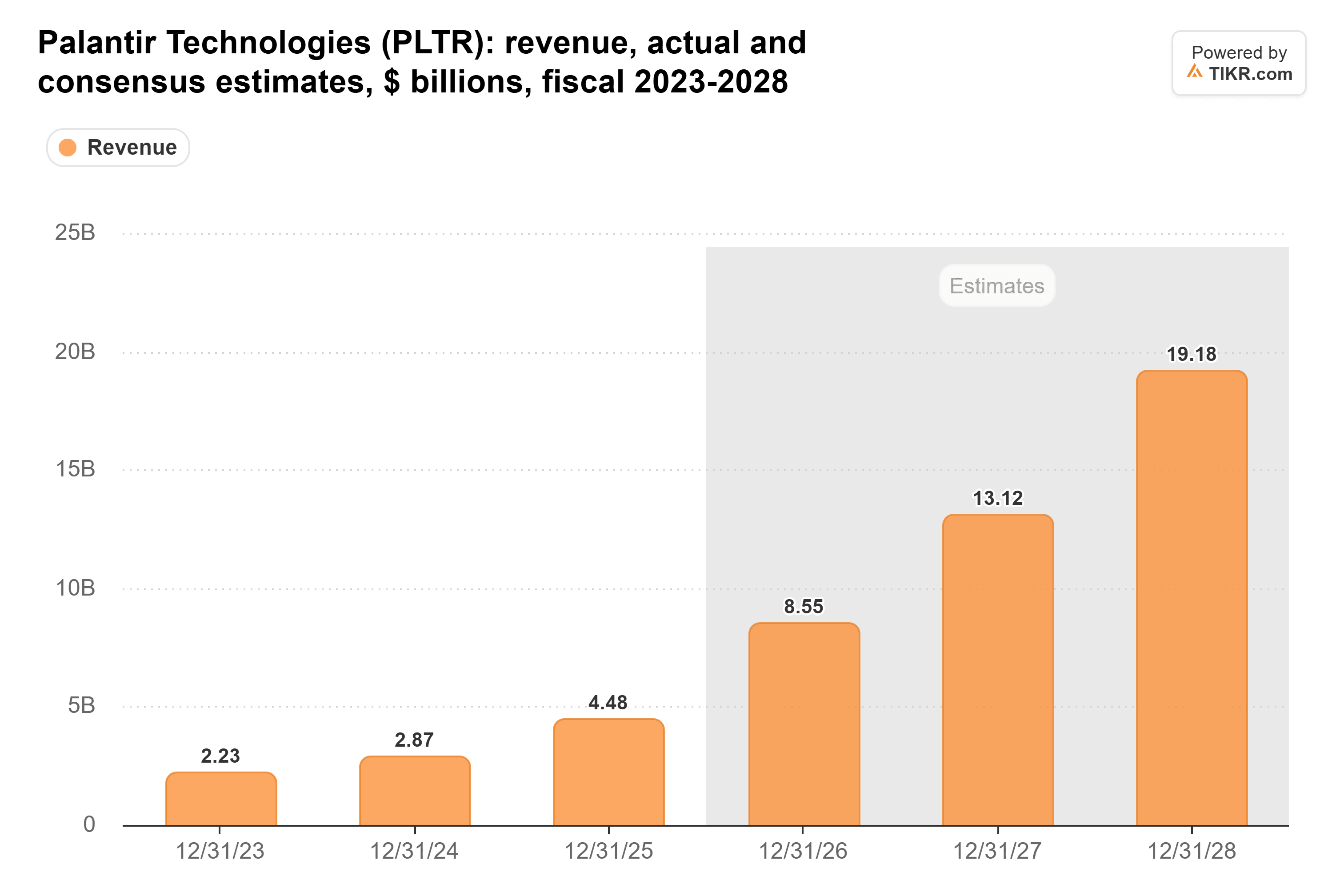
Those forecasts suggest Palantir can sustain strong growth beyond Trump’s proposed military spending package.
The risk is that federal budget delays or slower commercial AI adoption could make those aggressive expectations harder to achieve.
With the current government funding arrangement expiring on December 11, contract timing remains an important issue even if long-term demand for Palantir’s software stays strong.
Democrats Could Scrutinize Palantir’s Contracts
The defense budget is only one challenge facing Palantir as Democrats prepare to control Congress.
Greater oversight could bring renewed attention to how federal agencies award technology contracts.
According to Nextgov’s August reporting, roughly half of Palantir’s $3.2 billion in federal contract obligations since 2024 came through noncompetitive awards.
These contracts do not necessarily indicate wrongdoing, but they could attract scrutiny from lawmakers reviewing defense procurement practices.
Palantir CEO Alex Karp has emphasized his Democratic political background, although that does not eliminate the risk of stricter oversight or slower contract approvals.
The company’s rapidly expanding commercial business provides some diversification, but maintaining government growth will remain important to meeting Wall Street’s revenue expectations.
Palantir Still Trades at a Premium Valuation
Palantir shares came under pressure following the November 3 midterm elections, alongside broader weakness across AI and defense-related stocks.
The pullback has reduced its valuation considerably from the extremes reached in 2025.
Palantir trades at roughly 75x forward earnings, below its five-year average of approximately 102x and far below its historical peak of roughly 270x.
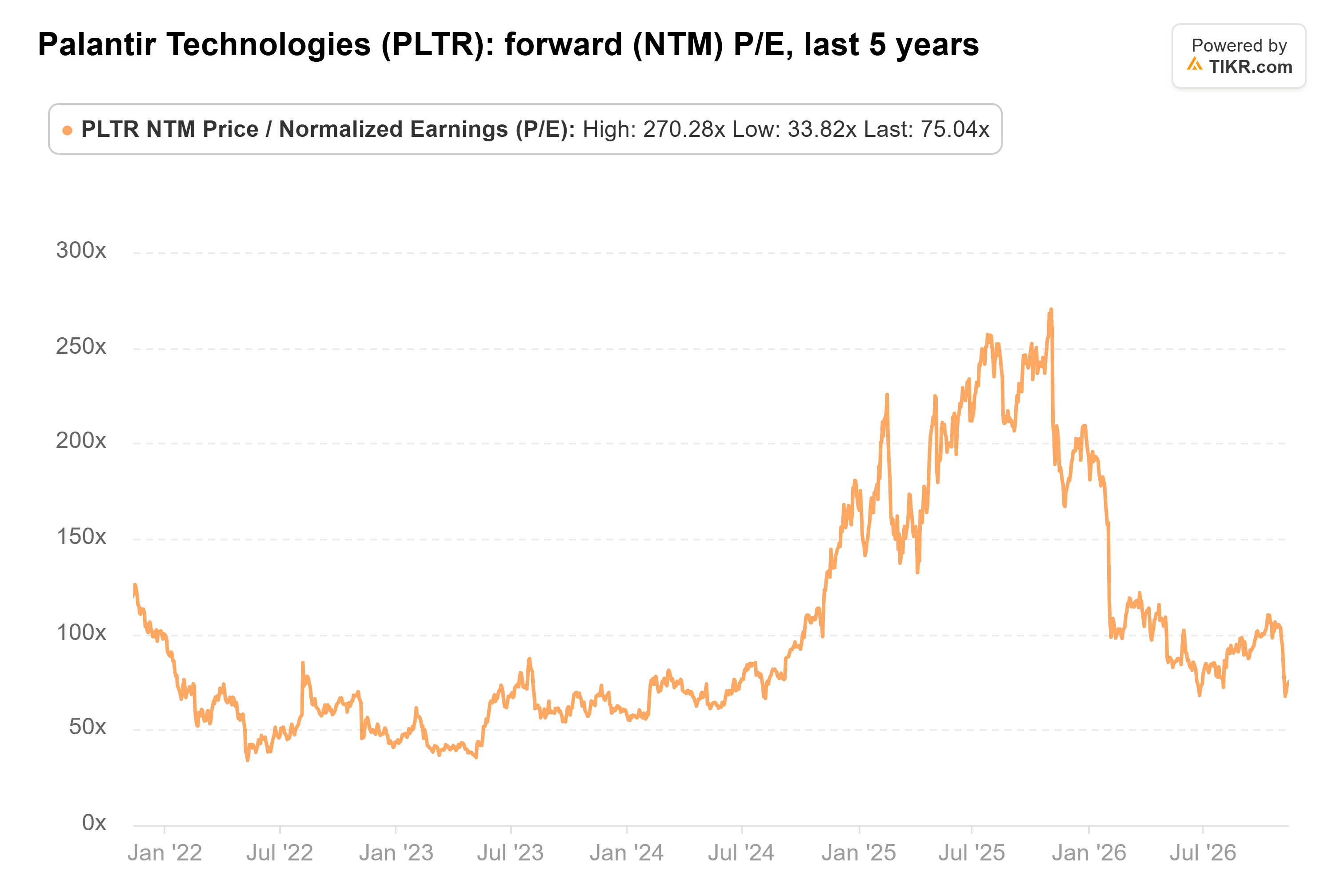
That makes the stock less expensive relative to its history, but not necessarily undervalued.
Wall Street already expects exceptional revenue growth through 2028, meaning the stock could face substantial pressure if government contracts slow or commercial demand disappoints.
My verdict: I would hold off on buying Palantir at its current valuation. Its government and commercial businesses are growing rapidly, but paying roughly 75x forward earnings leaves little margin for error. Delayed government contracts and weaker-than-expected growth are the biggest risks, while Trump’s proposed $350 billion military package is too uncertain to justify the premium today.
Palantir’s next major test will be its first 2027 financial guidance, expected in early February. A stronger outlook supported by accelerating government and commercial demand could justify reconsidering the stock.
Until then, I would wait for a more attractive valuation or clearer evidence that Palantir can exceed Wall Street’s ambitious growth expectations.
So What Is Palantir Stock Actually Worth?
TIKR lets you forecast the future price of any stock in less than a minute. Just enter a few assumptions into TIKR’s valuation model and see what Palantir could be worth.
Start from Wall Street consensus estimates, or adjust the inputs to reflect your own view of the business. It’s free to use.
Disclaimer:
Please note that the articles on TIKR are not intended to serve as investment or financial advice from TIKR or our content team, nor are they recommendations to buy or sell any stocks. We create our content based on TIKR Terminal’s investment data and analysts’ estimates. Our analysis might not include recent company news or important updates. TIKR has no position in any of the stocks mentioned. Thank you for reading, and happy investing!