Key Takeaways
- SemiAnalysis cut its forecast for AI accelerator spending in 2028 by 28%, to $758 billion, the day before NVIDIA’s third-quarter report.
- The cuts fall hardest on NVIDIA: the firm lowered its NVIDIA shipment forecast 22% for 2027 and 39% for 2028, while Broadcom’s custom-chip forecast fell 11% over five years.
- The firm blames slower growth at frontier labs and tighter financing, and those buyers are behind NVIDIA’s fastest-growing business.
- NVIDIA will probably reaffirm its roughly 70% growth target for fiscal 2028, so its receivables say more than the target does.
NVIDIA (NVDA) reports its third quarter after the close on Tuesday, Nov. 17, and one of the most widely followed research firms in chips just took a knife to the years after it.
On Monday, Tae Kim, author of The Nvidia Way, wrote on X that SemiAnalysis had cut its AI accelerator capex forecast in a note to institutional clients. On TBPN, co-host Jordi Hays summed it up: SemiAnalysis “is downgrading … their AI accelerator CapEx forecast by 28%, citing slower growth at Frontier Labs, tightening capital markets.”
The 28% is SemiAnalysis’s 2028 figure, which is now $758 billion, down from $1.054 trillion. The firm cut 2027 by 19%, to $627 billion, and left this year’s $392 billion or so alone. It didn’t spread the pain evenly, either. It lowered its forecast for NVIDIA’s shipments, measured by computing revenue, 22% for 2027 and 39% for 2028. Its forecast for custom-chip revenue at Broadcom (AVGO) fell 11% across 2026 to 2030.
That’s a big haircut for NVIDIA.
TIKR tracks 62 analysts on Nvidia. How many say “Buy”?
See the full breakdown of Buy, Hold, and Sell ratings on Nvidia, along with Wall Street’s revenue and earnings estimates, all in one place. More than 500,000 investors use TIKR to research stocks like this one. See Nvidia’s Analyst Ratings
The cut hits NVIDIA’s next fiscal year
NVIDIA’s fiscal 2028 runs from February 2027 to January 2028, so it lines up almost exactly with the 2027 spending SemiAnalysis just cut. It’s also the year Wall Street is watching. As Bloomberg Intelligence’s Kunjan Sabani said on Bloomberg Tech on Monday, “We really want them to reaffirm the 70% growth fiscal 28 target to make sure next year is intact.”
Consensus already counts on it, with revenue climbing about 67% to $689 billion in fiscal 2028, from about $412 billion this fiscal year:
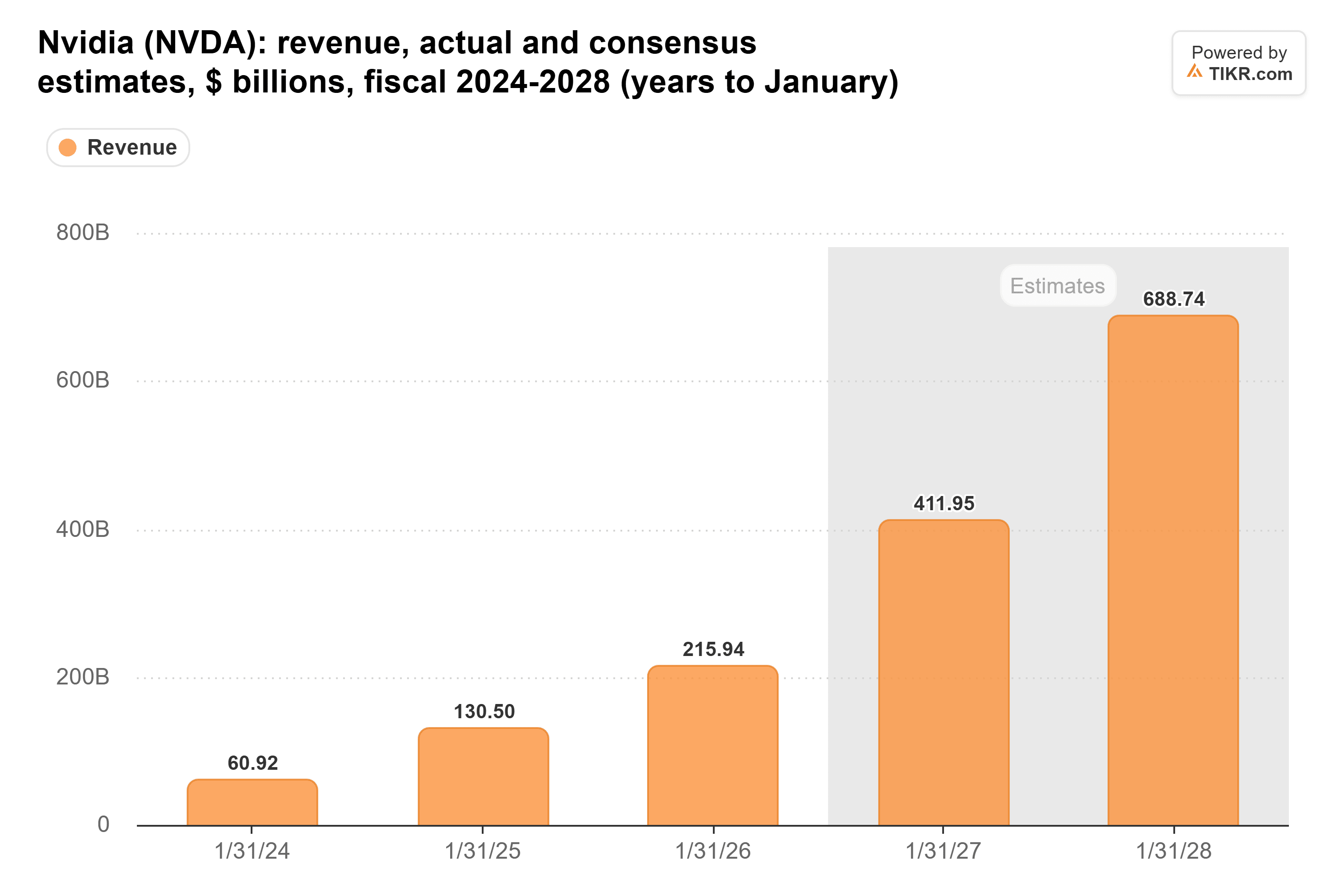
If SemiAnalysis is right, the $895 billion analysts expect for fiscal 2029 has the most to give back. That year lines up roughly with calendar 2028, when the firm cut NVIDIA’s shipments 39%.
Fiscal 2028 has more cushion. Management has called its roughly 70% a supply-limited figure and said customers’ forecasts point to growth doubling. That gap is why Dan Niles argued NVIDIA could lose 30% of its demand and still hit its forecast. On those numbers, I expect NVIDIA to reaffirm the target on Tuesday.
Broadcom gets off lightly
Broadcom’s custom chips come out of the same spending, and its estimates are just as steep:
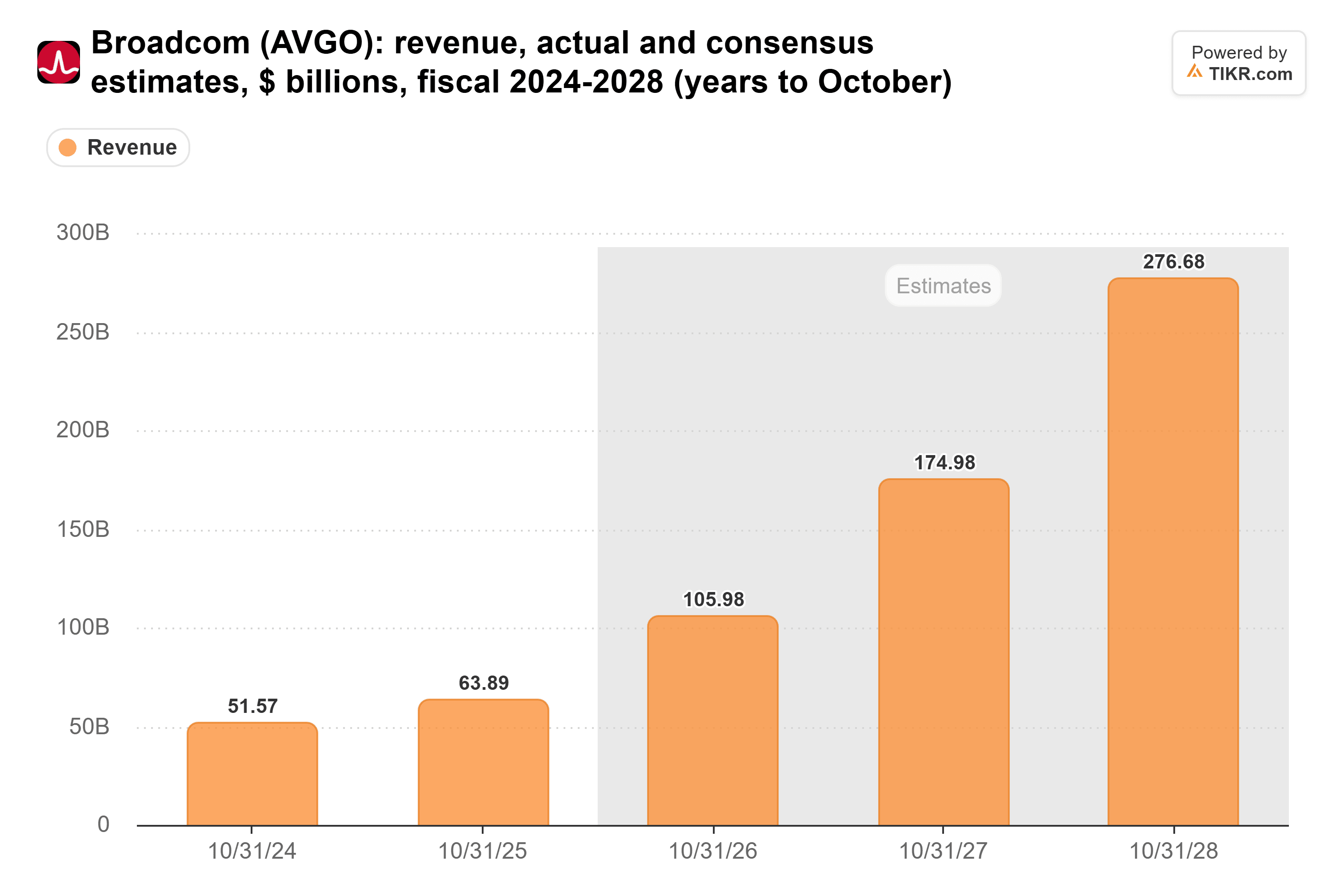
Analysts expect about $106 billion for the fiscal year that just ended. After that, they see about $175 billion in fiscal 2027 and $277 billion in fiscal 2028, gains of about 65% and 58%. Those estimates need spending to keep climbing into 2028 even more than NVIDIA’s do.
Yet SemiAnalysis puts most of its 11% trim down to lower prices as HBM costs fall, with no big cut to how many chips Broadcom ships. My read: custom chips go mostly to the hyperscalers, and SemiAnalysis’s financing worry is about projects without them.
Follow the financing
SemiAnalysis is still bullish on the labs themselves. “From what I saw, they’re still above consensus,” co-host John Coogan said on the same TBPN episode. The firm’s worry is how the build-out gets paid for. It says net-new recurring revenue growth at frontier labs slowed in the third quarter. It also says debt and equity financing tightened, particularly for projects without hyperscaler backing.
Those are NVIDIA’s fastest-growing customers. Revenue from its AI Clouds, Industrial and Enterprise buyers rose 138% to $40.3 billion in the July quarter, 45.3% of data center revenue. Management has also said the labs it backs with its own balance sheet will be roughly a quarter of next year’s business. Receivables hit $63.1 billion at the end of July, with days sales outstanding at 60.
So I’d take a reaffirmed 70% on Tuesday with a grain of salt. The number I’d watch is days sales outstanding against July’s 60: if it climbs, NVIDIA is financing more of its own demand. Of course, if Anthropic’s IPO goes well and the labs can raise money easily again, the financing SemiAnalysis is worried about could loosen as fast as it tightened.
So what is NVIDIA stock actually worth?
TIKR lets you forecast the future price of any stock in less than a minute. Just enter a few assumptions into TIKR’s valuation model and see what NVIDIA could be worth. Start from Wall Street consensus estimates, or adjust the inputs to reflect your own view of the business. It’s free to use.
Disclaimer:
Please note that the articles on TIKR are not intended to serve as investment or financial advice from TIKR or our content team, nor are they recommendations to buy or sell any stocks. We create our content based on TIKR Terminal’s investment data and analysts’ estimates. Our analysis might not include recent company news or important updates. TIKR has no position in any of the stocks mentioned. Thank you for reading, and happy investing!