


Key Takeaways
- Tower Semiconductor (TSEM) stock fell approximately 18% during the week ended November 6, despite record third-quarter revenue of $526 million, up 33% year over year.
- Lumentum (LITE) declined approximately 36%, while Marvell Technology (MRVL) fell around 29%, as the two AI-connectivity companies announced a $115 billion acquisition agreement amid a semiconductor selloff.
- Tower guided for $600 million in fourth-quarter revenue, exceeding analysts’ approximately $580 million forecast as silicon photonics demand accelerates.
- At 21.7x forward earnings on November 6, Tower traded below its five-year average of 25.7x, suggesting potential upside if earnings forecasts hold.
What Happened?
Tower Semiconductor (TSEM) stock fell approximately 18% during the week ended November 6, closing near $137 despite reporting record quarterly revenue and stronger-than-expected guidance.
According to its third-quarter earnings release, revenue reached $526 million, up 33% from $396 million a year earlier and above analysts’ approximately $522 million estimate.
Tower guided for fourth-quarter revenue of $600 million, representing 36% year-over-year growth and exceeding Wall Street’s roughly $580 million forecast.
“We are entering the strongest growth phase in our history,” CEO Russell Ellwanger said, with management expecting approximately $2 billion in full-year revenue.
Lumentum (LITE) declined approximately 36%, while Marvell Technology (MRVL) dropped around 29% during the same week.
Both companies serve the AI connectivity market, where demand for faster optical connections is also driving Tower’s silicon photonics expansion.
On November 2, Marvell announced its agreement to acquire Lumentum in an all-stock transaction with an implied enterprise value of approximately $115 billion.
The selloff intensified on November 5, when the Philadelphia Semiconductor Index fell 12.2%, according to Reuters, amid disappointing Qualcomm results and concerns about AI infrastructure spending.
Following Tower’s earnings, Stifel and Mizuho cut their price targets to $235, Craig-Hallum to $250, Susquehanna to $305, and Bank of America to $310. Wedbush lowered its target from $300 to $190 while maintaining a Neutral rating, reflecting concerns about Tower’s valuation.
Is Tower Semiconductor Undervalued or Overvalued?
Tower Semiconductor looks potentially undervalued at its November 6 valuation, supported by silicon photonics growth and rising earnings estimates.
Management expects silicon photonics to reach a $1.1 billion annualized revenue run rate in the fourth quarter, approximately five times the business’s total 2025 revenue.
Tower’s Japan 300mm expansion is progressing ahead of schedule, with customer contracts extending through 2029.
On November 3, Tower and Innolight announced that Innolight’s first near-package optics device entered early production using Tower’s PH18M silicon photonics process.
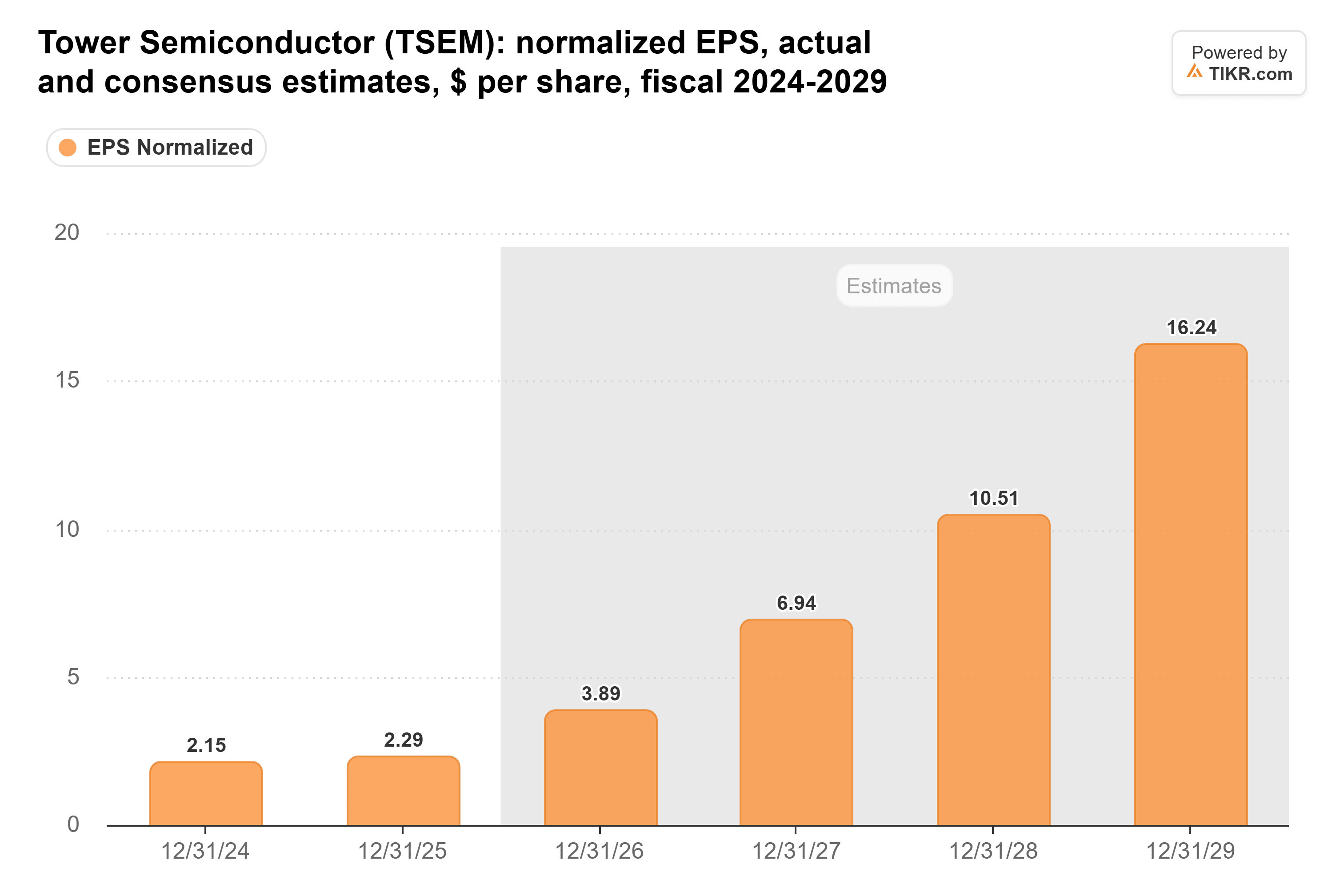
According to early-November TIKR estimates, analysts expect normalized earnings per share to increase from $2.29 in 2025 to $6.94 in 2027, approximately tripling.
At its November 6 closing price of approximately $137, Tower traded at 21.7x next-twelve-month earnings, below its five-year average of 25.7x.
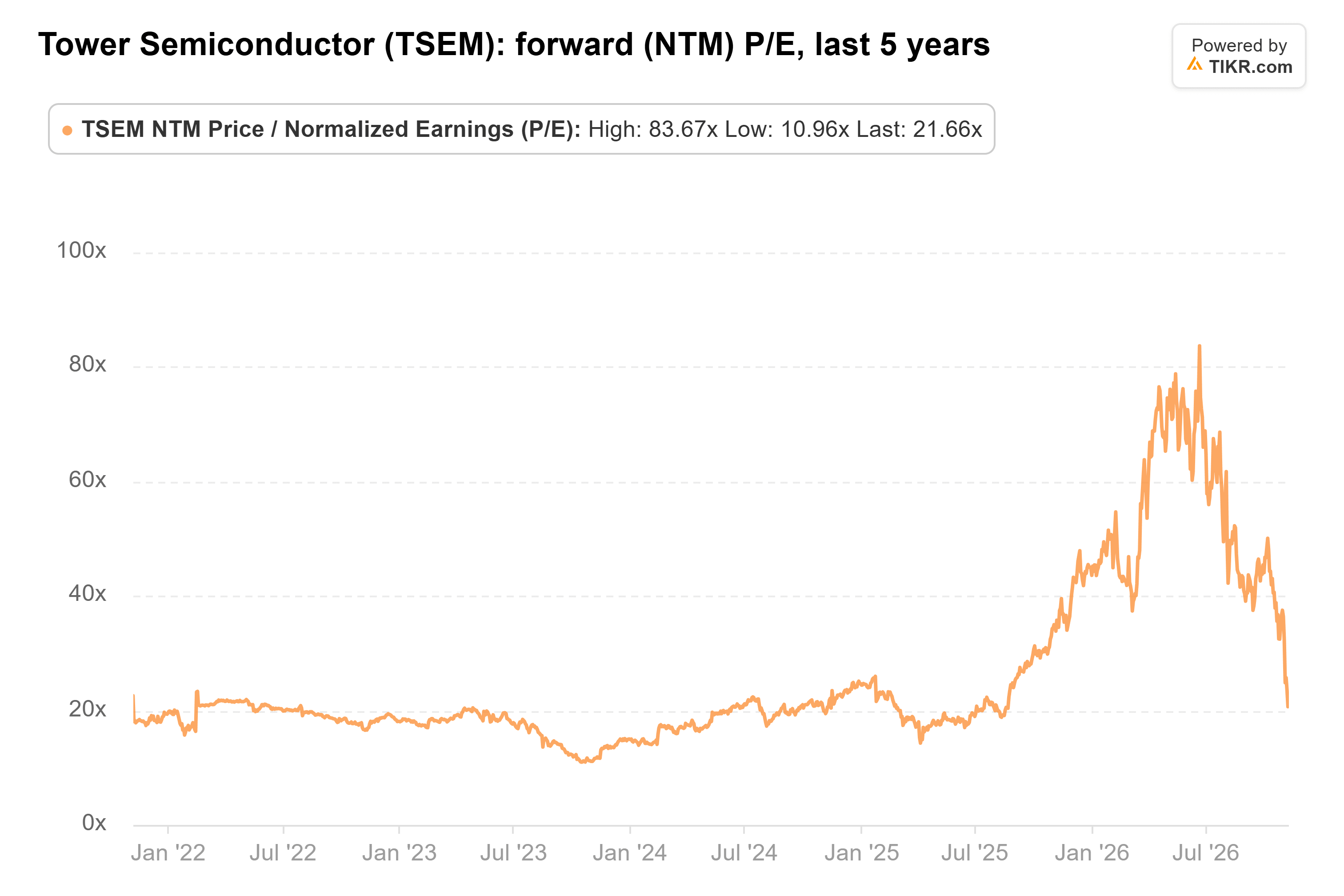
This discount suggests a more attractive valuation, although historical multiples do not guarantee future upside.
Wedbush’s $190 target implies approximately 30x forward earnings, while Bank of America’s $310 target implies nearly 49x, illustrating how much potential upside depends on valuation assumptions.
Capital spending remains a concern. In 2025, operating cash flow totaled $395 million against $444 million in capital expenditures.
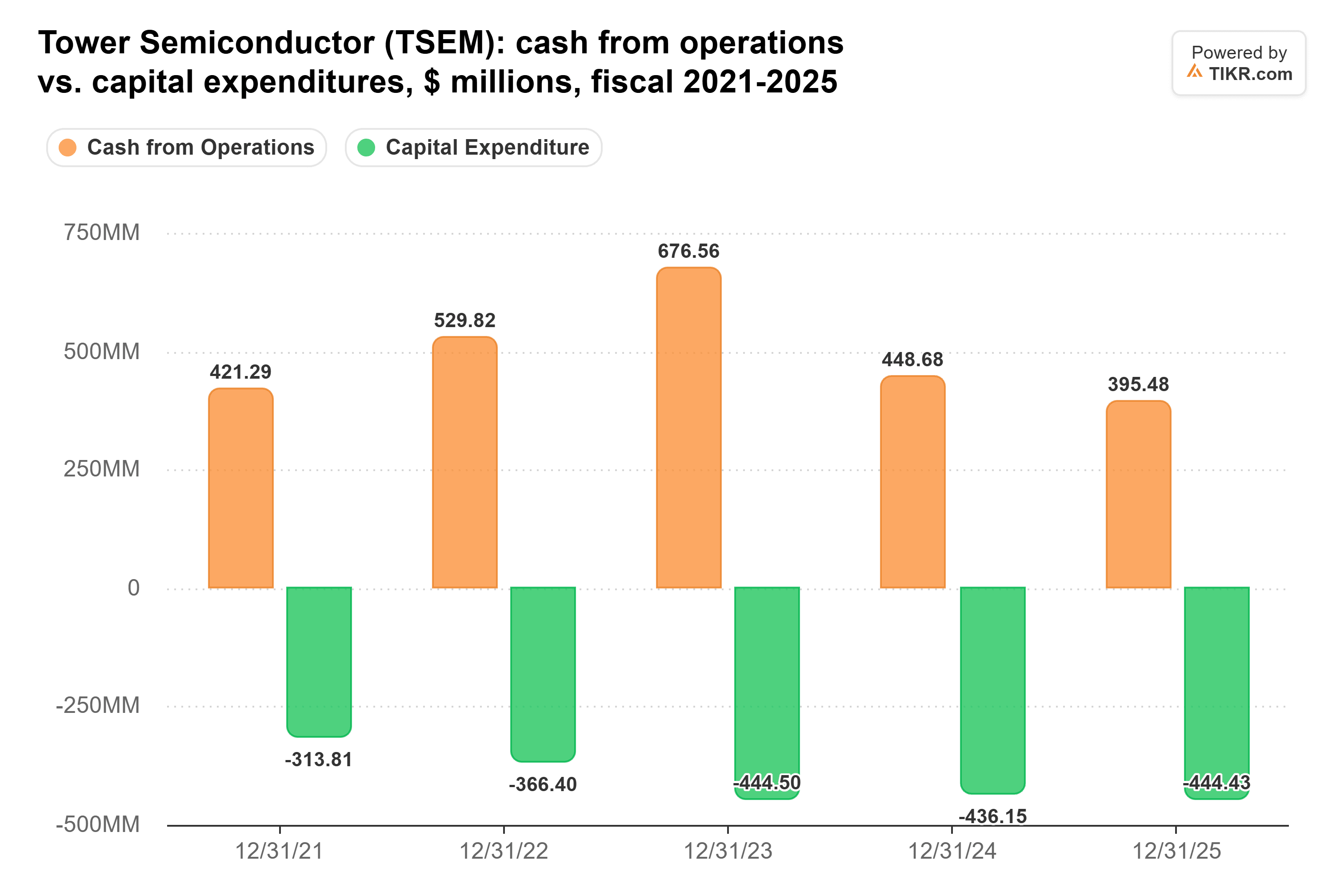
Third-quarter capital spending of $191 million also exceeded operating cash flow of $185 million.
Tower looks potentially undervalued at its November 6 valuation if earnings forecasts hold. However, high capital spending and weaker AI demand could limit upside. Over the next 12 months, investors should monitor Tower’s $600 million fourth-quarter revenue target, its $1.1 billion silicon photonics annualized run rate, and improvements in cash generation.
So what is Tower Semiconductor stock actually worth?
TIKR lets you forecast the future price of any stock in less than a minute. Just enter a few assumptions into TIKR’s valuation model and see what Tower Semiconductor could be worth. Start from Wall Street consensus estimates, or adjust the inputs to reflect your own view of the business. It’s free to use.
Value Tower Semiconductor for free
Disclaimer:
Please note that the articles on TIKR are not intended to serve as investment or financial advice from TIKR or our content team, nor are they recommendations to buy or sell any stocks. We create our content based on TIKR Terminal’s investment data and analysts’ estimates. Our analysis might not include recent company news or important updates. TIKR has no position in any of the stocks mentioned. Thank you for reading, and happy investing!


