Key Takeaways
- CoreWeave fell as much as 15% on Thursday after Jensen Huang resigned as Nvidia’s CEO, and CFO Colette Kress took over as interim CEO.
- CoreWeave has far more to lose than Nvidia if a more cautious Nvidia backs its customers less.
- CoreWeave’s total debt, including leases, grew from $2 billion in 2023 to $29.8 billion in 2025, and analysts expect it to keep raising money for years.
- Before the drop, CoreWeave traded at 1.4x forward sales, well below its average over the past year, so the stock already prices in a lot of bad news before Nvidia reports on Nov. 17.
CoreWeave (CRWV) fell as much as 15% on Thursday after Jensen Huang resigned as CEO of Nvidia (NVDA). He also left the board, effective immediately, after reports of two affairs, one involving an alleged Chinese spy. CoreWeave closed down 7%, and Chief Financial Officer Colette Kress is now Nvidia’s interim CEO.
Peter Atwater, who teaches economics at William & Mary, explained why the AI trade took it so hard in a post on X as the news broke:
“Given the vast amount of circular finance in which Nvidia was at the center, I’d suggest that the best analogy for the AI space this evening is a bicycle wheel spinning at 400 mph from which the hub was suddenly removed.”
And CoreWeave sits about as close to that hub as any company in the market.
TIKR tracks 62 analysts on Nvidia. How many say “Buy”?
See the full breakdown of Buy, Hold, and Sell ratings on Nvidia, along with Wall Street’s revenue and earnings estimates, all in one place. More than 500,000 investors use TIKR to research stocks like this one. See Nvidia’s Analyst Ratings
CoreWeave sits right next to the hub
Nvidia owns more than 10% of CoreWeave, sells it the GPUs it rents out, and invested $2 billion in January at $87.20 a share. It also holds a $6.3 billion order to buy capacity CoreWeave’s customers don’t use, running through April 13, 2032. Across the industry, Nvidia’s latest quarterly filing lists roughly $65 billion of commitments to rent back cloud capacity from companies like CoreWeave, by Yahoo Finance’s count. (It didn’t help that Nebius, another neocloud, let investors down with its own outlook the same day.)
Huang was at the center of those deals, and he publicly defended CoreWeave’s debt in October. Now a finance chief decides whether Nvidia signs more of them. One investor in r/ValueInvesting, writing a long post on Nvidia after Huang left, pointed to exactly that risk: “A new CEO might pull back on customer financing, which has helped support demand.”
Nvidia can afford the checks
Bloomberg’s Joe Weisenthal raised a different worry. On X, a reader asked whether US hyperscalers would get some relief on pricing if Nvidia stopped selling GPUs to Singapore-based companies. He replied: “Could be, though the flip would be that Nvidia is a less profitable company,” and so less able to backstop the companies that depend on it.
Still, Nvidia isn’t short of money. It had about $99 billion in cash and securities against $33 billion of debt at the end of July, so it can keep backing its customers if it wants to. If it chose to stop, Nvidia would lose some orders at the edges. CoreWeave would lose a backer it may need for years.
CoreWeave needs money for years
Analysts expect CoreWeave’s revenue to climb from $5.1 billion last year to $44.6 billion in 2028:
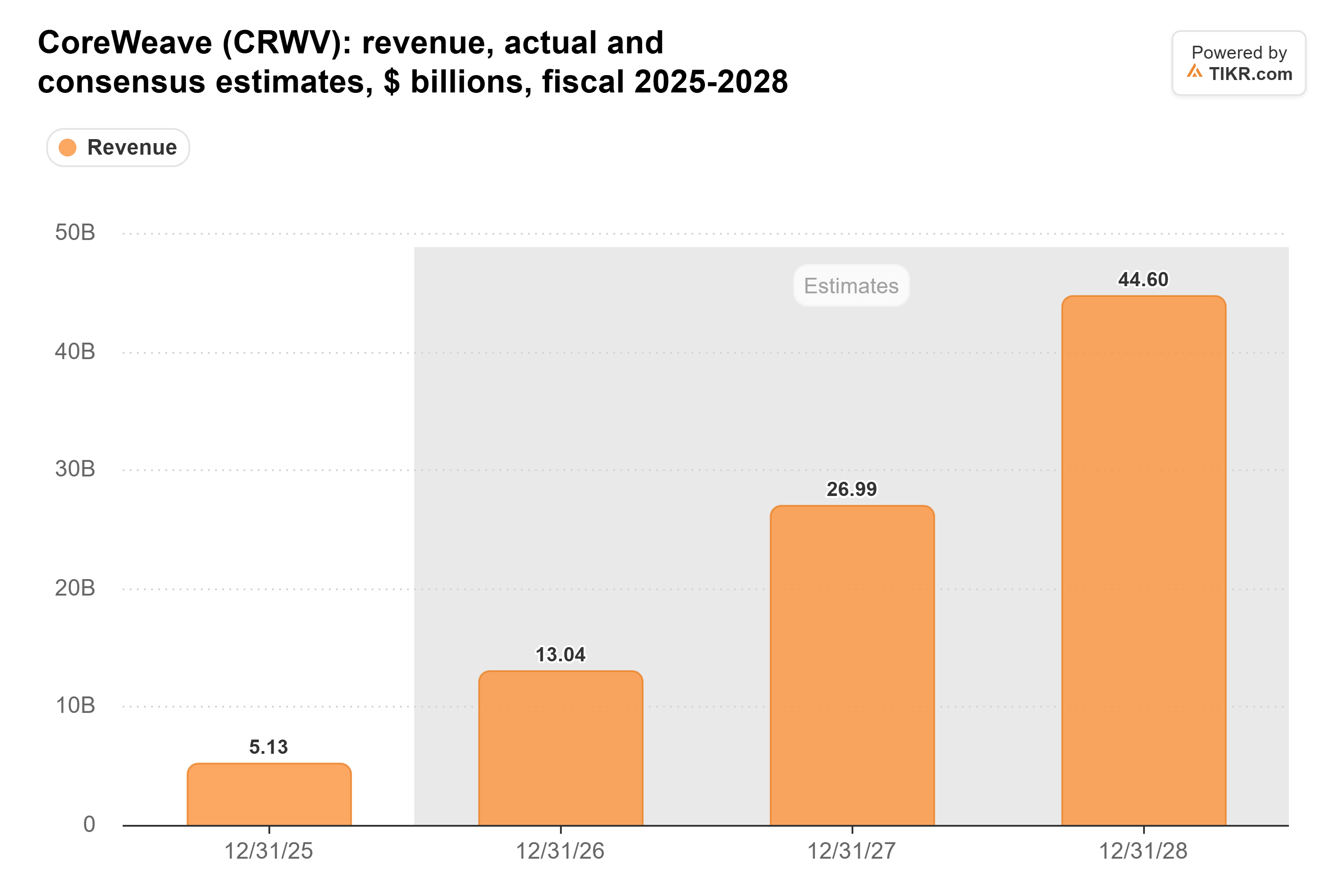
Huang’s exit doesn’t change the contracts behind those estimates. CoreWeave’s backlog reached about $132.5 billion at Sept. 30, and CEO Michael Intrator says the company is largely sold out through 2027.
Building the capacity to serve those contracts takes borrowed money. TIKR’s total debt figure, which includes leases, went from $2 billion in 2023 to $29.8 billion in 2025:
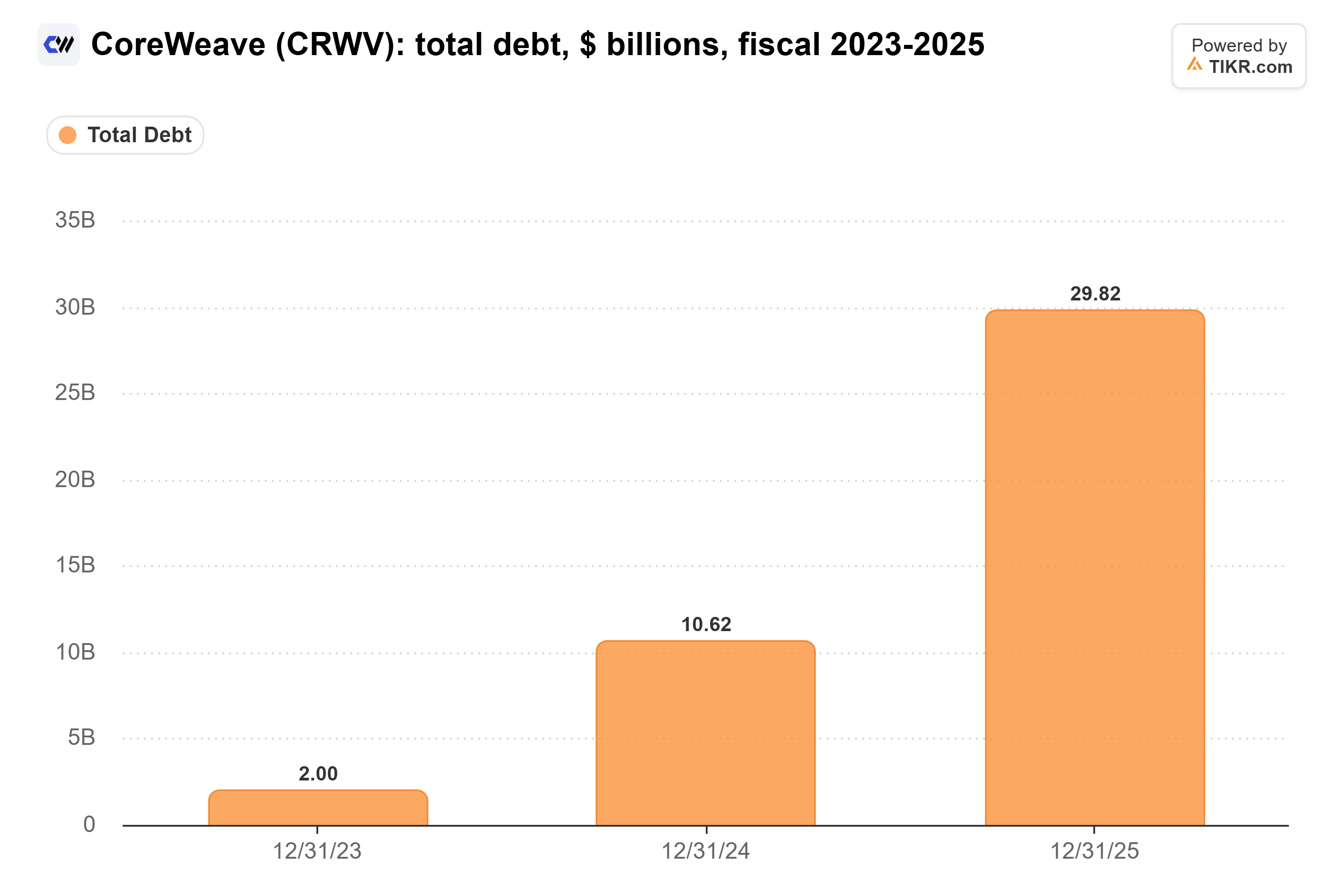
Borrowings alone, leaving out leases, reached $46.9 billion at Sept. 30. Net interest expense was $846 million in the third quarter, about four times the $207 million of operating income, and management expects $1.05 billion to $1.15 billion of interest in the fourth quarter. Analysts expect free cash flow to stay negative every year through 2030, so CoreWeave will keep raising money no matter who runs Nvidia.
The contracts outlast Huang
The support CoreWeave already has is in writing. Nvidia can end its capacity order for a material breach or insolvency, and a new CEO alone doesn’t cancel it. CoreWeave has also planned its next round of funding around its customers: Intrator said on the third-quarter call that the company “will not use the unsecured debt market to fund our business at current yields, nor do we need to.” It expects about $9 billion of customer prepayments and deposits over the next three months.
The next deal is less certain. My read: investors had counted on Huang to put Nvidia’s money behind CoreWeave whenever it needed backing, and they priced that hope out on Thursday.
They had already priced out plenty before Huang left. Before Thursday’s drop, CoreWeave traded at 1.4x forward sales, against a 3.5x average over the past year:
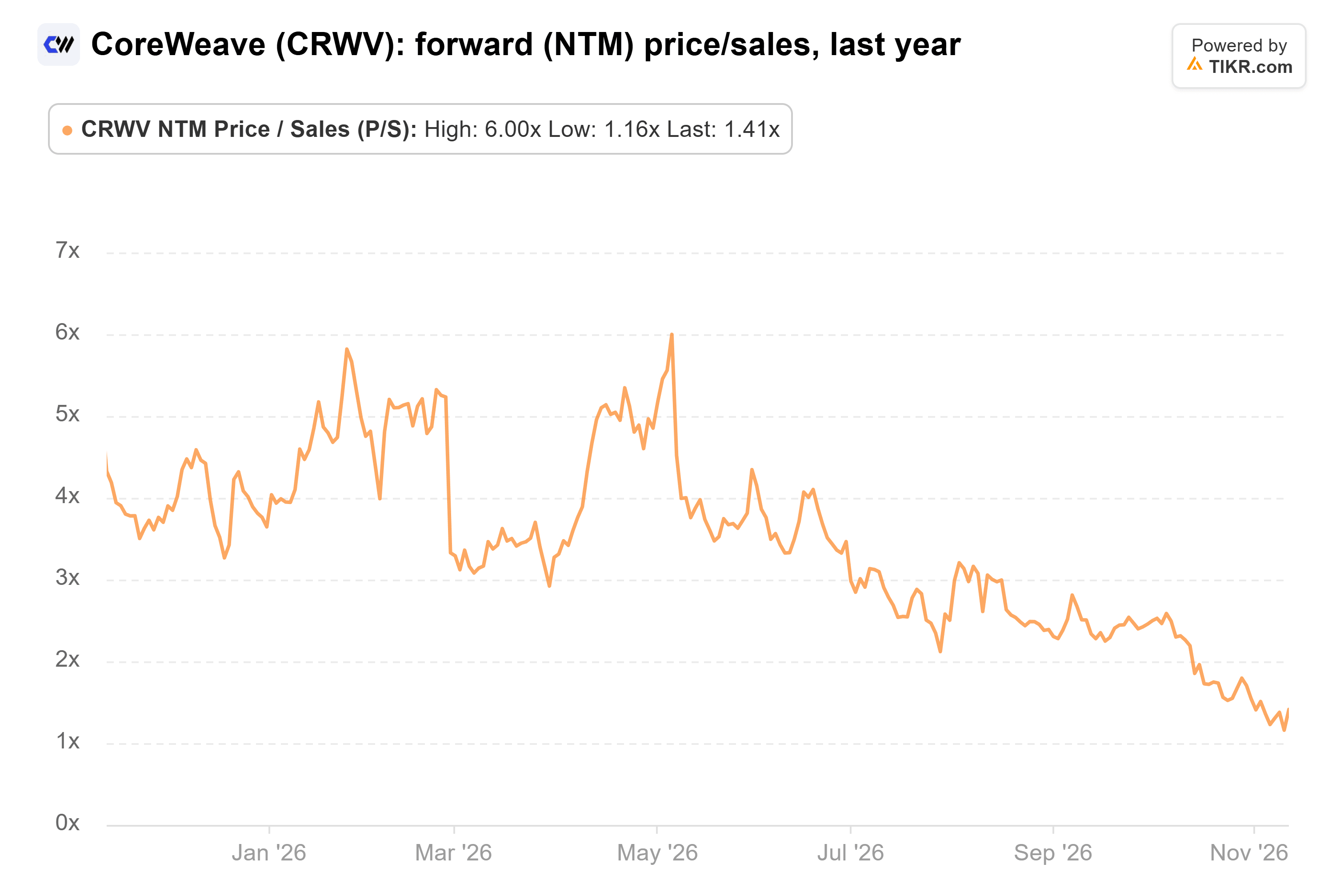
At today’s price, it’s even lower.
Bottom line: Huang’s exit is a real risk for CoreWeave and a much smaller one for Nvidia. But CoreWeave’s current support is under contract, its customers are paying for more of its buildout, and at this multiple I think the stock already prices in a pullback that hasn’t happened. Of course, Nvidia reports on Nov. 17. If Kress signals that Nvidia is done signing these deals, every neocloud will need a new backer.
So what is CoreWeave stock actually worth?
TIKR lets you forecast the future price of any stock in less than a minute. Just enter a few assumptions into TIKR’s valuation model and see what CoreWeave could be worth. Start from Wall Street consensus estimates, or adjust the inputs to reflect your own view of the business. It’s free to use.
Disclaimer:
Please note that the articles on TIKR are not intended to serve as investment or financial advice from TIKR or our content team, nor are they recommendations to buy or sell any stocks. We create our content based on TIKR Terminal’s investment data and analysts’ estimates. Our analysis might not include recent company news or important updates. TIKR has no position in any of the stocks mentioned. Thank you for reading, and happy investing!