Key Takeaways
- Super Micro fell 7% on Friday along with Dell and other hardware stocks, after Intel warned that memory prices and shortages are slowing PC demand.
- Super Micro sells no PCs. It has already said its September-quarter gross margin should come in at 12.0%-12.5%, above its own 10.4%-10.8% forecast.
- Intel’s warning covers recent weeks, so the memory test on Nov. 3 is Super Micro’s December-quarter margin outlook. Analysts expect a 10.2% gross margin for fiscal 2027.
- At 6.9x forward earnings, near its five-year low, the stock already prices in a squeeze. A margin outlook near 10% and an unchanged fiscal 2027 sales range would make the drop look overdone.
Super Micro Computer (SMCI) fell 7% on Friday after Intel (INTC) warned that memory shortages are choking PC demand. The selling ran through the hardware makers: Dell Technologies (DELL) fell 11%, and HP and Hewlett Packard Enterprise dropped too.
Super Micro reports its fiscal first-quarter results after the close on Tuesday, Nov. 3. Gross margin is where a memory squeeze would show up first.
Intel blamed memory for a PC slowdown
Intel CEO Lip-Bu Tan laid out the problem on Intel’s earnings call on Oct. 29: “In recent weeks, our customers began signaling a PC slowdown based on the memory prices and availability.” Intel’s stock fell 29% the next day.
That’s a PC problem first. Dell’s PC business takes the direct hit. But its AI server business came into Friday with a $95 billion backlog, after record AI orders of $60.9 billion and a raised fiscal 2027 revenue outlook of $192 billion.
Super Micro sells no PCs. Daniel Niles of Satori Fund wrote on X on Sunday that “I am not a fan of SuperMicro to be clear.” In the same post, he described its revenue as “purely enterprise related.”
TIKR tracks 18 analysts on Super Micro Computer. How many say “Buy”?
See the full breakdown of Buy, Hold, and Sell ratings on Super Micro Computer, along with Wall Street’s revenue and earnings estimates, all in one place. More than 500,000 investors use TIKR to research stocks like this one. See Super Micro Computer’s Analyst Ratings
The September quarter is mostly in the books
On Oct. 20, Super Micro said it expects September-quarter revenue of $18.5 billion-$19.5 billion, against guidance of $14.5 billion-$15.5 billion. It put gross margin at 12.0%-12.5%, up from the 10.4%-10.8% it had forecast.
So the quarter it reports on Nov. 3 is largely known. It also ended Sept. 30, before the “recent weeks” Tan described. That makes the December-quarter outlook the real memory test.
Analysts expect normalized EPS to rise from $3.63 in fiscal 2026 (the year to June 2026) to $4.75 in fiscal 2027 and $5.68 in fiscal 2028:

A memory squeeze would show up first as cuts to those estimates, and the preliminary September figures give analysts no reason to cut yet.
Customer mix has driven the margin’s swings
Super Micro’s quarterly gross margin fell from 16.7% in the September 2023 quarter to 6.3% in the December 2025 quarter. Then it jumped to 17.5% in the June 2026 quarter:
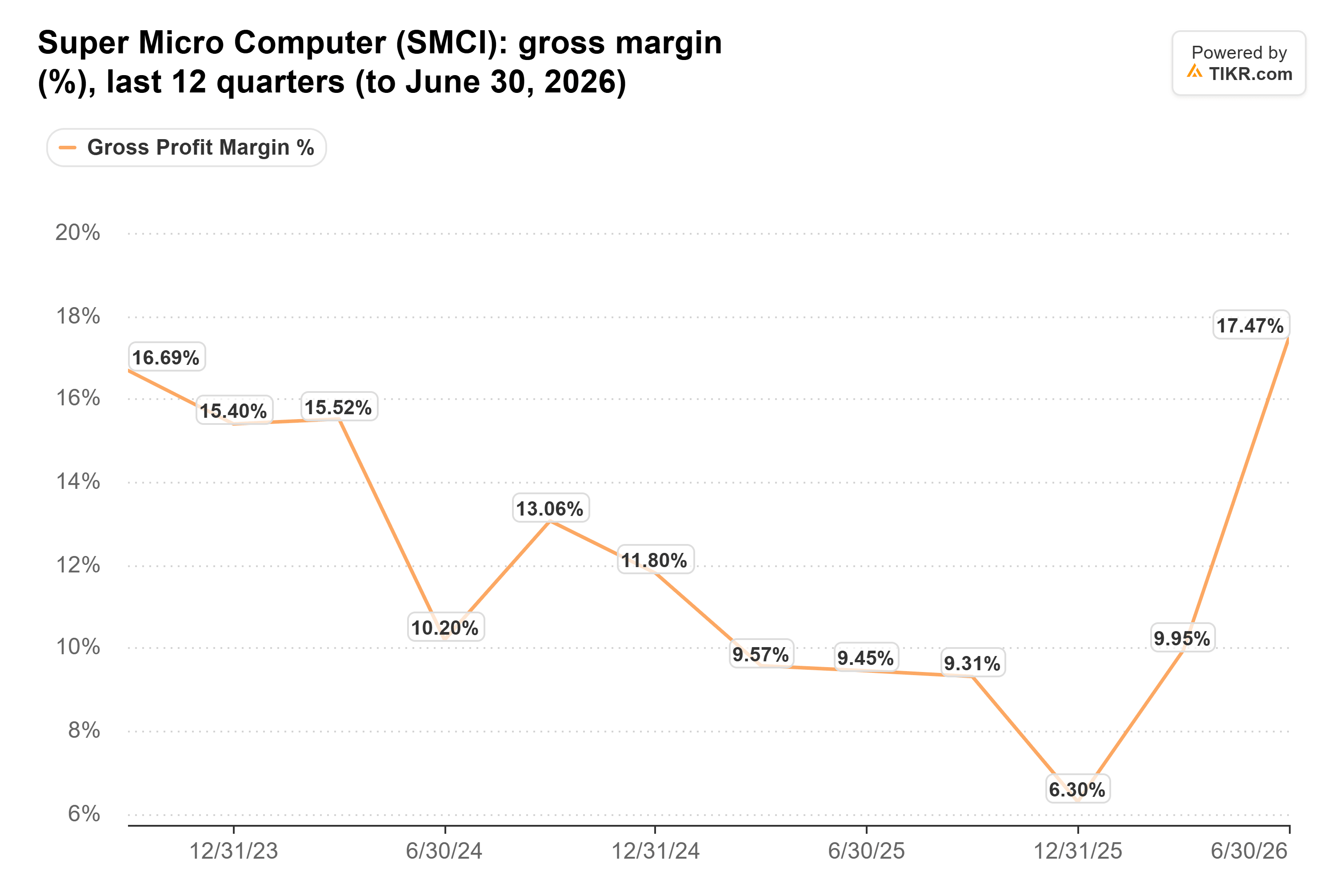
The low came when one big data center customer took about 63% of revenue. The high came when enterprise and channel sales made up half of revenue. Management credited about 75% of that quarter’s gain to mix, and part of that mix came from large contracts that slipped into the September quarter, possibly into December’s too. As CEO Charles Liang said on the June-quarter call, “high-volume GPU margin is usually much lower.”
So the December-quarter margin could take two hits at once: those big clusters shipping, and pricier memory. Analysts already expect a 10.2% gross margin for fiscal 2027. If Super Micro guides the December quarter to 10% or more, the memory worry looks overdone. A guide well below that puts the fiscal 2027 estimates at risk.
Watch the cash, and the orders
Free cash flow was negative $7.0 billion in fiscal 2026, as inventory swelled to $12.9 billion at June 30, 2026, from $4.7 billion a year earlier. Operating cash flow turned positive in the June quarter, at $747 million, after a $6.6 billion outflow in the March quarter. Pricier memory would tie up more cash in every server waiting to ship. So a second positive quarter, with inventory flat or lower, matters as much as the margin.
The stock may move more on demand, though. Super Micro guides fiscal 2027 revenue to $65 billion-$72 billion, and the consensus is $70.0 billion. Last week’s big tech reports gave investors reason to worry: Niles pointed to a neocloud partner of Microsoft pushing out capacity. Super Micro has dealt with this before, when customer site delays cut its March- and June-quarter revenue. A range held or raised on Nov. 3 would count for more than a point of margin either way.
At 6.9x, the bar is low
The stock already trades as if something will go wrong. Its forward P/E was 6.9x on Friday, near its five-year low of 6.2x and well under its 15x five-year average:
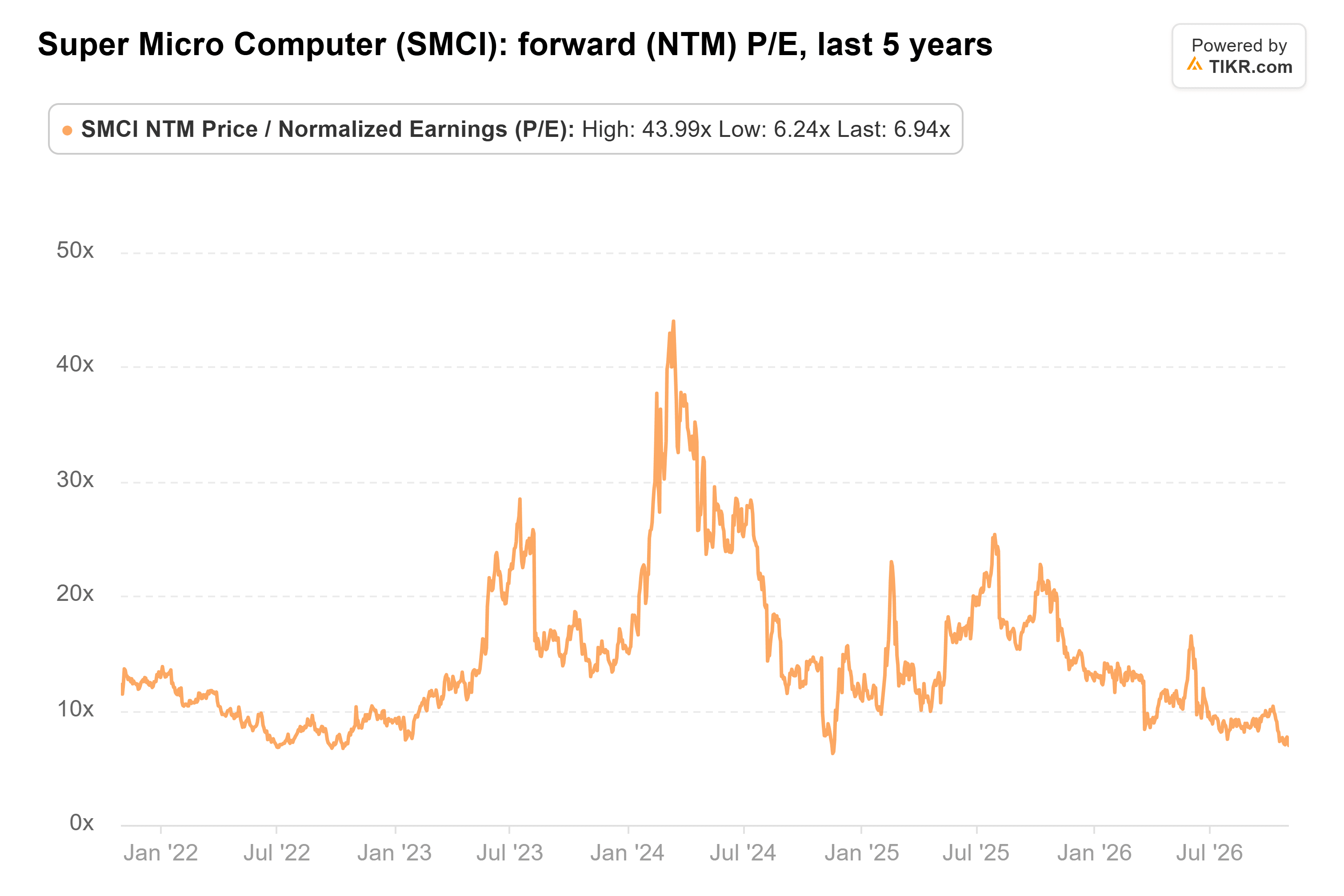
I think investors sold Super Micro for Intel’s problem. At this multiple, it needs only two things for Friday’s drop to look like a buying opportunity: a December margin outlook around 10%, and its fiscal 2027 range left in place.
Of course, Intel expects the slowdown to last until memory prices and availability return to normal. A good outlook on Nov. 3 only covers the next quarter of that.
So what is Super Micro stock actually worth?
TIKR lets you forecast the future price of any stock in less than a minute. Just enter a few assumptions into TIKR’s valuation model and see what Super Micro could be worth. Start from Wall Street consensus estimates, or adjust the inputs to reflect your own view of the business. It’s free to use.
Disclaimer:
Please note that the articles on TIKR are not intended to serve as investment or financial advice from TIKR or our content team, nor are they recommendations to buy or sell any stocks. We create our content based on TIKR Terminal’s investment data and analysts’ estimates. Our analysis might not include recent company news or important updates. TIKR has no position in any of the stocks mentioned. Thank you for reading, and happy investing!