Key Takeaways
- Pfizer reports third-quarter results before the open on Tuesday, Nov. 3, as income pitches push its 5.6% dividend yield.
- Pfizer’s dividend used 108% of its free cash flow in 2025 and 89% over the 12 months to June 2026, so the cash covering it is thin.
- Analysts expect normalized EPS to fall from $2.96 in 2026 to $2.46 in 2028, when today’s dividend would use about 70% of earnings.
- The dividend looks safe for now, but a raise looks unlikely before the patent losses pass, and December’s guidance and dividend declaration come next.
Pfizer (PFE) is back on income investors’ shopping lists, and its 5.6% dividend yield is the reason.
A widely syndicated income piece this week split $250,000 evenly across Pfizer, Merck, UnitedHealth and AbbVie. Pfizer’s $62,500 share paid the most, about $3,589 a year. Each of the other three paid roughly $1,400 to $1,600.
Pfizer reports its third quarter before the open on Tuesday, Nov. 3. Anyone buying it for that dividend needs the quarter to show cash flow covering it.
TIKR tracks 28 analysts on Pfizer. How many say “Buy”?
See the full breakdown of Buy, Hold, and Sell ratings on Pfizer, along with Wall Street’s revenue and earnings estimates, all in one place. More than 500,000 investors use TIKR to research stocks like this one. See Pfizer’s Analyst Ratings
The cash cover is thin
Measured against earnings, the dividend looks comfortable. Pfizer’s $1.72 a year is about 59% of the midpoint of its 2026 adjusted EPS guidance of $2.80-$3.00.
Cash flow tells a tighter story. Pfizer’s dividend used 108% of its free cash flow in 2025: it paid out $9.8 billion and generated $9.1 billion. Over the 12 months to June 2026, dividends took a thin 89%.
The first half of 2026 was the weak spot. Operating cash flow minus capital spending came to $2.5 billion, while Pfizer paid $4.9 billion in dividends. Part of that was one-time: in April, Pfizer paid the last installment of its repatriation tax, about $2.6 billion.
Borrowing didn’t cover the gap. Pfizer’s short-term borrowings and long-term debt fell from $64.8 billion at Dec. 31 to $63.2 billion at June 28. Over the same period, its cash and short-term investments fell from $13.6 billion to $11.7 billion.
Most of that debt dates back to the Seagen deal, which Pfizer funded with $31 billion of notes in May 2023. Management expects gross leverage to stay near or above its 2.7x target through the patent losses, with no buybacks.
Earnings are expected to shrink into 2028
Analysts expect Pfizer’s normalized EPS to fall from $3.22 in 2025 to $2.96 this year and $2.46 by 2028:
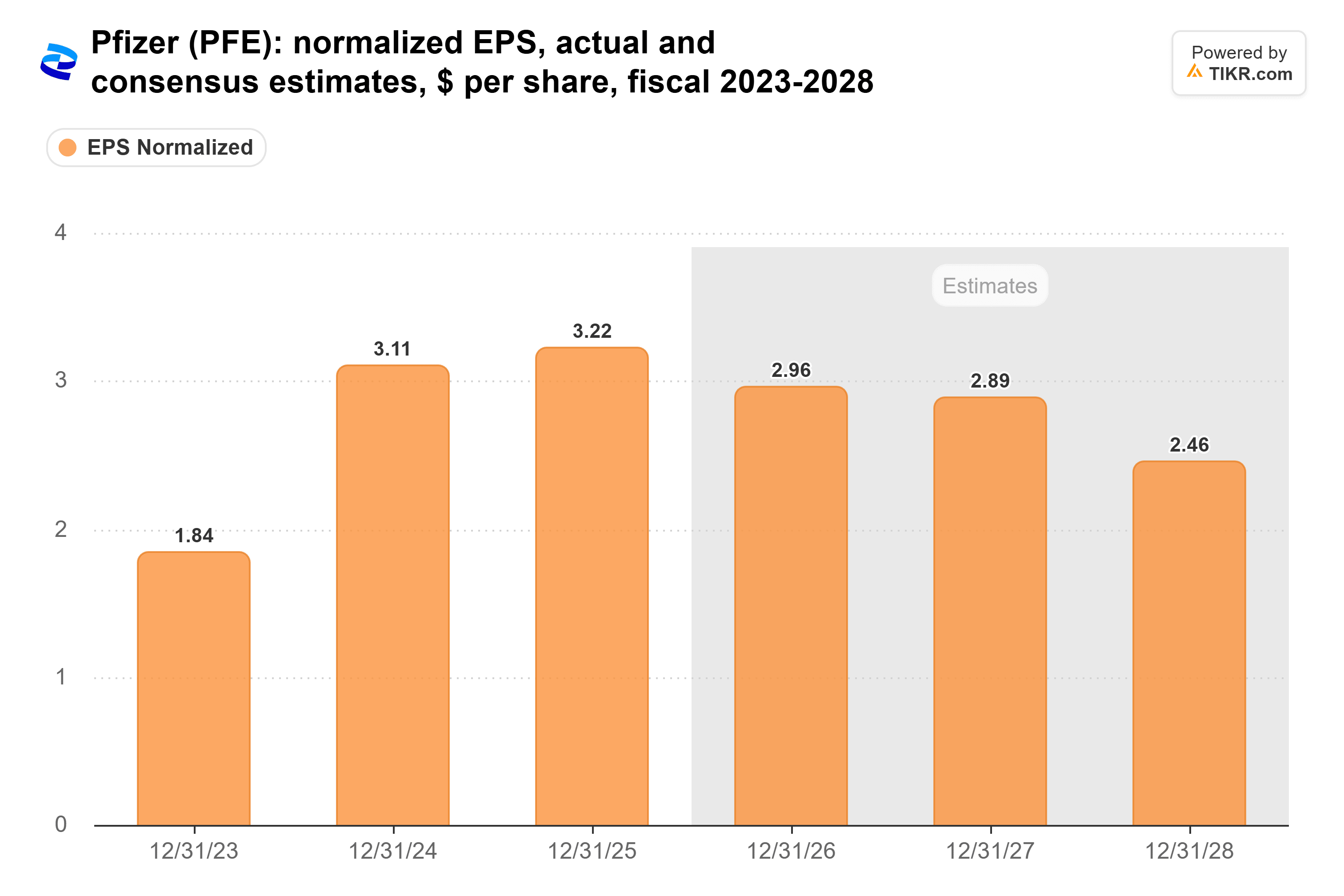
The drop comes from patents. Eliquis, Ibrance and Xtandi lose their U.S. basic patents in 2027, and settlements let generic Eliquis launch on April 1, 2028. Management estimates $14 billion to $15 billion of revenue is at risk through 2030. At $1.72 a share, the dividend would use about 70% of 2028’s expected earnings, up from 53% of 2025’s.
What Nov. 3 has to show
With the April tax payment out of the way, I’m watching three things:
- Cash flow: operating cash flow minus capital spending should start catching up to the roughly $2.5 billion Pfizer pays in dividends each quarter.
- Guidance: adjusted EPS guidance of $2.80-$3.00 for 2026 should hold, even after a roughly $0.10 charge tied to Innovent.
- Debt: Pfizer shouldn’t borrow to pay the dividend, and leverage should stay at management’s 2.7x target.
The quarter also has to support a forward P/E that’s climbed from about 9x to 11x this year. For income buyers, though, the dividend is what counts.
The dividend looks safe for now
Here’s where I land: Pfizer’s dividend looks safe through the patent cliff. The tax bill is paid, free cash flow covered the dividend over the past year, and management is targeting $9.7 billion of net cost savings through 2029.
But with earnings expected to shrink into 2028, I wouldn’t buy Pfizer expecting raises. The board has kept the quarterly dividend at $0.43 all through 2026. Buy it for the 5.6% yield as it stands.
Of course, Nov. 3 is only the first test. Last year Pfizer gave its next-year guidance in mid-December and declared its first-quarter dividend on Dec. 12. If guidance comes in well below the Street’s estimates, or the dividend comes in below $0.43, I’d rethink this.
So what is Pfizer stock actually worth?
TIKR lets you forecast the future price of any stock in less than a minute. Just enter a few assumptions into TIKR’s valuation model and see what Pfizer could be worth. Start from Wall Street consensus estimates, or adjust the inputs to reflect your own view of the business. It’s free to use.
Disclaimer:
Please note that the articles on TIKR are not intended to serve as investment or financial advice from TIKR or our content team, nor are they recommendations to buy or sell any stocks. We create our content based on TIKR Terminal’s investment data and analysts’ estimates. Our analysis might not include recent company news or important updates. TIKR has no position in any of the stocks mentioned. Thank you for reading, and happy investing!