
Key Takeaways
- Nvidia’s 13F for the third quarter shows it cut its Intel stake by 25% and its Nokia stake by 56%, which leaves SpaceX as its largest stock holding at about $19.7 billion.
- SpaceX took the top spot because of the Intel sale, since Nvidia’s SpaceX stake lost value over the quarter even after it added shares.
- The sale takes no cash from Intel, but it weakens the outside backing for a turnaround that still burns cash, days after Jensen Huang resigned.
- Nvidia reports tonight, and its next 13F in mid-February will show whether the selling continued.
Nvidia (NVDA) now owns less of its partners and more of its customer. Its 13F for the quarter ended Sept. 30, filed Monday, shows it cut its Intel (INTC) stake by 25% and its Nokia (NOK) stake by 56%, while SpaceX (SPCX) became its largest stock holding.
Intel fell 3% this morning, and Nokia fell 4%. And Nvidia reports its third-quarter results tonight, its first since Jensen Huang resigned as CEO on Nov. 12.
TIKR tracks 40 analysts on SpaceX. How many say “Buy”?
See the full breakdown of Buy, Hold, and Sell ratings on SpaceX, along with Wall Street’s revenue and earnings estimates, all in one place. More than 500,000 investors use TIKR to research stocks like this one. See SpaceX’s Analyst Ratings
The Intel sale put SpaceX on top
On Sept. 30, Nvidia held 161.1 million Intel shares, down from 214.8 million at the end of June. At the quarter-end price, what was left was worth $19.4 billion. Its SpaceX stake rose to 130.5 million shares from 122.8 million and was worth about $19.7 billion. SpaceX was the only one of the eight stocks in the filing where Nvidia reported owning more shares. Together, the two stakes make up more than 80% of its $48.3 billion disclosed portfolio.
SpaceX didn’t climb to the top on its own, though. At the end of June its stake was worth about $21 billion, so it lost value over the quarter even with the extra shares. If Nvidia had kept all its Intel shares, they’d have been worth about $26 billion on Sept. 30, which would have kept Intel comfortably in first place.
The Nokia cut went deeper. Nvidia held 72.86 million Nokia shares on Sept. 30, worth $738.8 million, down from 166.39 million. It bought in for $1 billion in October 2025, at $6.01 a share. That deal came with a partnership to run Nokia’s 5G and future 6G network software on Nvidia chips.
Intel’s recovery is already in the price
Analysts expect Intel’s normalized EPS to climb from $0.42 in 2025 to $2.99 by 2028:
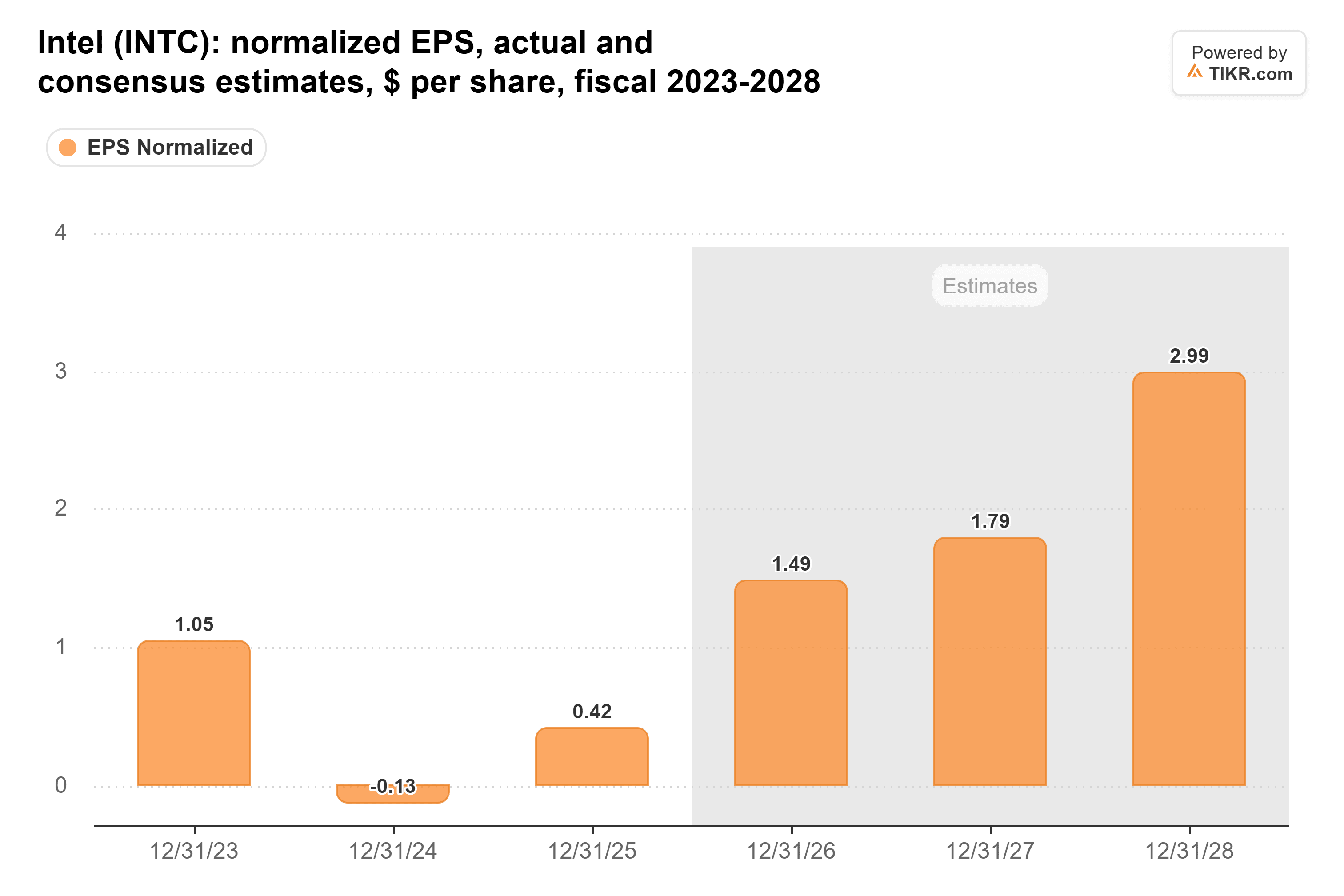
Those estimates are already slipping. The 2027 figure is now $1.79, down from $2.11 before Intel’s third-quarter report.
Investors are paying for that recovery up front. Intel trades at about 40x forward earnings. That’s below its three-year average of 67x, but far above the 10x to 18x range it held from 2014 to 2022:
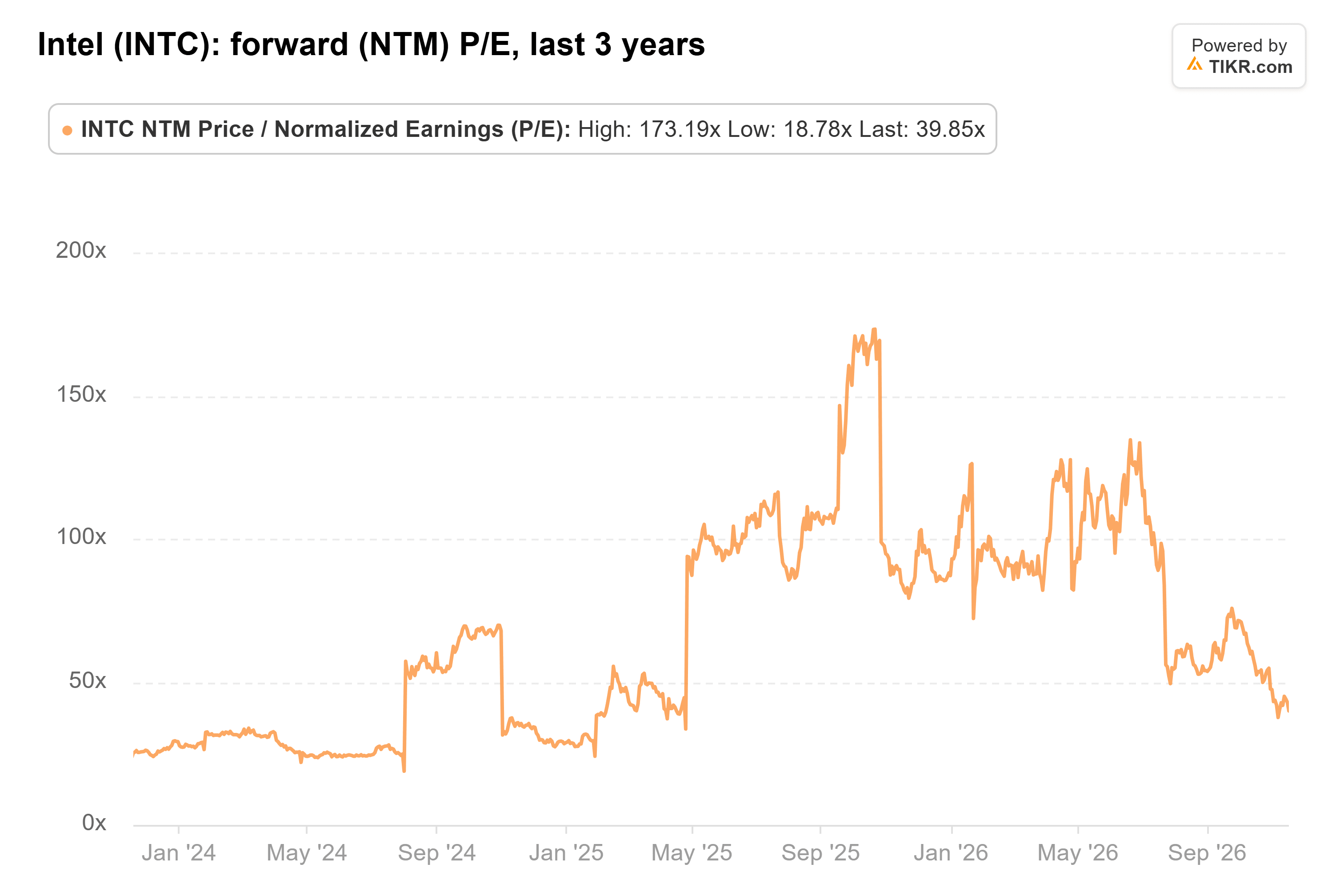
At that multiple, anything that weakens the turnaround matters to the stock.
Intel loses more than a shareholder
Nvidia’s sale doesn’t take a dollar out of Intel’s bank account. The $5 billion Nvidia paid for its shares in 2025 is already Intel’s, and Intel raised another $20 billion in August by selling stock at $95 a share.
Paying for the turnaround is still a problem. Intel’s free cash flow has been negative every year since 2022 as it spends on new fabs:
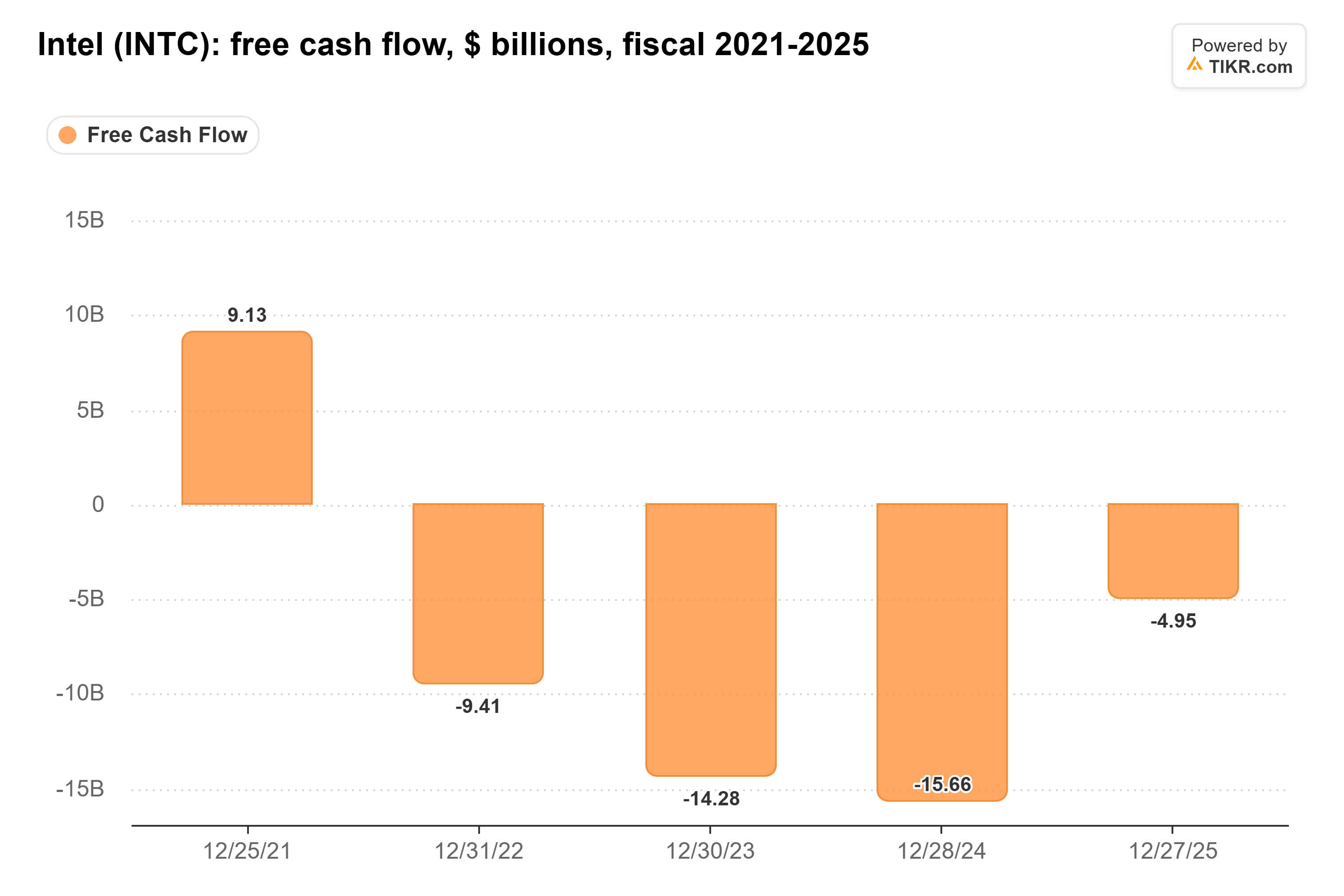
Analysts expect cash outflows of $1.2 billion in 2026 and $1.4 billion in 2027. Management says 2027 capex will be significantly higher than this year’s figure, which is over $20 billion. I’d expect Intel to need outside money again. Nvidia was the most valuable backer it had, because its investment came with a deal to pair Intel’s CPUs with Nvidia’s graphics chips. Huang championed that deal, and his resignation left CFO Colette Kress as interim CEO.
Nvidia is betting on its own customer
Most of Nvidia’s SpaceX stake came from its investment in xAI’s January funding round. That stake became SpaceX stock when SpaceX bought xAI in February. SpaceX also buys Nvidia’s chips. On SpaceX’s first earnings call as a public company, in August, Elon Musk said: “We’ve decided to build exclusively on Nvidia because we think [its] Vera Rubin architecture is the best architecture.”
Those Vera Rubin systems pair Nvidia’s GPUs with its own Vera CPU, which competes with Intel’s server chips. So Nvidia now owns more of a company that runs on its chips, CPUs included, and less of a CPU rival.
Bad news for Intel, whatever the reason
A 13F shows what Nvidia held on Sept. 30. It doesn’t say why it sold. Nvidia paid $23.28 a share for its Intel stock, and those shares were worth about $120 each on Sept. 30, so taking some profit would be a perfectly reasonable move. It also still holds three-quarters of its Intel shares, and the filing says nothing about the product partnership.
Still, I read this as bad news for Intel. Nvidia’s stake was the strongest vote of confidence Intel’s comeback had. Now Nvidia is trimming it, and the executive who made the deal is gone. That makes Intel’s next round of funding a harder sell. Kress’s first call tonight is the first chance to hear whether the Intel partnership outlasts Huang, and Nvidia’s next 13F, due in mid-February, will show whether the selling kept going.
So what is Intel stock actually worth?
TIKR lets you forecast the future price of any stock in less than a minute. Just enter a few assumptions into TIKR’s valuation model and see what Intel could be worth. Start from Wall Street consensus estimates, or adjust the inputs to reflect your own view of the business. It’s free to use.
Disclaimer:
Please note that the articles on TIKR are not intended to serve as investment or financial advice from TIKR or our content team, nor are they recommendations to buy or sell any stocks. We create our content based on TIKR Terminal’s investment data and analysts’ estimates. Our analysis might not include recent company news or important updates. TIKR has no position in any of the stocks mentioned. Thank you for reading, and happy investing!