Key Takeaways
- SpaceX is adding about 500 megawatts of AI compute a month, roughly 220,000 Nvidia GB300 chips, and expects to pass a gigawatt a month by the end of 2027.
- On Apollo CEO Marc Rowan’s estimate that half a gigawatt’s cost goes to Nvidia, that target means about $300 billion a year headed to Nvidia.
- Nvidia’s slice is likely smaller at SpaceX’s discount, while Micron stands to gain on memory prices from the same chips.
- At 8.7x forward earnings, the low of its five-year range, Nvidia gets little credit for a buyer that funds itself.
Elon Musk just put a number on how fast SpaceX (SPCX) is building AI compute. At the TomorrowX Summit on Nov. 18, he said:
“We’re right now in rough terms bringing on about half a gigawatt per month of AI compute, which is roughly 220,000 GB300s plus associated CPU, networking and cooling and everything.”
And on the latest episode of the Moonshots podcast, Peter Diamandis noted that SpaceX “expects to pass one gigawatt a month by the end of 2027, which is insane, right?”
It is. And those GB300s are Nvidia (NVDA) chips.
Each one also carries high-bandwidth memory, the kind Micron Technology (MU) sells to AI data centers. And the handiest rule for sizing all of this comes from the CEO of Apollo Global Management (APO), which just helped line up SpaceX’s chip-backed debt.
Call it $300 billion a year
Marc Rowan gave that rule on CNBC’s Squawk on the Street on Nov. 17: “the estimate is if it costs you roughly $50 billion to build a gigawatt, half of that ended up at NVIDIA.”
A gigawatt a month is 12 gigawatts a year. At $50 billion each, with half going to Nvidia, that’s about $300 billion a year of spending headed to Nvidia from one customer.
Analysts expect Nvidia to bring in $726 billion of revenue in the year ending January 2028, and $926 billion in the year ending January 2029:
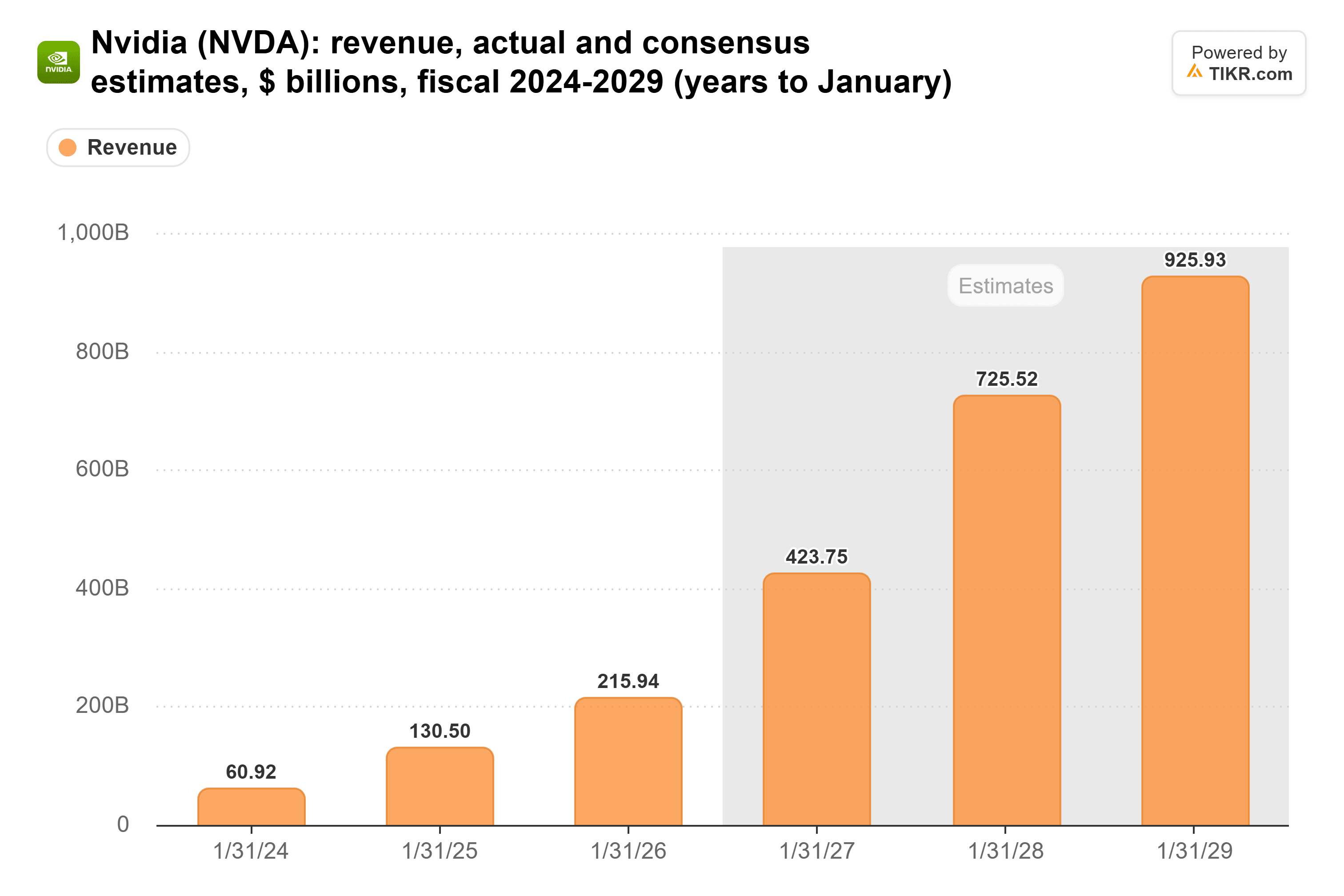
At that pace, SpaceX alone would be worth about a third of that later year’s sales.
TIKR tracks 40 analysts on SpaceX. How many say “Buy”?
See the full breakdown of Buy, Hold, and Sell ratings on SpaceX, along with Wall Street’s revenue and earnings estimates, all in one place. More than 500,000 investors use TIKR to research stocks like this one. See SpaceX’s Analyst Ratings
SpaceX is already spending like it
Musk isn’t just talking, either. SpaceX’s capital spending has climbed from $4.1 billion in the first quarter of 2025 to $19.6 billion in the third quarter of 2026:
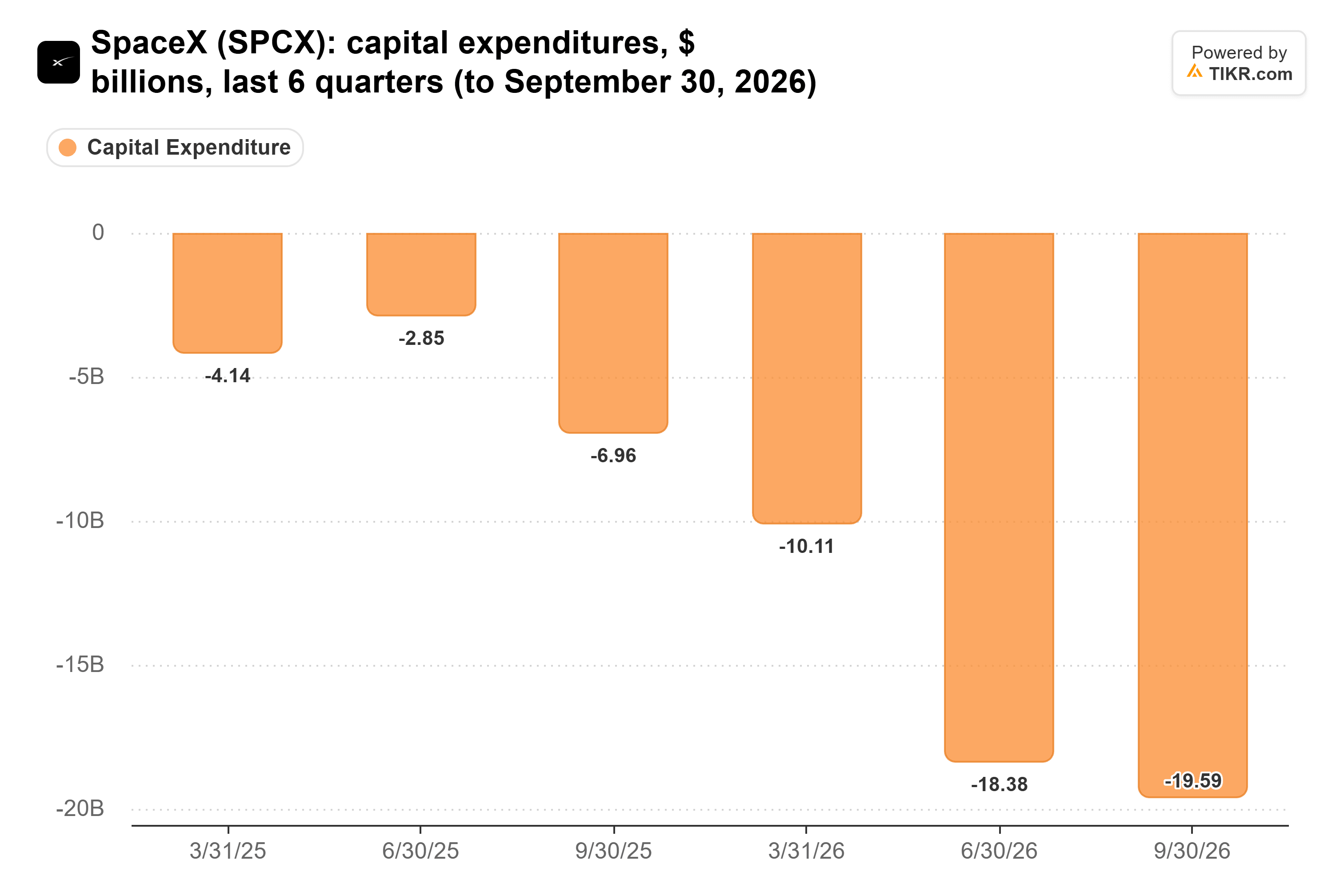
And management guided to $35 billion to $40 billion for the fourth quarter alone.
That money reaches Micron, too. Its Cloud Memory unit, home of its HBM business, grew revenue to $16.3 billion in the quarter ended Sept. 3, from $4.5 billion a year earlier, and management said on its September call that it had already contracted the vast majority of its calendar 2027 HBM supply, at significantly higher prices. So SpaceX helps Micron most by keeping those prices high, and its Dec. 17 report will show how firm they are.
Nvidia’s slice will likely be smaller
SpaceX isn’t paying industry prices, though. Musk says it builds its compute at roughly 60% of the industry’s cost, so I’d expect Nvidia’s cut of a SpaceX gigawatt to land below Rowan’s half.
SpaceX is also borrowing for part of the build. On Nov. 19, it priced $32 billion of chip-backed debt at 8.259%, and Apollo and Goldman Sachs said the next day that demand let them upsize the full financing to about $44 billion.
Rowan’s broader point is the bull case for Nvidia: if Nvidia stops acting as the industry’s banker, plenty of neoclouds lose access to capital, and the winners will be buyers that can fund themselves. SpaceX, with $89.9 billion of cash and marketable securities at Sept. 30 and lenders lining up, is one of them.
Nvidia is priced for far less
Nvidia trades at just 8.7x forward earnings, the lowest point of the last five years and a fraction of its 35x average:

The way I see it, even at SpaceX’s discount, a customer adding a gigawatt a month and paying with its own cash and the bond market is great news for Nvidia, and investors are giving that very little credit today.
Of course, Musk’s timelines don’t always hold. SpaceX’s fourth-quarter report in early 2027 is the first test: capex inside that $35 billion to $40 billion guide would show the pace is real.
So what is Nvidia stock actually worth?
TIKR lets you forecast the future price of any stock in less than a minute. Just enter a few assumptions into TIKR’s valuation model and see what Nvidia could be worth. Start from Wall Street consensus estimates, or adjust the inputs to reflect your own view of the business. It’s free to use.
Disclaimer:
Please note that the articles on TIKR are not intended to serve as investment or financial advice from TIKR or our content team, nor are they recommendations to buy or sell any stocks. We create our content based on TIKR Terminal’s investment data and analysts’ estimates. Our analysis might not include recent company news or important updates. TIKR has no position in any of the stocks mentioned. Thank you for reading, and happy investing!