Key Takeaways
- Shell’s dividend per share grew 17.4% a year from fiscal 2020 to fiscal 2025, well ahead of Social Security’s 3.6% cost-of-living adjustment for 2027.
- That growth rate starts in the year Shell cut its payout, and over 10 years its dividend per share fell.
- The dividend took 27% of free cash flow over the twelve months to June 30, 2026, and management points to a 9% increase over the last 12 months.
- Shell’s dividend check looks safe, and the next update should come with fourth-quarter results on Feb. 4.
Social Security checks are going up 3.6% in January. Shell (SHEL) has grown its dividend per share 17.4% a year since 2020.
For a retiree who wants income that keeps up with prices, that looks like an easy win for the oil giant. But that 17.4% comes with an asterisk.
The 3.6% cost-of-living adjustment applies to December 2026 benefits, so it shows up in checks paid from January 2027.
| Measure | Shell (SHEL) |
|---|---|
| Current dividend | $0.3906 a quarter per ordinary share ($0.7812 per ADS) |
| Dividend growth, fiscal 2020-2025 | 17.4% a year ($0.65 to $1.45 a share) |
| Dividend growth, fiscal 2015-2025 | -2.6% a year ($1.88 to $1.45 a share) |
| Cash dividend payout ratio, TTM to June 30, 2026 | 27% |
| Net debt / EBITDA, last twelve months | 0.54x |
| Social Security COLA, 2027 | 3.6% |
Source: TIKR, Shell and the Social Security Administration.
6 safe dividend stocks paying retirees 6%+ yields
There are over 100 stocks paying 6%+ annual dividends today.
But after an extensive investment review leveraging TIKR’s proprietary data, we now believe only six of them are truly safe for retirees.
They’re all yours as part of our new investment report. Learn more about how to get access right here.
Shell’s quarter gave the check plenty of backing
Shell’s third quarter, reported Oct. 29, brought $21 billion of cash flow from operations and $10.8 billion of adjusted earnings. On the gas side, Shell completed its ARC Resources acquisition in September, adding 370,000 barrels of oil equivalent a day of Canadian production.
It’s paying for that growth partly by selling what it doesn’t want. Sales of Jiffy Lube and its Na Kika stake brought in most of the quarter’s $2.7 billion of divestment proceeds, and net debt fell to $39.7 billion at the end of the third quarter from $41.8 billion at the end of the second. CEO Wael Sawan doesn’t sound eager to spend the cash on another big deal, either: “We will not allow the surplus cash to burn a hole through our pockets.”
Shell does flag two near-term headwinds: lost volumes at its Qatar assets because of the Strait of Hormuz situation, and refining margins that have softened so far in the fourth quarter.
The dividend takes barely a quarter of the cash
Shell’s dividend is well-covered, eating up just 27% of free cash flow over the twelve months to June 30, 2026: $8.44 billion of dividends against $31.55 billion of free cash flow. That’s in line with recent years. The ratio ranged from 16.2% in fiscal 2022 to 35.4% in fiscal 2025, the highest of the five, as free cash flow fell to $23.9 billion from $35.1 billion in fiscal 2024. The chart below shows how different things looked before 2020:
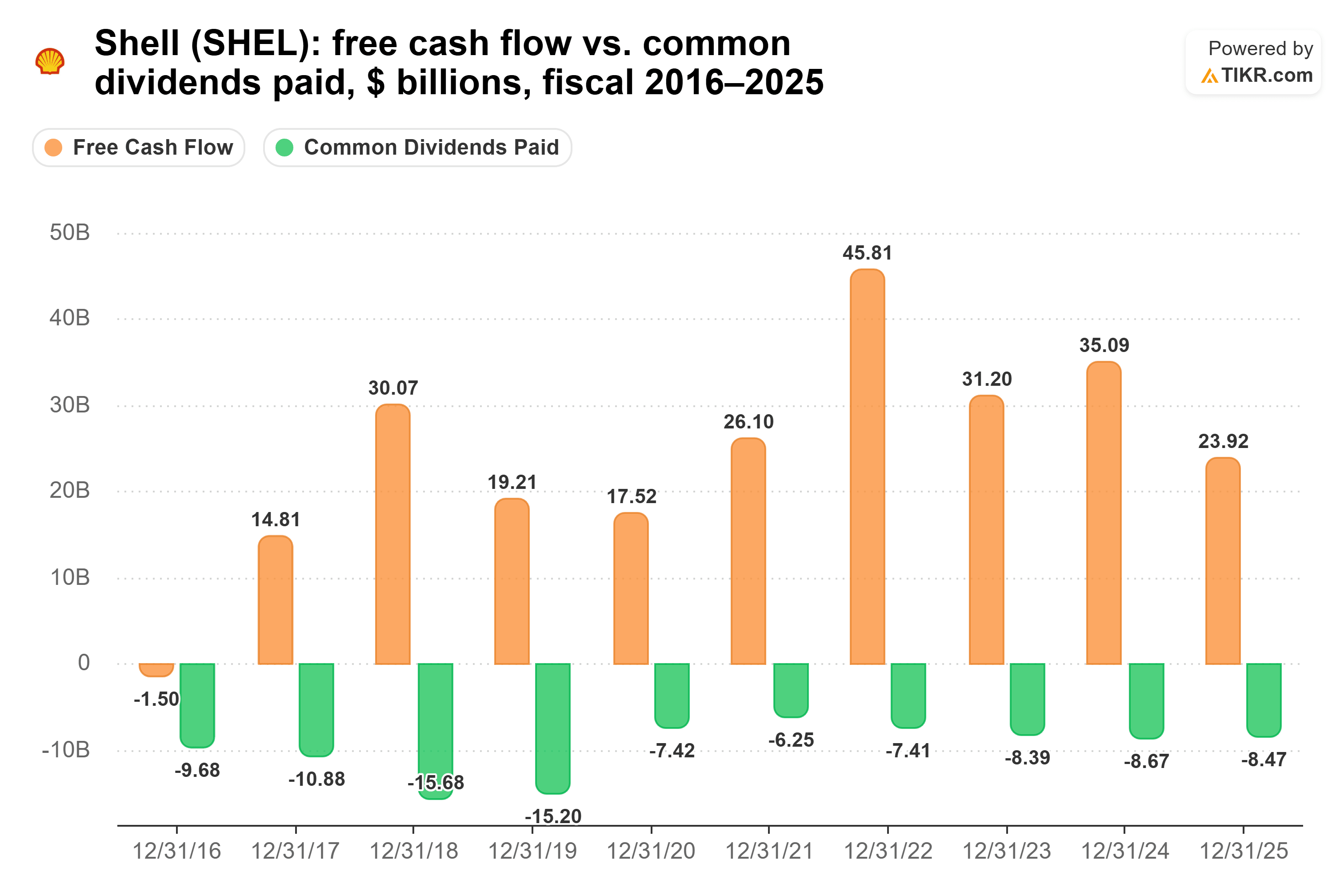
In fiscal 2016, Shell’s free cash flow was negative while it paid $9.68 billion of dividends, and in fiscal 2019, dividends of $15.2 billion took most of its $19.2 billion of free cash flow. Today’s dividend sits on a much firmer base.
Shell’s policy is to return 40% to 50% of its cash flow from operations to shareholders through dividends and buybacks together. “Our policy of shareholder distributions of 40% to 50% of CFFO through the cycle remains sacrosanct,” Sawan said on the third-quarter call. The $5 billion buyback announced on Oct. 29 is set to finish by the fourth-quarter results. My read: when cash gets tighter, Shell has room to shrink the buyback well before it has to touch the dividend.
The 17.4% starts from a cut
Shell’s dividend per share went from $0.65 in fiscal 2020 to $1.45 in fiscal 2025, which is where the 17.4% a year comes from. Fiscal 2020 was the year of the reset, as the chart shows: dividends paid fell to $7.42 billion from $15.2 billion in fiscal 2019. Stretch the window to 10 years, and the dividend per share fell from $1.88 in fiscal 2015 to $1.45, or 2.6% a year.
The pace now is slower, but it still beats Social Security comfortably. On the third-quarter call, Shell said: “Our progressive dividend remains one of our key financial priorities as can be seen by the 9% increase in our dividend per share over the last 12 months.” The third-quarter dividend Shell declared on Oct. 29, $0.3906 per ordinary share, matched the first and second quarters’ rate.
A check that should keep beating the COLA
The way I see it, Shell’s dividend check is about as safe as an oil company’s gets right now, and it should keep growing faster than Social Security. Just don’t count on 17.4% a year from here, since much of that was the rebound from 2020.
Shell’s dividend took 27% of free cash flow over the twelve months to June 30, its net debt was 0.54x EBITDA over the last twelve months, and its operating profit covered its interest 7.8x. That’s very little risk at today’s coverage. The risk that matters is the one 2020 showed: in a deep enough downturn, Shell has cut before.
Shell reports its fourth quarter on Feb. 4, alongside a capital markets update. That’s where I’ll be watching for the next raise, and for any change to the 40% to 50% policy.
Forget Shell: 6 safe 6%+ dividend yields you can buy right now
Dividends can hold the key to enormous wealth. But only if you buy the right ones.
Picking the right high-yield dividend stock can be the difference between a dream retirement…and scraping by every month, waiting for the next Social Security check to clear.
We’ve identified six stocks yielding 6%+ that we believe every retiree should know about right now. (And Shell isn’t one of them.)
Disclaimer:
Please note that the articles on TIKR are not intended to serve as investment or financial advice from TIKR or our content team, nor are they recommendations to buy or sell any stocks. We create our content based on TIKR Terminal’s investment data and analysts’ estimates. Our analysis might not include recent company news or important updates. TIKR has no position in any of the stocks mentioned. Thank you for reading, and happy investing!