Key Takeaways
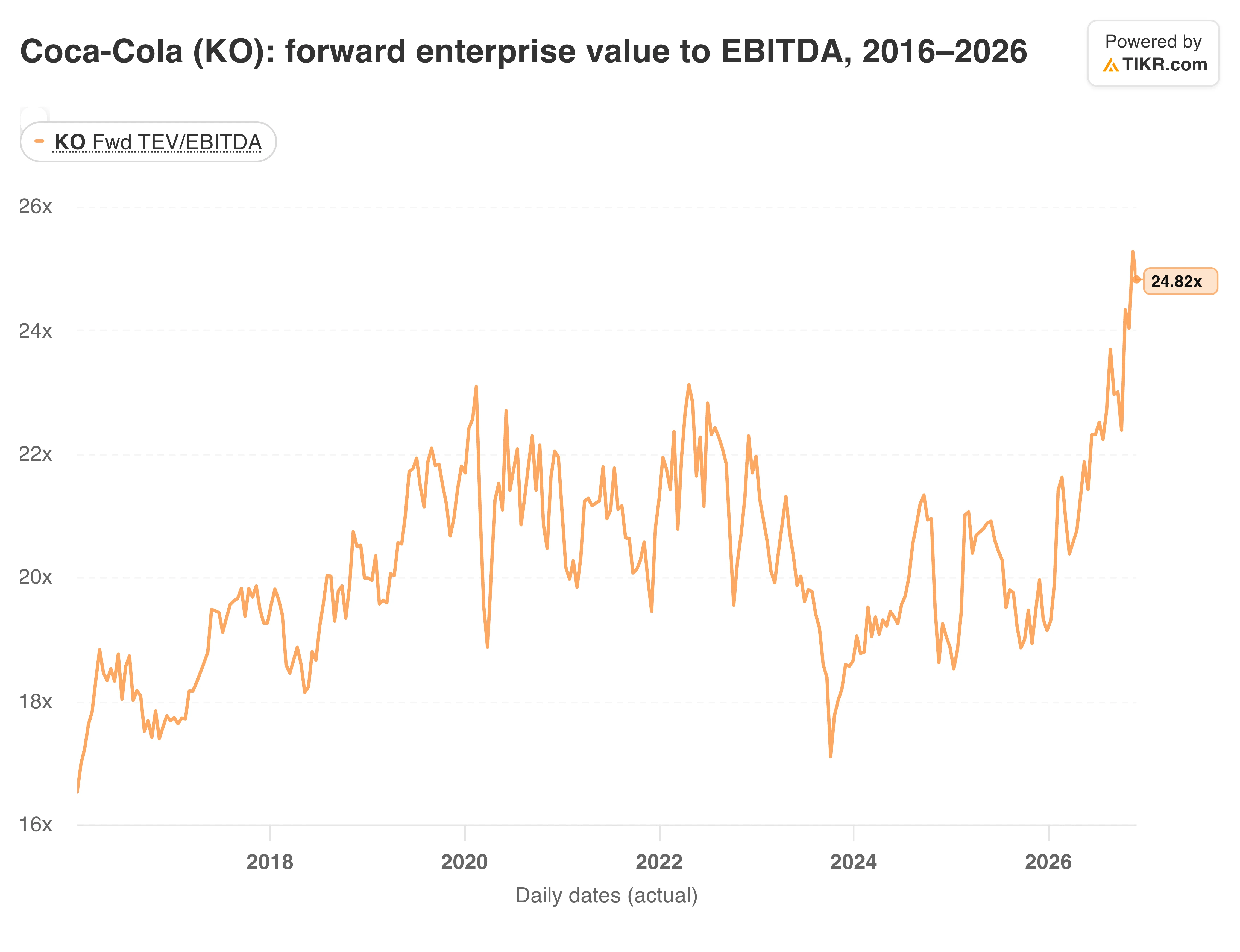
- Coca-Cola stock is up 39% this year and trades at 24.8x forward EBITDA, well above its 10-year average of 20.5x, even though expected growth hasn’t changed.
- Price/mix grew just 1% in the third quarter, and the sale of Coca-Cola Beverages Africa will cut 2027 comparable revenue by about 8 points.
- BodyArmor has absorbed $1.7 billion of trademark writedowns in two years, and the company says another charge is likely if results miss its revised plan.
- If the valuation drifts back to its five-year average, a buyer today could earn less than 4% a year over the next three years, even counting dividends.
Coca-Cola (KO) has been one of the market’s favorite places to hide in 2026. The stock is up 39% for the year and only about 2% below the 52-week high it set just a few weeks ago.
Before I get into the reasons why the stock’s price today makes me a little nervous, let me be clear: Nothing about the business is broken. Coca-Cola gained value share in the third quarter, grew volume, and now expects at least $13 billion of free cash flow this year. But every long-term investors knows that every investment decisions has two parts: the business you’re buying and the price you pay for it. After this year’s run, I believe the price matters more than the business for anyone buying today.

1. You’re paying a near-record price for ordinary growth
Coca-Cola trades at nearly 25x forward enterprise value to EBITDA, a valuation measure that accounts for the company’s debt. That’s roughly three standard deviations above its 10-year average of 20.5x and close to its highest level of the past decade. The forward PE ratio also now sits at 28x expected earnings, against a five-year average of about 23.5.
Most of that premium has come this year. The multiple stood at around 19x at the end of 2025 and has climbed about 30% in four quarters. Over the same stretch, forward EBITDA of about $18.0 billion is only about 12% above the $16.1 billion Coca-Cola earned in 2025. In other words, the stock price ran much faster than the earnings behind it.
A higher multiple can make sense when growth is speeding up, but that isn’t really happening here with Coke. Analysts expect EBITDA to grow about 7% a year through 2030, close to the roughly 6% a year Coca-Cola delivered from 2021 to 2025. Expected EPS growth of about 6.6% a year from 2026 to 2029 matches the pace of 2022 to 2025.
History also suggests stretched multiples don’t last at Coca-Cola. The multiple reached around 22x in late 2020 and in mid-2022, then fell to just under 18x by the third quarter of 2023.
Here’s why that matters if you’re holding for years. If the multiple simply returned to its 20.5x average at current estimates, Coca-Cola’s enterprise value would fall about 17%, and its equity value would fall about 19% because of the company’s debt. Spread over a three-year hold, that’s a drag of roughly 6 percentage points a year, enough to cancel out nearly all of the earnings growth you’re paying for. A small estimate cut or a growth miss could be all it takes to start that re-rating.
2. Pricing power is fading just as 2027 gets harder
Coca-Cola’s growth formula rests on two levers: selling more drinks (volume) and earning more on each one (price/mix). Management’s long-term goal is 2 to 3 points of growth from each.
Price/mix grew just 1% in the third quarter. Pricing actions added 4 points, but 3 points of unfavorable mix, mainly from developing markets growing faster than higher-priced developed ones, gave most of that back. On the company’s recent earnings call, one analyst noted that full-year 2026 price/mix could land near 2%, which would be among the lowest in about a decade. Management didn’t dispute the figure, though it stuck with its 2-to-3-point target.
Volume has carried the load this year, and that creates its own problem. Second-quarter volume growth of 5% was helped by an easier comparison, and management acknowledged it will be cycling a high-volume year in 2027.
Then there’s refranchising. Coca-Cola expects to complete the sale of Coca-Cola Beverages Africa, a large bottling business, around year-end. The deal should help margins and returns on capital, but management says it will reduce 2027 comparable revenue by 8 points and comparable EPS by 2 points.
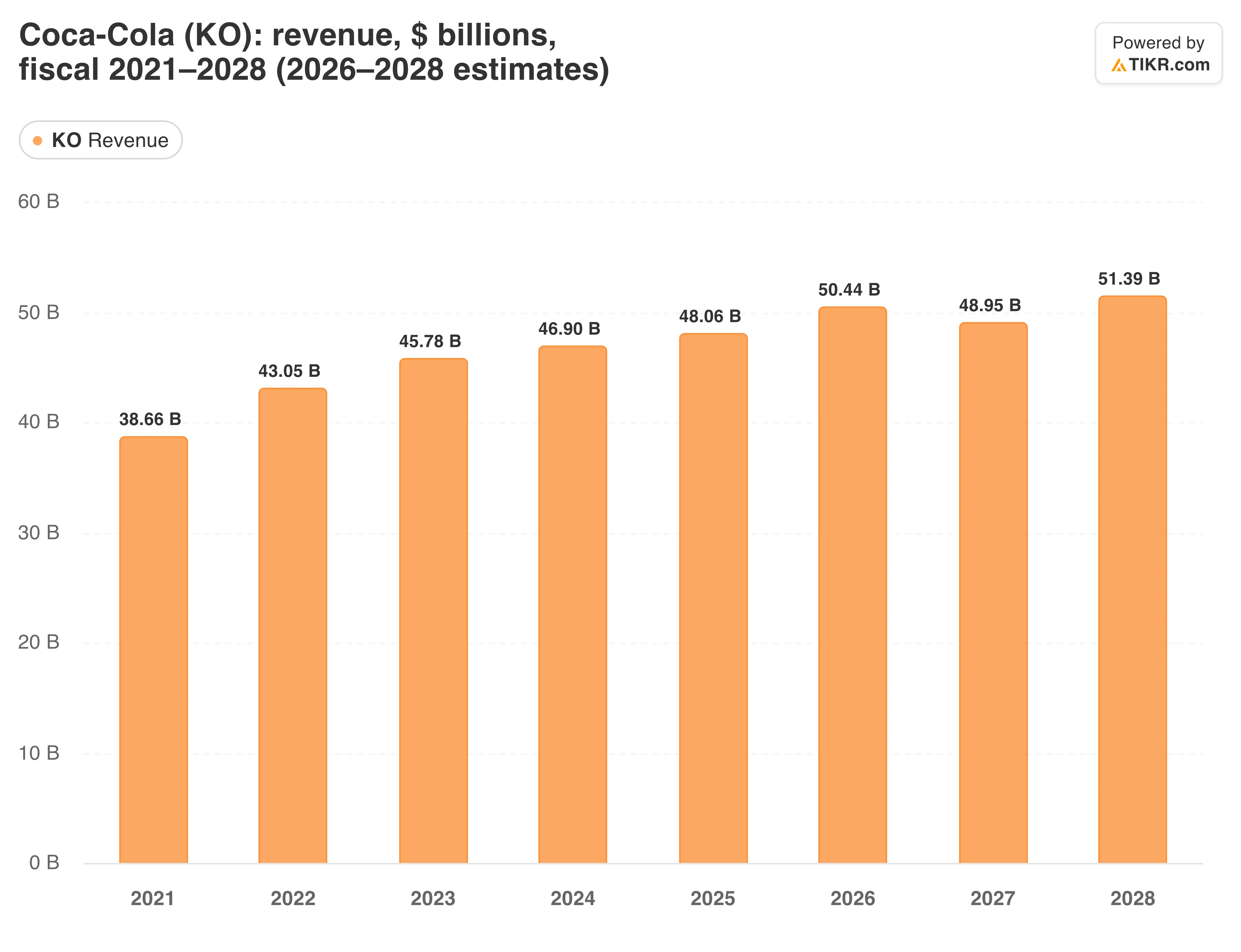
Analysts expect revenue to dip about 3% in 2027, to $48.9 billion from $50.4 billion, and EPS growth to slow to about 5% from roughly 12% this year. Add the slight currency headwind management expects for 2027, after a roughly 3-point tailwind to 2026 EPS, and next year starts to look ordinary for a stock priced at a premium.
For long-term holders, slower growth hurts twice. Each percentage point of lost annual earnings growth trims roughly 3% from the stock’s value over a three-year hold, before any change in the multiple. And when growth disappoints, the multiple rarely stays put. Coca-Cola plans to give its 2027 outlook in February, and weak price/mix guidance would test the premium the stock now carries.
3. Coca-Cola’s big bets beyond soda keep costing shareholders
North America produced 36.8% of Coca-Cola’s 2025 operating income, and that’s where its two biggest recent bets live: BodyArmor and fairlife.
Coca-Cola paid $5.6 billion in 2021 for the 85% of BodyArmor it didn’t already own. It has since written down the BodyArmor trademark twice: $760 million in 2024 and another $960 million in 2025, citing slower expected category growth and tougher competition. That leaves $2.44 billion of carrying value, and the company says the brand’s fair value is now about the same. If near-term results miss its revised projections, Coca-Cola says another impairment charge is “likely.” On the third-quarter call, management named Sprite and BodyArmor as areas where it needs to do better.
fairlife is the opposite problem: a winning brand that got expensive because it won. Coca-Cola paid about $6.2 billion of final contingent consideration to fairlife’s former owners in March 2025, after $4.8 billion of remeasurement charges in 2023 and 2024. The brand is still growing, but supply has been bumpy. A production incident affected four U.S. facilities this year, though management expects no material second-half impact, and Topo Chico supply constraints in Texas weighed on North America volume and price/mix in 2026.
Those deals hit shareholders where it counts most: cash. Reported free cash flow fell from $9.7 billion in 2023 to $4.7 billion in 2024 and $5.3 billion in 2025, as a $6.0 billion IRS deposit (more on that below) and then the fairlife payment came due.
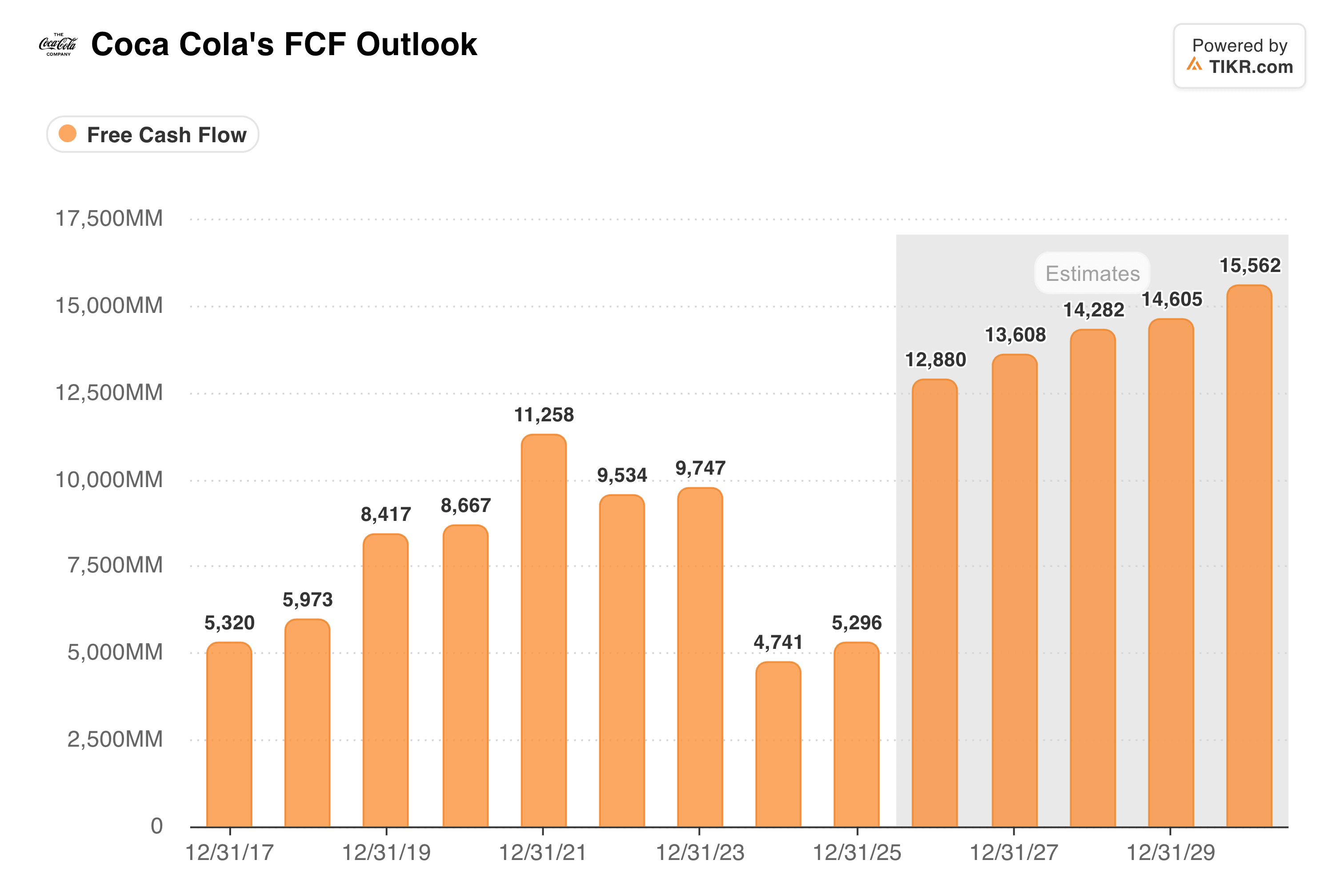
Cash flow is bouncing back, to about $14.3 billion over the past 12 months. And another BodyArmor charge wouldn’t sink the stock by itself, since $2.44 billion is less than 1% of Coca-Cola’s roughly $419 billion market value. However, today’s premium valuation assumes Coca-Cola can keep growing beyond soda, yet one of its two largest recent deals has been written down by $1.7 billion and the other ended in a $6.2 billion check. Every dollar spent on deals that underdeliver is a dollar that isn’t compounding for you through dividends or buybacks. Any further BodyArmor charge would show up with the next annual impairment test.
Two more risks worth watching
The IRS fight. The Tax Court sided with the IRS in 2024 over how Coca-Cola reported income from foreign licensees, and the company has made a $6.0 billion deposit while it appeals. If it loses, management puts the remaining exposure for 2010 to 2025 at about $14 billion including interest, against a tax reserve of just $512 million. A ruling is expected in the coming months.
Currency and emerging markets. International markets generated 60% of 2025 revenue, and currency cut operating income by 12% that year. After a roughly 3-point tailwind to 2026 EPS, management expects a slight headwind in 2027.
What this means if you’re buying today
Put it all together, and Coca-Cola stock looks priced for its best case. To see what that could mean for your returns, I ran Coca-Cola through TIKR’s Valuation Model Builder using assumptions that look reasonable next to the company’s own history: revenue growth of 3% a year, operating margins of 33% (a bit above the roughly 32% Coca-Cola earns today), and a P/E of 22 at the end of 2028, slightly below the stock’s 10-year average of 23.4.

The result is a target price of $87.24, about 10% below today’s $97.40. That works out to a loss of about 5% a year over the next few years. Expected dividends of roughly $4.70 per share would soften the blow, but you’d still be down about 6% on a stock most people buy for safety.
That’s a sharp turn from Coca-Cola’s track record. The stock returned 9% a year over the past decade and 12.3% a year over the past five years, helped along by a rising multiple. Starting from 28x earnings, that tailwind is much harder to count on.
TIKR’s model is one possible outcome. Here’s how a three-year hold to late 2029 could play out using analysts’ earnings estimates and about $7.30 per share of dividends (not reinvested):
- The P/E holds at 28: about $120 a share, for a total return of about 31%, or 9.5% a year.
- The P/E returns to its five-year average of 23.5: about $101 a share, for a total return of about 11%, or 3.6% a year. A $10,000 investment would grow to roughly $11,100.
- Earnings grow 4.5% a year instead, and the P/E returns to average: about $94 a share, for a total return of about 4%, or 1.3% a year.
Compare that with the stock market’s long-run average of roughly 10% a year, which would turn $10,000 into about $13,300 over three years. Coca-Cola only keeps pace if today’s premium multiple holds. If the multiple settles back toward its history, as TIKR’s model assumes, returns could range from modest to negative.
None of this makes Coca-Cola a bad company. Its brands, global bottling network, and cash generation are why investors pay up for it, and a 2.2% dividend yield backed by more than six decades of annual increases offers some cushion. But at 28x earnings, there’s very little room for error. If you already own the stock, there’s no urgent reason to sell. If you’re buying today, patience could pay off: waiting for a better price, or building a position slowly ahead of February’s 2027 outlook, may improve your odds of a solid long-term return.
Forget Coca-Cola: 6 safe 6%+ dividend yields you can buy right now
Dividends can hold the key to enormous wealth. But only if you buy the right ones.
Picking the right high-yield dividend stock can be the difference between a dream retirement…and scraping by every month, waiting for the next Social Security check to clear.
We’ve identified six stocks yielding 6%+ that we believe every retiree should know about right now. (And Coca-Cola isn’t one of them.)
Disclaimer:
Please note that the articles on TIKR are not intended to serve as investment or financial advice from TIKR or our content team, nor are they recommendations to buy or sell any stocks. We create our content based on TIKR Terminal’s investment data and analysts’ estimates. Our analysis might not include recent company news or important updates. TIKR has no position in any of the stocks mentioned. Thank you for reading, and happy investing!