Key Takeaways
- Energy Transfer yields 7.4% and Enterprise Products Partners yields 6.2%, and both raised their distributions this fall.
- Both cover their payouts comfortably on distributable cash flow: 1.7x for Enterprise and 1.8x for Energy Transfer in fiscal 2025.
- Energy Transfer’s faster growth since fiscal 2020 includes its rebound from a cut, and management now targets 3% to 5% a year.
- Energy Transfer carries more debt than Enterprise and plans about $7 billion of growth spending in 2027.
Pipeline investors got two raises this fall. Energy Transfer (ET) said on Oct. 22 that it was lifting its quarterly distribution to $0.3425 a unit, “the Partnership’s twentieth consecutive increase to its quarterly cash distribution.” A week later, Enterprise Products Partners (EPD) declared $0.56 a unit, up 2.8% from a year earlier.
Energy Transfer pays the bigger check, with a 7.4% yield at today’s prices against Enterprise’s 6.2%. Both are partnerships, so they pay distributions on units and send holders a K-1 at tax time.
So if you put $10,000 into one of them today, which one pays you more over the next 10 years?
| Metric | Enterprise Products Partners (EPD) | Energy Transfer (ET) |
|---|---|---|
| Yield | 6.2% | 7.4% |
| Annual distribution | $2.24 a unit | $1.37 a unit |
| Distribution growth, fiscal 2020-2025 | 4.0% a year | 7.8% a year |
| Distributable cash flow coverage, fiscal 2025 | 1.69x | 1.78x |
| Distributable cash flow coverage, fiscal 2026 consensus | 1.86x | 2.15x |
| Net debt/EBITDA (LTM) | 3.19x | 3.83x |
| Interest coverage (LTM) | 5.13x | 3.13x |
Source: TIKR, StockAnalysis. Yields at today’s prices and each company’s current distribution rate.
6 safe dividend stocks paying retirees 6%+ yields
There are over 100 stocks paying 6%+ annual dividends today.
But after an extensive investment review leveraging TIKR’s proprietary data, we now believe only six of them are truly safe for retirees.
They’re all yours as part of our new investment report. Learn more about how to get access right here.
Enterprise keeps its cushion steady
Enterprise’s growth comes from new capacity. Inlet volumes at its Permian gas processing plants hit a record 4.6 Bcf/d in the third quarter of 2026, up 12% from a year earlier. Co-CEO W. Fowler said Enterprise has been “opting for targeted organic growth” instead of buying at top-of-the-cycle prices.
Analysts expect distributable cash flow per unit to reach $4.17 in fiscal 2026, up from $3.66 in fiscal 2025, which would cover the $2.24 distribution 1.86x. Coverage has held between 1.63x and 1.84x every fiscal year since 2019:
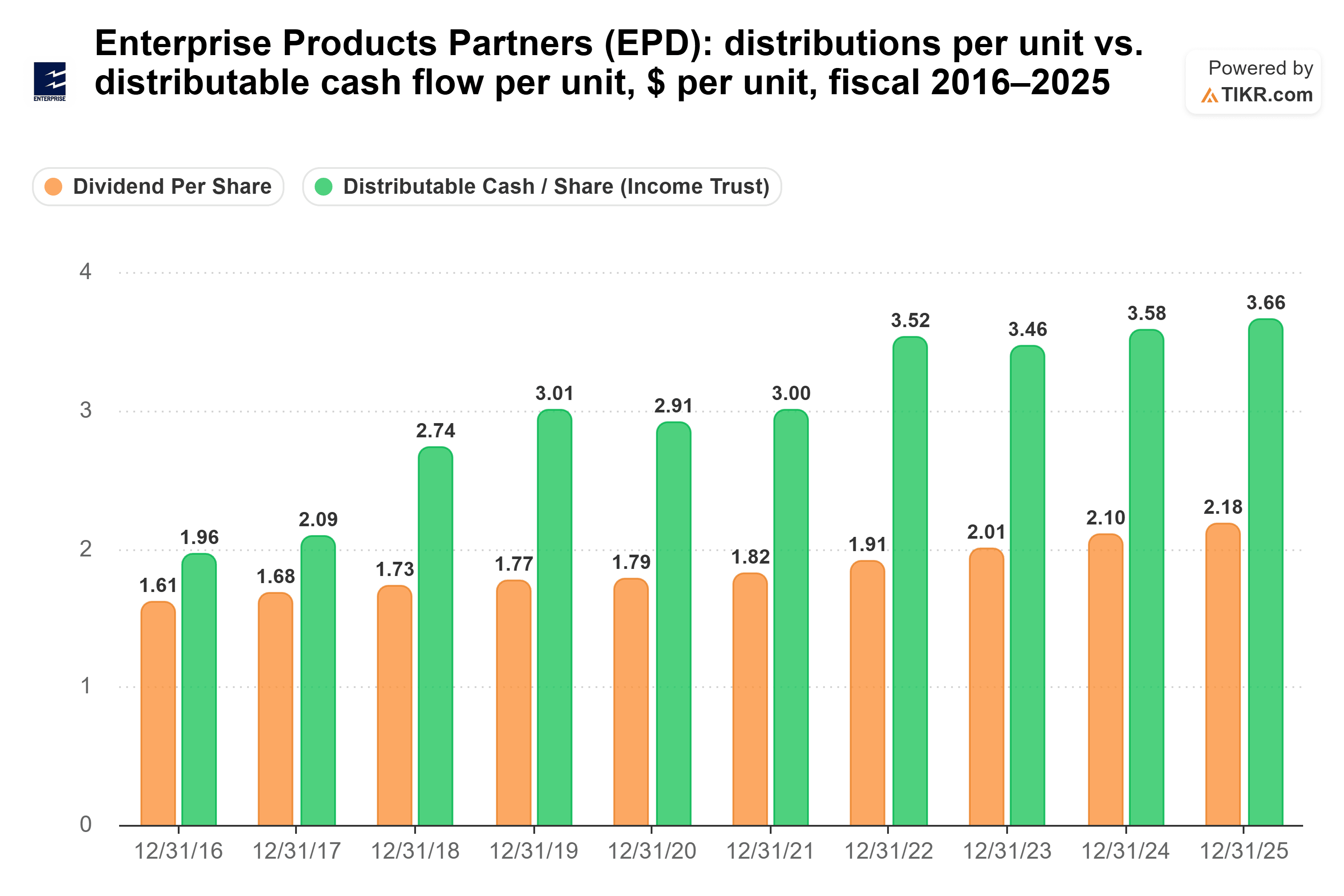
The distribution grew 4.0% a year from fiscal 2020 to fiscal 2025, from $1.78 to $2.17 a unit. The raises have been smaller lately: 3.3% in fiscal 2025 and 2.8% in the latest quarter.
Energy Transfer is buying as well as building
Energy Transfer is taking a different approach. On Nov. 19, it closed its purchase of Vaquero Midstream for $1.95 billion in cash and about 33.3 million new units.
In the third quarter of 2026, distributable cash flow rose 33% to $2.52 billion, and the company raised its 2026 adjusted EBITDA guidance to $19.7-$19.9 billion from $18.8-$19.1 billion. Management credited market volatility for the third straight quarter, along with Phase I of the Hugh Brinson Pipeline.
Those results are why analysts expect distributable cash flow per unit to jump to $2.94 in fiscal 2026 from $2.38, which would cover the $1.37 distribution 2.15x. Coverage has slipped as the raises resumed, from 2.40x in fiscal 2022 to 1.78x in fiscal 2025:
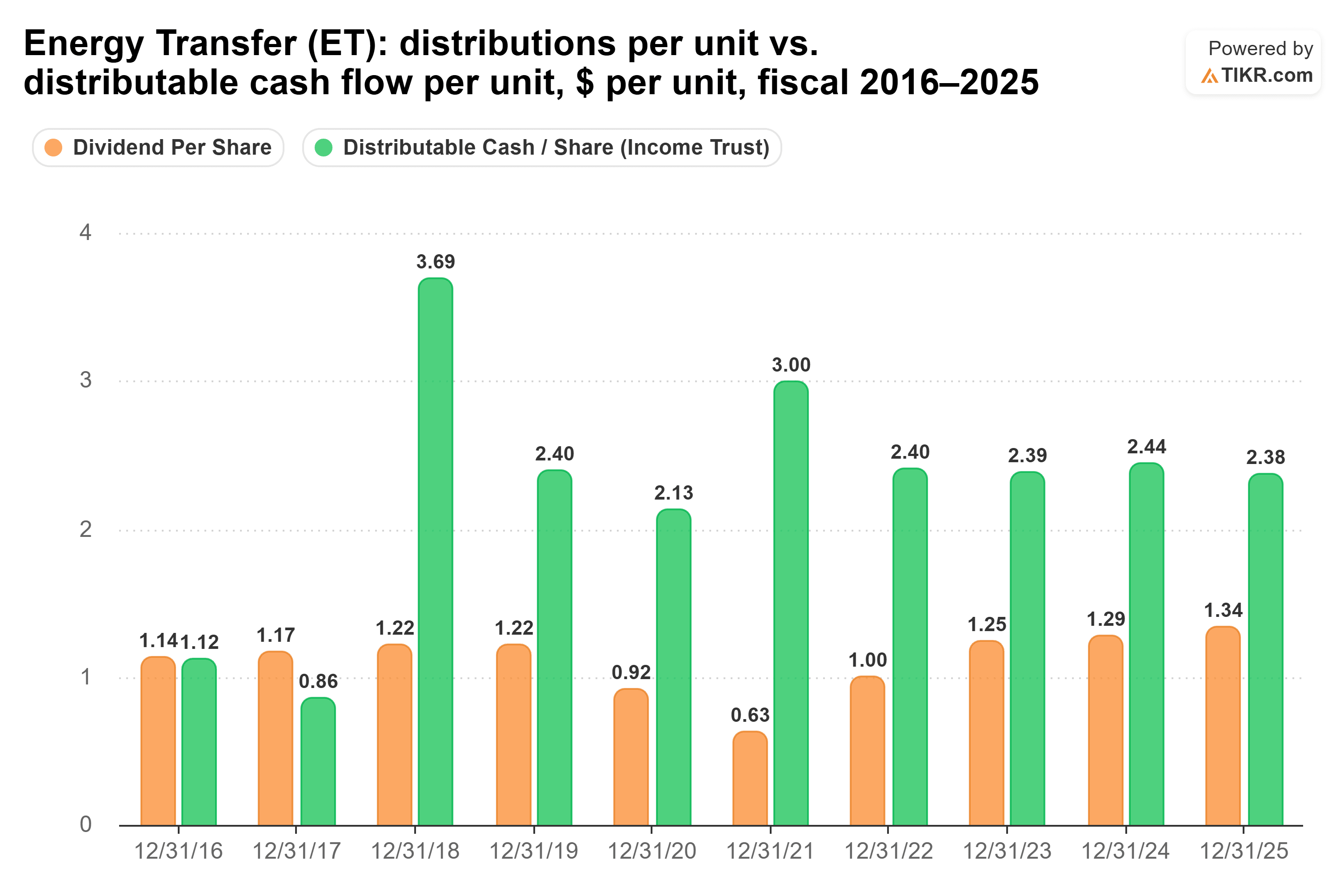
The distribution fell from $1.22 a unit in fiscal 2019 to $0.63 in fiscal 2021, then climbed back to $1.34 in fiscal 2025. That means its 7.8% a year since fiscal 2020 is partly a recovery from the cut. Management now targets 3% to 5% a year, and the 4.7% raise in fiscal 2025 falls inside that range.
Energy Transfer also carries more debt: net debt of 3.83x EBITDA over the past 12 months, against 3.19x for Enterprise, and interest coverage of 3.13x, against 5.13x. And it plans about $7 billion of growth spending in 2027.
So which dividend wins?
Energy Transfer pays you more over the next 10 years. If each dividend keeps growing at its current pace, $10,000 in Energy Transfer pays about $9,173 over the decade, against about $7,276 from Enterprise. That’s about $1,900 more, and Enterprise never catches up. At their 5-year growth rates, the gap widens to about $3,100. But Energy Transfer’s 5-year rate includes its recovery from the cut, so I’d count on the smaller figure.
Analysts’ estimates show enough cash behind Energy Transfer to keep raising:

They expect the distribution to reach $1.47 a unit by fiscal 2028, with $3.11 of distributable cash flow per unit behind it.
Enterprise has a strong case of its own. Its distribution rose every fiscal year from 2016 to 2025, and its debt is lighter. For an investor who wants the calmest ride, it’s hard to beat. But both payouts are well covered, and Energy Transfer pays a higher yield with more coverage. Over a decade, that’s too much income to pass up.
Of course, analysts expect Energy Transfer’s distributable cash flow per unit to dip to $2.89 in fiscal 2027, so some of this year’s gains from volatility may fade. Its fourth-quarter report comes early next year. If it falls well short of the $2.94 consensus for 2026 while the $7 billion budget for 2027 keeps growing, Enterprise’s steadier check starts to look like the better bet.
Forget Energy Transfer: 6 safe 6%+ dividend yields you can buy right now
Dividends can hold the key to enormous wealth. But only if you buy the right ones.
Picking the right high-yield dividend stock can be the difference between a dream retirement…and scraping by every month, waiting for the next Social Security check to clear.
We’ve identified six stocks yielding 6%+ that we believe every retiree should know about right now. (And Energy Transfer isn’t one of them.)
Disclaimer:
Please note that the articles on TIKR are not intended to serve as investment or financial advice from TIKR or our content team, nor are they recommendations to buy or sell any stocks. We create our content based on TIKR Terminal’s investment data and analysts’ estimates. Our analysis might not include recent company news or important updates. TIKR has no position in any of the stocks mentioned. Thank you for reading, and happy investing!