Key Takeaways
- Jason Calacanis predicts Nvidia will be forced to add biometric kill switches to its newest GPUs.
- A fingerprint scan looks unlikely, but new checks on Nvidia’s overseas buyers are already arriving.
- Some estimates say up to 20% of Nvidia’s sales reach China directly or indirectly.
- At 13x forward earnings, against a five-year average of 36x, the stock already prices in far worse.
Nvidia (NVDA) reports its third quarter tonight, and the questions about where its chips end up are getting a lot more specific.
On Monday, All-In podcast co-host Jason Calacanis made a prediction on X:
“NVIDIA will be forced to implement biometric activation/kill switches on its latest-generation GPUs. To enable them, an executive at a known buyer will need to turn on their webcam, read the serial number and then scan their fingerprint.”
That would make for one awkward install.
The guardrails are already going up
Nvidia’s board set up a National Security and Export Control Oversight Committee this week, chaired by director Suzanne Nora Johnson.
CNBC reported on Tuesday that Nvidia has told chip buyers the proposed Remote Access Security Act could expose it and them to US “legal action.” For now, Nvidia reportedly won’t sell chips to customers that rent more than half their GPUs to Chinese companies.
The Commerce Department isn’t waiting for Congress: on Monday it issued an interim rule to limit remote access to advanced AI chips and servers from certain countries.
TIKR tracks 62 analysts on Nvidia. How many say “Buy”?
See the full breakdown of Buy, Hold, and Sell ratings on Nvidia, along with Wall Street’s revenue and earnings estimates, all in one place. More than 500,000 investors use TIKR to research stocks like this one. See Nvidia’s Analyst Ratings
Even the worst case leaves plenty of growth
Cerity Partners’ Jim Lebenthal, who owns the stock, went straight to the worst case on Monday’s Halftime Report: “Let’s use the higher number of the range of how much sales go to China, including indirect illicit sales that has been estimated up to 20%.” He took 20% of the almost $700 billion analysts expect next year, about $140 billion.
Officially, customers headquartered in China and Hong Kong brought in $19.7 billion of Nvidia’s $215.9 billion of fiscal 2026 revenue, and management assumes no China data center compute revenue in its outlook.
Analysts expect Nvidia’s revenue to reach $689 billion in fiscal 2028, the year ending in January 2028:
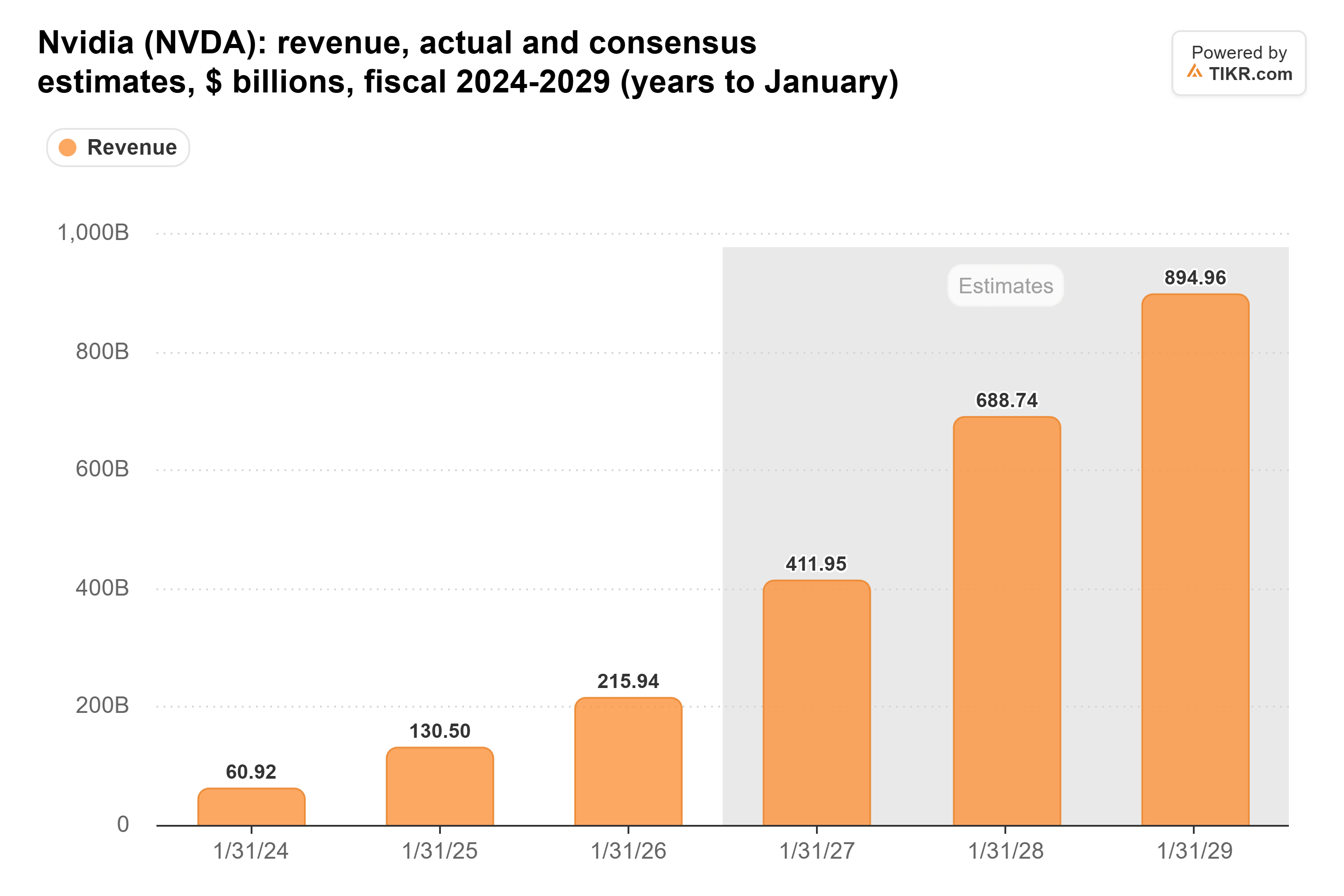
Take Lebenthal’s $140 billion out, and fiscal 2028 revenue would still come in about a third above the $412 billion analysts expect for this fiscal year.
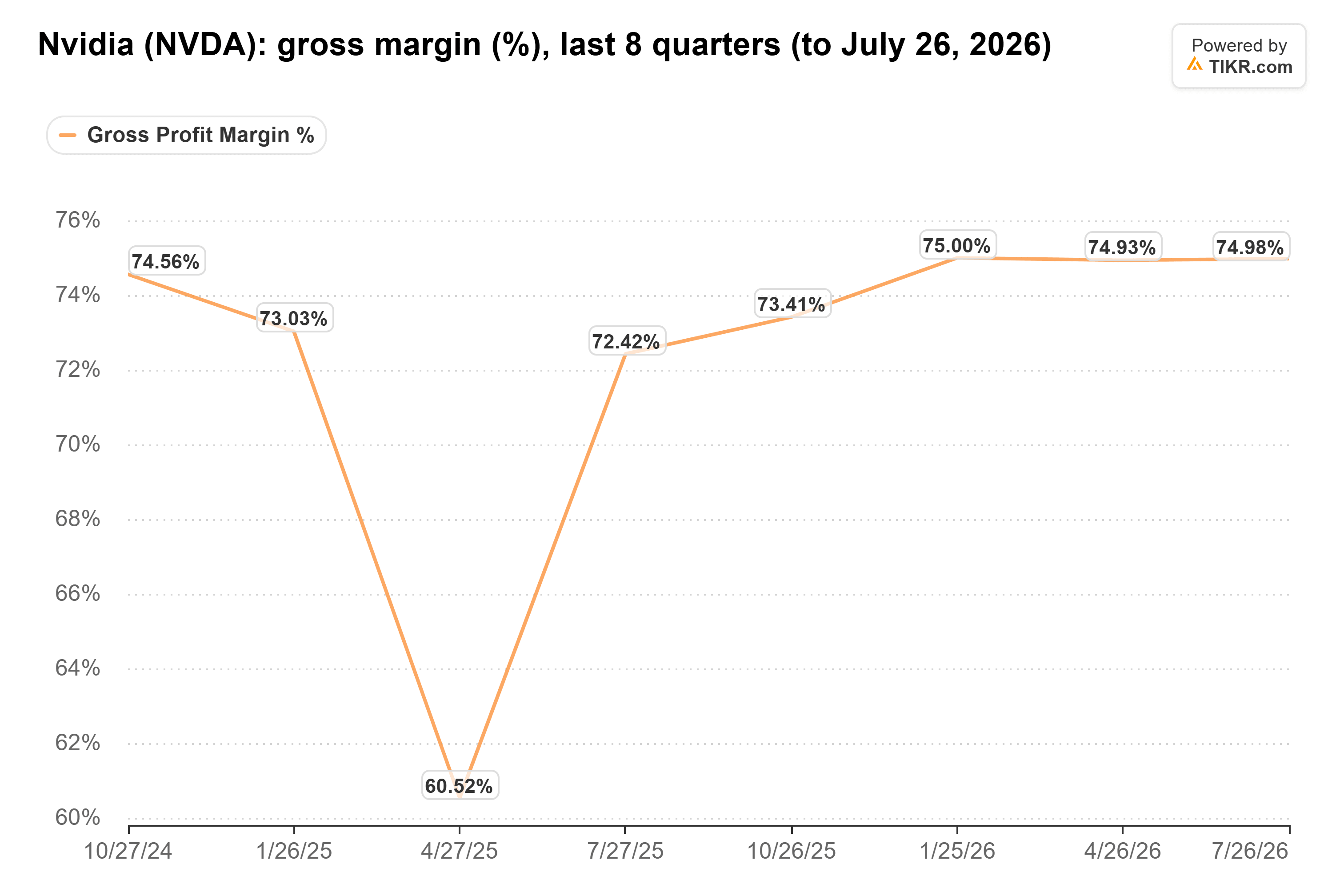
The last time Washington cut off a chip outright, Nvidia took one bad quarter. Its gross margin fell to 60.5% in the quarter ended April 27, 2025, when it took a $4.5 billion charge on H20 chips it could no longer ship to China, then recovered to 72.4% the next quarter:
The nukes premise isn’t policy yet
Calacanis builds his case on one big if: “if you believe Super Intelligence could wipe out humanity and is analogous to nuclear weapons, then it seems extremely practical, doesn’t it?”
So far, Treasury Secretary Scott Bessent has said Trump made it very clear China gets no Nvidia chips above the H100. No official has said a GPU needs a fingerprint to switch on.
A webcam and a fingerprint reader on every Rubin rack still look like a stretch to me, but tighter checks on who buys Nvidia’s chips outside the US look all but certain.
At 13x, the stock is braced for worse
Investors have already marked Nvidia down for a lot more than paperwork. The stock trades at 13x forward earnings, its lowest in five years, against a five-year average of 36x and a peak of 70x in May 2023:
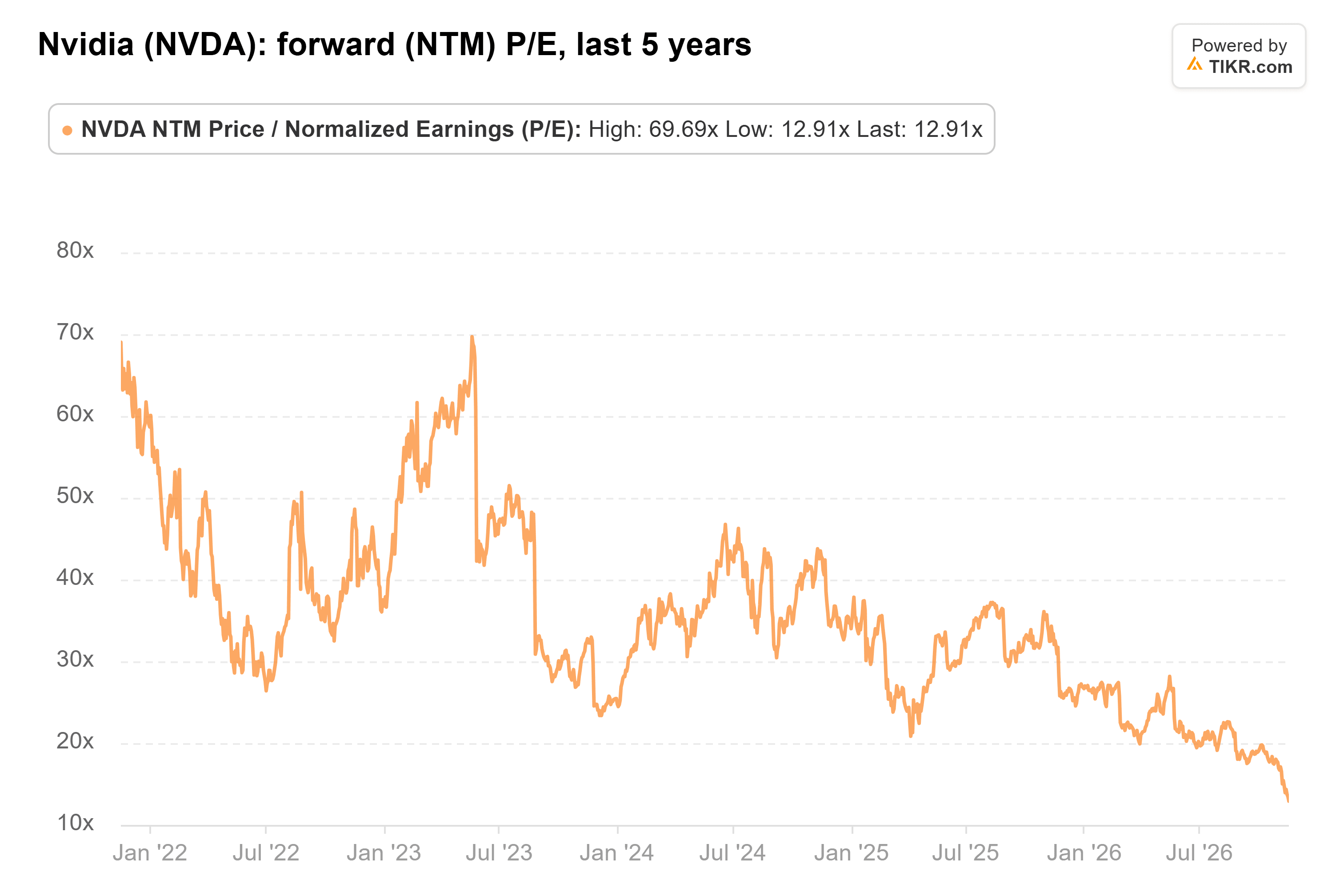
That multiple prices in something closer to Lebenthal’s worst case than to a few extra checks on overseas buyers. The way I see it, the guardrails are a cost Nvidia can carry, and at this price the market is more likely underrating its growth than overrating it.
Tonight’s call is the first test, against guidance of $108.0 billion of revenue, plus or minus 2%. Of course, if Washington ever adopts Calacanis’s nuclear-weapons framing, the controls could get much tighter than buyer checks.
So what is Nvidia stock actually worth?
TIKR lets you forecast the future price of any stock in less than a minute. Just enter a few assumptions into TIKR’s valuation model and see what Nvidia could be worth. Start from Wall Street consensus estimates, or adjust the inputs to reflect your own view of the business. It’s free to use.
Disclaimer:
Please note that the articles on TIKR are not intended to serve as investment or financial advice from TIKR or our content team, nor are they recommendations to buy or sell any stocks. We create our content based on TIKR Terminal’s investment data and analysts’ estimates. Our analysis might not include recent company news or important updates. TIKR has no position in any of the stocks mentioned. Thank you for reading, and happy investing!