Key Takeaways
- Pfizer CEO Albert Bourla wants AI to cut the time to a drug’s first human study from four years to two, then halve the time from there to approval.
- Faster lab work pays off in the 2030s, since nothing Pfizer starts now reaches human trials before generic Eliquis arrives in 2028.
- If Eli Lilly CEO Dave Ricks is right that human trials set the pace, IQVIA gains more than Charles River.
- Analysts expect Pfizer’s revenue to fall to $55.4 billion in 2028, so the next test is its 2027 guidance, likely in December.
Pfizer (PFE) CEO Albert Bourla just put a number on what he expects AI to do for drug development. In a post on X on Nov. 19, he wrote:
“I see AI as a structural transformation for R&D. Goal is to halve the time to first human study, from four years to two, then halve it again to approval.”
That’s a big promise. Shares closed at $27.54 that day, down 1.85%, and slipped to $27.40 on Nov. 20. The post comes about a week after Eli Lilly (LLY) CEO Dave Ricks argued that human trials set the pace of drug development. It also matters to the companies Pfizer pays along the way: Charles River Laboratories (CRL) sells safety testing in the four years before a first human study, and IQVIA (IQV) runs the trials after.
Two years off a decade-plus road
Saving two years is a real gain, but the lab is the shorter part of the trip. Bourla said at an Atlantic Council event in September that developing a medicine takes about 10 years on average, four or five of them preclinical. Ricks puts the human stage alone at “about 10 years in the clinic, a little less right now,” as he said on the Cheeky Pint podcast in November 2025. On either count, the first goal trims the smaller piece. The big savings would come from halving the time from first human study to approval, and Ricks doubts that part. Responding to Anthropic CEO Dario Amodei’s AI cure timeline, he wrote on X that “randomized human proof is the long pole in the tent.”
TIKR tracks 28 analysts on Pfizer. How many say “Buy”?
See the full breakdown of Buy, Hold, and Sell ratings on Pfizer, along with Wall Street’s revenue and earnings estimates, all in one place. More than 500,000 investors use TIKR to research stocks like this one. See Pfizer’s Analyst Ratings
None of this helps with 2028
Pfizer’s real problem comes much sooner. Generic versions of Eliquis can launch in the U.S. on April 1, 2028, and management puts the revenue at risk from patent losses through 2030 at $14 billion to $15 billion. Analysts expect revenue to fall from $62.6 billion in fiscal 2025 to $55.4 billion in fiscal 2028:
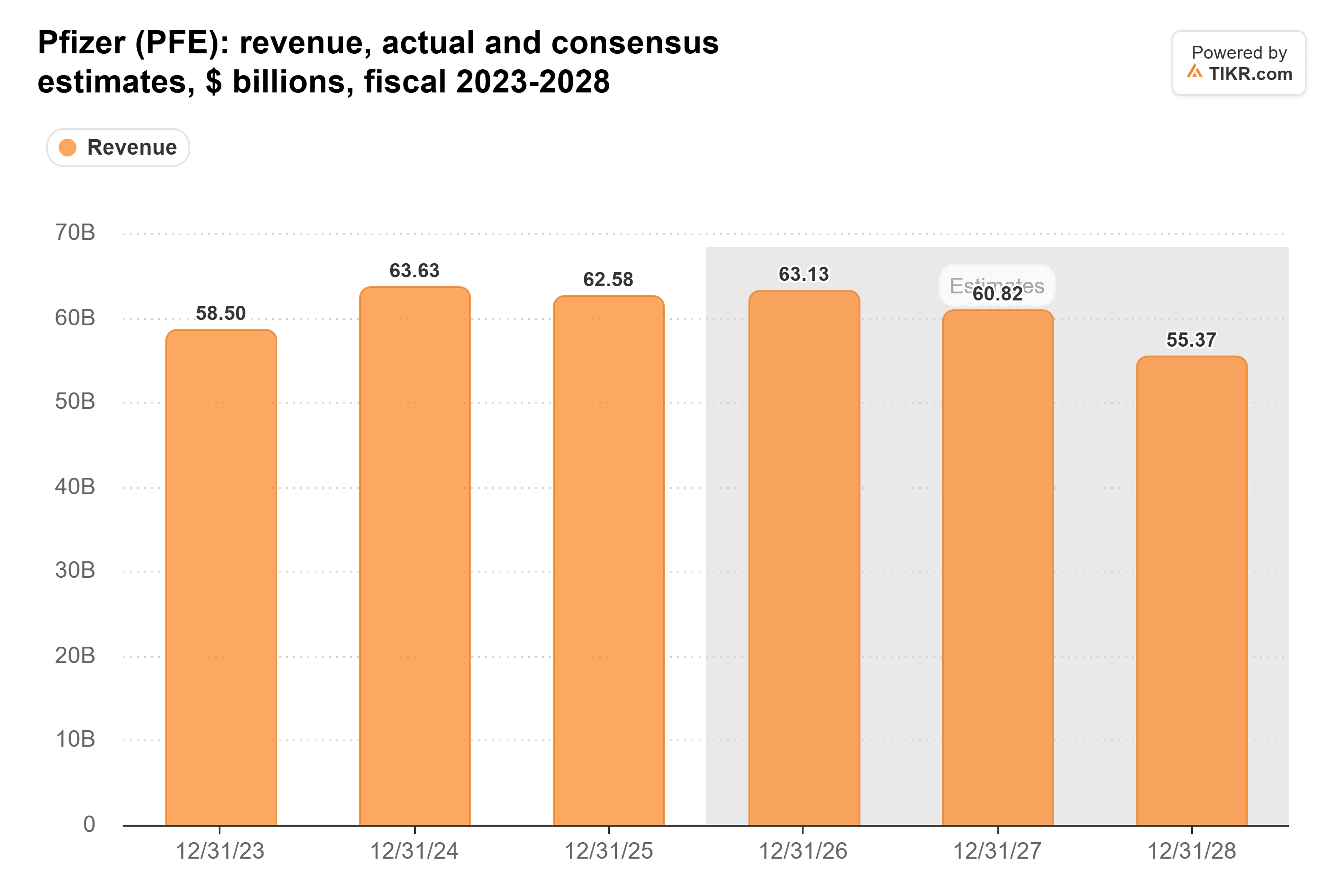
Nothing in Bourla’s post should move those estimates, because none of the years on this chart depend on it. Even on his timeline, a molecule Pfizer starts in November 2026 wouldn’t reach its first human study until late 2028, months after generic Eliquis arrives.
So the drugs that fill the gap are already on the market or in human trials. Launched and acquired products grew 32% operationally in the third quarter to $3.8 billion, and Pfizer is targeting a first approval in 2028 for berobenatide, its experimental monthly obesity shot. Management aims for risk-adjusted high single-digit revenue growth from the end of 2028 through the end of 2033.
Cheaper shots on goal
Where faster lab work helps sooner is cost per drug. Pfizer has spent more than $10 billion on R&D in each of the past five years:

Most of that money goes to human trials. Bourla said at the same September event that about 80% of a drug’s development cost comes in the last three or four years of big Phase 3 studies. Adjusted R&D rose 11% operationally in the first quarter and 12% in the second as spending on oncology and obesity candidates increased, then 18% in the third. In November, Pfizer raised its 2026 R&D outlook to $10.8 billion to $11.8 billion. The more likely payoff is more candidates for the same budget and earlier answers on which ones to drop. Don’t expect the R&D line itself to shrink much.
Good news for IQVIA, a question for Charles River
Charles River could go either way. Organic revenue in its Discovery and Safety Assessment segment grew 5.9% in the third quarter, driven by more regulated safety studies. If Pfizer and its peers cut two years from the lab stage, will Charles River bill fewer studies per drug, or test more drugs?
IQVIA’s question is easier. Its R&D Solutions segment booked $3.2 billion of net new business in the third quarter, up 15%, for a book-to-bill of 1.2x. If Ricks is right, more molecules reaching humans sooner means more trials to run, and IQVIA can say how much of that it expects at its Investor Day on Dec. 1.
A 2030s payoff
Bourla’s goal still deserves weight: two years saved on every early program, at a lower cost, adds up over a decade of drug development. Pfizer’s next few years, though, depend on drugs already in human trials and on the 2027 guidance it will likely give in mid-December. CFO Cecile Guegan said on the third-quarter call that it will reflect two products coming under Medicare price setting.
Of course, the second half of Bourla’s goal would change all of this if Pfizer can pull it off. Halving the time in the clinic is the claim to watch, and so is the number of Pfizer programs entering human studies each year.
So what is Pfizer stock actually worth?
TIKR lets you forecast the future price of any stock in less than a minute. Just enter a few assumptions into TIKR’s valuation model and see what Pfizer could be worth. Start from Wall Street consensus estimates, or adjust the inputs to reflect your own view of the business. It’s free to use.
Disclaimer:
Please note that the articles on TIKR are not intended to serve as investment or financial advice from TIKR or our content team, nor are they recommendations to buy or sell any stocks. We create our content based on TIKR Terminal’s investment data and analysts’ estimates. Our analysis might not include recent company news or important updates. TIKR has no position in any of the stocks mentioned. Thank you for reading, and happy investing!