Key Takeaways
- Pfizer yields 6.1% after raising its 2026 revenue guidance on Nov. 3, and Kinder Morgan yields 3.8% after reporting a record $14.4 billion project backlog on Oct. 21.
- $10,000 invested today pays $610 a year in Pfizer and $380 a year in Kinder Morgan.
- Kinder Morgan’s distributable cash flow covers its dividend 2.1x, while Pfizer paid out 89% of its free cash flow over the twelve months to June 2026 and more than all of it in fiscal 2025.
- Analysts expect Pfizer’s revenue to fall to $55.4 billion by fiscal 2028 as key drugs lose exclusivity, which is the main test for a 10-year owner.
Pfizer (PFE) raised its 2026 revenue guidance by $1.5 billion at the midpoint on Nov. 3, and its stock still yields 6.1%. That big yield comes with a patent cliff ahead.
Kinder Morgan (KMI) yields a smaller 3.8%, but its Oct. 21 results showed a record $14.4 billion backlog of expansion projects. For anyone buying a dividend to hold for a decade, the choice is a bigger check from a drugmaker heading into patent expirations, or a smaller one from a pipeline with years of projects ahead.
So if I could hold only one for the next 10 years, which would it be?
| Metric | Pfizer (PFE) | Kinder Morgan (KMI) |
|---|---|---|
| Dividend yield | 6.1% | 3.8% |
| Annual dividend | $1.72 a share | $1.19 a share |
| Dividend growth, fiscal 2020-2025 | 2.5% a year | 2.2% a year |
| Coverage, last reported | 89% cash dividend payout ratio (TTM to June 28, 2026) | 2.1x distributable cash flow coverage (fiscal 2025) |
| Net debt/EBITDA (LTM) | 1.9x | 4.1x |
| Interest coverage (LTM) | 7.0x | 3.0x |
6 safe dividend stocks paying retirees 6%+ yields
There are over 100 stocks paying 6%+ annual dividends today.
But after an extensive investment review leveraging TIKR’s proprietary data, we now believe only six of them are truly safe for retirees.
They’re all yours as part of our new investment report. Learn more about how to get access right here.
Pfizer’s big check has a thin cushion
Pfizer’s third-quarter revenue of $16.6 billion was roughly flat year over year operationally. Launched and acquired products grew 32%, while Paxlovid fell 63%.
The dividend has less room. Pfizer’s cash dividend payout ratio was a thin 89% over the twelve months to June 28, 2026, and dividends paid topped free cash flow in fiscal 2023 and fiscal 2025:

Management’s stated priority is “maintaining and, over the long term, growing our dividend.” Pfizer kept that priority unchanged on its third-quarter call, the same day it named Cecile Guegan permanent CFO. CEO Albert Bourla went further on the second-quarter call in August: “We feel extremely confident that … even the most stretched scenarios that we are running, we will be able to maintain our dividend.” That’s a firm commitment to the check, with raises as a long-term aim.
Here’s the risk: Ibrance, Xtandi and Eliquis outside the US face loss of exclusivity, and two Pfizer drugs get Medicare’s negotiated prices in 2027.
Kinder Morgan has cash to spare
Kinder Morgan’s check is smaller, but there’s far more cash behind it. Its distributable cash flow coverage was a comfortable 2.1x in fiscal 2025, with $2.42 a share against $1.17 of dividends. Coverage has held above 1.8x in every fiscal year since 2016:

That record starts after a cut, though. Kinder Morgan paid $1.60 a share in fiscal 2015 and $0.50 in fiscal 2016, and fiscal 2025’s $1.17 is still below the old level.
The business is growing now. Third-quarter adjusted EBITDA rose 9% to $2.18 billion. On Oct. 21, the board declared $0.2975 a share, or $1.19 annualized after a 2% raise this year. And Executive Chairman Richard Kinder bought 500,000 shares at an average of $29.99 on Nov. 6, about $15 million, according to a Form 4.
The risk is debt. Net debt is 4.1x EBITDA, against Pfizer’s 1.9x, and interest coverage is 3.0x. CEO Kimberly Dang also expects capital spending of about $4 billion a year for the next few years.
So which dividend wins?
If I can hold only one dividend stock for the next 10 years, it’s Pfizer. That bigger check is hard to pass up. Put $10,000 in Pfizer at its 6.1% yield, and at its 2.5% five-year growth rate it pays about $6,835 over the decade, against about $4,197 for Kinder Morgan at 2.2% a year. That’s about $2,638 more, and at those rates Kinder Morgan’s income never catches up. Even if Pfizer never raised again, $610 a year comes to $6,100 over 10 years, still about $1,900 ahead.
So the question for a 10-year owner is whether Pfizer can hold the check through its exclusivity losses. Analysts expect revenue to fall from $62.6 billion in fiscal 2025 to $55.4 billion in fiscal 2028:
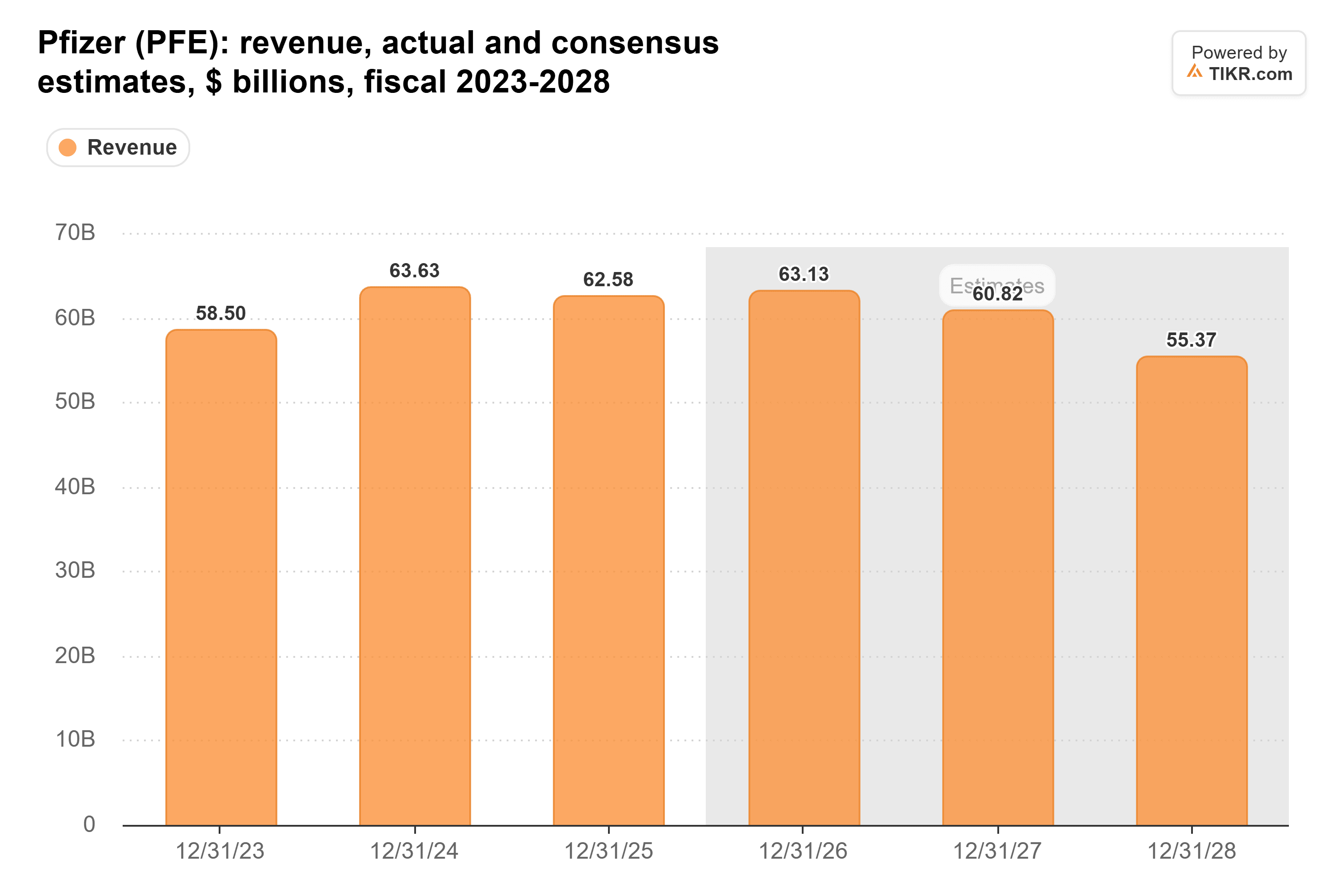
Pfizer has ways to bridge that. It expects to deliver nearly all of $7.2 billion in net cost savings by the end of 2026, plus another $2.5 billion from 2027 to 2029. On Nov. 12, Blackstone-managed funds agreed to cover up to $1.5 billion of development costs through 2028 for berobenatide, its experimental monthly obesity drug. Its lighter debt leaves room for a lean year, and management aims for risk-adjusted high-single-digit annual revenue growth from the end of 2028 through 2033.
This isn’t to say Kinder Morgan’s dividend isn’t safe. It’s covered about twice over, the business is growing, and its backlog lines up years of projects. It’s just that over 10 years, Pfizer pays far more, and its balance sheet gives it room to keep paying while it rebuilds.
Of course, Pfizer’s 2027 guidance will show how hard the exclusivity losses and Medicare pricing hit. If free cash flow keeps falling short of the dividend after that, my answer would change.
Forget Pfizer: 6 safe 6%+ dividend yields you can buy right now
Dividends can hold the key to enormous wealth. But only if you buy the right ones.
Picking the right high-yield dividend stock can be the difference between a dream retirement…and scraping by every month, waiting for the next Social Security check to clear.
We’ve identified six stocks yielding 6%+ that we believe every retiree should know about right now. (And Pfizer isn’t one of them.)
Disclaimer:
Please note that the articles on TIKR are not intended to serve as investment or financial advice from TIKR or our content team, nor are they recommendations to buy or sell any stocks. We create our content based on TIKR Terminal’s investment data and analysts’ estimates. Our analysis might not include recent company news or important updates. TIKR has no position in any of the stocks mentioned. Thank you for reading, and happy investing!