
Key Takeaways
- Palo Alto Networks reports fiscal first-quarter results after the close on Nov. 18, with its stock 29% below its 52-week high and guidance calling for revenue growth of 33% to 34%.
- Much of that growth comes from the CyberArk and Chronosphere deals, and on a pro forma basis the fiscal 2027 revenue guide is about 15% growth.
- The real tests are organic Next-Generation Security ARR and an operating margin that has fallen since the deals closed, with Fortinet, CrowdStrike and Zscaler all tied to the read.
- At 76x forward earnings against a five-year average of 57x, the stock isn’t cheap enough to buy on the 33% alone.
Palo Alto Networks (PANW) reports its fiscal first quarter after the close on Wednesday, Nov. 18, with the stock 29% below its 52-week high after a 3% slide on Tuesday. It’s the security group’s biggest report since Fortinet (FTNT) rattled the sector in late October, and it comes two weeks ahead of CrowdStrike (CRWD) on Dec. 1 and Zscaler (ZS) on Dec. 2.
Joe Terranova laid out the bar the bulls are counting on in Monday’s episode of CNBC’s Halftime Report: “You’re going to see 33 plus percent revenue growth.” The stock worried him more than the quarter did: “I think you’re going to get the beat. It’s the reaction I’m worried about.”
He has good reason to worry. That 33% is already in management’s guidance, and the deals Palo Alto closed over the past year do much of the work.
TIKR tracks 55 analysts on Palo Alto Networks. How many say “Buy”?
See the full breakdown of Buy, Hold, and Sell ratings on Palo Alto Networks, along with Wall Street’s revenue and earnings estimates, all in one place. More than 500,000 investors use TIKR to research stocks like this one. See Palo Alto Networks’ Analyst Ratings
The 33% is mostly bought
Guidance calls for first-quarter revenue of $3.30 billion to $3.31 billion, up 33% to 34%. Palo Alto spent $24.4 billion on acquisitions in fiscal 2026, mostly CyberArk and Chronosphere, and neither one was in last year’s first quarter. On the company’s own pro forma basis, fiscal 2026 revenue grew 17% to $12.3 billion. Measured against that base, the fiscal 2027 revenue guide is about 15% growth.
Analysts have already built the step-down into their numbers. Consensus has revenue up 23% to $14.2 billion in fiscal 2027, then up 14% to $16.2 billion in fiscal 2028.
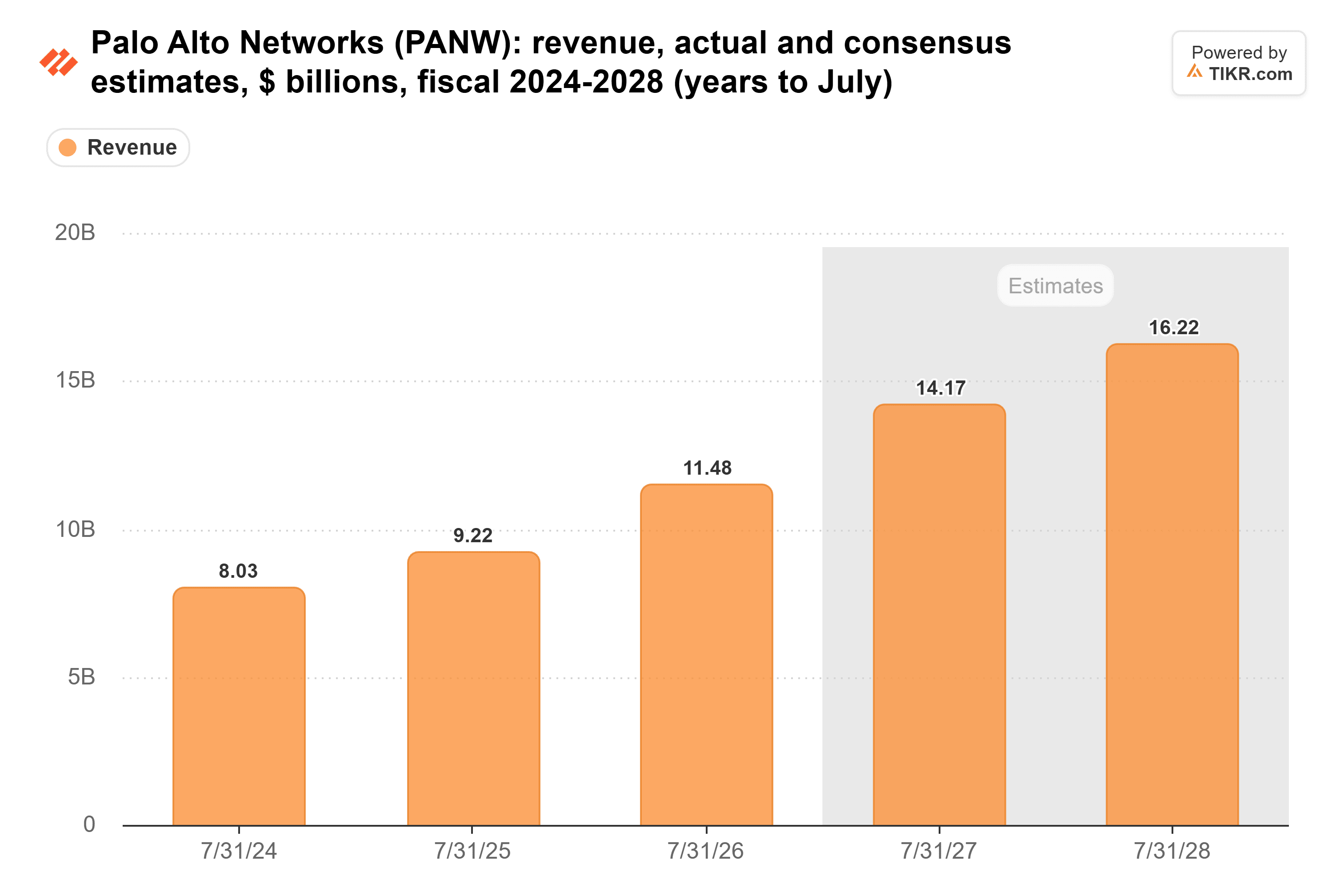
So if Palo Alto hits 33% on Wednesday, all it really shows is that the deals closed.
Organic growth has to show up
On Tuesday’s RiskReversal Pod, Matthew Hedberg, head of global TIMT research at RBC Capital Markets, put Palo Alto among the “five or six names that I cover where there’s real acceleration” from AI. Next-Generation Security ARR will show whether he’s right. Management guides it to $9.54 billion to $9.56 billion, up from $9.10 billion at July 31, and organic NGS ARR grew 28% in both the second and third quarters of fiscal 2026. The fourth quarter, though, got a nine-figure lift from a large AI customer moving onto Chronosphere, and management expects only the tail end of that move this quarter. A result above the top of the range, with organic growth still near 28%, would back Hedberg up.
Firewalls offer a second read, though product revenue now also includes some CyberArk software licenses. Fortinet’s product revenue growth slowed to 37% in the third quarter from 52%, and its shares closed down about 20% the next day, even with billings up 29%. Palo Alto’s product revenue grew 28.6% last quarter, and investors will want that pace to hold.
CrowdStrike has set a high bar in security operations. Its net new ARR rose 51% to a record $333 million in the quarter to July 31. Palo Alto’s XSIAM finished its fiscal year with ARR up 70% to over $700 million. If that pace holds, Palo Alto’s pitch to put everything on one platform is winning spending that CrowdStrike also wants.
Zscaler has even more riding on a single line of the report. Palo Alto’s SASE ARR grew 40% to $1.6 billion in its fiscal third quarter. Excluding its Red Canary deal, Zscaler’s ARR grew 20% to $3.63 billion as of July 31, and it guides 16.6% to 17.4% ARR growth for fiscal 2027. If Palo Alto’s SASE growth stays near 40%, Zscaler’s investors will want to know on Dec. 2 whether that guide is caution or lost share.
Margins have to hold, too
Palo Alto’s operating margin, as TIKR measures it, has fallen since CyberArk closed in February. It went from 15.5% in the quarter to January 2026 to below zero in the April quarter and 5.4% in the July quarter:
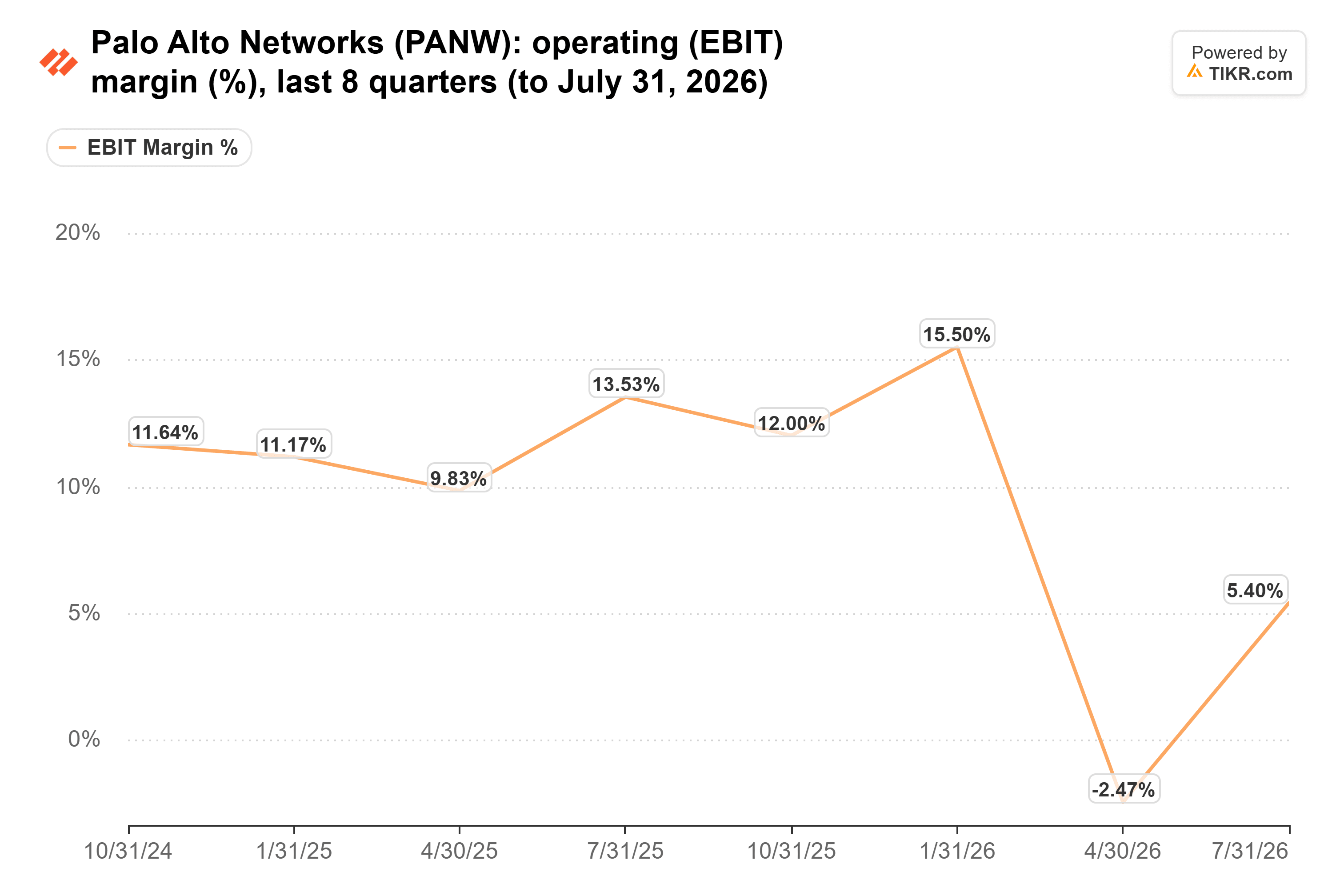
The acquired companies added $930 million of revenue in fiscal 2026 and an operating loss of $797 million, after amortization, stock pay and severance. On management’s adjusted basis, the fourth-quarter operating margin was 29.6%, against 30.3% a year earlier, and the fiscal 2027 guide is 29.5%. Management expects cloud hosting costs to grow faster than revenue this year, so an adjusted margin below 29% would be a bad sign. Cash has to keep up as well: the guide for adjusted free cash flow margin is 38.0% for fiscal 2027, after 38.4% in fiscal 2026.
At 76x, the drop hasn’t made it cheap
Even after the selloff, Palo Alto trades at 76x forward earnings. That compares with a five-year average of 57x and a high of 101x in August:
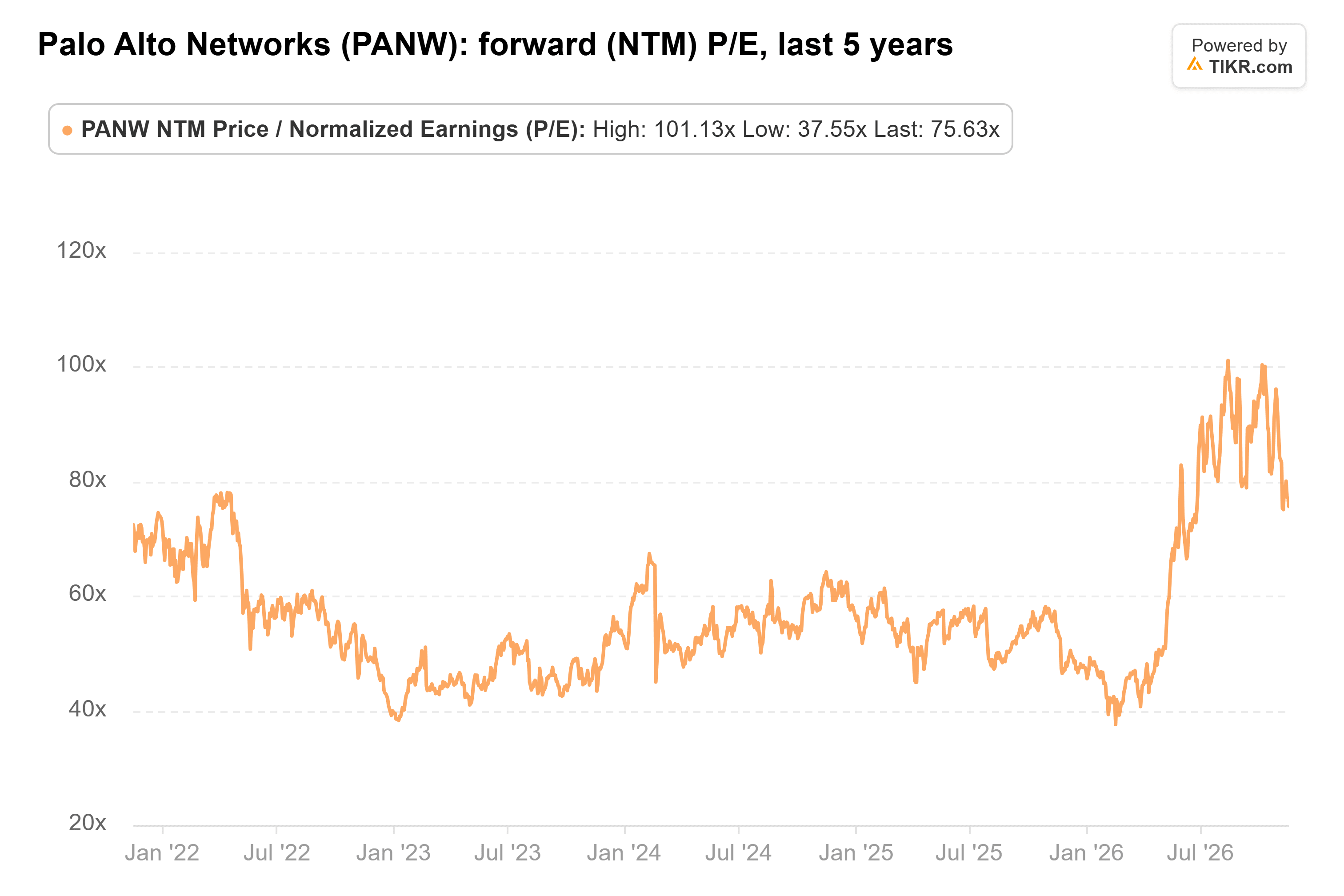
Per-share profit is also growing much more slowly than revenue. Guidance calls for fiscal 2027 adjusted EPS of $4.16 to $4.19, up 8% to 9%, because CyberArk was paid for largely in stock. Paying 76x for single-digit EPS growth only makes sense if organic growth and margins pick up from here.
So yes, Palo Alto has to deliver 33%, and the deals make that the easy part. The selloff hasn’t made the stock a bargain yet. The drop starts to look like a buying opportunity only if organic NGS ARR beats the guide and the adjusted operating margin holds at 29.5% or better.
The full-year guide may still move the stock more than the quarter does. A raise to the revenue or NGS ARR outlook would make 76x a lot easier to defend.
So what is Palo Alto Networks stock actually worth?
TIKR lets you forecast the future price of any stock in less than a minute. Just enter a few assumptions into TIKR’s valuation model and see what Palo Alto Networks could be worth. Start from Wall Street consensus estimates, or adjust the inputs to reflect your own view of the business. It’s free to use.
Value Palo Alto Networks for free
Disclaimer:
Please note that the articles on TIKR are not intended to serve as investment or financial advice from TIKR or our content team, nor are they recommendations to buy or sell any stocks. We create our content based on TIKR Terminal’s investment data and analysts’ estimates. Our analysis might not include recent company news or important updates. TIKR has no position in any of the stocks mentioned. Thank you for reading, and happy investing!