Key Stats for Oracle Stock
- Current Price: $148.56
- Target Price (Mid): ~$489
- Street Target: ~$238
- Potential Total Return: ~229%
- Annualized IRR: ~29% / year
Now Live: Discover how much upside your favorite stocks could have using TIKR’s new Valuation Model (It’s free) >>>
What Happened?
Oracle Corporation (ORCL) just did something unusual for a company whose stock has lost more than half its value. It posted the strongest growth in its history and watched the credit market react with open doubt. Roughly $18 billion of leveraged loans tied to Project Jupiter, the New Mexico data center Oracle plans to lease for its AI cloud, were quoted between 89 and 91 cents on the dollar by syndicate banks including Santander and Jefferies, according to a Financial Times report carried by Reuters. This is project-finance debt raised to build the campus, not Oracle corporate bonds, but Oracle is the tenant whose economics stand behind it. Healthy project loans trade near par, so a discount this wide is the market demanding a bigger cushion.
On September 10, Oracle reported fiscal first-quarter revenue of $19.3 billion, up 30%, with cloud infrastructure up 121%. The business is accelerating, and the credit market is flinching at the same moment, and which one the fundamentals support is what the numbers below decide.
The Quarter the Backlog Finally Converted
Oracle’s story has been a promise: a backlog piling up faster than anyone could model, with only part of it converting into revenue. Q1 pushed that conversion into a higher gear. Cloud infrastructure revenue reached $7.4 billion, up 121% year over year, after 93% growth in Q4, and total revenue grew sequentially in a fiscal Q1 for the first time.
The bottom line beat across the board, per TIKR’s Beats and Misses data. Adjusted EPS came in at $1.92 against a $1.74 estimate, a beat of more than 10%. EBITDA of $11.3 billion beat by 6%, and net income of $5.8 billion topped estimates by 12%. Remaining performance obligations, the contracted work Oracle has signed but not yet delivered, rose to $664 billion, up $209 billion year over year, and management now expects roughly half of it to convert into sales over the next 36 months. Oracle delivered 850 megawatts of new capacity and more than 300,000 GPUs in the quarter, almost triple its Q4 pace, while fleet utilization held at 97.9%.
See historical and forward estimates for Oracle stock (It’s free!) >>>
The Cash Gap the Credit Market Is Pricing
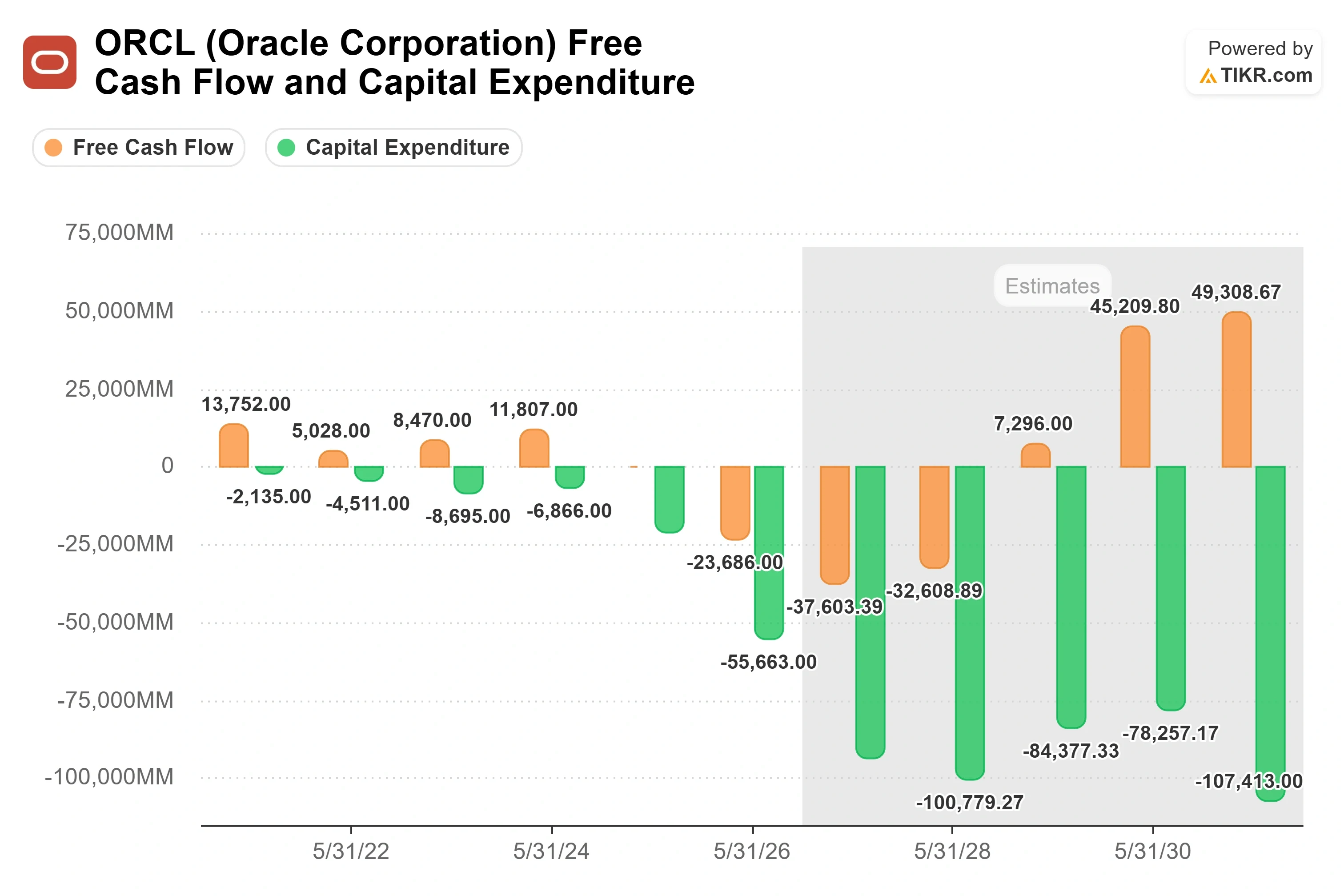
Oracle spent $28.5 billion on capital expenditures in Q1, which pushed free cash flow to negative $5.4 billion, against negative $362 million a year earlier. Net debt stands near $132 billion on TIKR’s data. During the quarter, Oracle completed a $20 billion at-the-market equity sale, a dilutive step after two quarters of signaling that customer prepayments would carry most of the funding load.
The debt is secured through a special-purpose structure, and it does not mean the project has failed. It does mean buyers want more protection. Project Jupiter is reported to be at least seven months behind on permitting, power, and local opposition in Doña Ana County, and S&P cut Oracle to BBB- in July, one notch above high yield. On an $18 billion facility, a 9 to 11 point discount is roughly $1.6 to $2 billion of loss the market is already penciling in.
Management addressed the site directly. “In terms of construction, data center is definitely on track,” co-CEO Clay Magouyrk said of New Mexico, adding that “neither of these sites will have any impact into our FY ’27 revenue or earnings guidance.” His point matters because it separates the financing headline from the delivery schedule, on which the revenue actually depends. He also pushed back on the depreciation fear that shadows the funding story: GPUs that came up for renewal in Q1, most of them four years or older, were renewed or resold at a 20% premium to prior contracts. If aging AI hardware holds pricing power like that, the useful-life bear case weakens.
Roughly $300 billion of the $664 billion backlog is tied to OpenAI, whose own projections, cited by the Financial Times, point to cumulative negative free cash flow near $278 billion from 2026 through 2030. Oracle’s economics depend on delivering for a customer spending faster than it earns. Magouyrk argued on the call that Oracle’s own capital should be uncoupled from its growth, since prepay and bring-your-own-hardware deals move the cash burden to suppliers and customers. That model is new, and the loan discount is the market asking to see it work first.
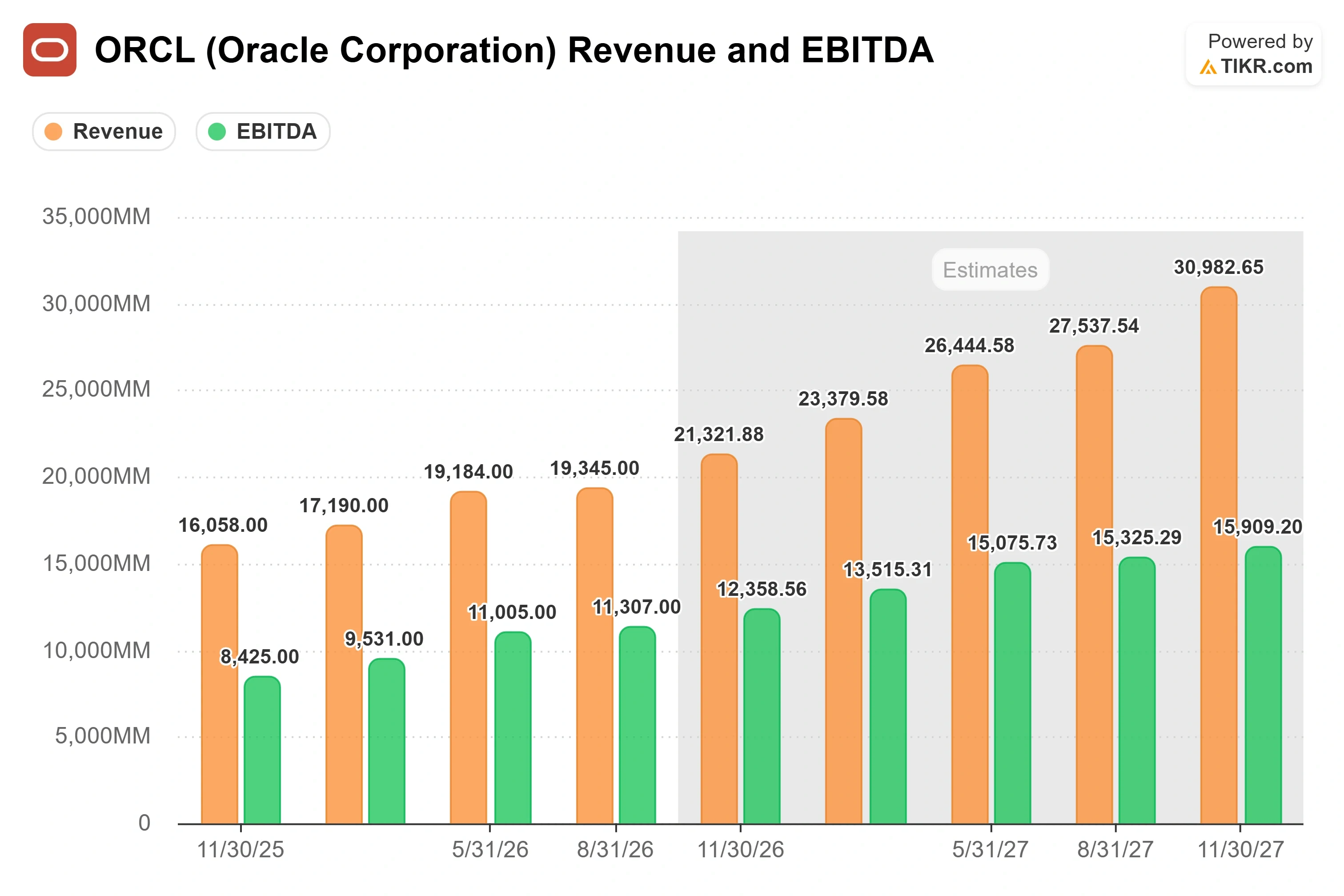
Against that risk sits a reset valuation. Oracle trades at 17.5x NTM P/E and 10.4x NTM EV/EBITDA, per TIKR’s Competitors page. On forward earnings, Salesforce trades at 15.9x and ServiceNow at 30.2x, so Oracle sits near the low end of that pair while growing faster than either. On the cash-flow multiple, Salesforce is 11.9x EV/EBITDA and ServiceNow 21.0x, both above Oracle’s 10.4x. Applying a lower multiple to the faster grower is only rational if the funding risk is severe, which is the question the model has to answer.
See how Oracle performs against its peers in TIKR (It’s free!) >>>
TIKR Advanced Model Analysis
- Current Price: $148.56
- Target Price (Mid): ~$489
- Potential Total Return: ~229%
- Annualized IRR: ~29% / year
See analysts’ growth forecasts and price targets for Oracle stock (It’s free!) >>>
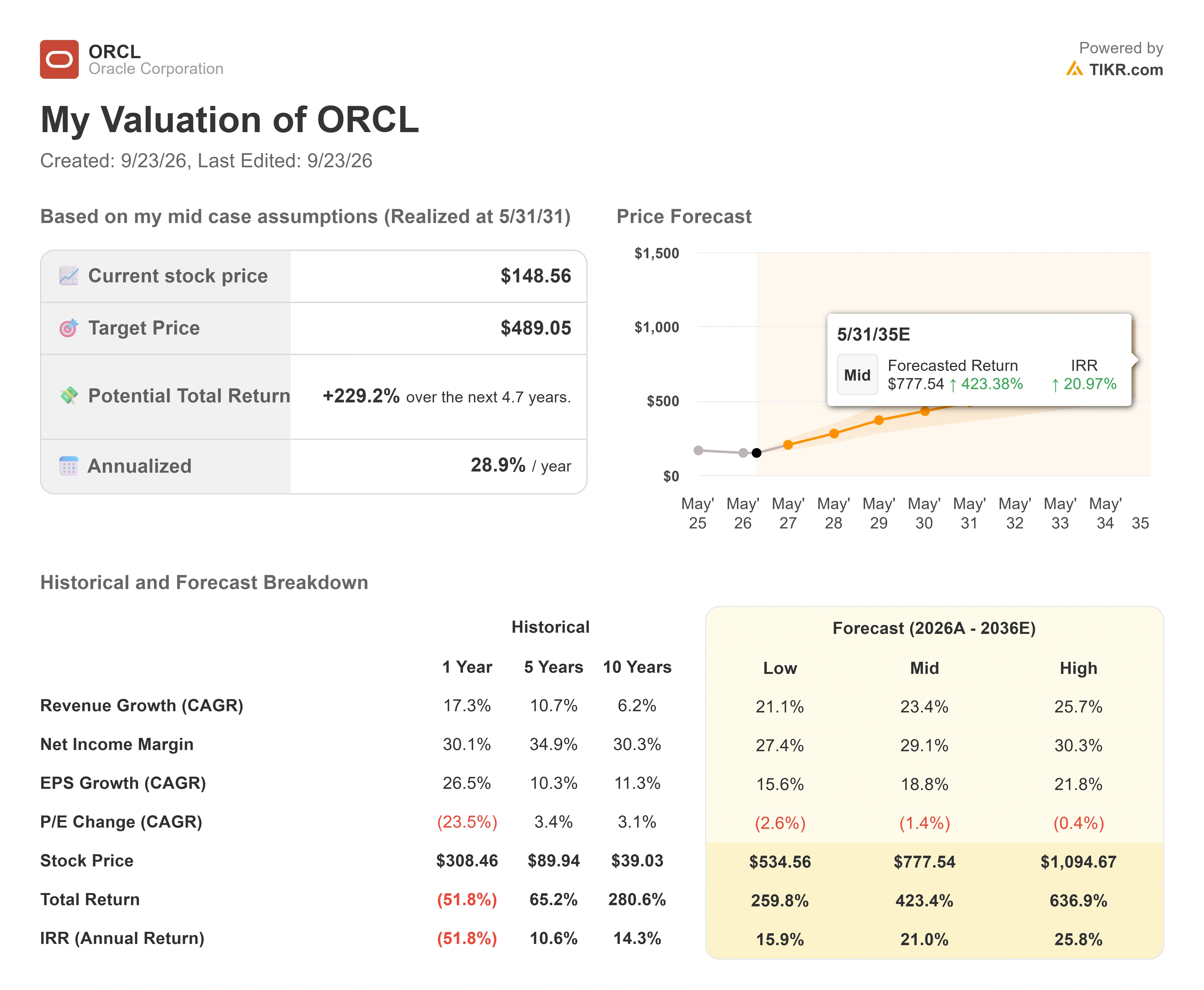
The TIKR Valuation Model uses the mid case here, the middle of the three scenarios, rather than the ceiling. It points to a fair value near $489 over roughly the next 4.7 years, a total return around 229%, and an annualized return near 29%. That sits far above the Street mean of about $238, so the model is making a more aggressive call than consensus and leans on the backlog converting on schedule.
Two revenue drivers carry it: cloud infrastructure, where the mid case assumes a revenue CAGR around 23% as RPO converts, and the multicloud database business, which grew 353% year over year in Q1. The margin driver is operating leverage, with the non-GAAP operating margin held near 42% and a modeled net income margin around 29%. The primary risk is the one the loan discount made visible: if a concentrated customer pushes its capacity drawdown out by a year or more, free cash flow recovery slips, and the multiple stays compressed. The upside is the buildout converting as contracted and the stock rerating toward its growth.
Conclusion
The next real test is whether the Project Jupiter loans climb back toward par or slide further, because that price is the cleanest live read on how the market rates Oracle’s funding chain. Watch it into Oracle’s October Investor Day, where management has promised more details on the capex path and the timeline to positive free cash flow. If the loans recover and Oracle attaches a credible date to that turn, the gap between the business and the stock starts to close. If the discount deepens and the cash deficit widens with no timeline, the fundamentals will keep accelerating into a stock the market refuses to trust. Oracle is the rare company where the income statement and the credit market are telling two different stories, and the reader’s job is to decide which one gets proven right first.
See what stocks billionaire investors are buying so you can follow the smart money with TIKR.
Should You Invest in Oracle?
The only way to really know is to look at the numbers yourself. TIKR gives you free access to the same institutional-quality financial data that professional analysts use to answer exactly that question.
Pull up Oracle, and you’ll see years of historical financials, what Wall Street analysts expect for revenue and earnings in the quarters ahead, how valuation multiples have moved over time, and whether price targets are trending up or down.
You can build a free watchlist to track Oracle alongside every other stock on your radar. No credit card required. Just the data you need to decide for yourself.
Looking for New Opportunities?
- See what stocks billionaire investors are buying so you can follow the smart money.
- Analyze stocks in as little as 5 minutes with TIKR’s all-in-one, easy-to-use platform.
- The more rocks you overturn… the more opportunities you’ll uncover. Search 100K+ global stocks, global top investor holdings, and more with TIKR.
Disclaimer:
Please note that the articles on TIKR are not intended to serve as investment or financial advice from TIKR or our content team, nor are they recommendations to buy or sell any stocks. We create our content based on TIKR Terminal’s investment data and analysts’ estimates. Our analysis might not include recent company news or important updates. TIKR has no position in any stocks mentioned. Thank you for reading, and happy investing!