Key Stats for Shopify Stock
- Current Price: $147.74
- Model Entry Price: $137.92
- Target Price (Mid): ~$372
- Street Target: ~$173
- Potential Total Return: ~170% from model entry
- Annualized IRR: ~26% / year
Now Live: Discover how much upside your favorite stocks could have using TIKR’s new Valuation Model (It’s free) >>>
What Happened?
Shopify (SHOP) closed up 7.12% on September 22 at $147.74, extending a two-day rally that began when CEO Tobi Lütke announced Meta’s new Muse AI agent will complete purchases across Shopify’s merchant network through Shop Pay. Meta had jumped more than 11% the day before on the Muse launch itself, which fits the picture: Meta built the shopper-facing agent, and Shopify supplied the checkout it runs on. What made the deal land for Shopify investors was the contrast with Amazon, which had just blocked the same agent from its marketplace.
In one week, the two biggest fears hanging over this stock, that AI would disintermediate Shopify and that it could lose the default checkout, were answered by a rival choosing to build on Shopify’s rails rather than around them. Shares have rebounded hard off a brutal year, yet the stock still trades near 93 times trailing earnings, and investors are split on whether agentic commerce is real revenue or expensive optionality.
What Management Said Before the Deal Made It Real
The Muse announcement did not come out of nowhere. Eleven days earlier, at Goldman Sachs’ Communacopia conference, CFO Jeff Hoffmeister explained exactly why Shopify expected to win the agentic shift, and the Meta deal reads like a live demonstration of it.
His central point was economic. When a shopper starts inside an LLM, discovers a product, and lands on a merchant’s site, Hoffmeister said, “the economics to us do not change. So whether you start on this LLM or that LLM, you’re still a channel for the merchant.” The checkout still runs through Shop Pay. That is why the Meta partnership reads as bullish rather than threatening: Muse becomes another top-of-funnel channel while Shopify keeps the payment, which is how Deutsche Bank characterized the deal, as evidence that AI platforms are choosing to operate inside Shopify’s infrastructure.
The conversion data makes it more than a talking point. Hoffmeister said shoppers arriving from an LLM are 2.5 times more likely to land directly on a product page, driving roughly an 80% uplift in conversion. Head of Growth Archie Abrams added that the majority of AI-started searches fall outside Shopify’s top 100 product categories, so the long tail of smaller merchants is where agentic discovery lands first.

See historical and forward estimates for Shopify stock (It’s free!) >>>
The Quarter and the Premium Underneath the Story
The narrative works because the numbers carry it. Q2 2026, reported August 5, delivered revenue of $3.58 billion, up about 34% year over year and 4% ahead of the Street. Free cash flow reached $654 million, a 21% beat, holding the margin above 18%, while EBIT margin expanded to 17.4%. That print, not the Muse deal, drove the recent target raises: Piper Sandler moved to $180 on September 8, Rosenblatt to $175, RBC to $180, and Bernstein initiated coverage on September 10 at Outperform with a $160 target, arguing AI lowers the barrier to starting a business and widens Shopify’s market. The consensus now reads 31 Buys, 11 Outperforms, and 11 Holds against a single Sell, with a mean target near $173.
For new buyers, the premium is the real question, and the peer gap frames it. Shopify trades at roughly 10x forward revenue, against IBM at 3.8x, GoDaddy at 3.0x, and Wix at 1.9x. None of those peers compounds revenue in the low-to-mid 30s or sits at the center of the agentic-checkout conversation, so the premium is defensible, but it leaves no room for error. The risk lives inside the same story that drives the bull case: Hoffmeister was candid that rising LLM costs are pressuring subscription-solutions gross margin as Sidekick usage climbs, a tension the company is managing through model distillation and caching rather than price hikes. If agentic volume scales faster than Shopify controls token costs, the margin expansion the model needs slows.
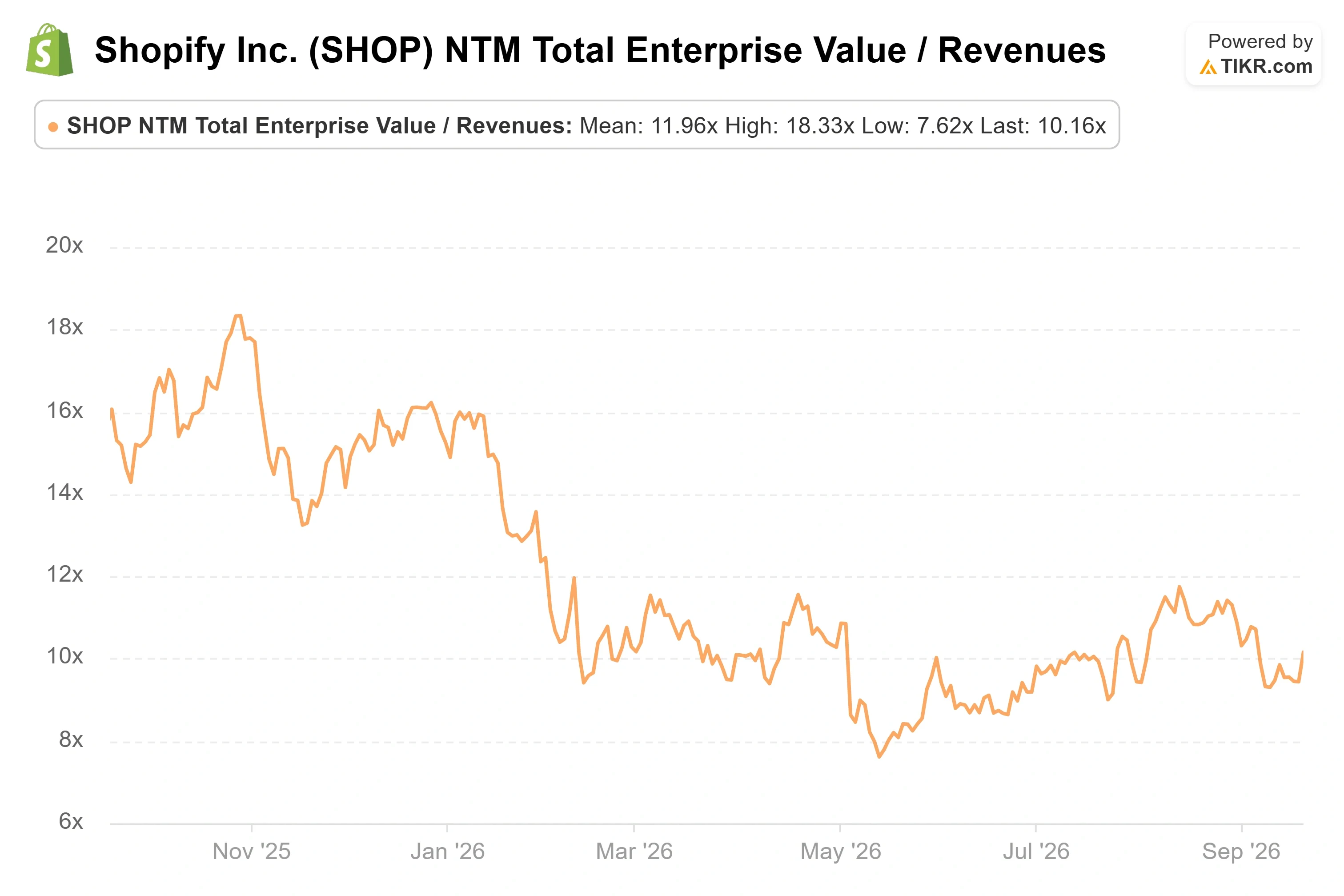
See how Shopify performs against its peers in TIKR (It’s free!) >>>
TIKR Advanced Model Analysis
- Current Price: $147.74
- Model Entry Price: $137.92
- Target Price (Mid): ~$372
- Potential Total Return: ~170% from model entry
- Annualized IRR: ~26% / year

See analysts’ growth forecasts and price targets for Shopify stock (It’s free!) >>>
TIKR’s mid-case model resolves to a target of around $372 by the end of 2030. Built off the September 21 close of $137.92, that implies roughly 170% total return and a 26% annualized IRR; measured from the current $147.74, the upside is closer to 152%. The output rests on two revenue drivers: rising payments penetration as more GMV flows through Shopify Payments and Shop Pay, and agentic discovery expanding the merchant funnel, the channel the Meta deal opens. The margin driver is operating leverage, with net income margin modeled around 17%. The primary risk is the LLM cost pressure Hoffmeister flagged, which could compress that margin path.
The upside is that agentic checkout becomes the default surface, and Shopify keeps the economics on every transaction routing through it. The downside is that the multiple compresses faster than earnings grow, and a stock at 93 times earnings gives back its recent gains before the revenue lands.
Conclusion
The Meta deal validated the thesis; the next print tests whether it converts to dollars. Watch Q3 earnings on November 3. The figure that matters is not headline revenue but the merchant-solutions growth rate and any commentary on subscription-solutions gross margin. If merchant monetization holds its pace and management signals LLM costs are contained, the agentic story is compounding on schedule. If margin slips while costs climb, the market will decide it paid 93 times earnings for a channel that has not yet paid for itself.
See what stocks billionaire investors are buying so you can follow the smart money with TIKR.
Should You Invest in Shopify?
The only way to really know is to look at the numbers yourself. TIKR gives you free access to the same institutional-quality financial data that professional analysts use to answer exactly that question.
Pull up Shopify, and you’ll see years of historical financials, what Wall Street analysts expect for revenue and earnings in the quarters ahead, how valuation multiples have moved over time, and whether price targets are trending up or down.
You can build a free watchlist to track Shopify alongside every other stock on your radar. No credit card required. Just the data you need to decide for yourself.
Analyze Shopify on TIKR Free →
Looking for New Opportunities?
- See what stocks billionaire investors are buying so you can follow the smart money.
- Analyze stocks in as little as 5 minutes with TIKR’s all-in-one, easy-to-use platform.
- The more rocks you overturn… the more opportunities you’ll uncover. Search 100K+ global stocks, global top investor holdings, and more with TIKR.
Disclaimer:
Please note that the articles on TIKR are not intended to serve as investment or financial advice from TIKR or our content team, nor are they recommendations to buy or sell any stocks. We create our content based on TIKR Terminal’s investment data and analysts’ estimates. Our analysis might not include recent company news or important updates. TIKR has no position in any stocks mentioned. Thank you for reading, and happy investing!