Key Takeaways
- Oracle stock is 54% below its June high, and the average analyst target has fallen to $236 from $348 a year ago, which is still 105% above the Nov. 17 close.
- Bernstein kept its Outperform rating and $325 target on Nov. 10, betting on positive free cash flow in the second half of fiscal 2028 and an OpenAI IPO.
- On fiscal 2028 earnings estimates, $236 is 21x, Oracle’s five-year average, while $325 needs 29x.
- The selloff looks overdone, but $325 within a year asks investors to pay a premium multiple before Oracle’s cash flow turns positive.
Oracle (ORCL) closed at $115.00 on Nov. 17, down 3.43% as software stocks sold off, leaving it 54% below its June high. Bernstein is sticking with its call: analyst Mark Moerdler’s Outperform rating and $325 price target sit 183% above that close.
Big bills, then two lost deals
Oracle’s fiscal first quarter, reported Sept. 10, brought $28.5 billion of capital spending and negative free cash flow of $5 billion, and Oracle sold $20 billion of stock. On Nov. 2, it priced another $20 billion of new shares and notes.
On Nov. 4, the Financial Times reported that Oracle had canceled a chip-leasing deal with Tencent worth an estimated $7 billion, and on Nov. 6, Bloomberg reported that Microsoft is winding down a deal to rent AI computing from Oracle. And OpenAI, which S&P estimated in July makes up about half of Oracle’s backlog, has reportedly raised only half of what it set out to in its latest round.
Bernstein is betting on the cash turning
In a Nov. 10 note, Moerdler named two catalysts: an OpenAI IPO and free cash flow turning positive in the second half of fiscal 2028, the timeline CFO Hilary Maxson repeated on CNBC that day.
Wall Street’s average target has fallen to $236 from $348 a year ago:

That’s still 105% above the Nov. 17 close, and $325 sits 38% above it. By Nov. 12, DBS had cut its target to $290 from $310, keeping its Buy rating.
TIKR tracks 42 analysts on Oracle. How many say “Buy”?
See the full breakdown of Buy, Hold, and Sell ratings on Oracle, along with Wall Street’s revenue and earnings estimates, all in one place. More than 500,000 investors use TIKR to research stocks like this one. See Oracle’s Analyst Ratings
Does $325 add up?
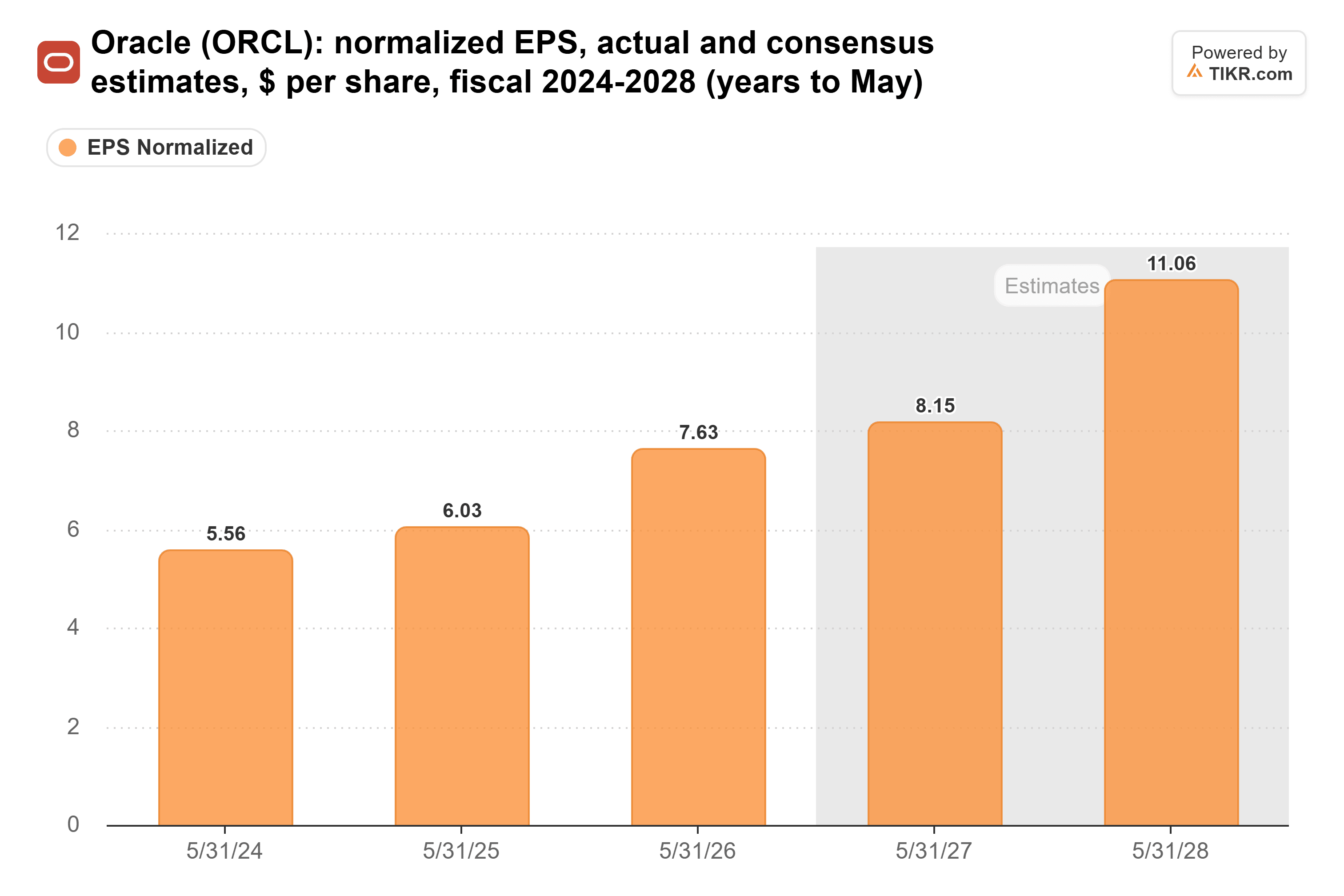
Analysts expect normalized EPS of $8.15 for the fiscal year ending May 2027, a touch above Oracle’s $8.10 non-GAAP guide, and $11.06 for fiscal 2028, up from $10.90 90 days ago:
Investors aren’t paying much for them. Oracle trades at under 14x forward earnings, against a five-year average of 21x:
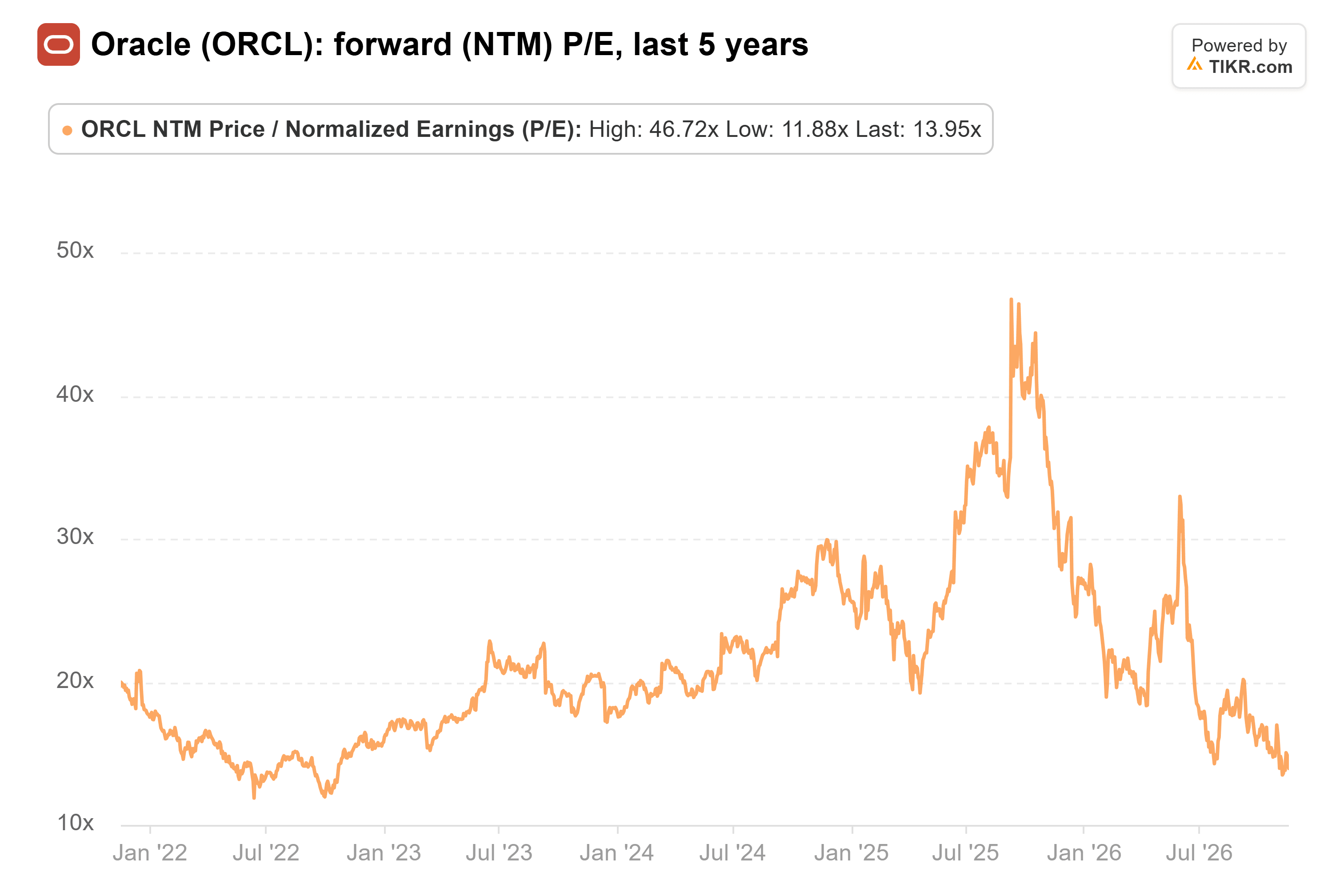
From 2014 to 2021, that multiple sat mostly in the low-to-mid teens while revenue grew about 1% a year. Last quarter, revenue grew 30%.
On those estimates, the Street’s $236 is 21x fiscal 2028 EPS, right at the average, so it only needs estimates to hold. Bernstein’s $325 is 29x. Earnings growing from the next twelve months’ $8.54 to $11.06 add 30%, so the rest has to come from the multiple more than doubling.
Room to recover, with a catch
Consensus has free cash flow at negative $27.0 billion for fiscal 2028, so a late site or a funding gap at OpenAI pushes the turn back. The selloff looks overdone. But Bernstein’s extra $89 a share asks investors to pay nearly 30x fiscal 2028 earnings before the cash turns and OpenAI shows it can pay, and that is a lot to expect within a year.
The second-quarter report in mid-December is the next test: the backlog needs to hold near $664 billion, with non-GAAP EPS inside Oracle’s $1.85 -1.93 guide.
So what is Oracle stock actually worth?
TIKR lets you forecast the future price of any stock in less than a minute. Just enter a few assumptions into TIKR’s valuation model and see what Oracle could be worth. Start from Wall Street consensus estimates, or adjust the inputs to reflect your own view of the business. It’s free to use.
Disclaimer:
Please note that the articles on TIKR are not intended to serve as investment or financial advice from TIKR or our content team, nor are they recommendations to buy or sell any stocks. We create our content based on TIKR Terminal’s investment data and analysts’ estimates. Our analysis might not include recent company news or important updates. TIKR has no position in any of the stocks mentioned. Thank you for reading, and happy investing!