Key Takeaways
- Oppenheimer kept its Outperform rating and $275 price target on Oracle on Oct. 29, [91%] above the stock’s price, after shares lost 49% in a year.
- At its Oct. 28 Investor Day, Oracle said free cash flow should turn positive in the second half of fiscal 2028. It also said it would raise no more than $20 billion of new financing.
- Analysts’ earnings estimates have held up, and the stock trades at 17x forward earnings against a five-year average of 21x.
- Oppenheimer’s target implies 32x forward earnings, a multiple Oracle has rarely reached, so a rebound looks likely to stop well short of $275.
Oracle (ORCL) stock has lost 49% of its value in a year, and Oppenheimer still thinks it’s headed to $275.
On Oct. 29, the day after Oracle’s Investor Day, analyst Brian Schwartz reiterated his Outperform rating and $275 price target. That’s 91% above the stock’s $144.34 on Oct. 28.
The AI build got expensive
Oracle spent $55.7 billion on capex in fiscal 2026 (the year to May 2026), against $67.4 billion of revenue, and its free cash flow came to negative $23.7 billion.
Paying for it took outside money. Oracle sold $25 billion of bonds in February. S&P cut its credit rating to BBB-, one step above junk, on July 9. And Oracle finished a $20 billion stock sale in the quarter to Aug. 31.
At its Oct. 28 Investor Day, Oracle said free cash flow should turn positive in the second half of fiscal 2028 and top $30 billion in fiscal 2029. It also said it would raise no more than $20 billion of additional financing.
Oppenheimer hasn’t budged
Schwartz raised his target to $275 from $235 in June and named Oracle the firm’s top pick for 2026, arguing that its backlog justified the heavier spending.
TIKR tracks 43 analysts on Oracle. How many say “Buy”?
See the full breakdown of Buy, Hold, and Sell ratings on Oracle, along with Wall Street’s revenue and earnings estimates, all in one place. More than 500,000 investors use TIKR to research stocks like this one. See Oracle’s Analyst Ratings
Can Oracle earn its way to $275?
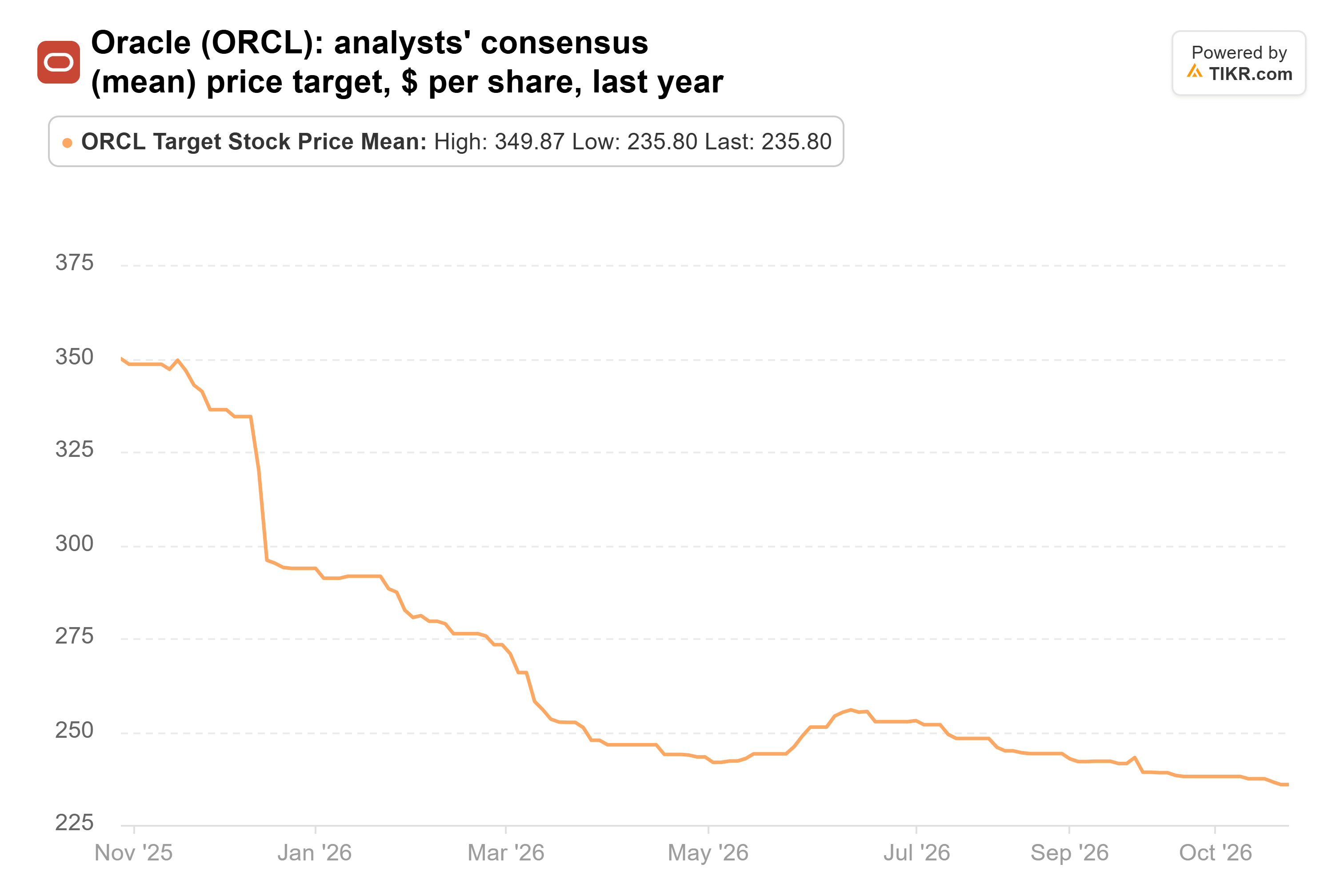
The consensus target was $236 on Oct. 27, down from $350 a year earlier, and Oppenheimer’s $275 is 17% above it.
Earnings estimates haven’t come down with it. Analysts expect normalized EPS of $8.14 in fiscal 2027 and $10.99 in fiscal 2028, up from $8.05 and $10.89 three months ago.

Investor Day gives them no reason to fall. Oracle reaffirmed its $8.10 forecast for fiscal 2027 and set a target of $21 or more for fiscal 2030.
The stock is cheap against its own history, at 17x forward earnings against a five-year average of 21x.

Oppenheimer’s target works out to 32x those same earnings. The highest multiple Oracle has ended any quarter at since 2014 is 33x.
$275 needs last year’s multiple back
The risks are the balance sheet and one customer. Total debt, leases included, was $169.1 billion at Aug. 31, and S&P has said OpenAI accounts for about half of Oracle’s backlog.
My take: Investor Day helped, but reaching $275 within a year means paying a multiple Oracle has rarely reached, before its free cash flow turns positive. I’d expect the stock to stop well short of it.
The second-quarter report in mid-December is the next test. A non-GAAP operating margin near the first quarter’s 42% would make paying up easier to justify.
So what is Oracle stock actually worth?
TIKR lets you forecast the future price of any stock in less than a minute. Just enter a few assumptions into TIKR’s valuation model and see what Oracle could be worth. Start from Wall Street consensus estimates, or adjust the inputs to reflect your own view of the business. It’s free to use.
Disclaimer:
Please note that the articles on TIKR are not intended to serve as investment or financial advice from TIKR or our content team, nor are they recommendations to buy or sell any stocks. We create our content based on TIKR Terminal’s investment data and analysts’ estimates. Our analysis might not include recent company news or important updates. TIKR has no position in any of the stocks mentioned. Thank you for reading, and happy investing!