Key Takeaways
- Oppenheimer upgraded NVIDIA to Outperform with a $250 price target on Nov. 23, citing Jensen Huang’s return as CEO.
- The stock fell on a CEO exit, an accounting question, and a broad tech selloff, while analysts’ earnings estimates kept rising.
- On consensus fiscal 2029 estimates, $250 is about 11x earnings. NVIDIA’s five-year average forward P/E is 36x, and Oracle says its OpenAI contract is fully funded.
- The target looks modest if the earnings hold up, and NVIDIA’s late 10-Q, due by Dec. 4, is the test.
By Nov. 20, NVIDIA (NVDA) had fallen 48% from its October high. On Nov. 23, it jumped 31.48% to close at $165.05 after its board reinstated Jensen Huang as CEO. Oppenheimer’s Rick Schafer upgraded the stock to Outperform from Perform the same day with a $250 price target, about 51% above that close.
A CEO exit, then an accounting question
On Nov. 12, Huang resigned as president and CEO. On the Nov. 17 earnings call, Chair Harvey Jones said the board “does not intend to reinstate Jensen as CEO.”
NVIDIA had filed its 10-Q or 10-K on results day for nine straight reports, but it has yet to file this one, and it’s now due by Dec. 4. On Nov. 20, Reuters reported that SEC enforcement staff are examining possible accounting issues at the company. NVIDIA has not confirmed any inquiry, and an SEC review is not a finding of wrongdoing. The stock fell 14% that day as tech stocks sold off broadly.
Oppenheimer is betting on Huang
The board said it voted unanimously to bring Huang back. Its meetings with him left it “satisfied with respect to Mr. Huang’s candor and ability to lead NVIDIA.”
Schafer had cut the stock to Perform on Nov. 12, without a price target, as Huang’s departure loomed. His Nov. 23 note called Huang’s return “a win for AI and a win for investors.”
TIKR tracks 63 analysts on Nvidia. How many say “Buy”?
See the full breakdown of Buy, Hold, and Sell ratings on Nvidia, along with Wall Street’s revenue and earnings estimates, all in one place. More than 500,000 investors use TIKR to research stocks like this one. See Nvidia’s Analyst Ratings
Does $250 add up?
Analysts’ average target fell from $329 on Oct. 23 to $244 on Nov. 20, about where it was a year earlier:
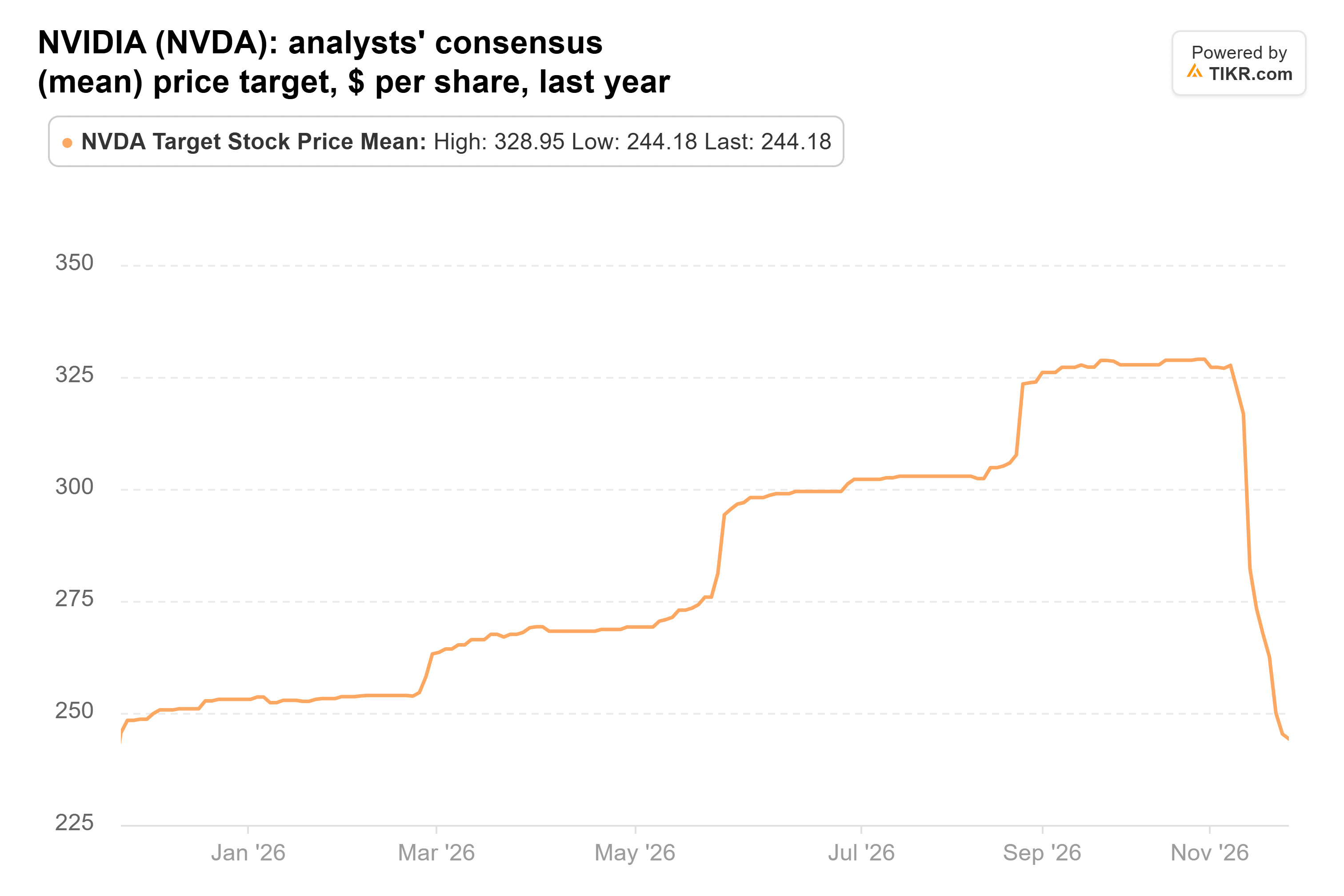
That leaves Oppenheimer’s $250 just 2% above the Street. Consensus normalized EPS for fiscal 2028, the year ending January 2028, is $16.61, up from $13.00 90 days ago. Analysts expect $21.77 for fiscal 2029:

On that fiscal 2029 figure, $250 works out to about 11x earnings. The stock’s forward P/E fell to 10x on Nov. 19. That’s its lowest in five years, against a five-year average of 36x:

Even after the Nov. 23 jump, the multiple is a fraction of that average. So $250 doesn’t depend on a rerating, only on the estimates holding.
Oracle (ORCL), which offers NVIDIA’s Vera Rubin systems on its cloud, said on Nov. 20 that its OpenAI contract is fully funded and that Vera Rubin rack deliveries are on track. That’s one OpenAI buildout with its money in place. NVIDIA’s own OpenAI exposure is separate: up to $105 billion of credit support for an Ohio campus leased to OpenAI.
The 10-Q is the real test
NVIDIA said on Nov. 23 that it “will continue to cooperate with ongoing government investigations and inquiries.” The 10-Q is where investors will see NVIDIA’s receivables and guarantees in detail, along with any new risk disclosures.
Receivables are already stretching. Days sales outstanding rose to 64 in the October quarter from 60 in July, according to NVIDIA’s CFO commentary. $250 looks reachable if the earnings hold up, but a forward P/E that bottomed near 10x says the market doubts the numbers, and Oppenheimer’s case rests on the CEO. A clean 10-Q by Dec. 4 would make $250 look conservative.
So what is NVIDIA stock actually worth?
TIKR lets you forecast the future price of any stock in less than a minute. Just enter a few assumptions into TIKR’s valuation model and see what NVIDIA could be worth. Start from Wall Street consensus estimates, or adjust the inputs to reflect your own view of the business. It’s free to use.
Disclaimer:
Please note that the articles on TIKR are not intended to serve as investment or financial advice from TIKR or our content team, nor are they recommendations to buy or sell any stocks. We create our content based on TIKR Terminal’s investment data and analysts’ estimates. Our analysis might not include recent company news or important updates. TIKR has no position in any of the stocks mentioned. Thank you for reading, and happy investing!