Key Takeaways
- Peter Diamandis says Eli Lilly’s tirzepatide sold $44 billion in 2026’s first nine months, more than Anthropic’s $33.2 billion.
- The profit gap is far wider than the sales gap: Lilly kept an adjusted 45.6% of 2025 revenue as operating income, and Anthropic had an operating loss in the third quarter.
- Falling GLP-1 prices are the main risk, as Novo Nordisk’s flat 2026 sales outlook shows.
- Lilly’s market value is closing in on Broadcom’s, yet it trades at 29.7x forward earnings, well below its five-year average of 40x.
On the Nov. 28 episode of Moonshots, Peter Diamandis, who spends most of his podcast on AI, argued that Eli Lilly (LLY) has the bigger business story.
By his count, tirzepatide, which Lilly sells as Mounjaro and Zepbound, brought in $44 billion in 2026’s first nine months. All of Anthropic (ANT) brought in $33 billion.
His summary: “One drug outselling the top AI lab on the planet.”
The sales figures mostly check out
Anthropic’s amended S-1 puts its revenue for the nine months to Sept. 30 at $33.2 billion. Lilly’s second-quarter 10-Q shows Mounjaro and Zepbound had already brought in $27.7 billion in the first half alone. Then Lilly’s third-quarter revenue rose 39% to $24.4 billion, led by the same two drugs.
Together, Mounjaro and Zepbound generated $16.1 billion in the third quarter, bringing nine-month sales to $43.8 billion.
Lilly’s total revenue nearly doubled from fiscal 2023 to fiscal 2025, and analysts expect $119 billion by 2028:
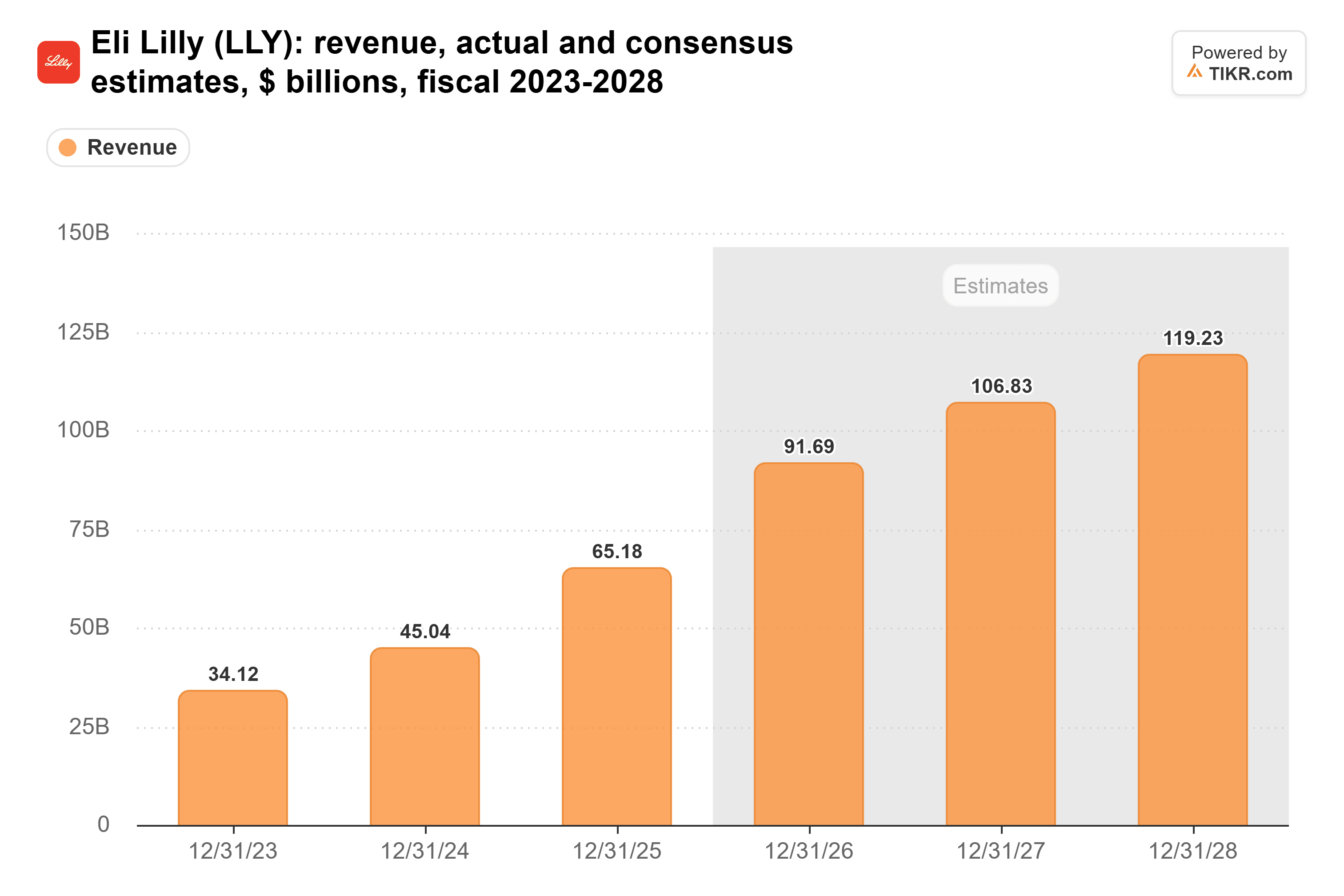
Tirzepatide made 65% of Lilly’s first-half revenue, so most of that growth comes from one molecule.
TIKR tracks 31 analysts on Eli Lilly. How many say “Buy”?
See the full breakdown of Buy, Hold, and Sell ratings on Eli Lilly, along with Wall Street’s revenue and earnings estimates, all in one place. More than 500,000 investors use TIKR to research stocks like this one. See Eli Lilly’s Analyst Ratings
The profit gap is much wider
Diamandis’s sharper point was about profit: “One of these businesses prints cash. The other one is printing data centers.”
Anthropic swung to a $567 million operating loss in the third quarter, after a $974 million operating profit in the second. Its amended S-1 blames pricier compute bought on short-term deals. Even on its own adjusted measure, which leaves out stock pay and a $2 billion donation-matching charge, its operating margin slipped to 15% from 19%.
Lilly’s margin has moved the other way as tirzepatide scaled:
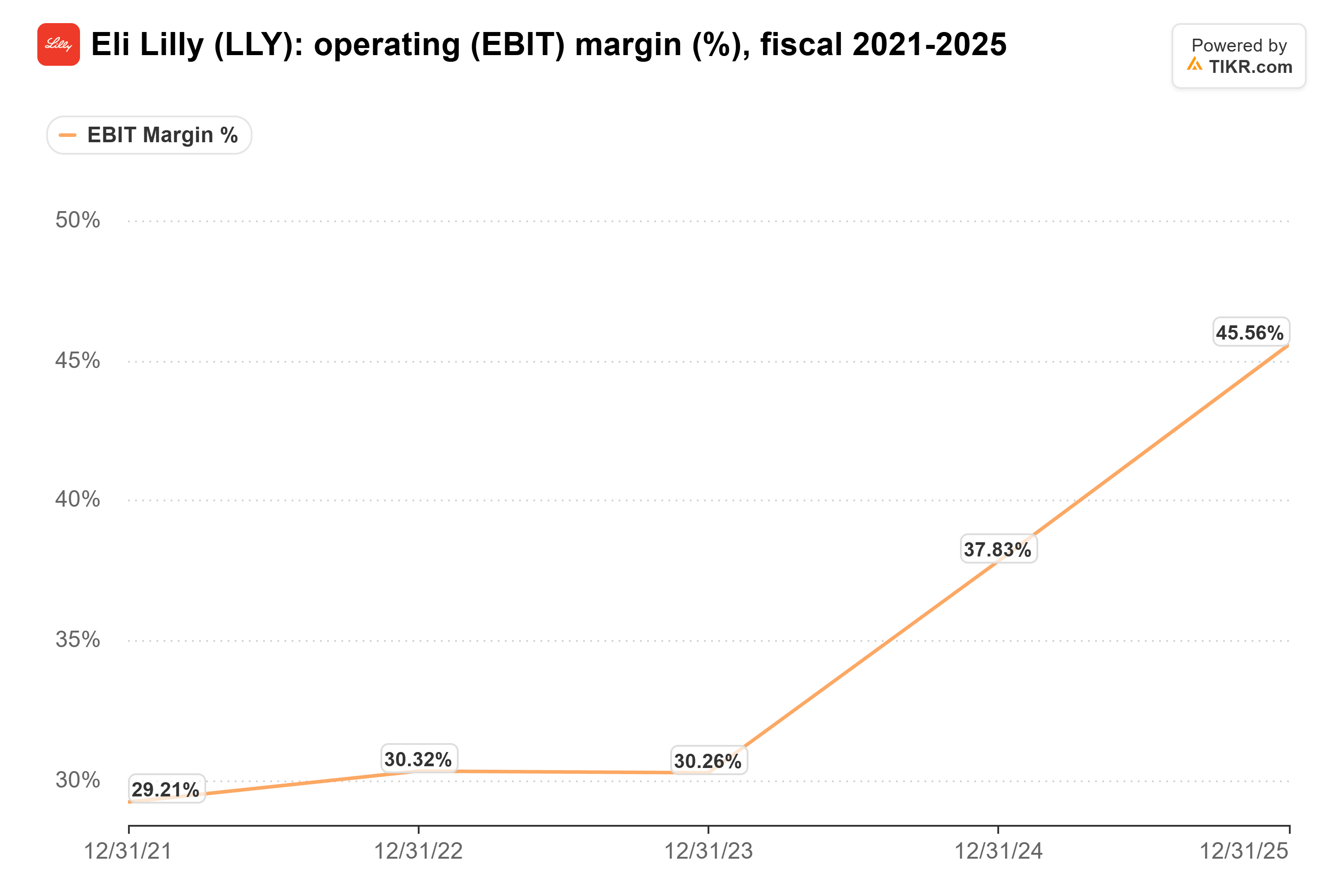
That’s 45.6% of 2025’s revenue kept as operating income, before acquired research and special charges. It’s roughly three times Anthropic’s adjusted margin, although the two measures exclude different expenses. Lilly also generated $10.8 billion of free cash flow in 2026’s first half.
Both of them are cutting prices
In the second quarter of 2026, Lilly’s realized prices fell 13% while volume rose 60%.
Novo Nordisk (NVO) shows what happens when volume stops outrunning price. Novo still expects 2026 adjusted sales to land somewhere between down 2% and up 2% at constant exchange rates. Its Ozempic sales fell 5% from a year earlier in the third quarter at constant exchange rates.
Anthropic is cutting prices too. Its amended S-1 says price cuts on new models and contract discounts took about $600 million out of revenue from the second quarter to the third. But Anthropic is growing much faster: its third-quarter revenue jumped 47% from the second quarter, to $17.0 billion. Anthropic has already passed tirzepatide on quarterly sales.
Investors aren’t paying up for Lilly
Lilly’s market value is closing in on that of Broadcom (AVGO), a point CNBC’s Mike Santoli made on Squawk on the Street on Nov. 25.
Investors are paying less for each dollar of Lilly’s expected earnings than they usually do:

At 29.7x, Lilly trades well below its five-year average of 40x. That’s closer to its 23.0x low from August 2025 than to its 67.2x peak in October 2023. Meanwhile, analysts expect normalized EPS to climb from $24.21 in 2025 to $58.05 in 2028.
Even if Anthropic takes the annual sales lead, I think Lilly at 29.7x forward earnings is the better-priced way to own growth at this scale.
Of course, that case needs volume to keep outrunning price for a few more years. The next big tests are Lilly’s Dec. 7 investor day and its retatrutide filing, planned for the first quarter of 2027.
So what is Eli Lilly stock actually worth?
TIKR lets you forecast the future price of any stock in less than a minute. Just enter a few assumptions into TIKR’s valuation model and see what Eli Lilly could be worth. Start from Wall Street consensus estimates, or adjust the inputs to reflect your own view of the business. It’s free to use.
Disclaimer:
Please note that the articles on TIKR are not intended to serve as investment or financial advice from TIKR or our content team, nor are they recommendations to buy or sell any stocks. We create our content based on TIKR Terminal’s investment data and analysts’ estimates. Our analysis might not include recent company news or important updates. TIKR has no position in any of the stocks mentioned. Thank you for reading, and happy investing!