
Key Takeaways
- NVIDIA’s interim CEO Colette Kress said older Hopper GPUs have been recontracted at up to twice their original price, and CoreWeave, Nebius and IREN rose this morning.
- Rising rents on chips two generations old weaken the bear case that neocloud GPUs stop earning long before they’re fully depreciated.
- CoreWeave still lost $709 million in its third quarter, so the higher rents have to show up in its profits.
- CoreWeave traded at 1.2x forward sales before today’s rally, far below its 3.4x average over the past year.
Neocloud investors just got their best news in weeks, and it came from NVIDIA (NVDA).
On NVIDIA’s third-quarter call Tuesday evening, interim CEO Colette Kress said token prices have fallen nearly 60% since May, which is pushing up demand for compute. Then she said this:
“Hopper GPUs have recontracted at up to twice their original price under the multiyear agreements, while the B300 rates have risen more than 60% since their introduction.”
For a chip that’s two generations old, that’s remarkable.
After weeks of selling, CoreWeave (CRWV) was up 2% this morning, Nebius (NBIS) 4% and IREN (IREN) 3%.
TIKR tracks 63 analysts on Nvidia. How many say “Buy”?
See the full breakdown of Buy, Hold, and Sell ratings on Nvidia, along with Wall Street’s revenue and earnings estimates, all in one place. More than 500,000 investors use TIKR to research stocks like this one. See Nvidia’s Analyst Ratings
The old chips are still earning
The bear case on neoclouds has always come down to depreciation. CoreWeave’s 2025 annual report gives its technology equipment a six-year useful life. Skeptics argue that GPUs lose their value well before then, which would mean its reported profits are too high.
Kress just described the opposite. A Hopper that gets recontracted at a higher rate years after it went in keeps earning on a cost CoreWeave has already locked in. That makes a six-year schedule look a lot more reasonable.
CoreWeave said last week that it has “10x as much qualified demand” as capacity. Analysts expect its revenue to climb from $5.13 billion in 2025 to $45.1 billion in 2028:
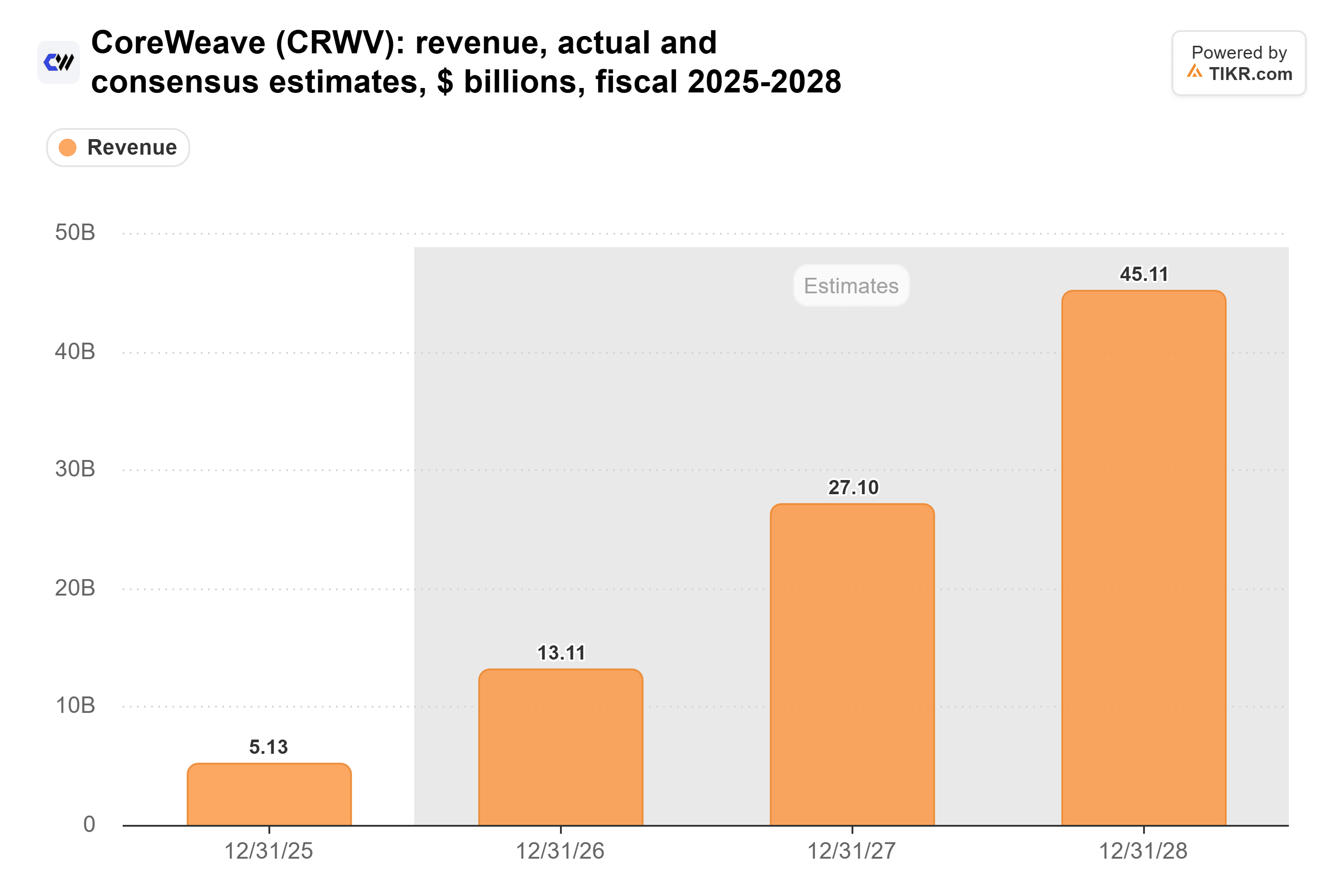
Those estimates came before Kress’s comments, and higher rents on older gear make them easier to hit.
Nebius gets the same tailwind but has a different problem. It lowered the bottom of its $3.0 billion to $3.4 billion 2026 guidance, blaming delays at third-party data centers. With rents rising, every month of delay costs it more.
IREN is still building out its AI cloud. If each chip earns for longer, that buildout should be easier to finance.
Investors were betting the other way
Weeks of selling left CoreWeave at 1.2x forward sales at Tuesday’s close, matching its low for the past year:
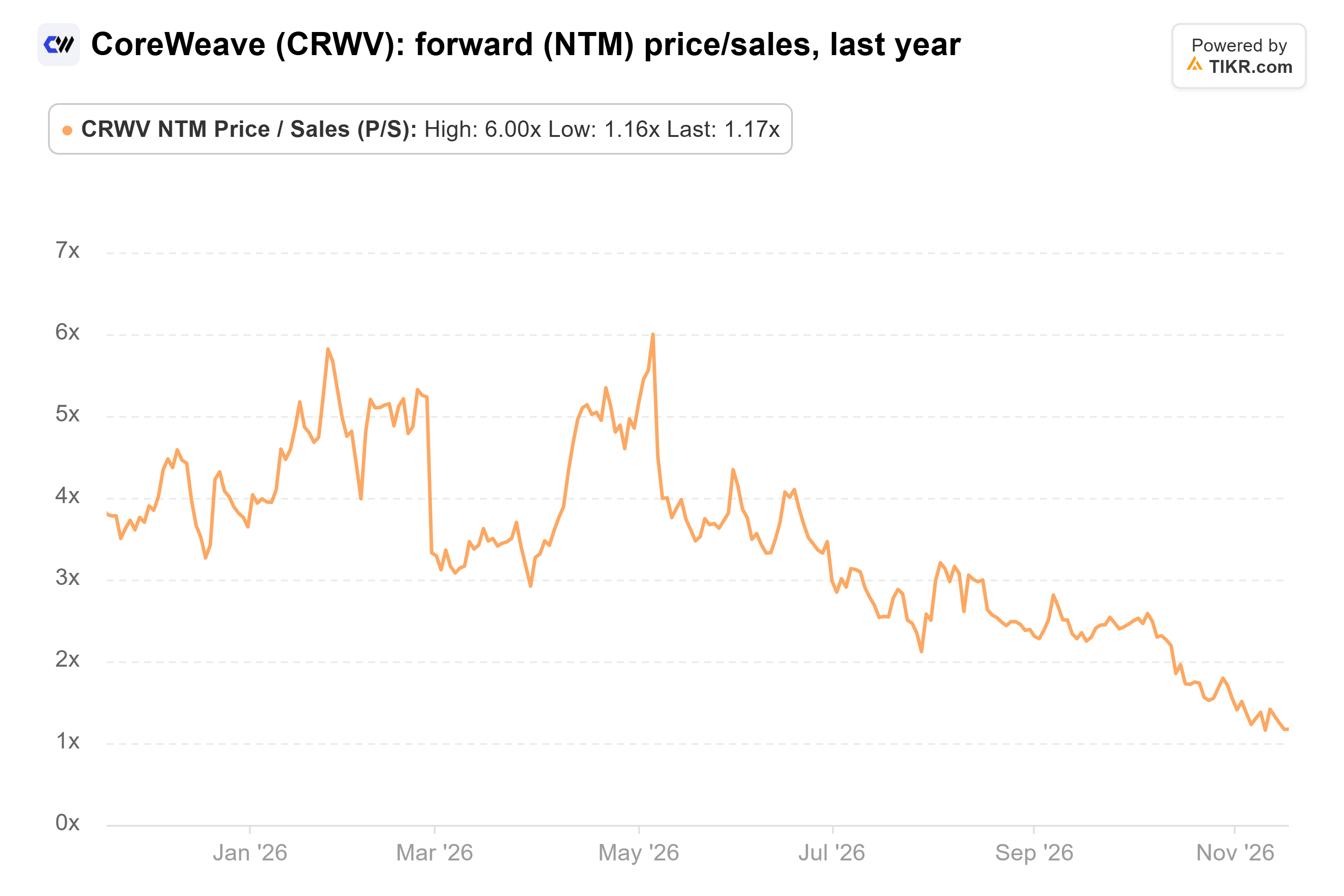
Over that year, the multiple averaged 3.4x. Today’s gain lifts it only slightly. That’s the kind of price investors pay for a business whose chips lose value fast, and Kress just described chips gaining it.
Higher rents still have to reach the bottom line
Not everyone sees rising rents as a win. When Michael Dell posted on X last week that H100 rents had risen 58% in a year, short seller Jim Chanos replied:
“This fact should terrify any company that is still unprofitable renting out GPU’s at these rates. If not now, when…?”
He has a point, and CoreWeave is the obvious example. Its operating margin went from 16.9% in 2024 to just below zero in 2025:
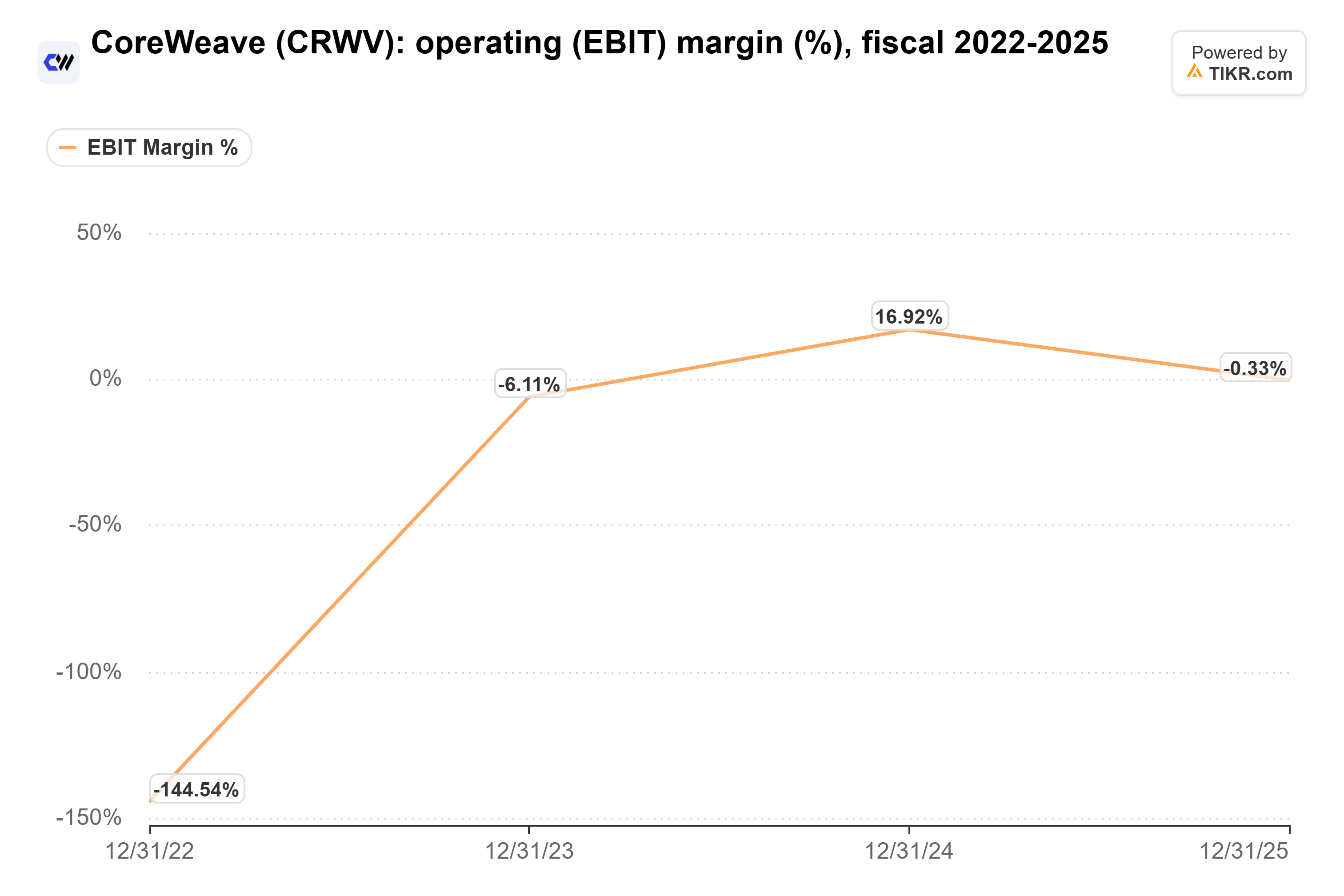
It has improved since. CoreWeave’s GAAP operating margin reached 6% in the third quarter, but $846 million of net interest expense turned that into a $709 million net loss.
Still good news for CoreWeave
Most of the extra rent on a chip whose cost is already locked in goes straight to operating income, which is exactly the line Chanos says has to improve.
The way I see it, the depreciation bear case just lost its best argument. At these prices, CoreWeave doesn’t need much to go right.
Of course, NVIDIA’s top-of-the-range figure still has to show up in the neoclouds’ own numbers. CoreWeave’s fourth-quarter report, likely in late February, is the test. A GAAP operating margin above the third quarter’s 6%, with interest expense growing more slowly than revenue, would show the higher rents reaching shareholders.
So what is CoreWeave stock actually worth?
TIKR lets you forecast the future price of any stock in less than a minute. Just enter a few assumptions into TIKR’s valuation model and see what CoreWeave could be worth. Start from Wall Street consensus estimates, or adjust the inputs to reflect your own view of the business. It’s free to use.
Disclaimer:
Please note that the articles on TIKR are not intended to serve as investment or financial advice from TIKR or our content team, nor are they recommendations to buy or sell any stocks. We create our content based on TIKR Terminal’s investment data and analysts’ estimates. Our analysis might not include recent company news or important updates. TIKR has no position in any of the stocks mentioned. Thank you for reading, and happy investing!