Key Takeaways
- Nvidia’s 13F for the quarter ended Sept. 30 shows SpaceX as its largest holding, at 41% of its US stocks, just ahead of Intel.
- For Nvidia shareholders, the stake is small: the whole $48.33 billion portfolio is worth less than the $65.3 billion of net income Nvidia earned in its latest quarter.
- SpaceX matters more to Nvidia as a customer. It’s building out Nvidia’s newest systems while spending far more cash than its business brings in.
- SpaceX’s earnings estimates have risen while its stock fell 16% since Sept. 30, so the numbers back Nvidia’s stake. How SpaceX pays for its buildout is the thing to watch.
Nvidia (NVDA) has a new biggest holding, and it’s also one of Nvidia’s customers: SpaceX (SPCX).
Nvidia’s 13F for the quarter ended Sept. 30, filed Nov. 16, shows 130.47 million SpaceX shares worth $19.68 billion. That’s 40.7% of the $48.33 billion of US-listed stocks the filing holds.
SpaceX passed Intel by a nose
That puts SpaceX just ahead of Intel (INTC), Nvidia’s largest holding the quarter before, at 40.1%. Nvidia held 6% more SpaceX shares at Sept. 30 than at June 30. It held about a quarter fewer Intel shares: 161.08 million, down from 214.8 million.
The gap has only grown since. SpaceX is down 16% from its Sept. 30 price, while Intel is down 55%, with a $1.6 billion guidance miss along the way. Even so, the Intel shares Nvidia still holds cost it $23.28 each in 2025, so it’s sitting on a big gain at Intel’s last close of $54.47.
TIKR tracks 63 analysts on Nvidia. How many say “Buy”?
See the full breakdown of Buy, Hold, and Sell ratings on Nvidia, along with Wall Street’s revenue and earnings estimates, all in one place. More than 500,000 investors use TIKR to research stocks like this one. See Nvidia’s Analyst Ratings
The stake is small next to Nvidia’s profits
For Nvidia shareholders, the 41% sounds bigger than it is. Nvidia’s whole 13F portfolio is worth $48.33 billion at quarter-end prices. That’s less than the $65.3 billion of GAAP net income Nvidia earned in the single quarter ended Oct. 25. It also returned $28.1 billion to shareholders in buybacks and dividends that quarter. And since a 13F covers only US-listed stocks, Nvidia’s private stakes aren’t in it.
The drop since Sept. 30 will show up in Nvidia’s GAAP earnings, which include the gains and losses on its stakes. Its non-GAAP earnings leave them out. So a weaker SpaceX and Intel can drag on GAAP EPS for a quarter while the chip business carries on.
The bigger tie is SpaceX as a customer
Nvidia’s SpaceX stake goes back to xAI. Nvidia was a strategic investor in xAI’s $20 billion funding round in January, and xAI merged into SpaceX in February. That business now rents out AI computing power as SpaceX’s Super Intelligence segment, and it runs on Nvidia’s hardware. Nvidia’s third-quarter release lists SpaceX’s AI unit among the partners where its newest Vera Rubin racks are coming online soon.
So Nvidia shareholders are tied to SpaceX’s compute bet twice: through the stock and through the orders. And that bet is expensive. SpaceX spent $48.1 billion on capex in the first nine months of 2026, against $13.1 billion of operating cash flow. It guided fourth-quarter capex to $35 billion to $40 billion. On Nov. 19, it took on $32 billion of chip-backed debt at 8.259%.
Do SpaceX’s numbers back the bet?
Mostly, yes. Analysts expect SpaceX’s normalized EPS to climb from $0.28 this year to $2.91 in 2027 and $5.98 in 2028:
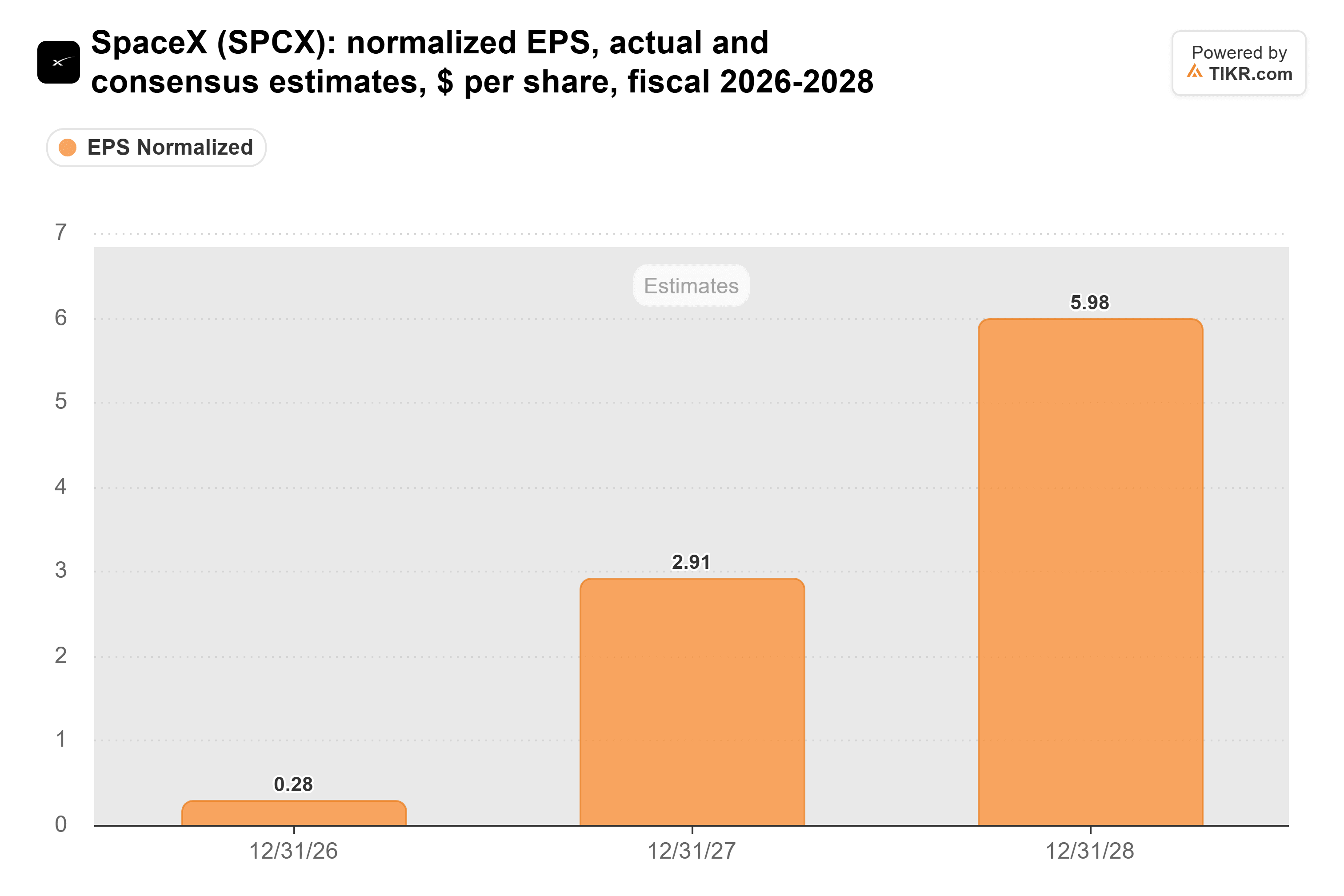
Those estimates have gone up while the stock fell. In late October, the 2027 and 2028 figures were $2.50 and $5.69. As a result, SpaceX’s forward P/E has dropped to about 42x, from nearly 97x at Sept. 30.
Meanwhile, analysts’ average price target has more than doubled since SpaceX listed in June. It’s now $256.25, about 101% above the last close:
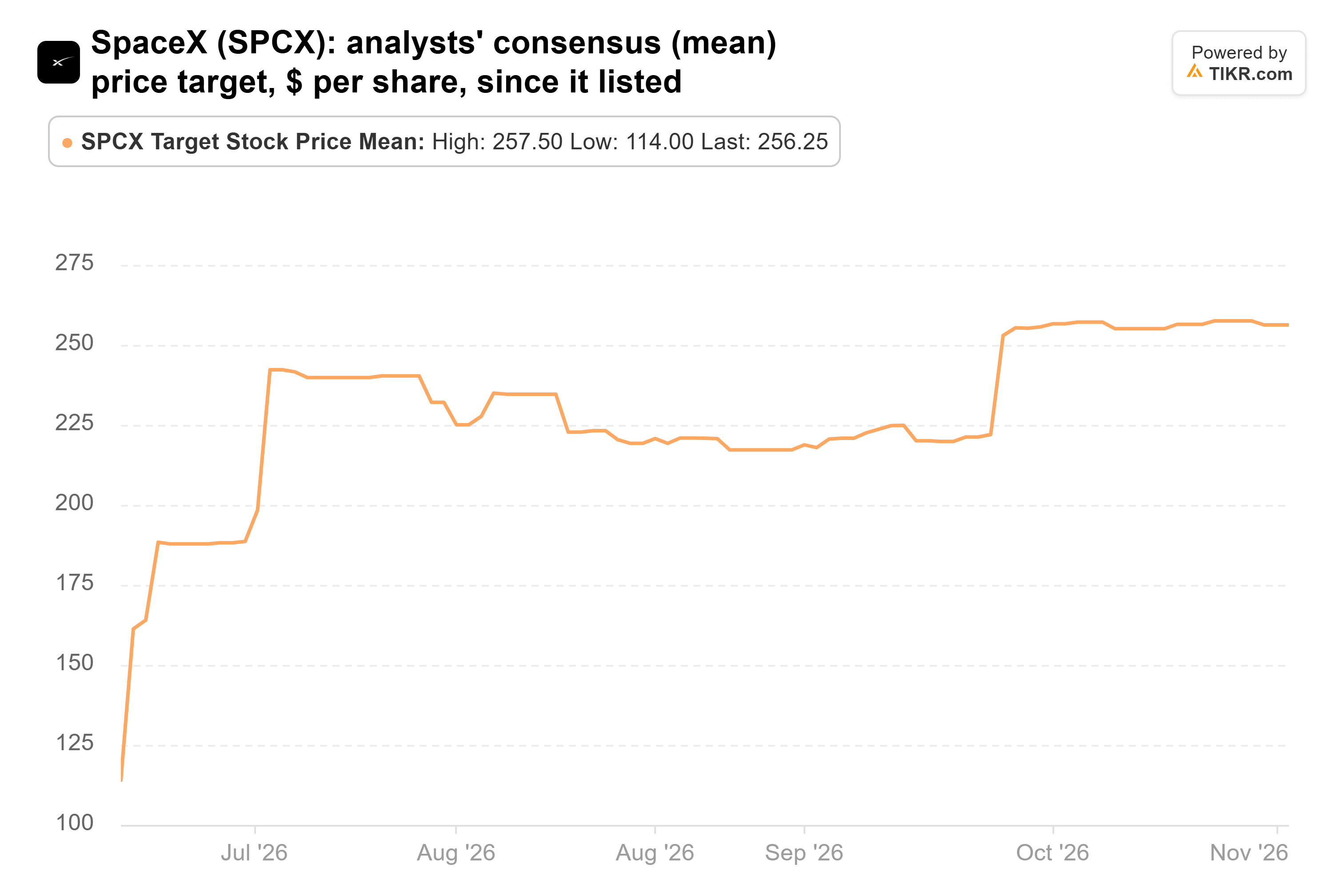
On 2028’s $5.98 estimate, that target works out to about the 42x SpaceX trades at on its next 12 months’ earnings today. So the target needs the estimates to hold and the multiple to stay put, which is a reasonable ask. (The math is ours.)
SpaceX’s funding could still trip it up. Analysts expect negative free cash flow of $57.7 billion this year and $140.7 billion in 2027. And Anthropic, reportedly its largest compute renter, can end its contract on 90 days’ notice.
The way I see it, Nvidia shareholders can relax about the 41%. The stake is small next to Nvidia’s profits, and SpaceX’s own estimates are moving the right way. The real exposure is SpaceX the customer: if its funding gets tight, Nvidia would feel it in orders as well as in its portfolio.
SpaceX’s fourth-quarter results, due early next year, are the next test. December revenue needs to reach $8.3 billion to hit SpaceX’s $100 billion annualized run-rate goal, and capex needs to land inside that $35 billion to $40 billion guide. Nvidia’s next 13F, due by mid-February, will show whether it kept adding.
So what is Nvidia stock actually worth?
TIKR lets you forecast the future price of any stock in less than a minute. Just enter a few assumptions into TIKR’s valuation model and see what Nvidia could be worth. Start from Wall Street consensus estimates, or adjust the inputs to reflect your own view of the business. It’s free to use.
Disclaimer:
Please note that the articles on TIKR are not intended to serve as investment or financial advice from TIKR or our content team, nor are they recommendations to buy or sell any stocks. We create our content based on TIKR Terminal’s investment data and analysts’ estimates. Our analysis might not include recent company news or important updates. TIKR has no position in any of the stocks mentioned. Thank you for reading, and happy investing!