Key Takeaways
- Oracle’s credit default swaps widened again on Nov. 24 to a level ZeroHedge puts wider than Bear Stearns’ in January 2008, a day after Jensen Huang’s return as CEO sent Nvidia’s stock up 32%.
- Nvidia’s backing doesn’t settle Oracle’s real problem, which is whether OpenAI can pay for the capacity Oracle is building for it.
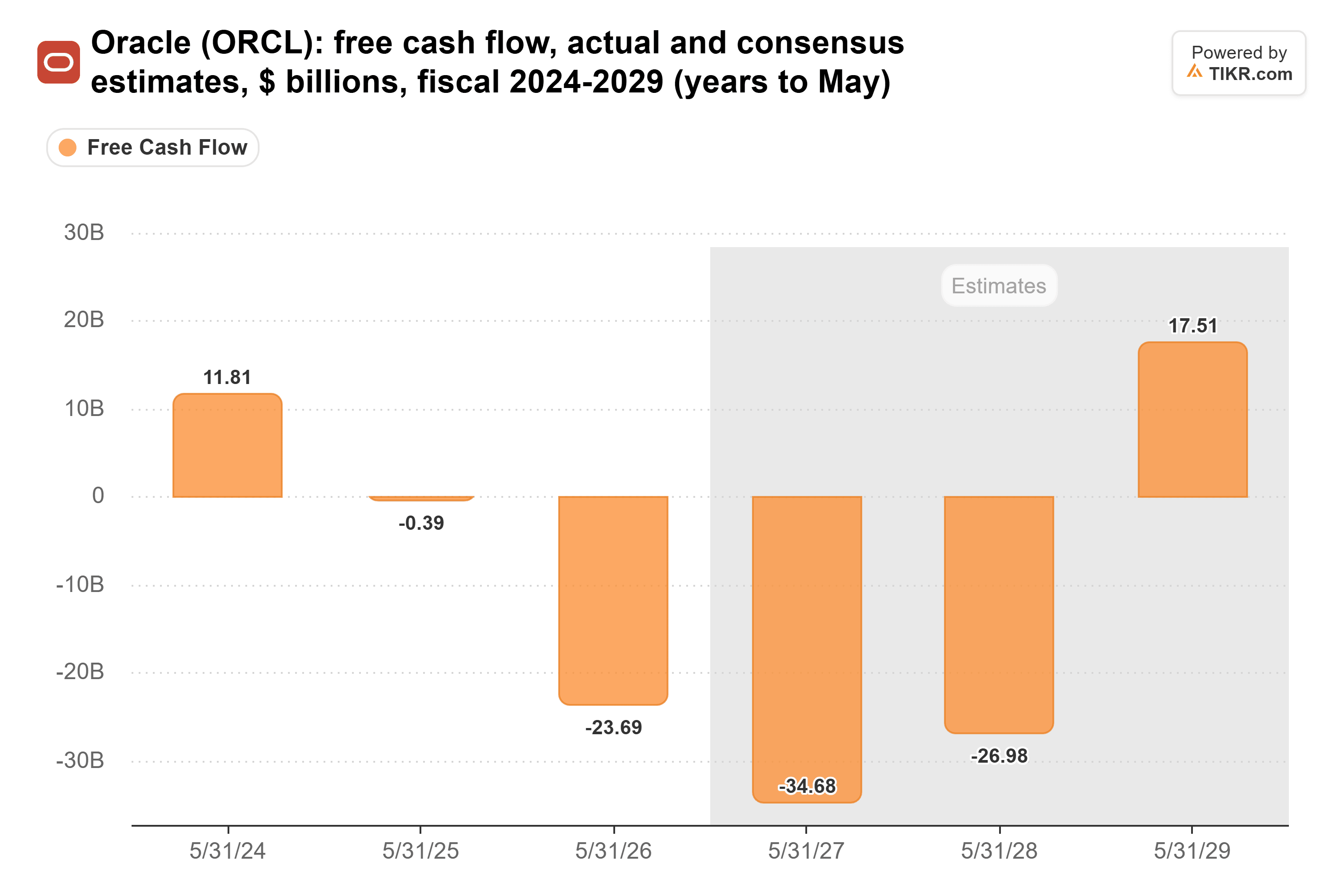
- Analysts expect Oracle’s free cash flow to stay negative through fiscal 2028.
- Hyperscaler swaps also hit record wides, which puts Meta and Amazon in the same conversation.
On Monday, investors cheered Jensen Huang’s return as CEO of Nvidia (NVDA) and sent its stock up 32%. By Tuesday, the credit market was back to worrying about Oracle (ORCL).
Oracle’s credit default swaps blew out again, and ZeroHedge says they’re now wider than Bear Stearns’ were in January 2008.
ZeroHedge also posted that hyperscaler swaps “blew out to record wide.” Anyone holding Meta Platforms (META) or Amazon (AMZN) should notice, since both are spending more on AI capacity than their operations bring in.
What exactly happened
Huang was reinstated as Nvidia’s CEO on Nov. 23, and the companies Nvidia has propped up rallied hardest. CoreWeave and Nebius, neoclouds Nvidia holds stakes in, jumped 22% and 20% as traders bet that Huang would go back to using Nvidia’s cash to backstop weaker AI players, Axios Markets reported.
That bet should help Oracle too. In an Oct. 20 note, TD Cowen said “NVIDIA is providing credit support” to Oracle, either through backstops or by leasing capacity directly and subleasing it, as Ed Zitron posted.
Colette Kress, Nvidia’s CFO and interim CEO until Huang’s return, had stressed last week that Nvidia would be more selective about these investments. Huang’s return seemed to put that backing back on the table, but Oracle’s swaps widened anyway.
TIKR tracks 42 analysts on Oracle. How many say “Buy”?
See the full breakdown of Buy, Hold, and Sell ratings on Oracle, along with Wall Street’s revenue and earnings estimates, all in one place. More than 500,000 investors use TIKR to research stocks like this one. See Oracle’s Analyst Ratings
OpenAI still has to pay the bill
Nvidia’s help goes to Oracle’s capacity. Oracle’s credit is priced on whether OpenAI can pay for that capacity.
S&P has said OpenAI accounts for about half of Oracle’s backlog, which stood at $664 billion at the end of August. OpenAI posted a third-quarter operating loss of about $13.5 billion, based on The Wall Street Journal’s figures, and its latest funding round has reached just $15 billion, half its original $30 billion target, per CNBC.
Oracle can’t pay for the build with its own cash any time soon. In fiscal 2026, the year to May, it spent $55.7 billion on capex against $32.0 billion of cash from operations. Analysts expect its free cash flow to stay negative through fiscal 2028:
Oracle says it’s funded
On Nov. 20, Oracle said it has secured the money for its OpenAI contract, and it called its Nov. 2 raise, about $10 billion of stock and $10 billion of notes, its final capital raise. Some of Tuesday’s swap buying may simply be lenders hedging what they’ve already lent into the build.
Still, Oracle has to get paid for that capacity, and its borrowing has climbed along the way:
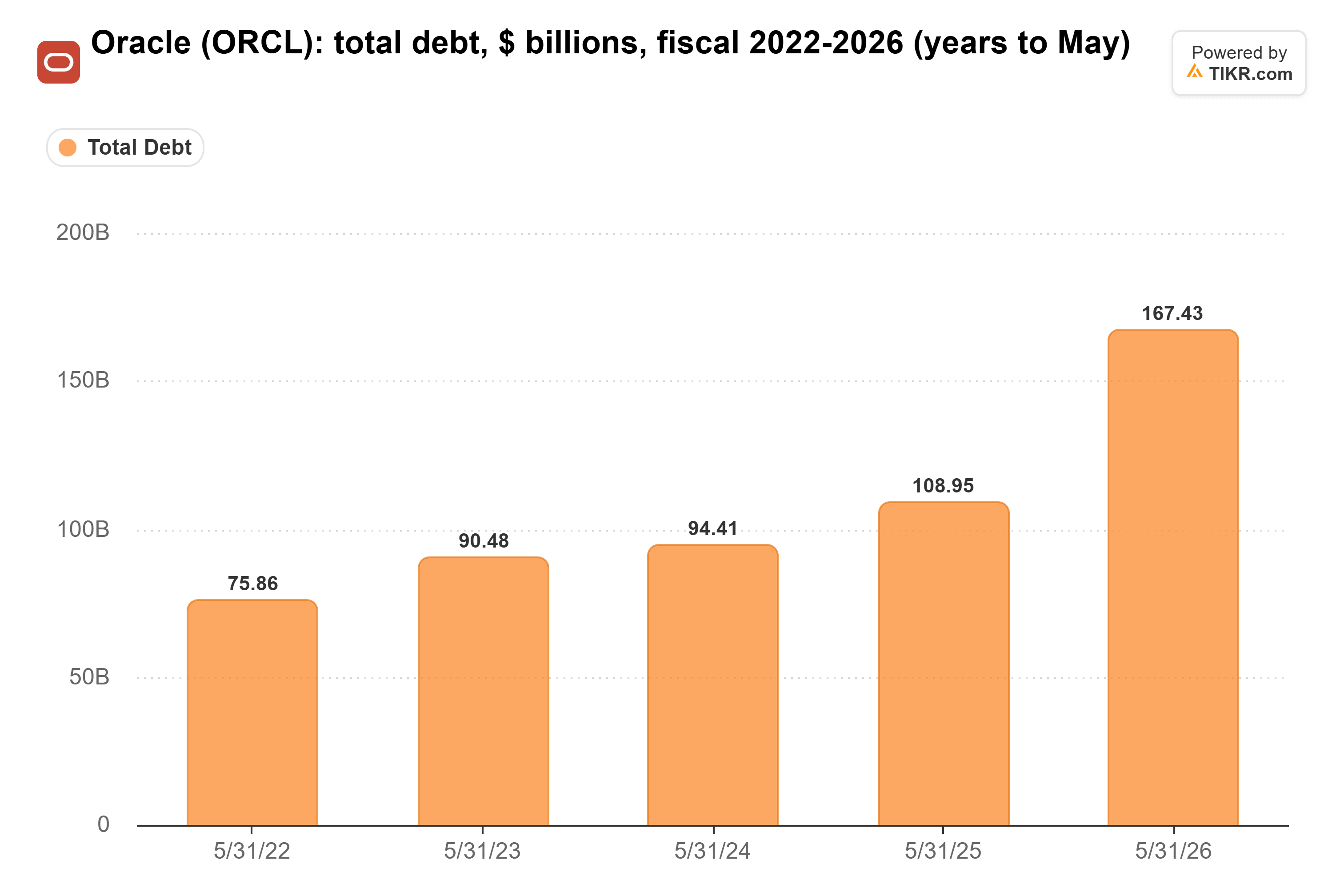
Total debt reached $169.1 billion at the end of August. S&P rates Oracle BBB-, one notch above junk, and has said it could cut the rating again if no path to positive free operating cash flow appears by fiscal 2029.
Meta and Amazon have more cushion
Meta’s third-quarter capex, including finance-lease principal, was $34.91 billion, more than the $32.79 billion of operating cash flow it brought in, and it guides 2026 capex to $135 billion to $145 billion. The question for Meta is whether its own credit starts trading alongside Oracle’s before it lays out its 2027 spending in late January.
Amazon is tied to OpenAI directly: AWS signed new agreements with both OpenAI and Oracle last quarter. Its free cash flow was a $42.4 billion outflow over the 12 months to September, but it brought in $168.3 billion of operating cash flow over the same stretch, more than 5x Oracle’s fiscal 2026 total. That gives Amazon far more room than Oracle to absorb an OpenAI shortfall.
The test comes in December
Huang’s return doesn’t fix Oracle’s problem. Until OpenAI shows it can raise money as fast as it commits to spending it, I expect Oracle’s lenders to keep demanding more protection, whatever Nvidia does.
The next real read comes with Oracle’s fiscal second-quarter results in mid-December. Two things would go a long way toward calming lenders: a backlog that grows past $664 billion on customers other than OpenAI, and net cash capex on pace for management’s fiscal 2027 cap of no more than $70 billion.
So what is Oracle stock actually worth?
TIKR lets you forecast the future price of any stock in less than a minute. Just enter a few assumptions into TIKR’s valuation model and see what Oracle could be worth. Start from Wall Street consensus estimates, or adjust the inputs to reflect your own view of the business. It’s free to use.
Disclaimer:
Please note that the articles on TIKR are not intended to serve as investment or financial advice from TIKR or our content team, nor are they recommendations to buy or sell any stocks. We create our content based on TIKR Terminal’s investment data and analysts’ estimates. Our analysis might not include recent company news or important updates. TIKR has no position in any of the stocks mentioned. Thank you for reading, and happy investing!