Key Takeaways
- Stanley Druckenmiller’s Duquesne Family Office held no airline stocks at Sept. 30, after holding $108 million of United Airlines and $56 million of Delta Air Lines at the end of June.
- Fuel is hurting the whole industry this year: United, Delta and American Airlines all reported third-quarter fuel bills up 60% or more from a year earlier.
- Analysts expect United’s 2026 earnings to fall about a third, then recover past 2025’s level in 2027.
- At about 9x next year’s earnings estimate, United’s stock already reflects the fuel hit, and the numbers favor holding it over selling.
Stanley Druckenmiller’s family office no longer owns any airline stocks. Duquesne Family Office’s 13F for the quarter ended Sept. 30, filed Nov. 16, shows no airline stocks at all. Three months earlier, it held United Airlines (UAL) and Delta Air Lines (DAL).
He got out in a year when fuel has cut deep into every carrier’s profits. American Airlines Group (AAL) now expects an adjusted loss for all of 2026.
Two airlines, sold out
At the end of June, Duquesne held 794,795 United shares worth $108 million, or 2.5% of the fund. It also held 603,000 Delta shares worth $56 million, another 1.3%. By Sept. 30, both positions were gone. (Those weights are shares of the $4.15 billion of US stocks that the 13F holds across 60 positions.)
A 13F shows only what a fund held on the last day of the quarter. It can’t tell us when he sold, at what price, or why. Since Sept. 30, United has fallen 2% and Delta has gained 1%, so getting out hasn’t made much difference yet.
TIKR tracks 25 analysts on United Airlines. How many say “Buy”?
See the full breakdown of Buy, Hold, and Sell ratings on United Airlines, along with Wall Street’s revenue and earnings estimates, all in one place. More than 500,000 investors use TIKR to research stocks like this one. See United Airlines’ Analyst Ratings
Fuel is the whole industry’s problem
United’s third-quarter fuel bill rose close to 62% from a year earlier, to $4.84 billion. The airline expects to pay about $4.80 a gallon in the fourth quarter, up from $3.90 in the third. Demand is still strong: revenue came in at $17.88 billion. CEO Scott Kirby told CNBC that United is passing about 72% of the oil price surge on to customers and wants to get closer to 100%. Still, its adjusted EPS of $2.54 came in just below the $2.57 analysts expected, and it lowered its profit outlook for 2026.
Its two biggest rivals face the same costs. On Oct. 9, Delta cut its 2026 adjusted EPS guidance to $5.10-$5.60 from $6.50-$7.50 after its adjusted fuel expense rose 62% in the third quarter. American is in worse shape. Its fuel expense rose 67.5%, and it now expects an adjusted loss of $1.00 to $1.60 a share for 2026. It also expects to pay about $4.70 a gallon in the fourth quarter, nearly double what it paid a year earlier.
Analysts expect United’s normalized EPS to fall to $7.11 in 2026, from $10.62 in 2025, then climb to $11.96 in 2027 and $17.04 in 2028:

Most of this year’s fuel hit is already in those estimates. The rebound in 2027 depends on fuel prices easing and United’s fare increases holding up.
United is already priced for a rough year
United trades at about 13x forward earnings. At $108.71, it’s 9.1x the 2027 estimate. Analysts’ average price target has risen over the past year, from $123.10 to $151.30, though it’s below its July peak of $162.15:
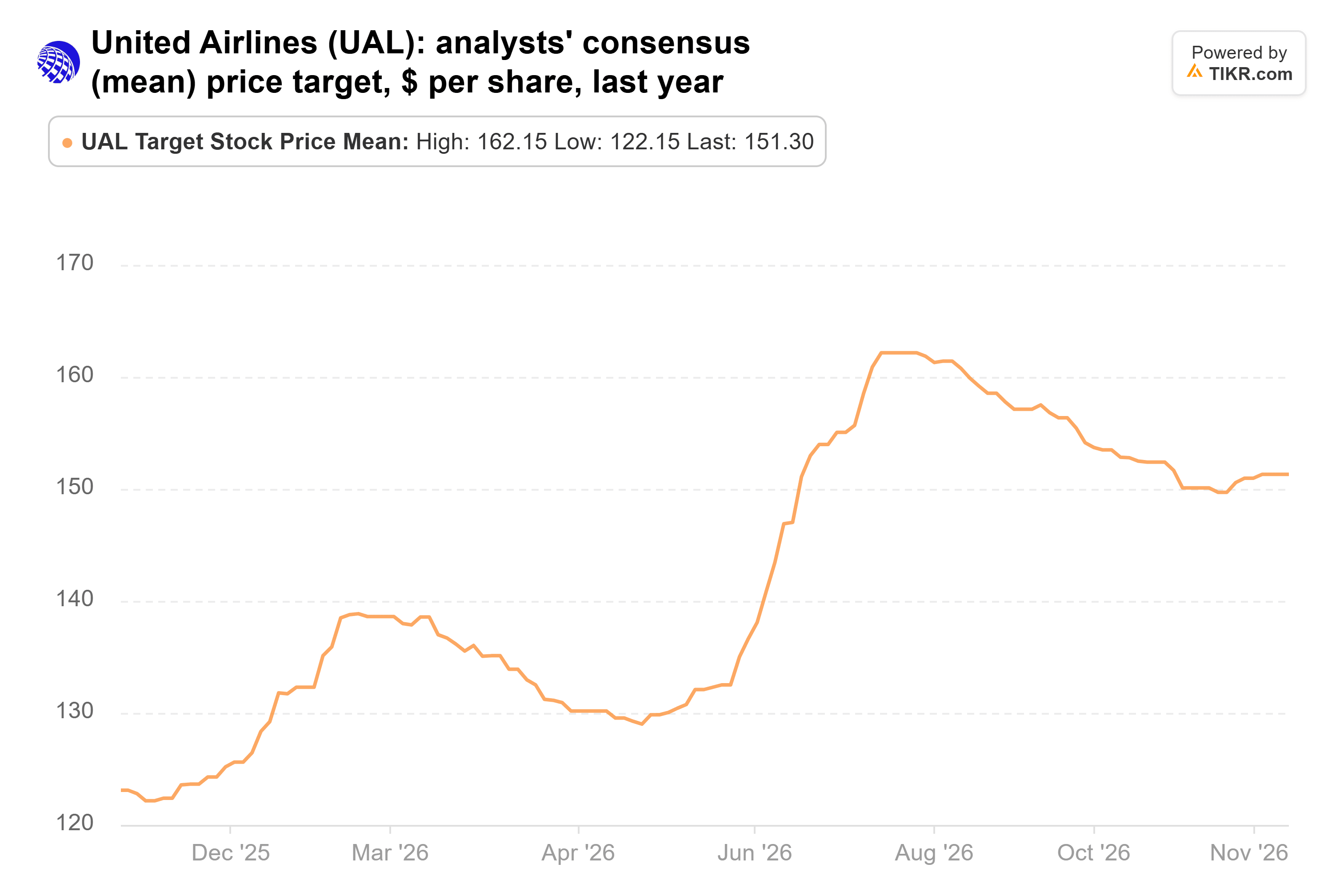
That average target is 39% above the last close, and individual targets range from $98 to $203. On 2028 estimates, $151 is 8.9x earnings, below today’s multiple. So United doesn’t need a higher multiple to get there, just for the estimates to hold. Delta looks much the same: it also trades at about 13x forward earnings, and its average target is 21% above the last close.
I wouldn’t follow him out
The main risk is that fuel stays expensive for longer. In October, United’s investor update said its fourth-quarter fuel assumption was about $0.45 a gallon above what consensus expected, which it put at about $1.00 of EPS for the quarter. American also expects to grow more slowly in 2027 because of fuel.
Even so, I’d hold United at this price. Demand is strong enough that it’s passing most of the higher fuel cost on to customers. At about 9x next year’s estimate, the stock already prices in a bad year. Druckenmiller may get a cheaper chance to buy back in, but I wouldn’t sell alongside him here.
United’s fourth-quarter report in January is the next test. If fuel lands near the $4.80 a gallon United assumed and fares cover all of the increase, as Kirby wants, the $11.96 estimate for 2027 stays within reach. Duquesne’s next 13F, due in mid-February, will show whether he’s still out.
So what is United Airlines stock actually worth?
TIKR lets you forecast the future price of any stock in less than a minute. Just enter a few assumptions into TIKR’s valuation model and see what United Airlines could be worth. Start from Wall Street consensus estimates, or adjust the inputs to reflect your own view of the business. It’s free to use.
Value United Airlines for free
Disclaimer:
Please note that the articles on TIKR are not intended to serve as investment or financial advice from TIKR or our content team, nor are they recommendations to buy or sell any stocks. We create our content based on TIKR Terminal’s investment data and analysts’ estimates. Our analysis might not include recent company news or important updates. TIKR has no position in any of the stocks mentioned. Thank you for reading, and happy investing!