Key Takeaways
- Goldman Sachs and Apollo are marketing slices of a roughly $40 billion debt package that buys Nvidia chips for SpaceX to rent, Bloomberg reported.
- Elon Musk says he would never lend to a company that only makes money serving AI from a data center, and this deal is written so lenders can count on all of SpaceX, Starlink included, to pay the rent.
- The chips will earn compute revenue: SpaceX’s AI segment brought in more than half of its third-quarter sales, and analysts expect total revenue to reach $336 billion in 2028.
- The debt should find buyers on SpaceX’s credit, but shareholders carry the neocloud risk, so the price the bonds sell at is the number to watch.
Goldman Sachs (GS) and Apollo Global Management (APO) are shopping pieces of a roughly $40 billion chip financing for SpaceX (SPCX), Bloomberg reported on Nov. 4. The money buys Nvidia (NVDA) chips that SpaceX will rent for its AI data centers.
That sits awkwardly next to Elon Musk’s own lending rule. Dave Blundin, a regular on Moonshots with Peter Diamandis, read Musk’s line back on the show’s Nov. 4 episode:
“I would never lend money to somebody who only makes money by serving AI from a data center.”
It’s why Musk expects death and consolidation for neoclouds as debt markets shut. But SemiAnalysis’ Dylan Patel put SpaceX itself in that camp on TBPN a day earlier: “He’s taking SpaceX and turning it into a NeoCloud, right? In some sense, right?”
So who’s right? Goldman and Apollo’s buyers are about to weigh in.
TIKR tracks 39 analysts on SpaceX. How many say “Buy”?
See the full breakdown of Buy, Hold, and Sell ratings on SpaceX, along with Wall Street’s revenue and earnings estimates, all in one place. More than 500,000 investors use TIKR to research stocks like this one. See SpaceX’s Analyst Ratings
Half of SpaceX’s sales already come from AI
Patel has a point. SpaceX’s AI segment brought in $7.56 billion of its $14.6 billion of third-quarter revenue, nearly triple the second quarter’s $2.56 billion, mostly on cloud contracts.
Analysts expect total revenue to climb steeply from here:
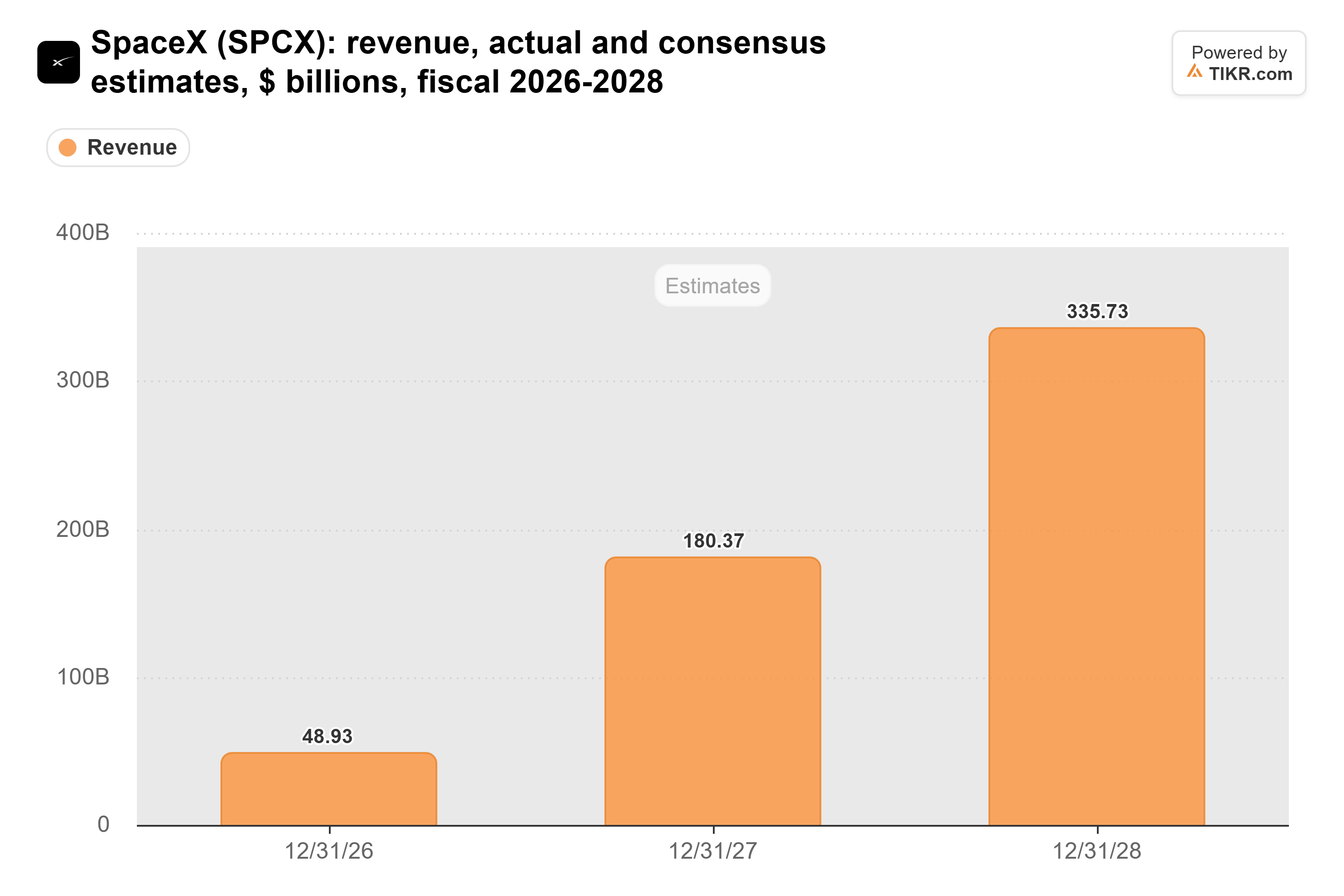
Getting to $336 billion in 2028 means renting out far more compute, and this debt is how SpaceX plans to pay for it. Morgan Stanley’s $300 target puts $165 on enterprise AI and $118 on connectivity, Starlink included.
SpaceX owes the rent no matter what
A special purpose vehicle managed by Apollo-backed Atlas SP buys the chips and issues the debt. Bloomberg says the structure keeps it off SpaceX’s balance sheet. The debt and a $7 billion lease prepayment pay for about $47.3 billion of Nvidia’s latest Rubin chips, due in the first half of 2027.
SpaceX rents them for five years, and its marketing presentation reportedly says the rent is owed whatever happens to the equipment, force majeure included.
So these lenders are counting on all of SpaceX, Starlink and launches included. That’s Musk’s rule at work.
The catch: SpaceX owes five years of rent, but its biggest customer can leave sooner. Bloomberg identified Anthropic as the source of 34.5% of third-quarter revenue. Either side can end that contract on 90 days’ notice after its first three months.
SpaceX’s debt was already climbing, too:
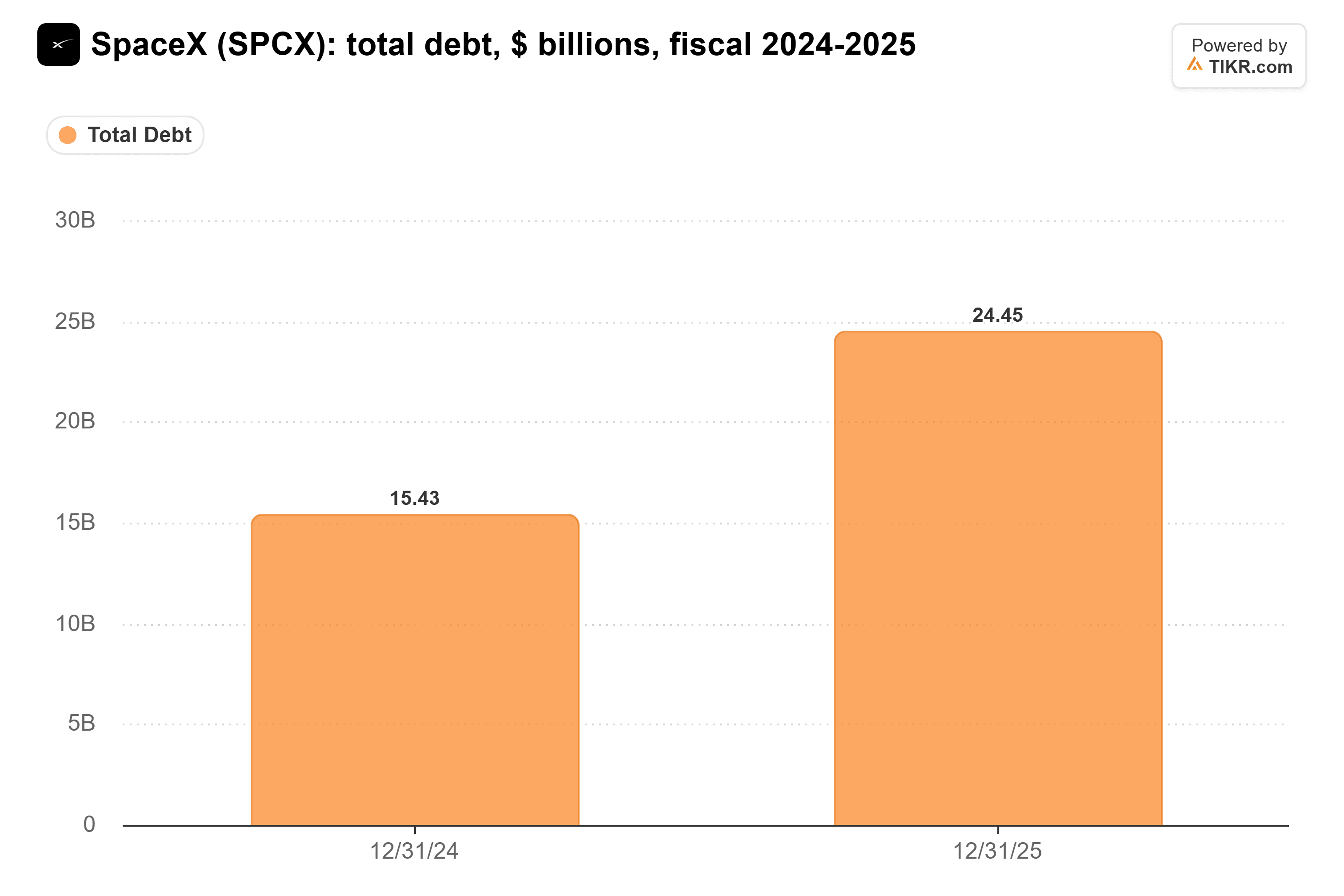
Debt and finance leases reached $38.8 billion by Sept. 30, up from $22.9 billion at the end of 2025. Yet SpaceX’s own filing calls this deal a master finance lease. If it lands on that line too, $40 billion would more than double it.
Starlink can’t pay for all of this
Starlink makes SpaceX a good credit by Musk’s standard: Connectivity earned $5.21 billion from operations in the first nine months, while space and AI lost a combined $4.51 billion.
But the data-center build costs far more than Starlink earns:
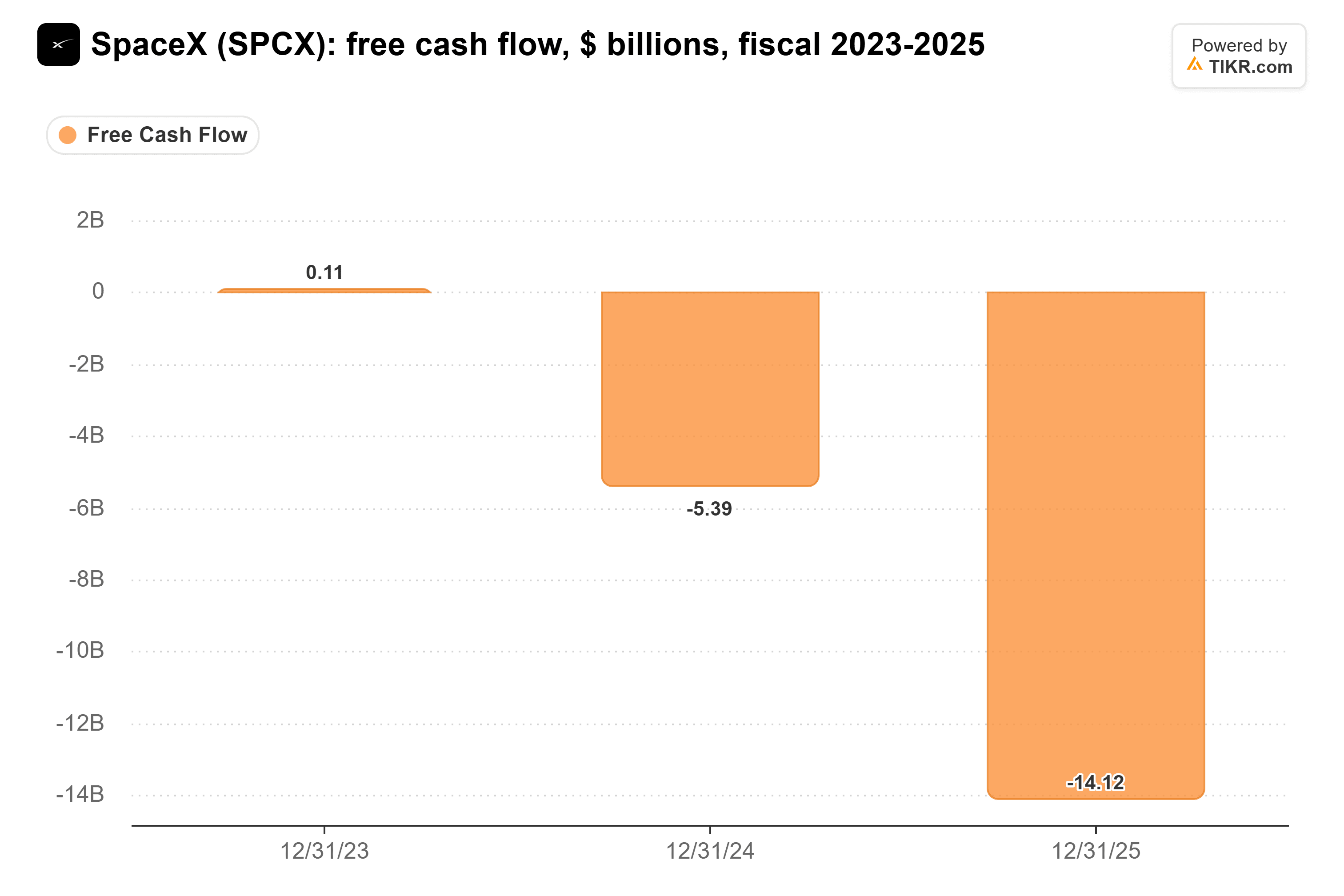
Free cash flow was -$10.0 billion in the third quarter alone. Morgan Stanley doesn’t see it turning positive until 2031, and it expects $390 billion of outside borrowing along the way.
So this $40 billion is just the start.
Selling the loan down is routine
Goldman reportedly led an $8.3 billion senior-secured loan that goes to other banks, and Apollo was the key investor in the bonds headed to asset managers. Banks arrange deals like this to sell them, so the sale itself says little.
The backdrop is less routine. Investors agreed to the package before it priced, which left them exposed as lenders turned against neoclouds such as CoreWeave.
Blundin’s version of Musk’s pitch is that lenders should skip the other AI clouds at 15% and lend to SpaceX at about 8%. If these bonds price near the low end, buyers see SpaceX. Near the high end, they see Patel’s neocloud.
The way I see it, this debt sells, because the deal hands lenders SpaceX’s credit. Shareholders get no such cushion: more than half of Morgan Stanley’s $300 target sits on the AI business, the part Musk says he’d never lend to on its own. I’d want to see where these bonds price before paying up for that.
Of course, the Rubin chips don’t arrive until the first half of 2027, and SpaceX’s fourth-quarter results early next year will show how much cash its $35 billion to $40 billion capex quarter used.
So what is SpaceX stock actually worth?
TIKR lets you forecast the future price of any stock in less than a minute. Just enter a few assumptions into TIKR’s valuation model and see what SpaceX could be worth. Start from Wall Street consensus estimates, or adjust the inputs to reflect your own view of the business. It’s free to use.
Disclaimer:
Please note that the articles on TIKR are not intended to serve as investment or financial advice from TIKR or our content team, nor are they recommendations to buy or sell any stocks. We create our content based on TIKR Terminal’s investment data and analysts’ estimates. Our analysis might not include recent company news or important updates. TIKR has no position in any of the stocks mentioned. Thank you for reading, and happy investing!