Key Takeaways
- Elon Musk said at the DealBook Summit that he shouldn’t receive Tesla stock awards just for merging Tesla with SpaceX.
- That eases a real dilution worry, since his 2025 pay package covers 423.7 million shares, but it’s a statement, not a deal term, and the exchange ratio still matters most for Tesla holders.
- Analysts expect SpaceX’s revenue to reach $338 billion in 2028, more than twice the $146.1 billion they expect from Tesla, while Tesla trades at about 180x forward earnings.
- Any merger needs the votes of a majority of Tesla’s outstanding shares, and Musk admitted Tesla’s vote could fail.
Elon Musk has answered one of the biggest questions hanging over a merger of Tesla (TSLA) and SpaceX (SPCX): what happens to his Tesla pay.
At the New York Times’ DealBook Summit on Nov. 18, Andrew Ross Sorkin asked him whether he should get his Tesla pay award, which is tied to Tesla’s own operating targets, if the companies merge.
Musk’s response? Referring to awards “contingent upon Tesla execution,” he said, “I should not receive those stock option awards simply for merging with SpaceX.”
That leaves Tesla holders with the harder question of what a deal would actually pay them.
The award is no small thing
The package Tesla shareholders approved in November 2025 covers 423.7 million shares, about 12% of the 3.53 billion diluted shares Tesla averaged in 2025. Each of its 12 tranches normally requires both a market-value milestone, from $2 trillion to $8.5 trillion, and an operational goal such as 20 million vehicles delivered. Over the last five years, Tesla’s diluted share count has gone up only slowly:
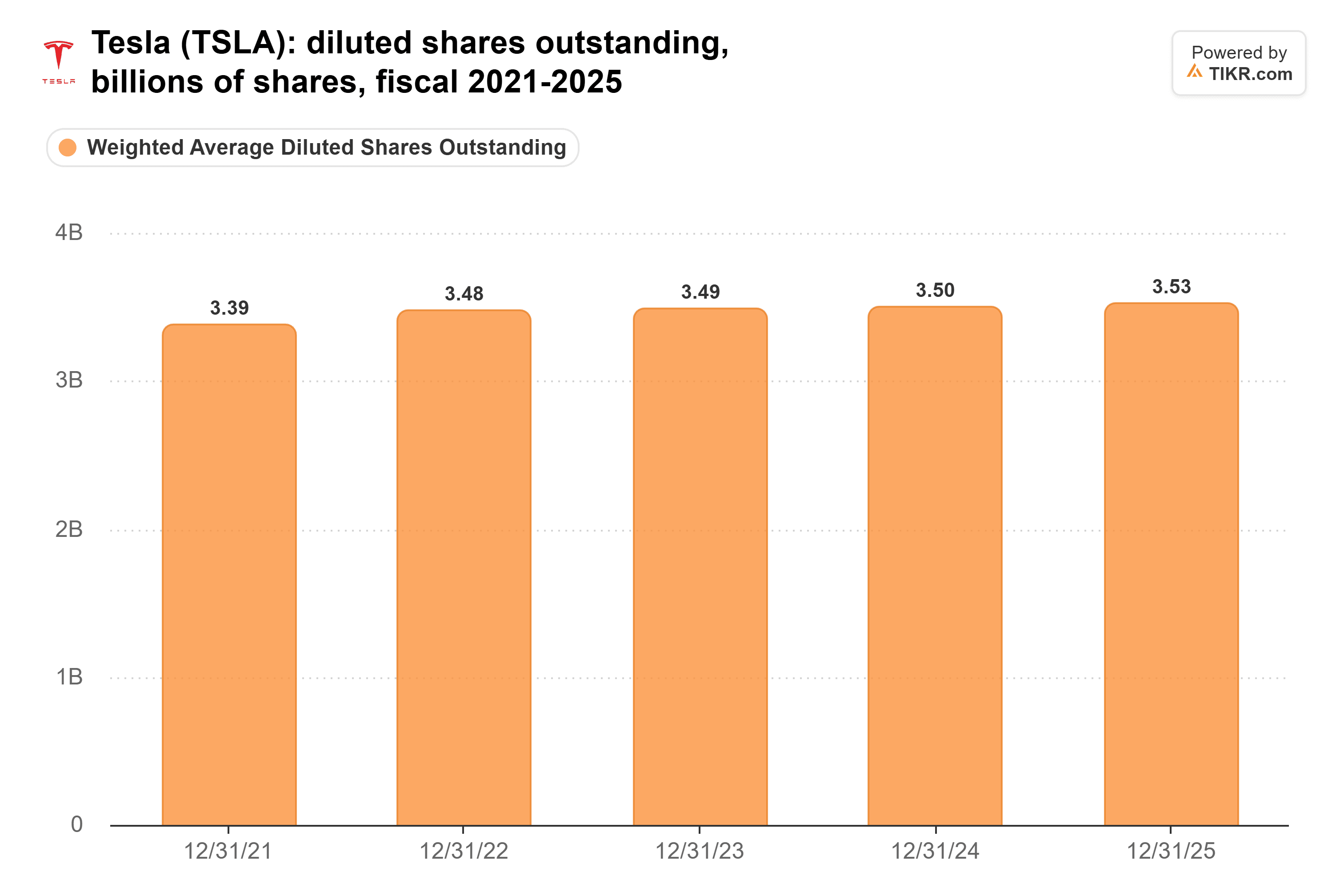
The award alone is about 3x the 140 million shares that count added from 2021 to 2025. Under its terms, if a deal counts as a change in control, the operational goals drop out and shares can be earned on market value alone. A merger that let Musk collect shares that way would have cost Tesla holders plenty.
TIKR tracks 40 analysts on SpaceX. How many say “Buy”?
See the full breakdown of Buy, Hold, and Sell ratings on SpaceX, along with Wall Street’s revenue and earnings estimates, all in one place. More than 500,000 investors use TIKR to research stocks like this one. See SpaceX’s Analyst Ratings
The exchange ratio is the real test
Whether Tesla holders come out ahead depends on the exchange ratio, which depends on how the market values each company when the terms are set.
Analysts expect SpaceX’s revenue to climb from $49.0 billion in fiscal 2026 to $338 billion by 2028:
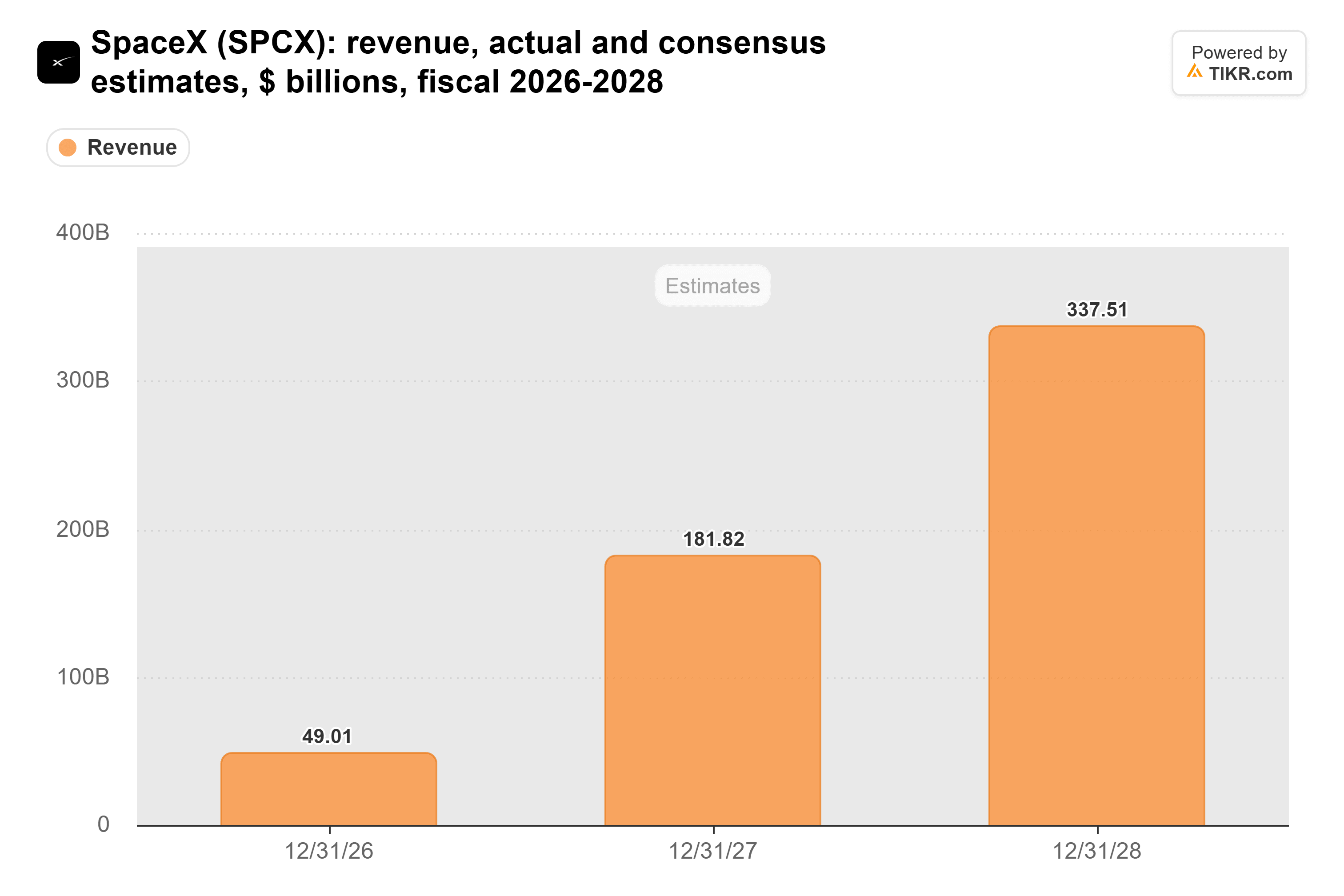
That’s more than twice the $146.1 billion analysts expect from Tesla in 2028. If the ratio follows the size of the two businesses, Tesla holders end up with the smaller share of the combined company. Bank of America analyst Alexander Perry put a number on it in an Oct. 29 note: at Oct. 20 closing prices, a swap with no premium would leave Tesla holders with 42.4%.
Tesla holders’ best bargaining chip is their own stock. Tesla trades at about 180x forward earnings, far above its five-year average of 109x:
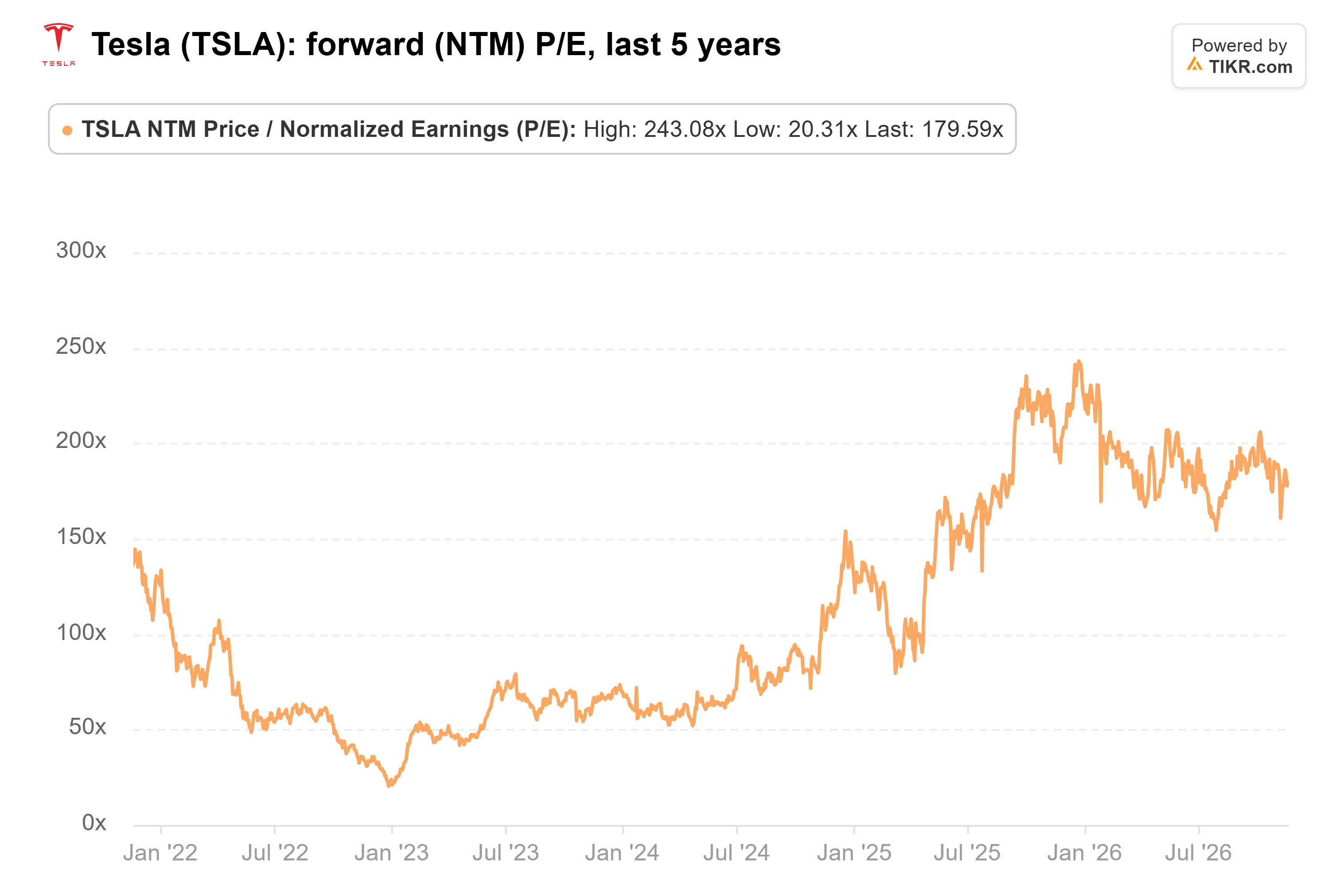
All else equal, Tesla holders get more of the combined company if terms are set while that multiple sits near 180x than if it falls back toward its average.
Tesla’s vote is no formality
Musk named the risk himself: “These require shareholder votes, which may or may not succeed, at least in the case of Tesla.”
That’s a high bar. A Tesla merger vote needs a majority of all outstanding shares, so a share that isn’t voted counts the same as a no. Both boards have formed special committees of independent directors to negotiate, and Musk has stepped back from their talks.
Tesla is already pushing for turnout ahead of its Dec. 3 annual meeting, where holders vote on directors. There’s no merger on that ballot, so a deal would need its own vote later, where turnout matters even more. Musk posted a reminder on X on Nov. 19: “Remember to cast your Tesla votes!”
What the committees’ terms need to show
Musk’s pledge on the award removes one source of friction, and it could make any deal easier to sell. The bigger test is the ratio: whether the terms pay a premium on Tesla’s current rich multiple and value its robotaxi and Optimus business in its own right.
Perry expects a 20% to 30% premium, which in his math would still leave Tesla holders with less than half of the combined company. There are no terms yet, and the first numbers from the special committees will show how close they come.
So what is Tesla stock actually worth if the deal doesn’t go through?
TIKR lets you forecast the future price of any stock in less than a minute. Just enter a few assumptions into TIKR’s valuation model and see what Tesla could be worth. Start from Wall Street consensus estimates, or adjust the inputs to reflect your own view of the business. It’s free to use.
Disclaimer:
Please note that the articles on TIKR are not intended to serve as investment or financial advice from TIKR or our content team, nor are they recommendations to buy or sell any stocks. We create our content based on TIKR Terminal’s investment data and analysts’ estimates. Our analysis might not include recent company news or important updates. TIKR has no position in any of the stocks mentioned. Thank you for reading, and happy investing!