SpaceX (SPCX) has the money for its next wave of AI chips. In a post on X on Sunday, October 25, Elon Musk said SpaceX had closed $40 billion of mostly callable debt to buy GPUs, for deliveries in the first and second quarters of 2027. Reuters noted it wasn’t clear whether pricing had been agreed, and Musk named no lenders, rate or maturity.
SpaceX stock closed at $147.44 on Friday, so Monday’s session is the first chance for shares to react. Nvidia (NVDA) is the other name in play: Musk has said SpaceX will build its data centers on Nvidia hardware alone.
Why SpaceX Could Borrow $40 Billion
Musk kept the explanation short: “we’re investment grade and have Starlink & launch revenue.”
The deal has been in the works for weeks. On October 6, SpaceX was reported to be raising $40 billion for Nvidia chips, split into about $10 billion of bank loans and $30 billion of investment-grade debt, with Apollo Global Management (APO) expected to lead. Bloomberg later reported the plan would use a special purpose vehicle to keep the debt off SpaceX’s balance sheet and protect its credit rating. (Whether “closed” means that structure is final is still unclear.)
SpaceX’s Balance Sheet Can Carry It, for Now
SpaceX ended September with $51.3 billion in cash plus $38.6 billion in marketable securities, according to its third-quarter results. Total debt was $38.8 billion, roughly flat since June.

If all $40 billion lands on the balance sheet, total debt more than doubles to about $79 billion. The spending explains why SpaceX wants it. Operating cash flow rose to $9.6 billion in the third quarter, but capex hit $19.6 billion, a gap of about $10 billion. Through nine months, SpaceX spent $48.1 billion on capex against $13.1 billion of operating cash flow.

The bill is about to get bigger. SpaceX guided to $35 billion to $40 billion of fourth-quarter capex, so the new debt covers about one quarter’s worth of spending at that pace.
TIKR Tracks 63 Analysts on SpaceX. How Many Say “Buy”?
See the full breakdown of Buy, Hold, and Sell ratings on SpaceX, along with Wall Street’s revenue and earnings estimates, all in one place. More than 500,000 investors use TIKR to research stocks like this one. See SpaceX’s Analyst Ratings
Sizing the $40 Billion for Nvidia
The GPUs land in the first half of 2027, which falls mostly in Nvidia’s fiscal 2028 (the year ending January 2028). Analysts already expect Nvidia’s revenue to climb from $412 billion this fiscal year to $692 billion in fiscal 2028.
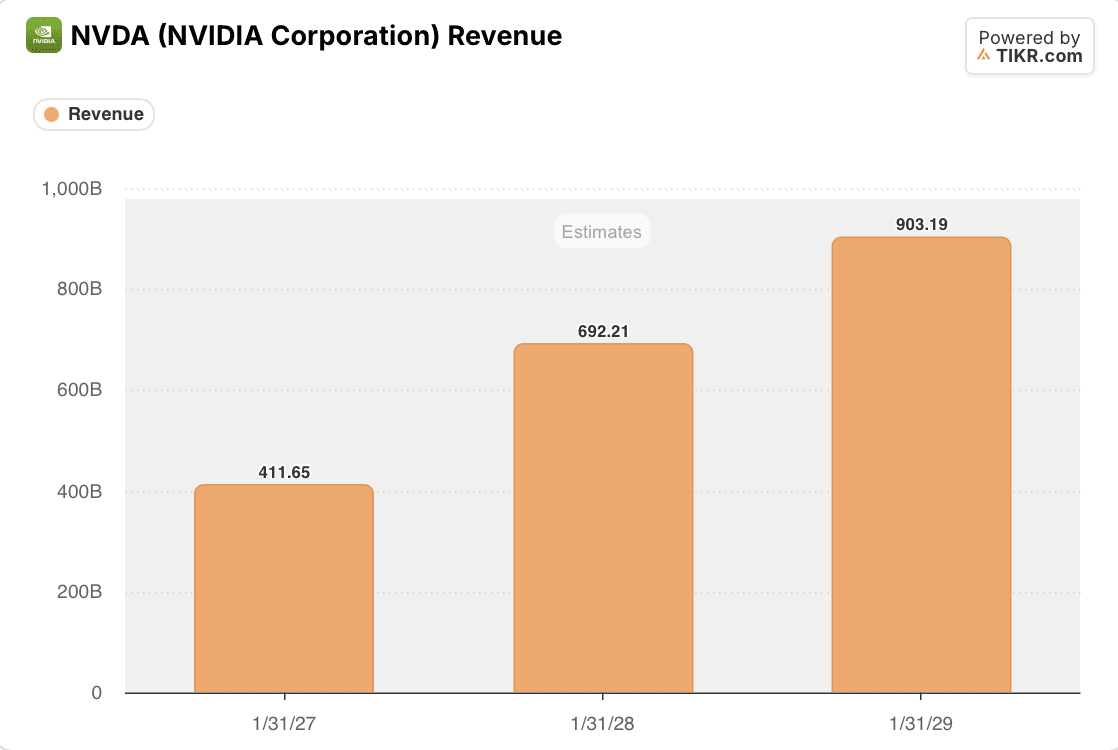
Even if every dollar went to Nvidia, $40 billion would be about 6% of fiscal 2028 estimates, or about 14% of the $281 billion of growth analysts already model. Treat that as a ceiling. The October 6 reports described a financing plan rather than a confirmed order, and nothing disclosed shows how much reaches Nvidia’s revenue line, or when. The deal does show SpaceX can pay for its 2027 chips.
Musk’s Warning Cuts Both Ways for Nvidia
The second half of Musk’s post may matter more. He said debt markets have nearly shut off funding for companies without substantial revenue outside AI data centers, and predicted that more than 200 neoclouds will consolidate into a few survivors.
CoreWeave (CRWV) and Nebius (NBIS) fit that description: both rent out Nvidia GPUs and lean heavily on debt to fund their buildouts. That’s the catch for Nvidia. SpaceX’s $40 billion shows the strongest buyers can still borrow. If smaller ones can’t, Nvidia’s demand narrows to fewer, bigger customers with more bargaining power.
Conclusion
The $40 billion says more about SpaceX’s credit than about new Nvidia demand. At most, that’s about 6% of Nvidia’s fiscal 2028 revenue estimate, and how much is new to analysts is unknown.
For SpaceX, the debt looks manageable as long as Starlink keeps paying: the Connectivity segment earned $2.37 billion of operating income in the third quarter. SpaceX’s $33 billion to $37 billion first-quarter 2027 revenue guide covers the whole company, so it won’t settle this. The test is the cash the new GPUs generate once deployed, and SpaceX’s 2027 results will show it.
So What Is SpaceX Stock Actually Worth?
TIKR lets you forecast the future price of any stock in less than a minute. Just enter a few assumptions into TIKR’s valuation model and see what SPCX stock could be worth. Start from Wall Street consensus estimates, or adjust the inputs to reflect your own view of the business. It’s free to use.
Value Space Exploration Technologies Corp. for free→
Disclaimer:
Please note that the articles on TIKR are not intended to serve as investment or financial advice from TIKR or our content team, nor are they recommendations to buy or sell any stocks. We create our content based on TIKR Terminal’s investment data and analysts’ estimates. Our analysis might not include recent company news or important updates. TIKR has no position in any of the stocks mentioned. Thank you for reading, and happy investing!