Key Takeaways
- The FCC approved up to 1 million SpaceX compute satellites on Nov. 25, and Musk says SpaceX leads the world “by an order of magnitude.”
- One X user’s math puts orbital compute at about $21 million per megawatt at Starship-era launch prices.
- At IREN’s GPU-and-server cost, the compute hardware alone would cost more than that user’s whole satellite.
SpaceX (SPCX) won the FCC’s conditional approval on Nov. 25 for Starmind, up to a million compute satellites.
A day later, X user @TSLAFanMtl ran the numbers on an orbital satellite and called Starship “an insurmountable moat.”
Elon Musk’s response? “No advantage is insurmountable, but, at least for now, SpaceX is beating the rest of the world by an order of magnitude and that lead appears to be widening.”
So even Musk won’t call it a moat. Still, the lead reaches IREN (IREN), which builds the ground AI data centers orbit must undercut, and Planet Labs (PL), whose Suncatcher prototype with Google went up on a SpaceX rideshare on Oct. 1. SpaceX says it has put more than 80% of the world’s mass into orbit each year since 2023.
The Price of a Kilogram Does the Work
The post assumes a 3-tonne satellite that costs $3 million to build and carries 175 kW of compute. Launching it at $250 per kilogram costs $750,000, so 175 kW lands in orbit for $3.75 million, or about $21 million per megawatt.
Baron Capital CEO Ron Baron, whose funds own SpaceX, wrote on X that “data centers built by others cost on average $60 billion for a gigawatt,” and he estimates SpaceX builds its own gigawatt for $35 billion. On the post’s numbers, the satellite costs about a third of what others pay on the ground.
At the post’s Falcon price of $1,000 per kilogram, though, the launch alone costs $3 million, and the satellite comes to about $34 million per megawatt, about what Baron says SpaceX pays on the ground.
The Chips Cost the Same in Orbit
At $250 per kilogram, the launch is only a fifth of the bill. The priciest part of any AI computer is the chips, and they cost the same in orbit as in Texas. IREN’s 200 MW Microsoft contract a year ago came with $5.8 billion of GPUs and related equipment, or $29 million per megawatt. At that rate, 175 kW of that hardware would cost about $5.1 million, more than the post’s whole satellite.
TIKR Tracks 41 Analysts on SpaceX. How Many Say “Buy”?
See the full breakdown of Buy, Hold, and Sell ratings on SpaceX, along with Wall Street’s revenue and earnings estimates, all in one place. More than 500,000 investors use TIKR to research stocks like this one. See SpaceX’s Analyst Ratings
For Now, SpaceX’s Money Goes to the Ground
SpaceX has until Nov. 25, 2033, to get its first Starmind satellite working. Analysts expect revenue to climb from $49.1 billion in 2026 to $336 billion in 2028:

Spending is on the ground. Capex rose from $4.42 billion in 2023 to $20.9 billion in 2025, far more than cash from operations:
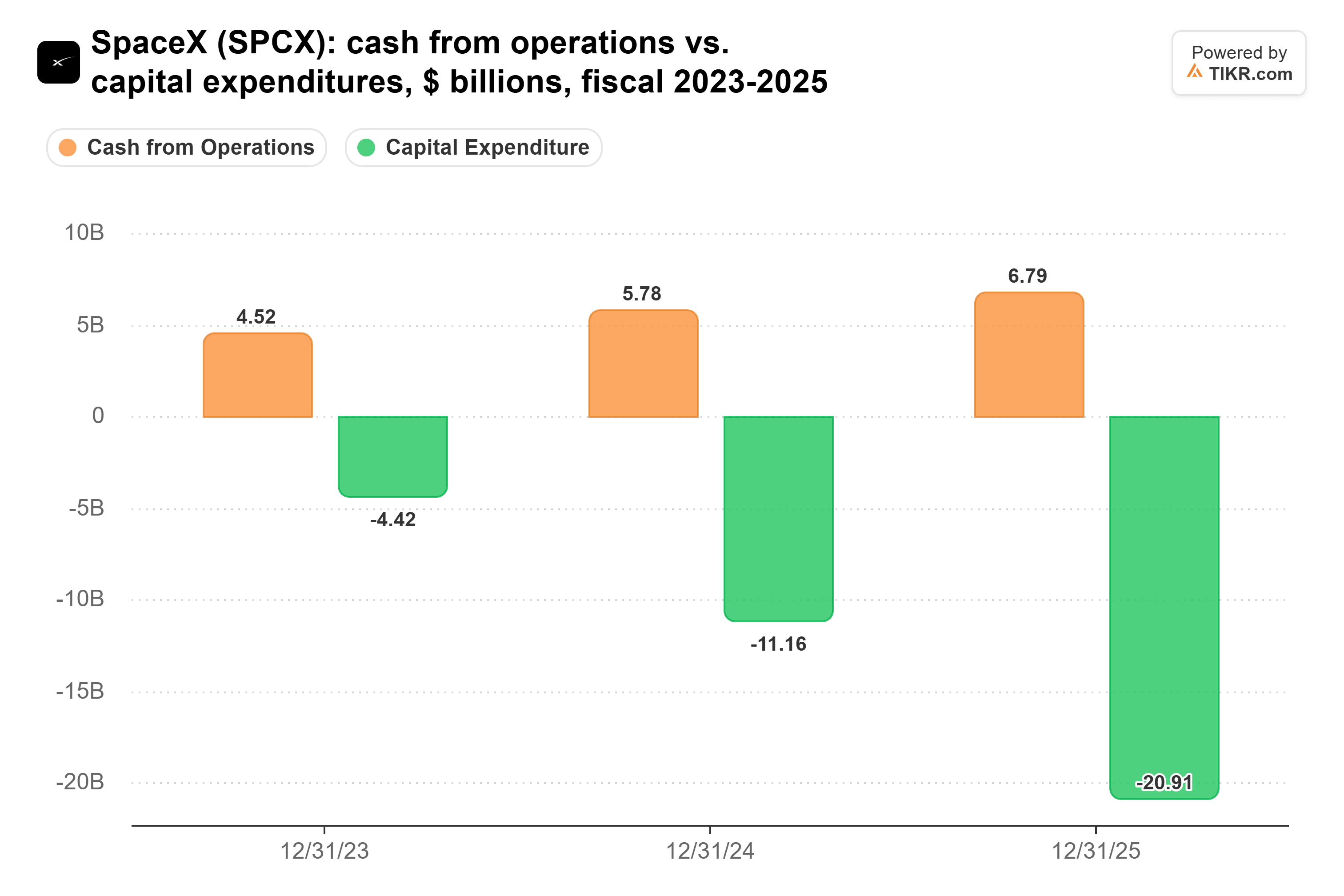
SpaceX spent another $48.1 billion in the first nine months of 2026, 83% of it in the segment that runs its AI data centers.
Planet’s own satellites flew on the Suncatcher rideshare, despite a launch deal with Germany’s Isar Aerospace. Scaling orbital compute means buying rides from a would-be rival.
SpaceX Has a Real Lead With a Distant Payoff
Musk’s lead is why orbital compute pencils out at all, but it can’t make the chips any cheaper. I’d treat Starmind as an option near-term estimates don’t count yet, on top of a ground buildout that must pay for itself first.
The number to watch is Starship’s cost per kilogram. On the post’s numbers, orbit undercuts the ground near $250. Near $1,000, it only ties SpaceX’s own ground builds.
So What Is SpaceX Stock Actually Worth?
TIKR lets you forecast the future price of any stock in less than a minute. Just enter a few assumptions into TIKR’s valuation model and see what SpaceX could be worth. Start from Wall Street consensus estimates, or adjust the inputs to reflect your own view of the business. It’s free to use.
Disclaimer:
Please note that the articles on TIKR are not intended to serve as investment or financial advice from TIKR or our content team, nor are they recommendations to buy or sell any stocks. We create our content based on TIKR Terminal’s investment data and analysts’ estimates. Our analysis might not include recent company news or important updates. TIKR has no position in any of the stocks mentioned. Thank you for reading, and happy investing!