Key Takeaways
- The FCC approved SpaceX’s request for up to 1 million Starmind data-center satellites, and Elon Musk called it “a great asset to America and the world.”
- SpaceX has until November 2033 to have its first satellite working and until 2035 to reach 100,000.
- Until then, SpaceX’s computing revenue depends on data centers on the ground, which leaves GE Vernova’s turbine demand safe this decade.
- The next test is SpaceX’s fourth-quarter report in early 2027.
The FCC has given SpaceX (SPCX) something no company has had before: a US license for data centers in space.
“Today, in a historic first, the FCC approved SpaceX’s request for 1 million satellites (orbital compute modules) to create data centers in space,” FCC Chairman Brendan Carr posted on X on Nov. 25.
SpaceX CEO Elon Musk’s response? “Much appreciated. This will be a great asset to America and the world.”
The license comes with a long deployment schedule, though. Until those satellites go up in real numbers, AI data centers will keep getting their power on the ground. That’s good news for GE Vernova (GEV), whose order book for the gas turbines and grid equipment those data centers need keeps growing.
SpaceX has until 2033 to fly the first one
Under the FCC’s order, SpaceX needs this many Starmind satellites working by Nov. 25 of each year:
- 2033: 1
- 2035: 100,000
- 2038: 500,000
- 2040: 1,000,000
According to reports on the order, the authorization becomes void if SpaceX misses one. The grant is also narrower than the headline number: it covers only the satellites’ backup Ka-band radio links, and SpaceX must file a final debris plan before deploying any above 600 km. Those dates are only the minimums, of course, and SpaceX can move faster. But orbital computing is a business for the 2030s.
SpaceX shares had a volatile session on Nov. 25, falling more than 9% before closing up 1.3% at $127.44.
TIKR tracks 41 analysts on SpaceX. How many say “Buy”?
See the full breakdown of Buy, Hold, and Sell ratings on SpaceX, along with Wall Street’s revenue and earnings estimates, all in one place. More than 500,000 investors use TIKR to research stocks like this one. See SpaceX’s Analyst Ratings
Analysts aren’t counting on orbit
Analysts’ estimates end well before the first deadline anyway. Consensus has SpaceX’s revenue climbing from $49.1 billion in fiscal 2026 to $336 billion in fiscal 2028:

That growth has to come from Starlink and from the data centers SpaceX runs or is building on Earth. Its Super Intelligence segment produced $7.56 billion of the third quarter’s $14.6 billion of revenue, and a single customer accounted for 34.5% of it.
The FCC’s order shouldn’t move those estimates: the first satellite isn’t due until nearly five years after the last year they cover.
SpaceX is spending on Earth first
SpaceX’s capital spending rose from $4.4 billion in fiscal 2023 to $20.9 billion in fiscal 2025:

And it’s climbing much faster now. SpaceX spent $48.1 billion on capital projects in the first nine months of 2026, and it has guided to another $35 billion to $40 billion in the fourth quarter.
As spending rose, free cash flow went from slightly positive in fiscal 2023 to negative $14.1 billion in fiscal 2025:
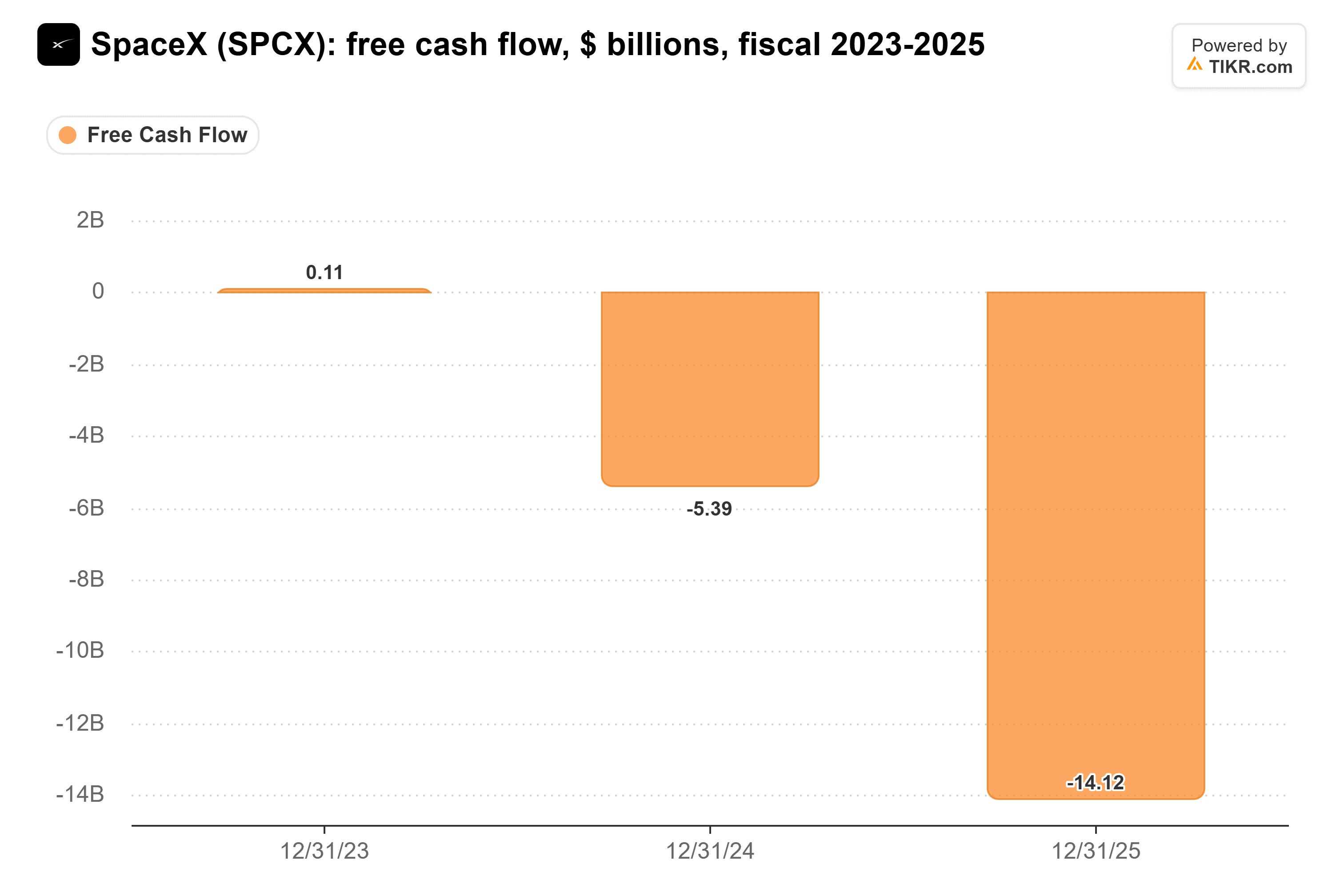
Over the 12 months to Sept. 30, free cash flow was negative $39.3 billion. On Nov. 19, SpaceX also sold $32 billion of chip-backed debt to buy AI chips, with the largest piece yielding 8.259%. Whatever Starmind costs, SpaceX will have to pay for it on top of all that.
No orbital threat to GE Vernova’s turbines
GE Vernova took $29.3 billion of orders in the third quarter, up 96% organically. Its gas equipment under contract (backlog plus slot reservations) rose to 122 GW from 116 GW, a smaller gain than the double-digit jumps earlier in 2026, according to Utility Dive. Management still expects at least 130 GW by the end of 2026.
If computing in orbit doesn’t arrive at scale until the mid-2030s, it’s no threat to the turbines GE Vernova is building this decade. The question for its next report, scheduled for Jan. 27, is whether data-center buyers keep reserving production slots further into the 2030s.
A real option, with a long runway
Musk is right that it’s a great asset. Still, the approval mainly gives SpaceX an option on the 2030s. Until then, it still has to earn its keep on the ground by renting out computing power fast enough, and to enough customers, to carry the debt it’s taking on.
The next test comes with fourth-quarter results in early 2027. Spending needs to stay within the $35 billion to $40 billion range, and cash and marketable securities, which stood at $89.9 billion as of Sept. 30, need to hold up.
So what is SpaceX stock actually worth?
TIKR lets you forecast the future price of any stock in less than a minute. Just enter a few assumptions into TIKR’s valuation model and see what SpaceX could be worth. Start from Wall Street consensus estimates, or adjust the inputs to reflect your own view of the business. It’s free to use.
Disclaimer:
Please note that the articles on TIKR are not intended to serve as investment or financial advice from TIKR or our content team, nor are they recommendations to buy or sell any stocks. We create our content based on TIKR Terminal’s investment data and analysts’ estimates. Our analysis might not include recent company news or important updates. TIKR has no position in any of the stocks mentioned. Thank you for reading, and happy investing!