Key Takeaways
- Elon Musk said on Monday that trials letting Tesla owners add their own cars to the Robotaxi network may start next month, if things go well.
- Owners’ cars would let Tesla grow its fleet without buying the cars, as it guides to about $20 billion of capital spending this year.
- Each owner who sends a car out for Tesla is a car Uber loses, and Uber’s operating margin only turned positive in 2023.
- Musk’s robotaxi dates have slipped before, so the date to watch is when owners’ cars start earning money in the network. Tesla has put that around the second quarter of 2027.
An Uber driver in Austin just told Elon Musk he’d rather his Model Y work for Tesla (TSLA) without him than keep driving it for Uber Technologies (UBER). Musk says owners like him may get to start trying that as soon as next month.
The driver calls himself a “Diamond level Uber driver in the Austin area (using FSD exclusively),” and said in a post on X that he gets “anywhere between 49% and 63% of the passenger fare.”
His conclusion: “I’d rather send my Model Y off to work for Robotaxi without me.”
Musk’s response on Monday? “Coming soon. If things [go] well, may start trials next month.”
Then he added a pitch to every driver reading: “Much better to manage a fleet of cars than have to drive just one car by yourself!”
TIKR tracks 44 analysts on Tesla. How many say “Buy”?
See the full breakdown of Buy, Hold, and Sell ratings on Tesla, along with Wall Street’s revenue and earnings estimates, all in one place. More than 500,000 investors use TIKR to research stocks like this one. See Tesla’s Analyst Ratings
Trials would beat Tesla’s own timeline
That’s earlier than anything Tesla has said before. On its third-quarter call in October, management said customer cars would join the Robotaxi fleet “somewhere around Q2 next year.” JPMorgan analyst Rajat Gupta expects the same timing. In a note to clients on Sunday, he wrote that customer-owned cars running unsupervised FSD should become “another, capital-light source of supply” for the network starting in the second quarter of 2027.
A trial is still short of owners actually getting paid. But trials next month would start testing the Model Ys already in owners’ garages months ahead of that date. The news also comes days after Tesla began inviting select customers to buy a Cybercab. Those cars are for personal use only, and Tesla hasn’t said whether they’ll ever be able to join the network.
Analysts aren’t counting on owners’ cars yet
Wall Street’s numbers don’t include any of this. Consensus has Tesla’s normalized EPS rising from $1.66 in 2025 to $3.24 by 2028:
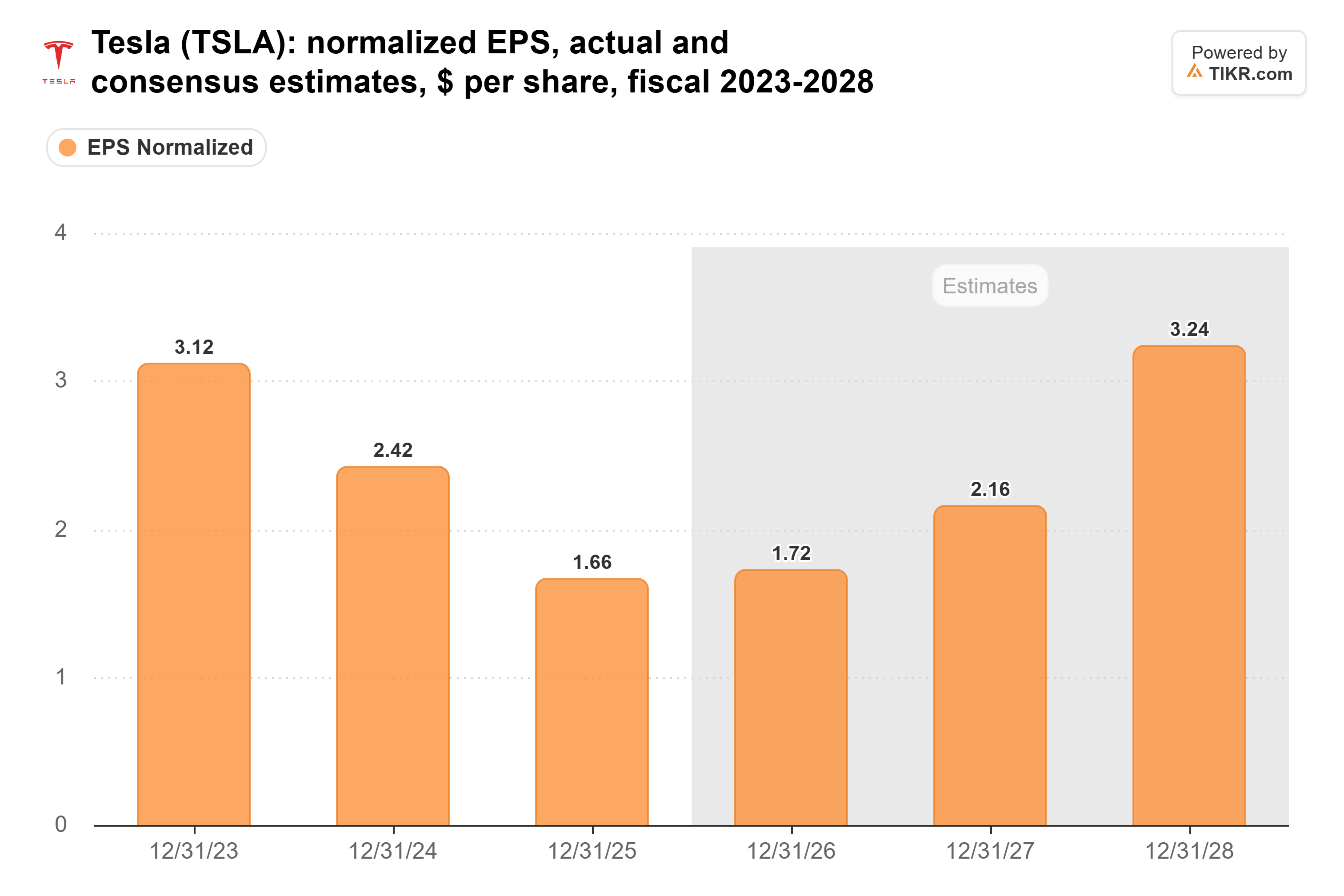
Trials next month shouldn’t move those estimates much, since Gupta expects the Cybercab build’s earnings contribution “to remain limited during the initial build,” with revenue inflecting in 2028. Still, the stakes are big: JPMorgan puts 40% of its sum-of-the-parts value for Tesla on robotaxis and rates the stock Neutral with a $430 price target.
Tesla doesn’t have to buy these cars
Owners’ cars matter because Tesla is already spending heavily on everything else. Its capital spending peaked at $11.3 billion in 2024, then fell to $8.5 billion in 2025:
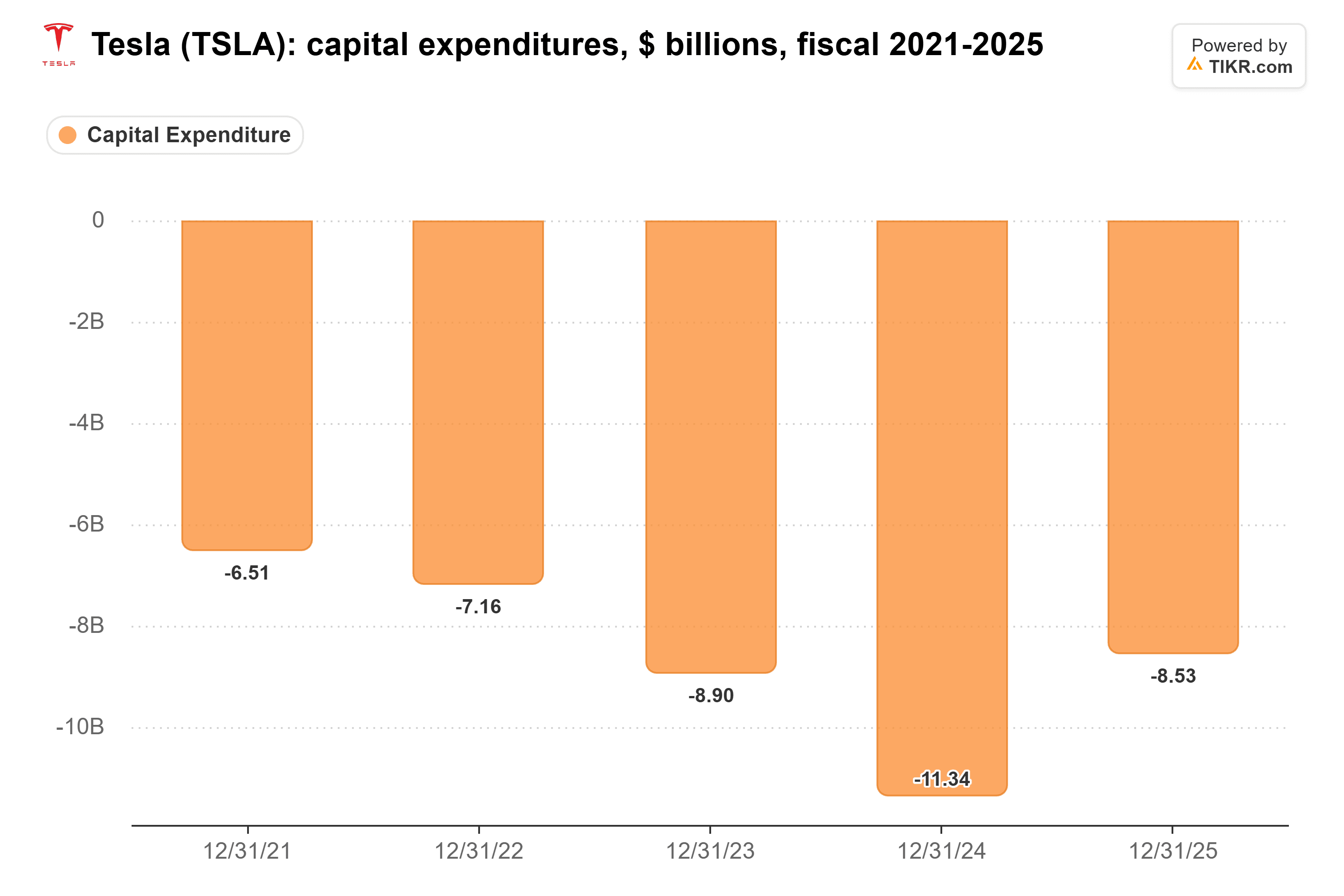
This year it’s going back up. Management guides about $20 billion for 2026, more than twice last year’s total, and says spending will keep growing for several years.
Every Model Y an owner adds to the network is a car Tesla didn’t have to build and pay for. Tesla had 1.74 million active FSD subscriptions at the end of the third quarter. By comparison, Yahoo Finance reported on Monday that it has about 1,300 robotaxis registered in Texas. Not every one of those subscribers’ cars will qualify, and not every owner will want to lend out their car. But even a small share of them would dwarf today’s fleet.
Uber’s drivers own their cars, too
Uber has scaled the same way for years: its drivers bring their own cars, so Uber doesn’t have to buy them. What Tesla is offering is different, because a Tesla owner’s car could earn money without the owner behind the wheel. Tesla hasn’t said how it would split fares with owners. But to a driver who keeps 49% to 63% of each fare and does all the driving himself, any cut of the fare for no work at all is going to look good.
And Uber doesn’t have much margin to spare to keep him. Its operating margin only turned positive in 2023:
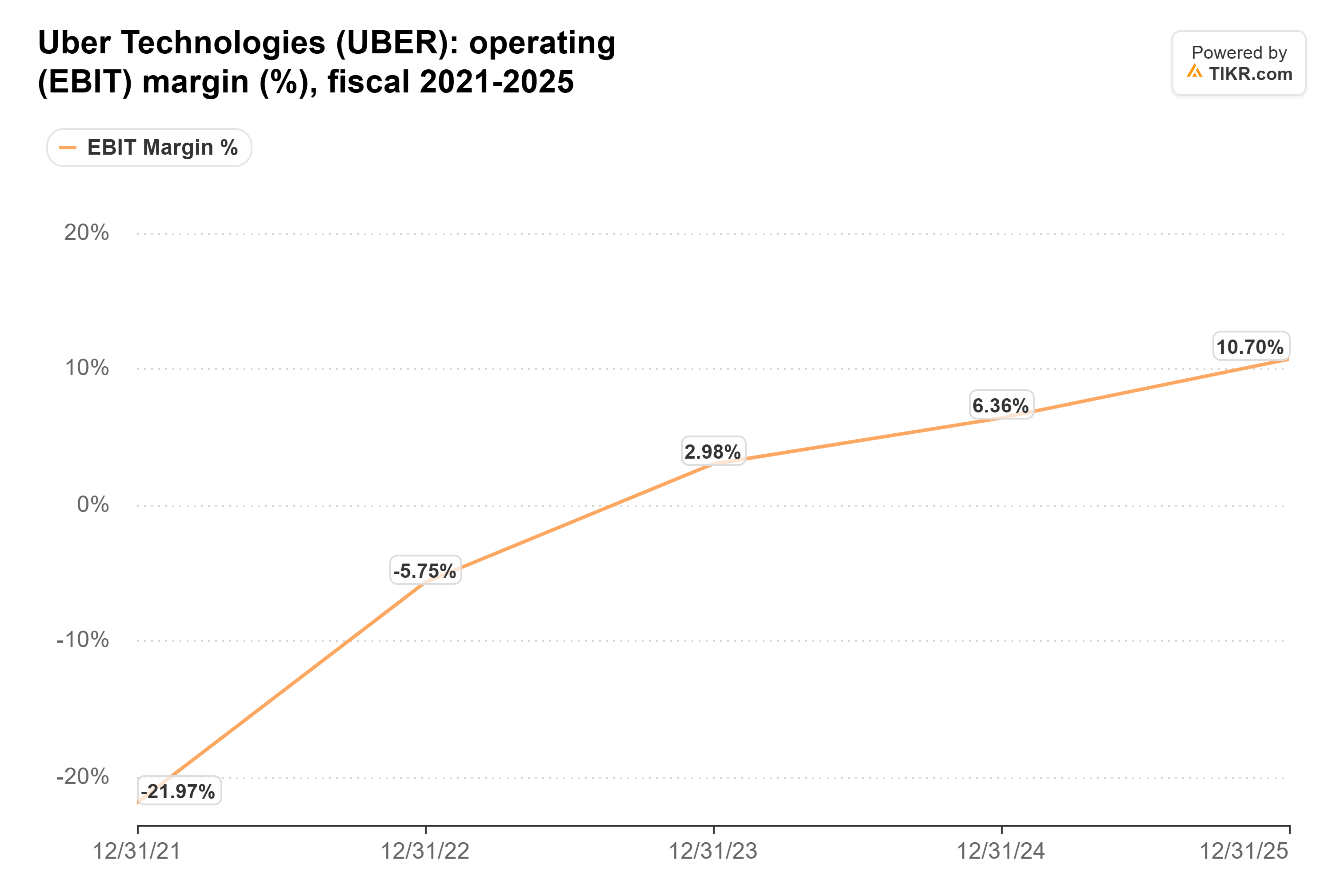
In the third quarter of 2026, Uber’s non-GAAP operating income reached a record 3.9% of gross bookings. That’s real progress, but it’s a thin margin to defend against a rival whose cars don’t need drivers. Of course, Uber has partnered with Waymo and other self-driving companies to put robotaxis in its own app. Still, every owner who sends a car out on Tesla’s network takes a car, and often a driver, off Uber.
Musk’s calendar is the catch
Musk hedged this one himself, with “if things [go] well.” His robotaxi dates have slipped before. In January he expected driverless rides in “dozens of major cities” by the end of 2026, and on the October call management cited six. Regulators are watching, too: NHTSA is looking at a defect petition over school-zone speeding that covers about 1,000 Robotaxis.
The way I see it, owners’ cars are the cheapest way for Tesla to grow its network and the clearest threat it poses to Uber. Tesla gets a bigger fleet without the capex, and Uber loses the cars and drivers its business runs on. The trials will show whether owners take Musk up on the offer. The date that matters more is the one Tesla gave for owners’ cars to start earning money in the network, around the second quarter of 2027.
So what is Tesla stock actually worth?
TIKR lets you forecast the future price of any stock in less than a minute. Just enter a few assumptions into TIKR’s valuation model and see what Tesla could be worth. Start from Wall Street consensus estimates, or adjust the inputs to reflect your own view of the business. It’s free to use.
Disclaimer:
Please note that the articles on TIKR are not intended to serve as investment or financial advice from TIKR or our content team, nor are they recommendations to buy or sell any stocks. We create our content based on TIKR Terminal’s investment data and analysts’ estimates. Our analysis might not include recent company news or important updates. TIKR has no position in any of the stocks mentioned. Thank you for reading, and happy investing!