Key Takeaways
- Elon Musk said rents for SpaceX’s large training clusters are rising, while rents for clusters below about 5,000 GPUs are falling.
- The split favors big-cluster owners like SpaceX and CoreWeave, plus Nvidia, which sells them chips, over smaller neoclouds.
- A fund’s letter estimates Anthropic accepted a 60% rent increase from SpaceX in October, but neither company has confirmed it, and the premium rests on few tenants.
- Nebius’s prepaid deals set it apart from smaller renters, and SpaceX’s first-quarter 2027 revenue against its $33 billion to $37 billion guide is the next test.
What happens to GPU rents as all that new AI capacity comes online?
SpaceX (SPCX) CEO Elon Musk answered on Nov. 28, and his answer depends on size, as he put it on X:
“The rental price for large, coherent blocks of compute configured for high-bandwidth training is increasing, sometimes very significantly, but the price for small amounts of compute (below ~5k GPUs) is decreasing. Overall, the average rental price per GPU for SpaceX compute is rising.”
That matters for CoreWeave (CRWV) and Nebius (NBIS), which rent out GPUs too, for Anthropic (ANT), which pays SpaceX for big blocks, and for Nvidia (NVDA), which sells everyone the chips.
Big training blocks are getting pricier
Leopold Aschenbrenner’s Situational Awareness fund estimated in its third-quarter investor letter that Anthropic accepted a 60% increase in its SpaceX compute rental rate in October, according to a highlight Martin Shkreli posted on X. Neither company has confirmed it.
AI is now more than half of SpaceX’s business: its Super Intelligence segment, home to the compute it rents out, brought in $7.56 billion of its $14.6 billion in third-quarter revenue. Analysts expect total revenue to keep climbing fast, from $49.1 billion in 2026 to $182 billion in 2027 and $336 billion in 2028:
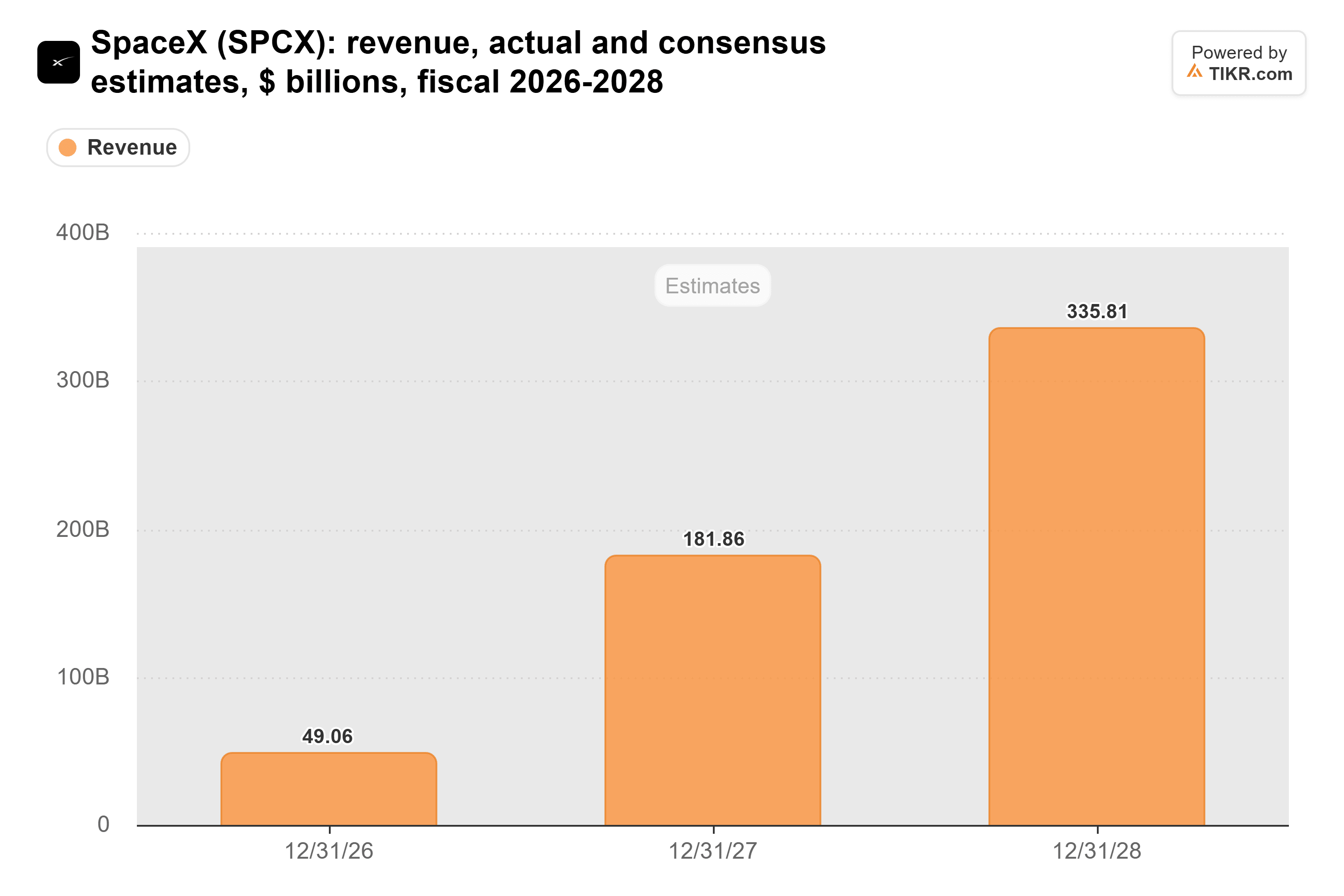
Those estimates were set before Musk’s post, and a rising average rent per GPU gives analysts no obvious reason to cut them.
TIKR tracks 41 analysts on SpaceX. How many say “Buy”?
See the full breakdown of Buy, Hold, and Sell ratings on SpaceX, along with Wall Street’s revenue and earnings estimates, all in one place. More than 500,000 investors use TIKR to research stocks like this one. See SpaceX’s Analyst Ratings
Small clusters are a different story
SpaceX cut its spot price for small Blackwell clusters to $10 to $12 per GPU-hour, from about $15 to $15.50, according to a SemiAnalysis note to institutional clients that Crypto Briefing and other outlets reported and a summary circulating on X relayed. SpaceX hasn’t confirmed the change.
That’s the end of the market investors worry about for Nebius. Its gross margin nearly doubled in less than two years, to 77.6% in the quarter to Sept. 30, 2026, from 40.1% in the quarter to Dec. 31, 2024:
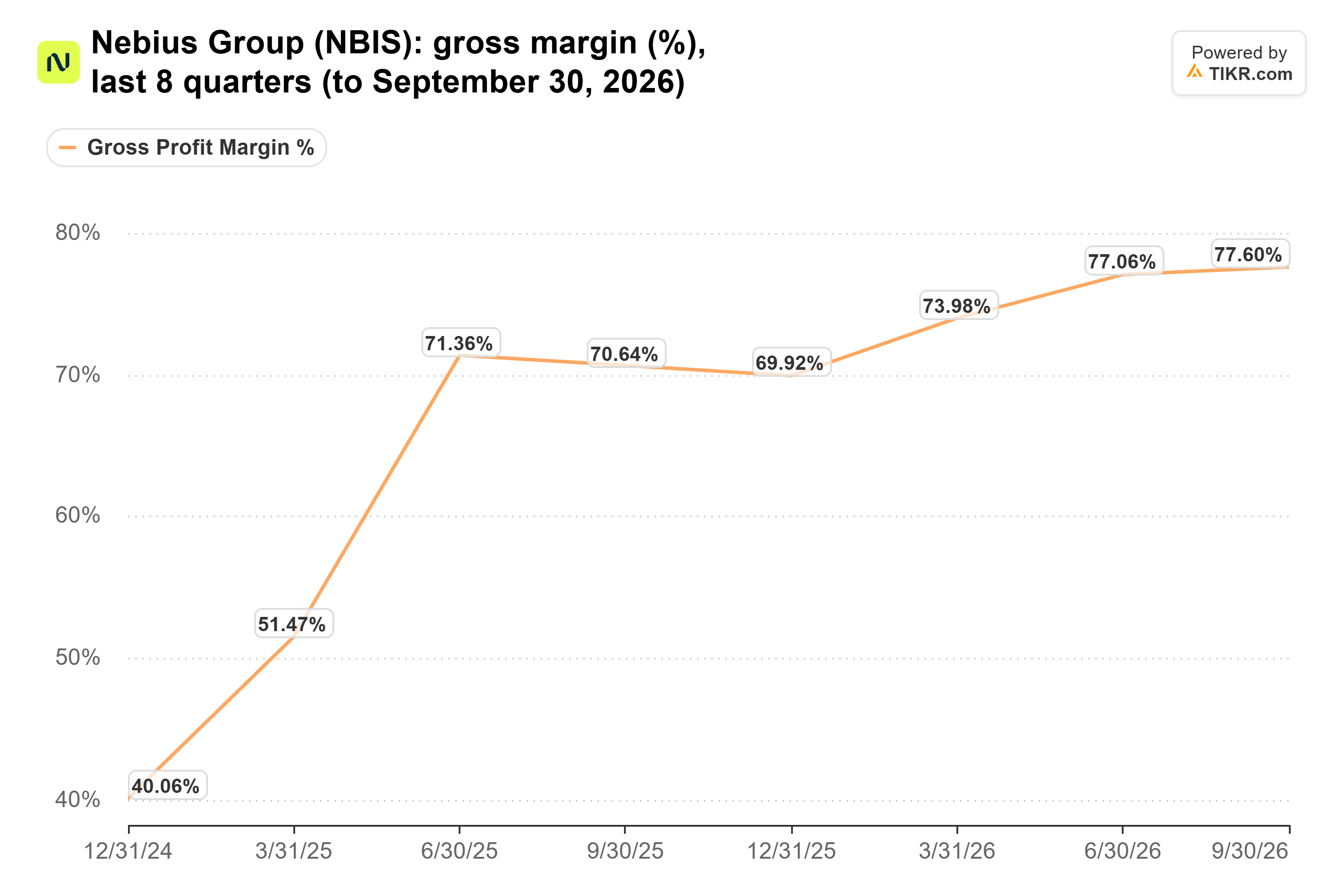
A margin that rich has plenty of room to shrink if rents fall. But Nebius has been signing deals that look more like the big end of the market. Founder and CEO Arkady Volozh wrote in his third-quarter letter: “Prepayments on Q3 agreements covered more than 100% of the associated capex.” Smaller neoclouds without contracts like that have the most to lose.
The big-cluster owners come out ahead
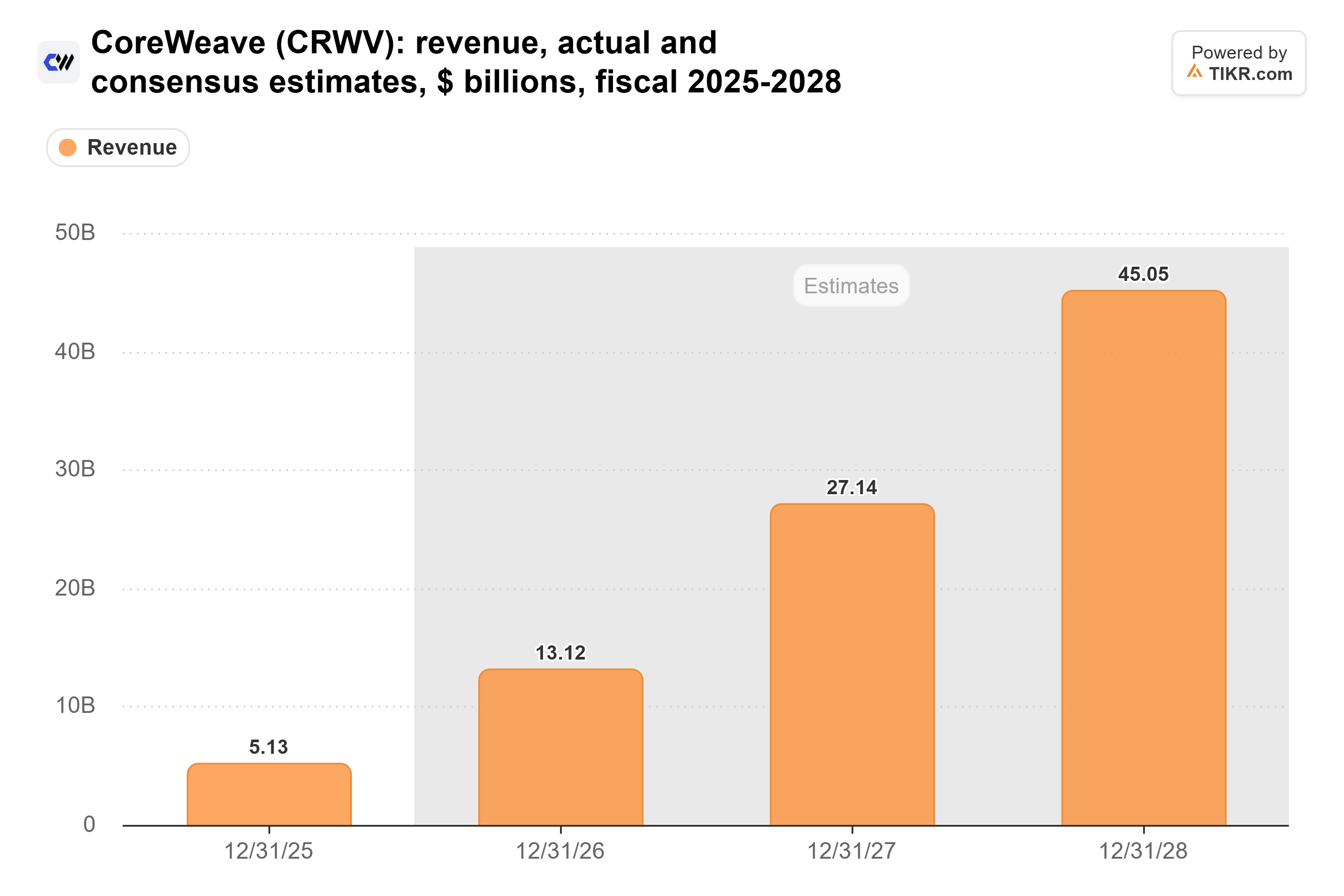
After SpaceX, CoreWeave looks like the clearest winner, since its growth comes from renting the big clusters AI labs train on. Analysts expect its revenue to more than double in 2026, to $13.1 billion from $5.13 billion, and reach $45.1 billion by 2028:
Nvidia wins too: lead times for new orders of its B300, the chip big training clusters are built on, now run 26 to 40 weeks, Taiwan’s Commercial Times reported, citing Nvidia’s server makers, as Beth Kindig noted on X.
Anthropic is on the other side of the trade. SpaceX’s prospectus put its first contract at $1.25 billion a month through May 2029, and Anthropic’s own IPO filing shows SpaceX commitments of up to $120.5 billion through 2029, which either side can end on 90 days’ notice after initial periods. The same filing commits it to at least $47.2 billion of Microsoft Azure spending through June 2033, which gives it other capacity to lean on.
Size wins, for now
The premium rests on thin evidence, though. The 60% is one fund’s estimate about one tenant, and the same SemiAnalysis note reportedly says Anthropic won’t renew a roughly 50,000-GPU H200 cluster at SpaceX. One customer made up 34.5% of SpaceX’s third-quarter revenue, its 10-Q shows, and Bloomberg reported that customer is Anthropic.
Still, Musk’s split favors whoever owns big clusters: SpaceX and CoreWeave first, plus Nvidia, which sells them the chips.
The test comes early in 2027, when those 90-day exits open and SpaceX reports a first quarter it has guided to $33 billion to $37 billion of revenue. A result below $33 billion would suggest the big-block premium is thinner than Musk made it sound.
So what is SpaceX stock actually worth?
TIKR lets you forecast the future price of any stock in less than a minute. Just enter a few assumptions into TIKR’s valuation model and see what SpaceX could be worth. Start from Wall Street consensus estimates, or adjust the inputs to reflect your own view of the business. It’s free to use.
Disclaimer:
Please note that the articles on TIKR are not intended to serve as investment or financial advice from TIKR or our content team, nor are they recommendations to buy or sell any stocks. We create our content based on TIKR Terminal’s investment data and analysts’ estimates. Our analysis might not include recent company news or important updates. TIKR has no position in any of the stocks mentioned. Thank you for reading, and happy investing!