Key Takeaways
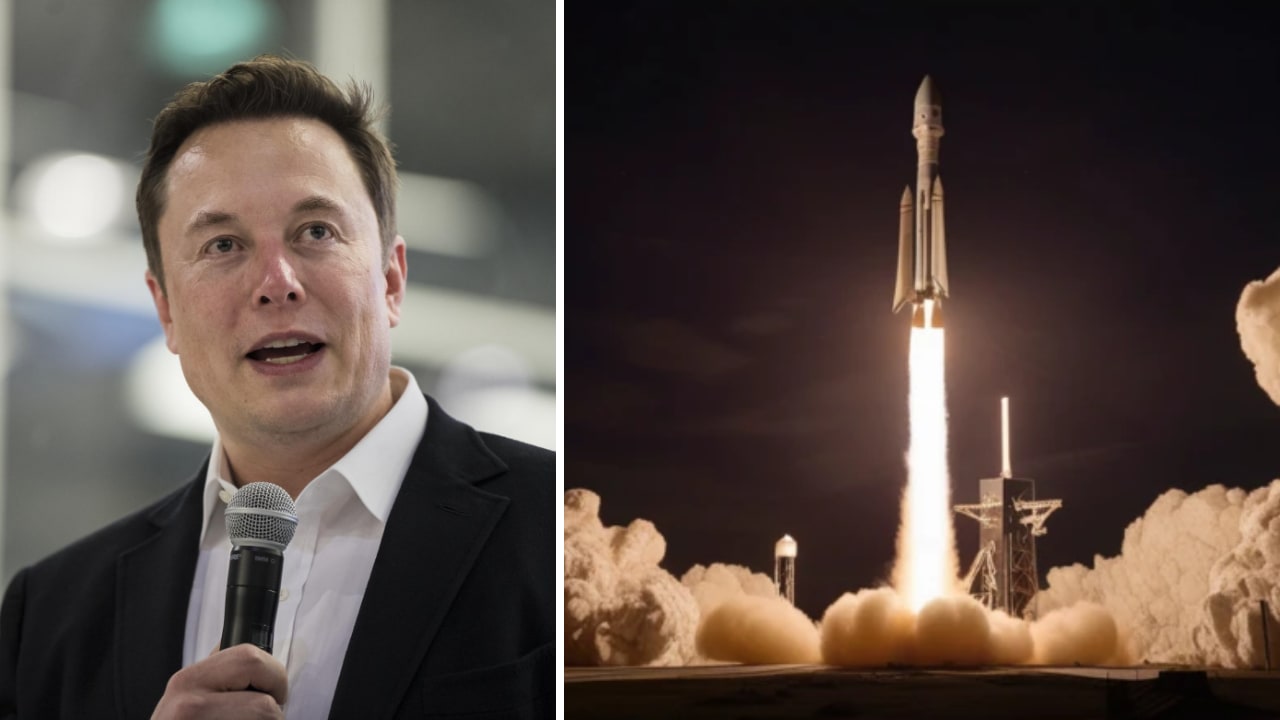
- SpaceX CEO Elon Musk replied “Accurate” when Atreides Management’s Gavin Baker said SpaceX engineers have solved orbital compute’s problems and are stressed about Starship reusability.
- That makes launch cost the deciding factor for orbital compute, and only full, rapid Starship reuse brings that cost down.
- On one SpaceX bull’s numbers, launching a 3-tonne compute satellite costs $3 million at Falcon prices and $30,000 at Starship’s target.
- SpaceX is aiming to launch the first Starmind satellites in 2027, well ahead of the FCC’s November 2033 deadline, but the stock still rests on Starlink and compute on the ground.
The Federal Communications Commission cleared SpaceX (SPCX) on Nov. 25 to put up to 1 million Starmind compute satellites in orbit. The stock closed up 1.30% at $127.44 that day, after trading as low as $112.93. So what’s left to figure out?
Mostly the rocket, according to Gavin Baker, managing partner and CIO of Atreides Management. In a clip from his interview on the Sourcery podcast, Baker said that “all of these experts online are very skeptical about orbital compute, and oh the cooling and oh this. And you know, to the SpaceX engineers, they have solved those problems.”
“What they’re actually stressed about,” he added, “is Starship and reusability.”
Elon Musk’s response on Nov. 27? “Accurate.”
Starlink already proved the satellite part
Baker’s case rests on what SpaceX already flies. “They’re operating 11,000 satellites today,” he said, and a Starlink V3 satellite already uses “maybe 10 to 15% the power” of an orbital compute satellite and “has to be cooled.”
The rocket is still a work in progress. On Nov. 14, Flight 15 ended with the launch tower catching the ship. That was the first time SpaceX recovered a Starship upper stage from orbit, though the booster wasn’t caught.
TIKR tracks 41 analysts on SpaceX. How many say “Buy”?
See the full breakdown of Buy, Hold, and Sell ratings on SpaceX, along with Wall Street’s revenue and earnings estimates, all in one place. More than 500,000 investors use TIKR to research stocks like this one. See SpaceX’s Analyst Ratings
Do the math on launch costs
Reuse matters because it sets the price of getting to orbit. One SpaceX bull on X ran the numbers on Nov. 25. He assumed a $3 million, 3-tonne satellite with 175 kilowatts of compute sold at $10 billion per gigawatt a year over a five-year life. He put Falcon’s cost at about $1,000 per kilogram today and says SpaceX is targeting $10 with Starship V4. Those inputs are his estimates, not SpaceX figures.
At $1,000 per kilogram, launching that satellite costs $3 million, as much as building it. At $10, it costs $30,000. On his numbers, the satellite’s gross margin goes from about 31% at Falcon prices to about 65% at Starship’s target.
His middle case of $250 per kilogram already gets to 57%, so the first big drop from Falcon’s price matters most.
The money is still on the ground
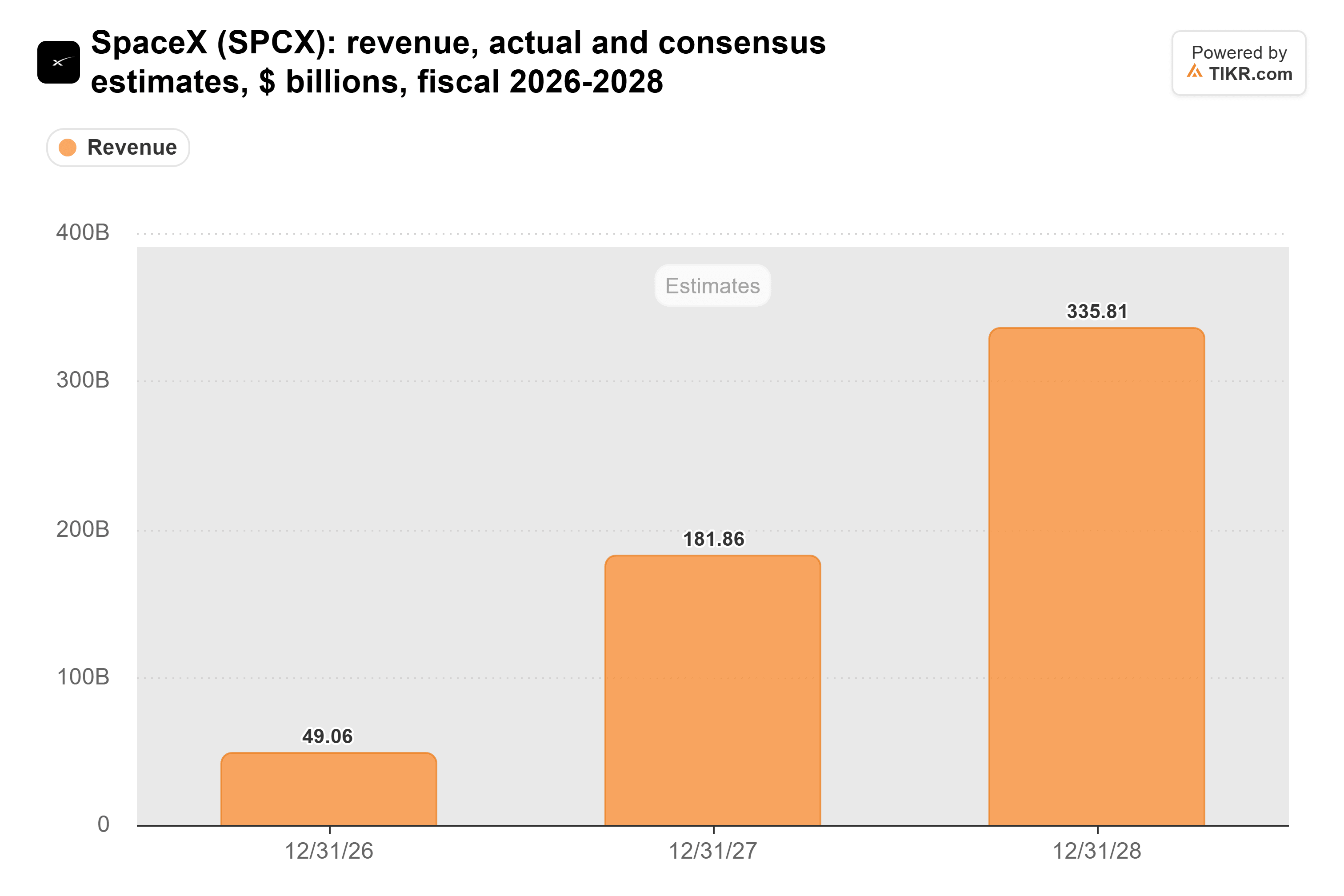
None of this pays off soon. Musk has said SpaceX expects to start launching Starmind satellites in 2027, with volume ramping in 2028 and 2029. The FCC’s order gives SpaceX far more room than that: the first satellite by Nov. 25, 2033, half the constellation by 2038, and all of it by 2040. Meanwhile, analysts expect revenue to grow from $49.1 billion this year to $336 billion in 2028:
SpaceX’s growth today comes from businesses it already runs. Its Super Intelligence segment, built around data centers on the ground, brought in $7.56 billion of its $14.6 billion in third-quarter revenue, more than half of sales. Connectivity, the segment that holds Starlink, earned $2.37 billion of the quarter’s $2.79 billion operating income.
Building out on the ground already costs far more than the business brings in:
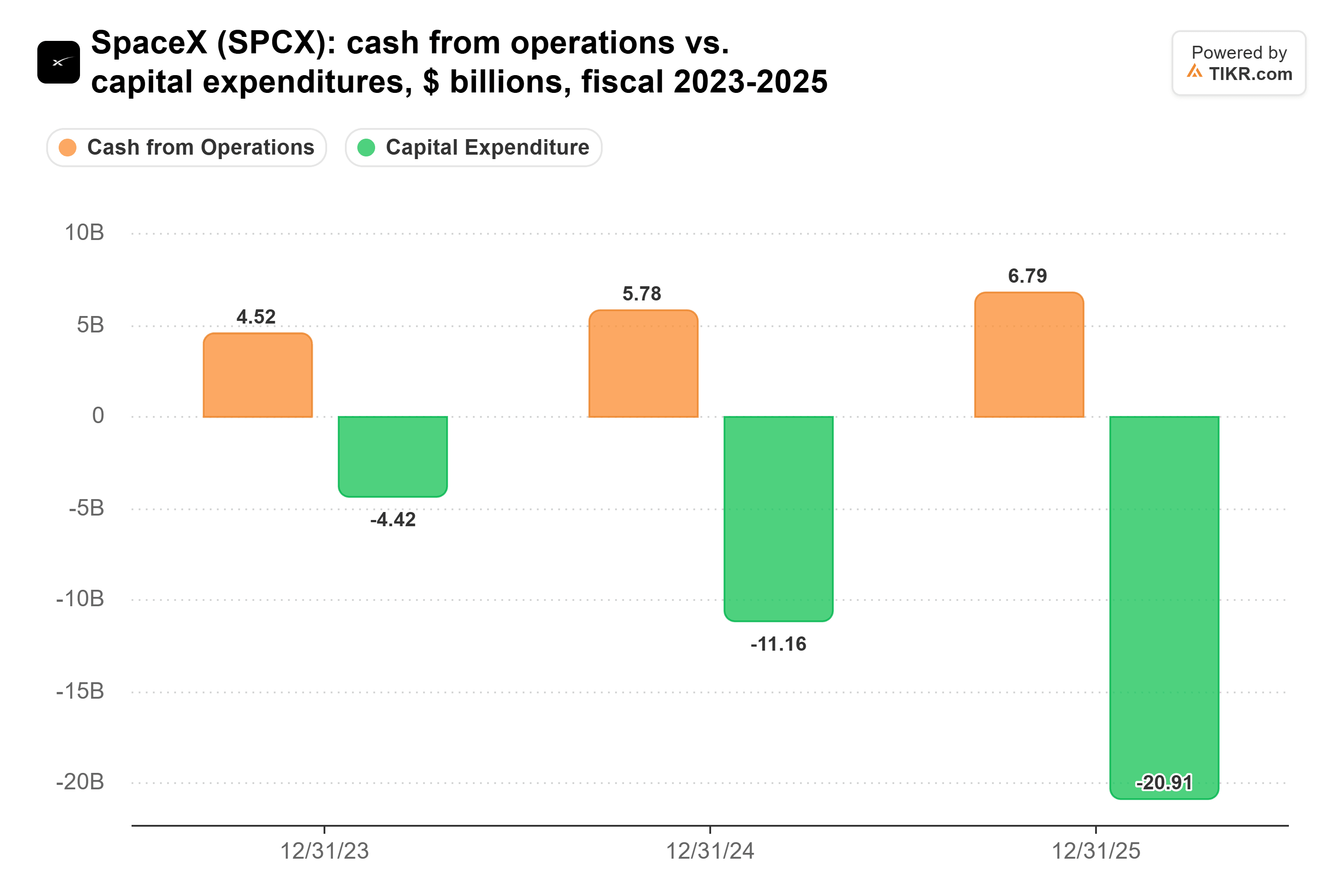
The gap has widened since. In the first nine months of 2026, SpaceX spent $48.1 billion on capex against $13.1 billion of operating cash flow, and about $40 billion of that capex went to its compute segment. If launch gets cheap enough, some of that future data-center spending could move to space.
Keep your eye on the catches
Musk’s reply points to launch cost as the open problem. SpaceX works on that problem in public, with milestones anyone can track. No Starmind satellite has flown yet, though, so orbital compute is still a plan, not a revenue line.
How often Starship flies is the number to watch. On the Oct. 20 third-quarter call, Musk guided to weekly Starship flights in the first half of 2027, a slower pace than the at-least-daily flights he floated in August for about a year out. Catching the booster and the ship on the same flight, then flying them again, would put orbital compute’s last big problem on a real timeline.
So what is SpaceX stock actually worth?
TIKR lets you forecast the future price of any stock in less than a minute. Just enter a few assumptions into TIKR’s valuation model and see what SpaceX could be worth. Start from Wall Street consensus estimates, or adjust the inputs to reflect your own view of the business. It’s free to use.
Disclaimer:
Please note that the articles on TIKR are not intended to serve as investment or financial advice from TIKR or our content team, nor are they recommendations to buy or sell any stocks. We create our content based on TIKR Terminal’s investment data and analysts’ estimates. Our analysis might not include recent company news or important updates. TIKR has no position in any of the stocks mentioned. Thank you for reading, and happy investing!