
Key Takeaways
- Morgan Stanley CEO Ted Pick said AI spending is running at about $1 trillion a year for the next several years, which puts the build-out in its “second or third inning.”
- If that pace holds, NVIDIA’s revenue has years of growth left. But its forward P/E has fallen to 17x, against a 30x average over the past three years.
- Analysts expect NVIDIA’s revenue to more than double, from about $412 billion in fiscal 2027 to about $903 billion in fiscal 2029.
- NVIDIA looks cheap if the spending holds. Its Nov. 17 report and the hyperscalers’ 2027 budgets are what to watch next.
Morgan Stanley (MS) CEO Ted Pick just put a price tag on the AI build-out, and it’s welcome news for NVIDIA (NVDA) shareholders still licking their wounds. NVIDIA fell 4% in Friday’s tech selloff, part of an 11% drop over the past month.
In an interview on Bloomberg Talks on Monday, Pick was asked whether he worries about the return on all this spending. He said not every project will pay off. But he’s “highly confident” that the $10 trillion to $15 trillion going into AI will earn enough to justify it over the next 15 to 30 years. Then he put a pace on it:
“I think the kind of ranges we’re seeing right now are about $1 trillion a year for the next several years, which gets us thinking we’re somewhere in the second or third inning.”
Investors selling NVIDIA clearly expect a shorter game.
TIKR Tracks 26 Analysts on Morgan Stanley. How Many Say “Buy”?
See the full breakdown of Buy, Hold, and Sell ratings on Morgan Stanley, along with Wall Street’s revenue and earnings estimates, all in one place. More than 500,000 investors use TIKR to research stocks like this one. See Morgan Stanley’s Analyst Ratings
Demand still outruns supply
Goldman Sachs CEO David Solomon shared a stage with Pick. In his own Bloomberg Talks interview, he said the industry is early in the build-out and that “demand for compute right now far exceeds the supply.”
NVIDIA’s management says the same about its own business. On its Aug. 26 earnings call, it guided for revenue to grow about 70% in fiscal 2028 (the year ending January 2028), and said supply was what held that figure down.
Analysts expect revenue to more than double, from about $412 billion this fiscal year to $903 billion in fiscal 2029. (NVIDIA’s fiscal year ends in January, so TIKR’s chart labels each year by the calendar year it mostly covers.)
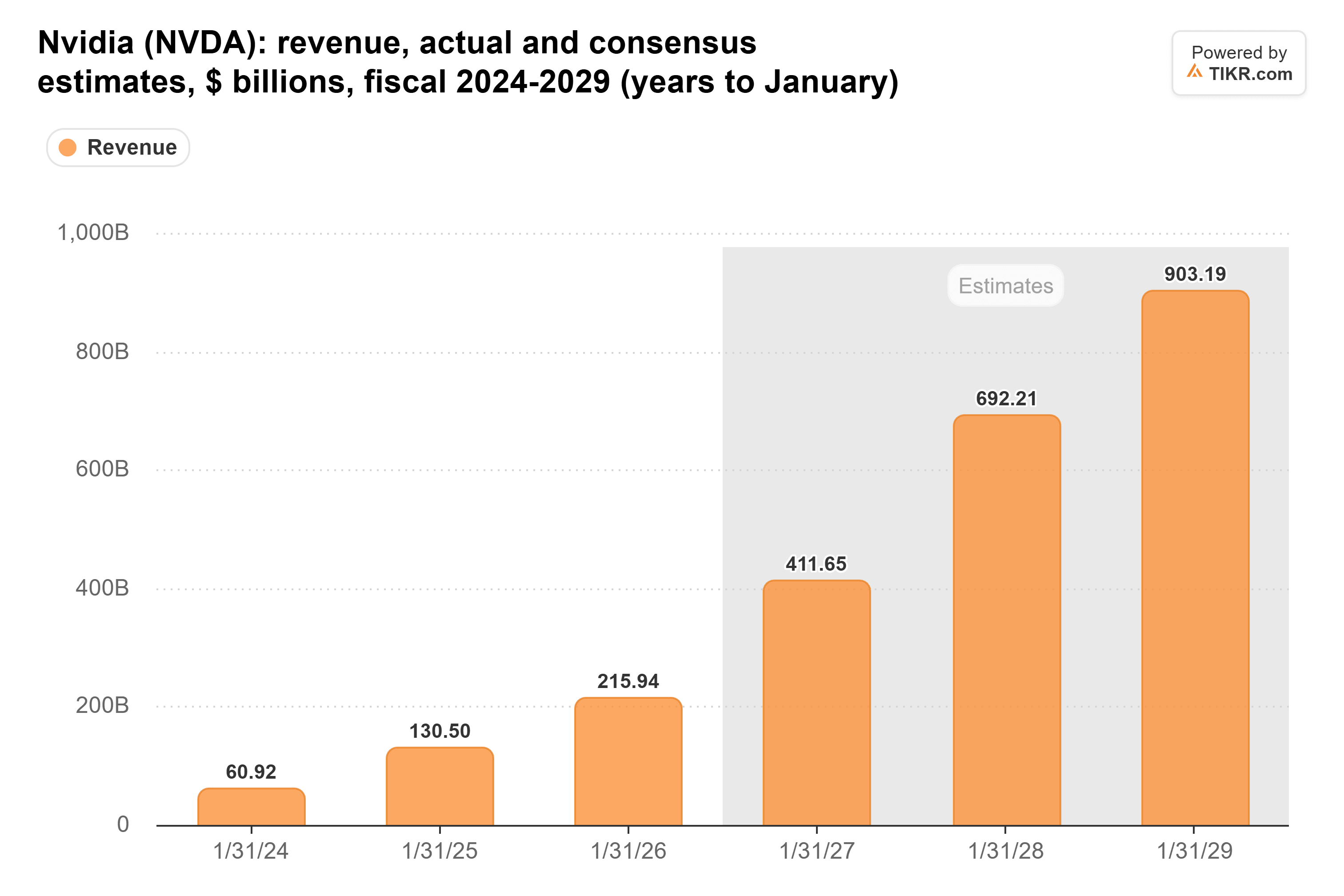
Analysts have been raising those numbers since the summer: the fiscal 2028 estimate is up 25% since June.
In those estimates, growth slows to 30.5% in fiscal 2029 and 21.3% in fiscal 2030, which is about what a long build-out at a steady pace would look like. Nothing Pick or Solomon said gives analysts a reason to cut.
Priced like the game is almost over
Investors aren’t paying for any of that. NVIDIA trades at 17x forward earnings, its lowest in three years and far below its 30x average over that time:
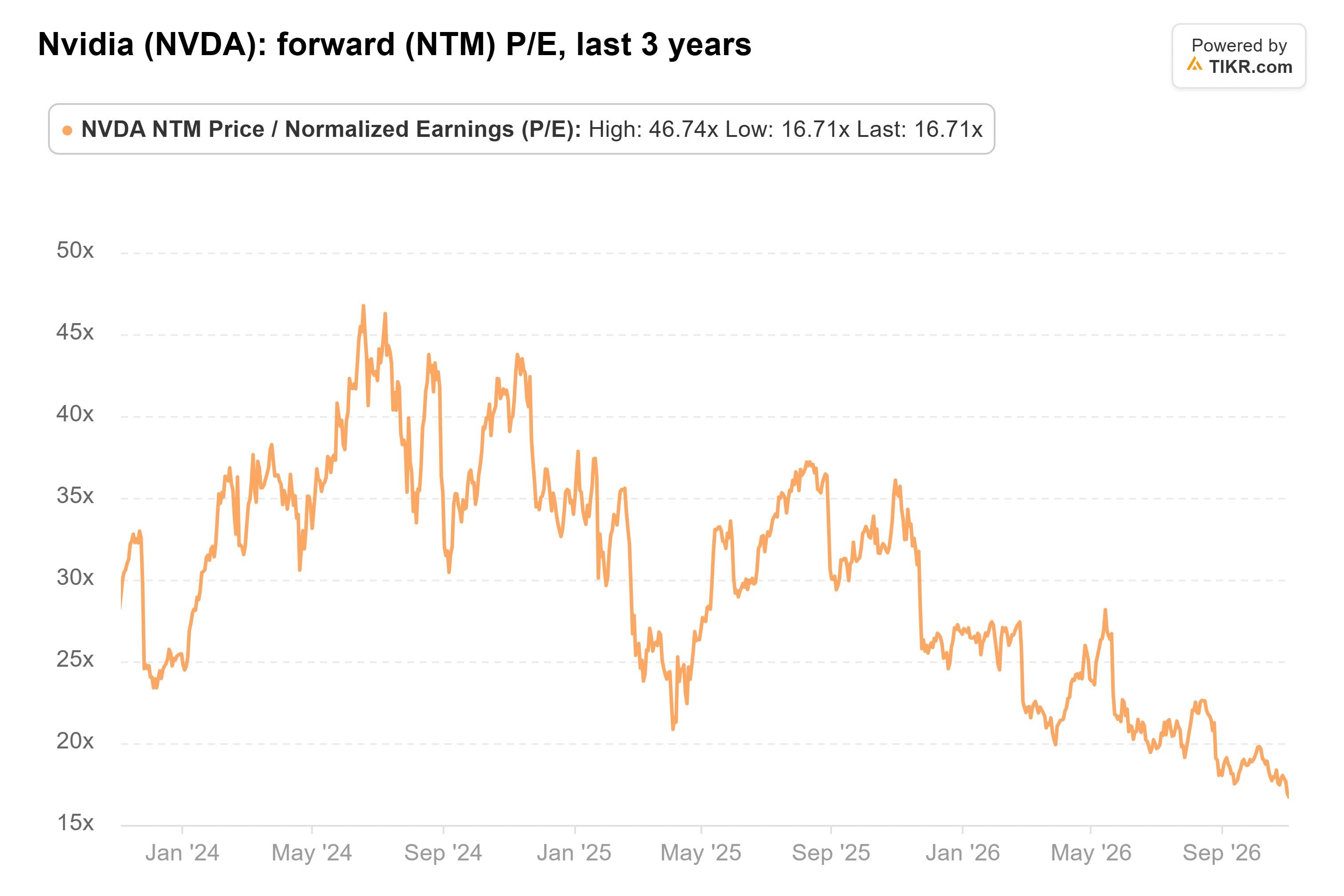
That’s also below every quarter-end reading TIKR has going back to mid-2015.
That’s the kind of multiple investors pay for a company at the top of its cycle. Friday’s selloff came from two worries: Big Tech’s free cash flow is shrinking as its capex climbs, and the hyperscalers may cut spending in 2027 to calm their own shareholders. That would mean fewer chip orders for NVIDIA.
Pick’s trillion dollars a year answers part of that worry. It isn’t a perfect fit: analysts’ $903 billion for NVIDIA’s fiscal 2029 would be most of his $1 trillion, so his figure likely counts spending more narrowly than NVIDIA’s own estimate of about $1.3 trillion of top-five hyperscaler capex in 2027. Either way, both numbers point to spending that stays high, not one that falls off a cliff.
Morgan Stanley sees both ends of the game
The selloff itself may be nearly over, too. Mike Wilson is Morgan Stanley’s chief investment officer and chief US equity strategist. On Bloomberg Talks on Oct. 27, he said the correction that started under the market’s surface in June was probably 80% to 90% done, and “we’re in the ninth inning of this.” After that, he expects the bull market to keep going into 2027.
So Wilson’s ninth inning is the correction, and Pick’s second or third is the spending. If both are right, the selloff is close to done while the build-out has years to run. In that setup, a 17x multiple looks too low.
Of course, both CEOs run banks that earn fees arranging the money for this build-out. Solomon expects robust financing for AI over the next 12 to 24 months, though he couldn’t promise “it will go without bumps in the coming years.”
If AI spending holds anywhere near a trillion dollars a year, NVIDIA at 17x forward earnings looks cheap to me.
We’ll hear from NVIDIA itself on Nov. 17, when it reports its October quarter and gives its outlook for the January quarter. The bigger test comes when the hyperscalers set their 2027 capex budgets. If those come in lower, Pick’s trillion a year starts to look optimistic.
So what is NVIDIA stock actually worth?
TIKR lets you forecast the future price of any stock in less than a minute. Just enter a few assumptions into TIKR’s valuation model and see what NVIDIA could be worth. Start from Wall Street consensus estimates, or adjust the inputs to reflect your own view of the business. It’s free to use.
Disclaimer:
Please note that the articles on TIKR are not intended to serve as investment or financial advice from TIKR or our content team, nor are they recommendations to buy or sell any stocks. We create our content based on TIKR Terminal’s investment data and analysts’ estimates. Our analysis might not include recent company news or important updates. TIKR has no position in any of the stocks mentioned. Thank you for reading, and happy investing!