Key Takeaways
- JPMorgan’s credit default swap data puts Meta and Broadcom in a “stretched” tier at about 160 basis points, about twice the 80 basis points for Microsoft, Alphabet and Amazon.
- Meta has no cloud business, so its ads have to pay for its AI build-out, and borrowing covers the gap.
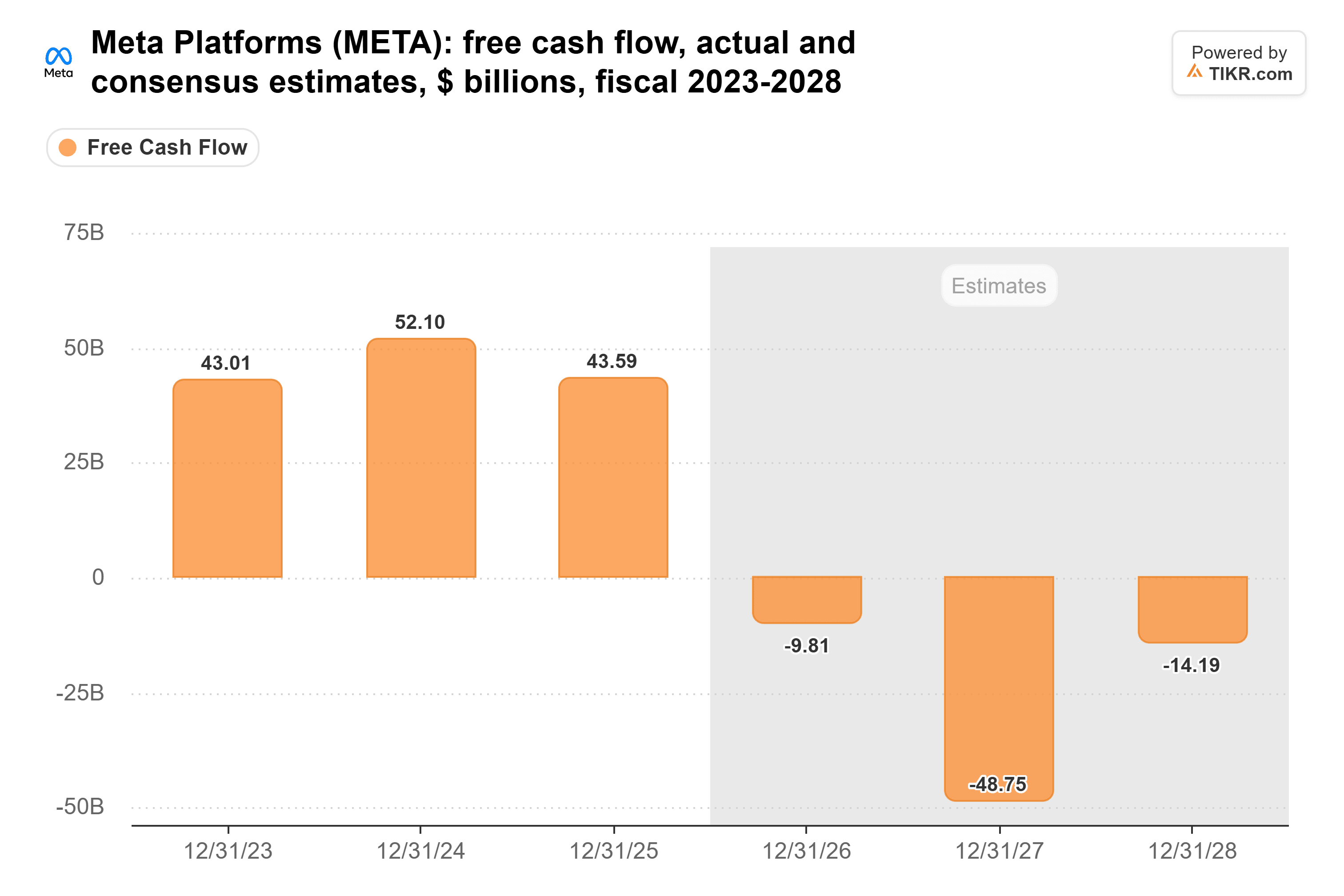
- Analysts expect Meta’s free cash flow to fall from $43.6 billion in 2025 to negative $48.8 billion in 2027.
- Meta’s fourth-quarter report in late January sets its 2027 capex plan, and how much more it borrows at today’s wider spreads.
Credit traders have started sorting Big Tech by how each company pays for AI, and Meta Platforms (META) landed a tier below Microsoft (MSFT) and Alphabet (GOOG).
The investor account StockSavvyShay laid out JPMorgan’s credit default swap data on X. It splits the AI trade into three tiers:
- Cash funded: Microsoft, Alphabet and Amazon at about 80 basis points, “with enough cash flow to fund most of their CapEx”
- Stretched: Meta and Broadcom (AVGO) at about 160 basis points, “as financing commitments continue to grow”
- Credit-dependent: SpaceX and Oracle at about 275 basis points
That was before hyperscaler CDS blew out to record wides this week, as Zero Hedge pointed out on X.
TIKR tracks 58 analysts on Microsoft. How many say “Buy”?
See the full breakdown of Buy, Hold, and Sell ratings on Microsoft, along with Wall Street’s revenue and earnings estimates, all in one place. More than 500,000 investors use TIKR to research stocks like this one. See Microsoft’s Analyst Ratings
Meta builds only for itself
Microsoft and Alphabet rent much of their computing power to outside customers. Azure revenue grew 48% to $33.2 billion in Microsoft’s fiscal first quarter, and Google Cloud’s revenue more than doubled to $30.7 billion in Alphabet’s third quarter.
Meta has no cloud to rent out. Ads made up 97.6% of its 2025 revenue, so every server it buys has to pay off inside its own apps. Analysts expect its free cash flow to swing from $43.6 billion in 2025 to deep in the red:
Now Meta borrows to build
Meta’s capex nearly quadrupled from 2021 to 2025, while its cash from operations doubled:

This year, the lines crossed. In the third quarter, Meta spent $34.9 billion on capex, including finance-lease principal, against $32.8 billion of operating cash flow. It has borrowed heavily to keep building, and its total debt grew more than sixfold from 2021 to 2025:
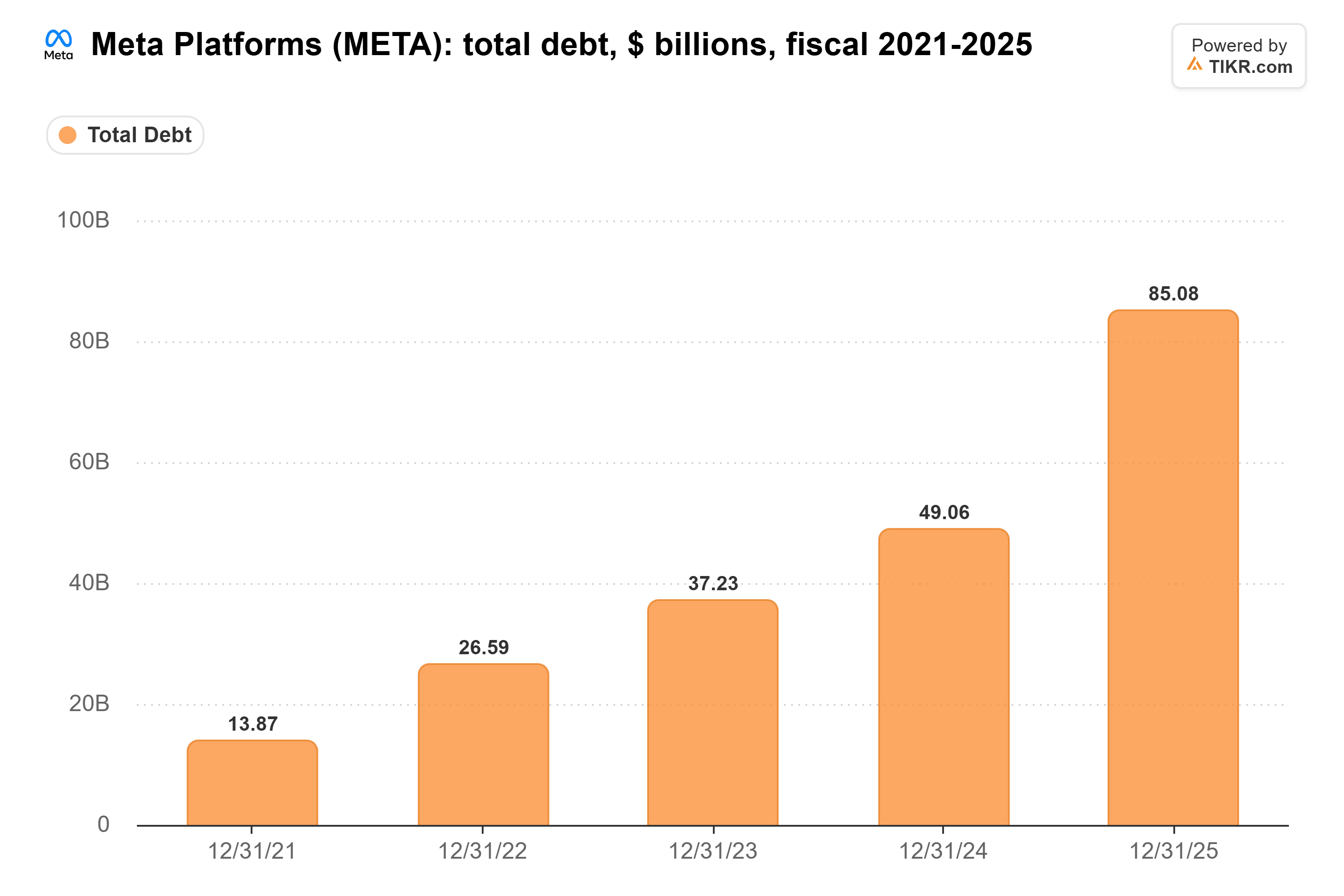
By Sept. 30, its long-term debt alone, $83.7 billion, was more than its $82.45 billion of cash and marketable securities. Third-quarter interest on its notes was $882 million, against $205 million a year earlier.
Every basis point now counts
When Meta paid for everything out of cash flow, what lenders charged it barely mattered to shareholders. Now each new bond costs more, and that cost comes out of whatever the AI build earns. Meta will also be competing for the same money: JPMorgan strategists expect companies to raise $450 billion in high-grade bonds for AI capex in 2027.
Broadcom shares Meta’s tier for a different reason. Its two backstops for Anthropic could cost it up to about $72 billion, roughly three times the $24.0 billion of cash it held on Aug. 2. When Broadcom reports on Dec. 9, watch for any new financing it takes on for the AI labs buying its chips.
Meta can still pay its way
Meta’s ads still bring in plenty of cash: third-quarter revenue rose 26% to $64.6 billion, and management guides the fourth quarter to $73 billion to $76 billion.
The way I see it, Meta can carry this debt. But in each year it spends more than it makes, it borrows in a credit tier priced at about twice Microsoft’s and Alphabet’s, for a build with no outside customers to pay it back.
The next test is Meta’s fourth-quarter report in late January, when it sets its 2027 budget. Meta will likely have to raise every dollar of capex above the roughly $210 billion consensus at today’s wider spreads, and JPMorgan’s Meta analyst, Doug Anmuth, now models $255 billion, about $45 billion more.
So what is Meta stock actually worth?
TIKR lets you forecast the future price of any stock in less than a minute. Just enter a few assumptions into TIKR’s valuation model and see what Meta could be worth. Start from Wall Street consensus estimates, or adjust the inputs to reflect your own view of the business. It’s free to use.
Disclaimer:
Please note that the articles on TIKR are not intended to serve as investment or financial advice from TIKR or our content team, nor are they recommendations to buy or sell any stocks. We create our content based on TIKR Terminal’s investment data and analysts’ estimates. Our analysis might not include recent company news or important updates. TIKR has no position in any of the stocks mentioned. Thank you for reading, and happy investing!