Key Takeaways
- Starlink said more than 3 million Beeline Kazakhstan customers are using Starlink Mobile in cellular dead zones less than two months after launch.
- SpaceX is showing that a carrier partner can scale satellite phone service fast, while AST SpaceMobile still lacks the satellites it needs for continuous coverage.
- AST lost $342 million in 2025, and analysts don’t expect its revenue to really ramp until 2027 and 2028.
- T-Mobile, Starlink’s US partner, and AT&T, one of AST’s partners, will show whether the same race plays out in the US.
SpaceX (SPCX) just showed how fast phone service from space can catch on when a carrier does the selling.
Less than two months after Starlink Mobile launched in Kazakhstan, Starlink said on X that more than 3 million Beeline Kazakhstan customers “are staying connected on their phones in cellular dead zones.”
That’s a problem for AST SpaceMobile (ASTS), whose whole business is connecting ordinary phones from orbit. The stock is down 64% in 2026.
It’s also a test for two carriers on opposite sides: T-Mobile (TMUS) sells Starlink’s direct-to-cell service in the US as T-Satellite, and AT&T (T) is one of AST’s carrier partners and an investor in the company.
TIKR tracks 13 analysts on AST SpaceMobile. How many say “Buy”?
See the full breakdown of Buy, Hold, and Sell ratings on AST SpaceMobile, along with Wall Street’s revenue and earnings estimates, all in one place. More than 500,000 investors use TIKR to research stocks like this one. See AST SpaceMobile’s Analyst Ratings
AST is still waiting on its satellites
Third-quarter revenue was $42.32 million, up 187.1% from a year earlier but short of what analysts expected, and management kept its full-year forecast of $150 million to $200 million. Analysts expect most of the growth over the next two years:

That ramp, to $586 million in 2027 and $1.65 billion in 2028, depends on getting BlueBirds into orbit. AST aims to have about 45 in orbit by mid-2027, and it estimates it needs 45 to 60 for continuous coverage in key markets. Its next three are sitting at Cape Canaveral, waiting for SpaceX to confirm a launch date. (Yes, that SpaceX.)
Until the network is up, AST keeps losing money:
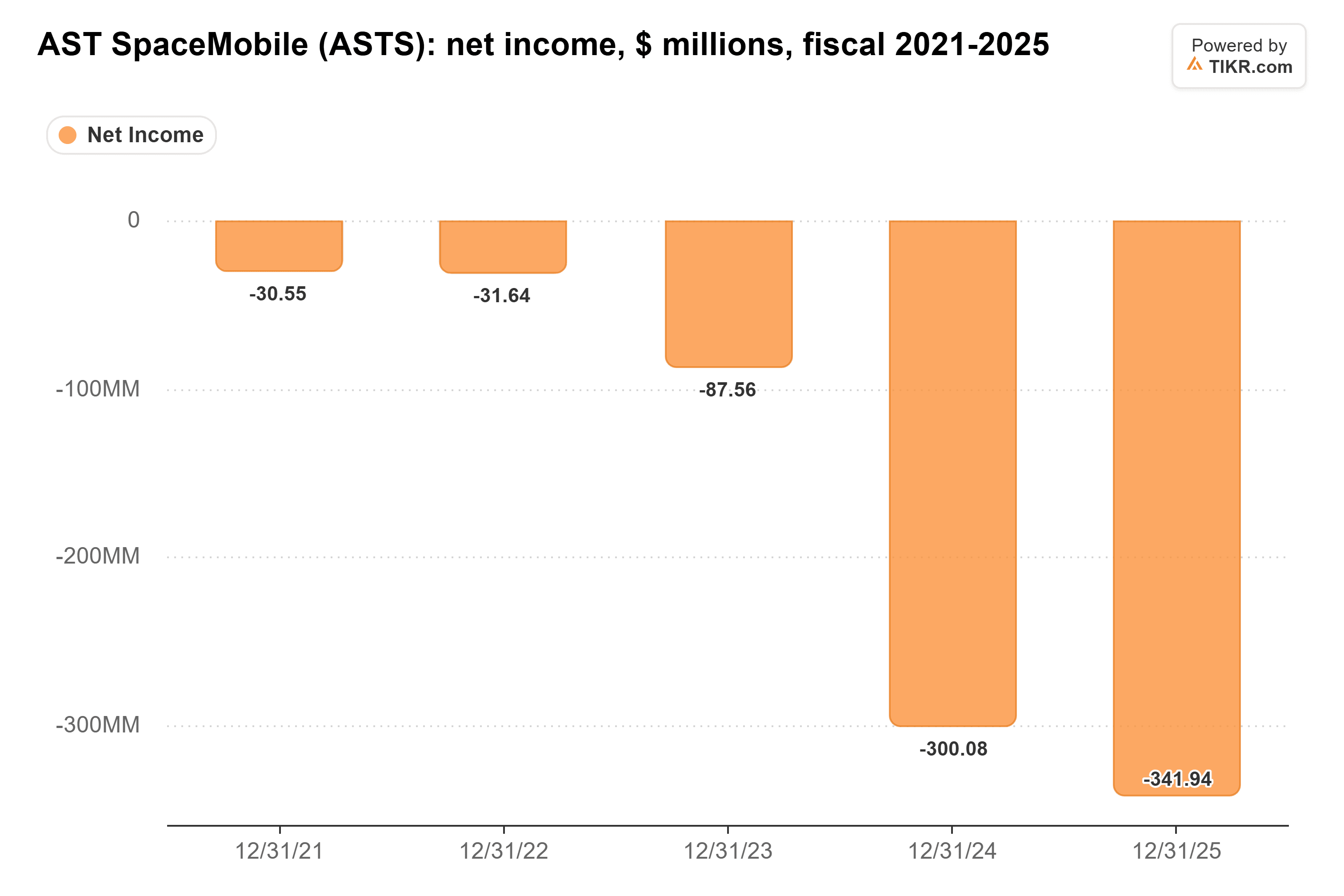
It posted another GAAP net loss of $132.38 million in the third quarter. The $2.80 billion of cash and equivalents it held at the end of September buys it time, but it also carries $4.08 billion of long-term debt.
SpaceX doesn’t need Kazakhstan to pay off
SpaceX’s revenue was already climbing fast before phone service mattered:
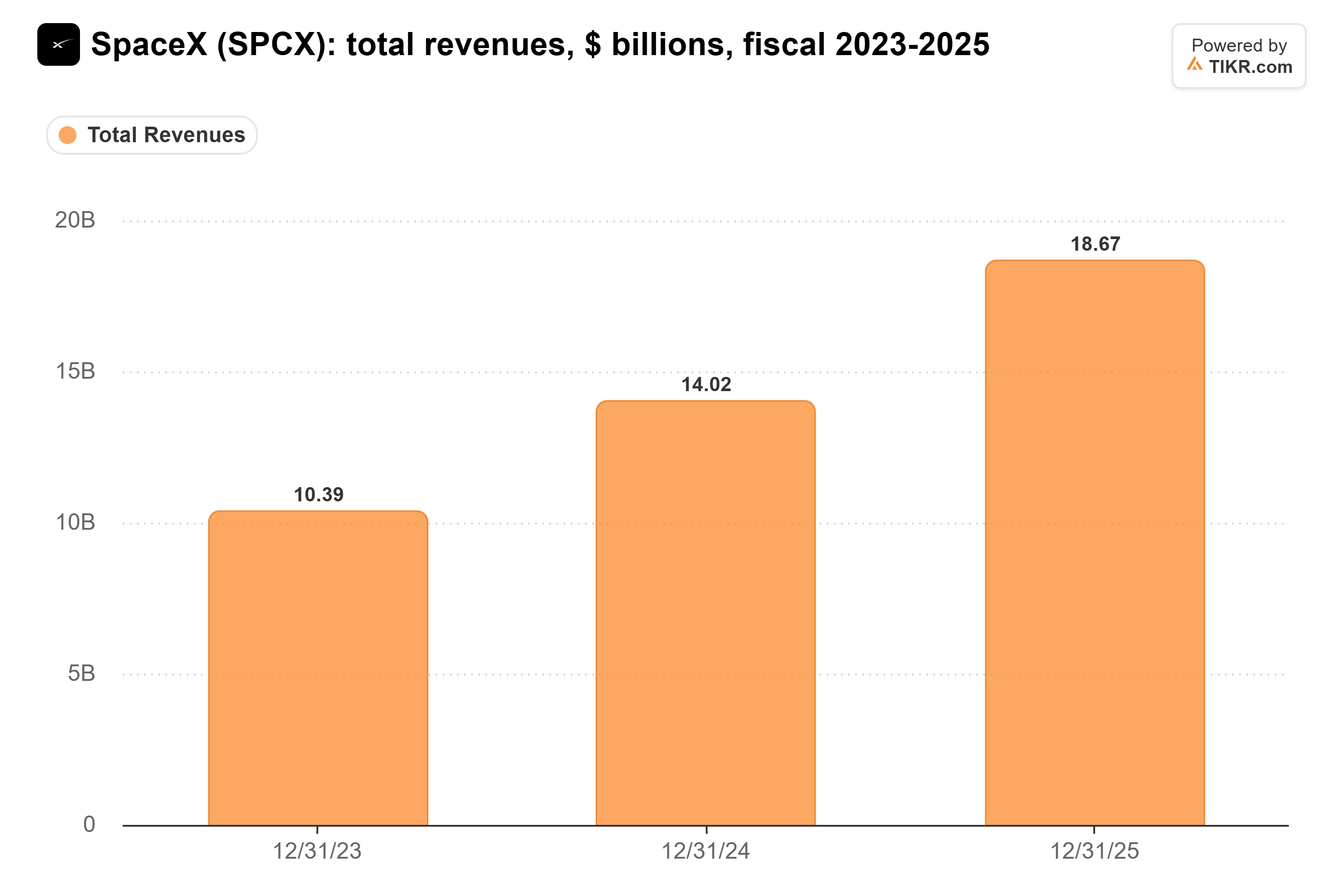
Over the last twelve months it’s even higher: $32.0 billion. The Connectivity segment made $5.2 billion of operating income in the first nine months of 2026. And SpaceX said in its IPO prospectus that it had about 30 carrier partners as of March 31, 2026. Kazakhstan shows what happens when one of them switches the service on: Beeline already had the customers and the phones, and Starlink filled in the map.
The carriers picked sides
T-Mobile’s postpaid account churn rose to 1.09% in the third quarter from 0.97% a year earlier. Coverage where there are no towers is one more reason for a customer to stay, so T-Satellite sign-ups are worth watching when T-Mobile reports its fourth quarter early next year.
AT&T is on the other side of the bet, and its Mobility segment produced 96.9% of its 2025 segment operating income. Postpaid phone churn held at 0.92% in the third quarter, so satellite service isn’t pulling customers away yet. But the longer AST takes to reach continuous coverage, the longer T-Mobile gets to sell satellite coverage as its own edge.
The speed is the story
Of course, Beeline’s own post says 3 million customers “have used the Starlink service.” Neither company has said how many pay for it or what Beeline pays Starlink, and one country’s revenue won’t move the needle much for SpaceX.
But AST also needs carriers for its service to scale. Any carrier that signs with Starlink first will already have a satellite option when AST comes calling.
AST does still have a window: SpaceX moved its next-generation Starlink Mobile service to early 2028 on its third-quarter call, from the end of 2027 on its second-quarter call. And director Adriana Cisneros bought $500,000 of stock in her own name on Nov. 20 at an average price of $23.54, according to her Form 4.
AST needs those BlueBirds flying
Still, Starlink’s Kazakhstan number is bad news for AST. This year’s drop already prices in a lot of doubt, but I’d want to see AST’s network carry real traffic before following its director in.
The next tests come soon: those three BlueBirds need a confirmed launch date, AST’s promised intermittent US service needs to go live by year-end, and the fourth-quarter report early next year needs to show 2026 revenue of at least $150 million, the bottom of AST’s range.
So what is AST SpaceMobile stock actually worth?
TIKR lets you forecast the future price of any stock in less than a minute. Just enter a few assumptions into TIKR’s valuation model and see what AST SpaceMobile could be worth. Start from Wall Street consensus estimates, or adjust the inputs to reflect your own view of the business. It’s free to use.
Value AST SpaceMobile for free
Disclaimer:
Please note that the articles on TIKR are not intended to serve as investment or financial advice from TIKR or our content team, nor are they recommendations to buy or sell any stocks. We create our content based on TIKR Terminal’s investment data and analysts’ estimates. Our analysis might not include recent company news or important updates. TIKR has no position in any of the stocks mentioned. Thank you for reading, and happy investing!