Key Takeaways
- McDonald’s reports third-quarter results before the open on Wednesday, Nov. 4. Analysts expect normalized EPS of $12.88 for 2026, up from $12.20 in 2025.
- At 20.2x forward earnings, below its five-year average of 23.9x, the stock is a fair price if that growth holds.
- Currency drove much of its first-half earnings growth, and its operating margin slipped on TIKR’s measure in both quarters, though McDonald’s own adjusted margin held.
- The things to watch are U.S. comparable sales and the fourth-quarter outlook, since management expects slightly negative U.S. comparable sales for the third quarter.
McDonald’s (MCD) reports its third-quarter results before the open on Wednesday, Nov. 4. The stock is valued as a steady compounder, so the report has one job: keep full-year earnings on the path analysts expect.
The back half needs about 5% growth
Analysts expect McDonald’s normalized EPS to rise to $12.88 this year, from $12.20 in 2025, and to keep climbing through 2028:
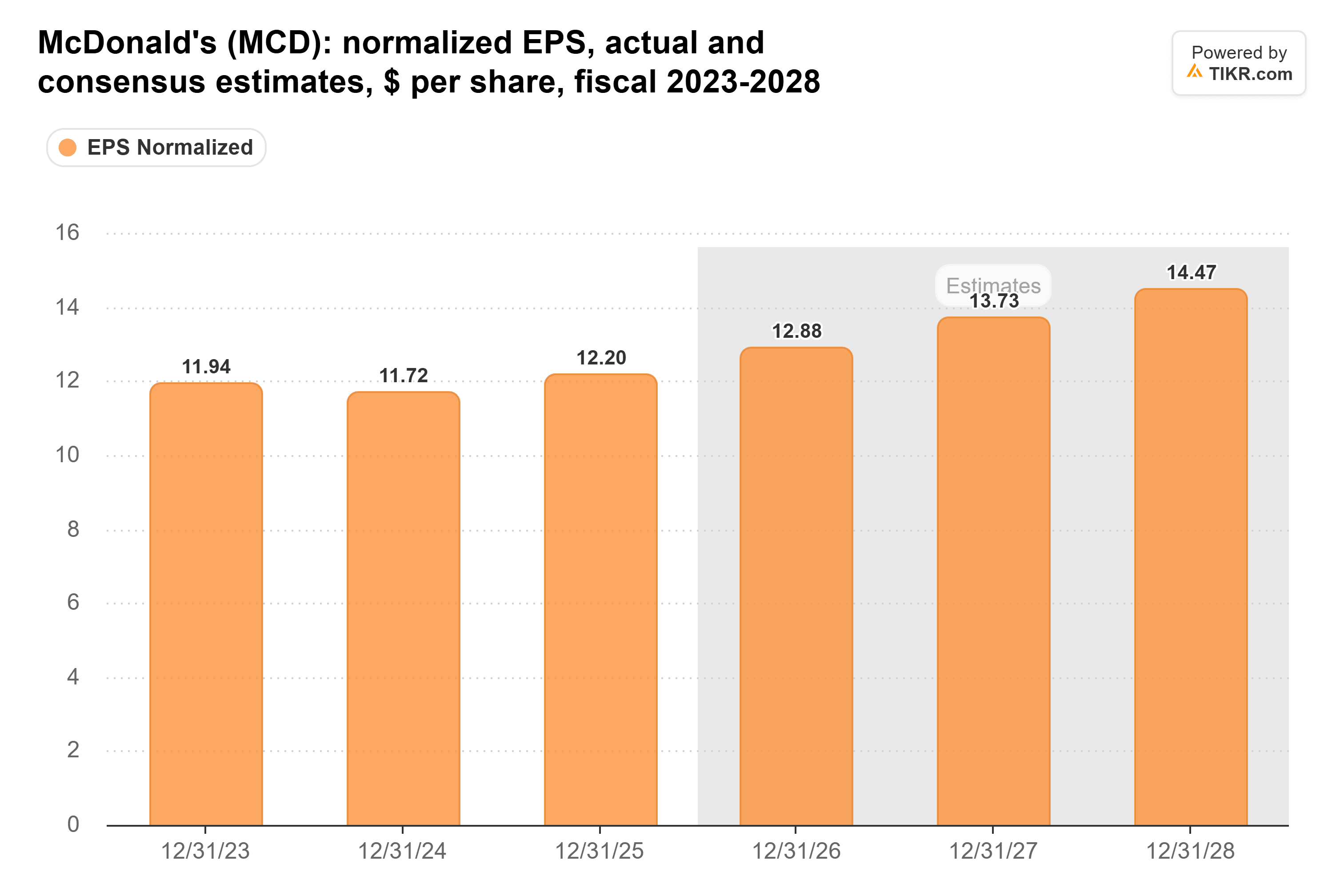
McDonald’s earned $6.21 a share on an adjusted basis in the first half of 2026: $2.83 in the first quarter and $3.38 in the second. To reach the consensus, it needs $6.67 in the back half. That’s about 5% more than the $6.34 it earned in the second half of 2025.
That looks like an easy bar, since first-half EPS grew 6%. But much of that growth came from currency. In constant currencies, first-quarter adjusted EPS rose just 1%, McDonald’s said in its first-quarter release, against 6% as reported. And on the second-quarter call, management cut its estimate of this year’s currency boost to about $0.15 a share, from $0.20 to $0.30.
So Wednesday’s report has to show growth that comes from the restaurants.
The margin can’t slip a third time
About 95% of McDonald’s restaurants are franchised, so it earns most of its profit as rent and royalties. That keeps its operating margin in the mid-40s, and the third quarter is usually its strongest:
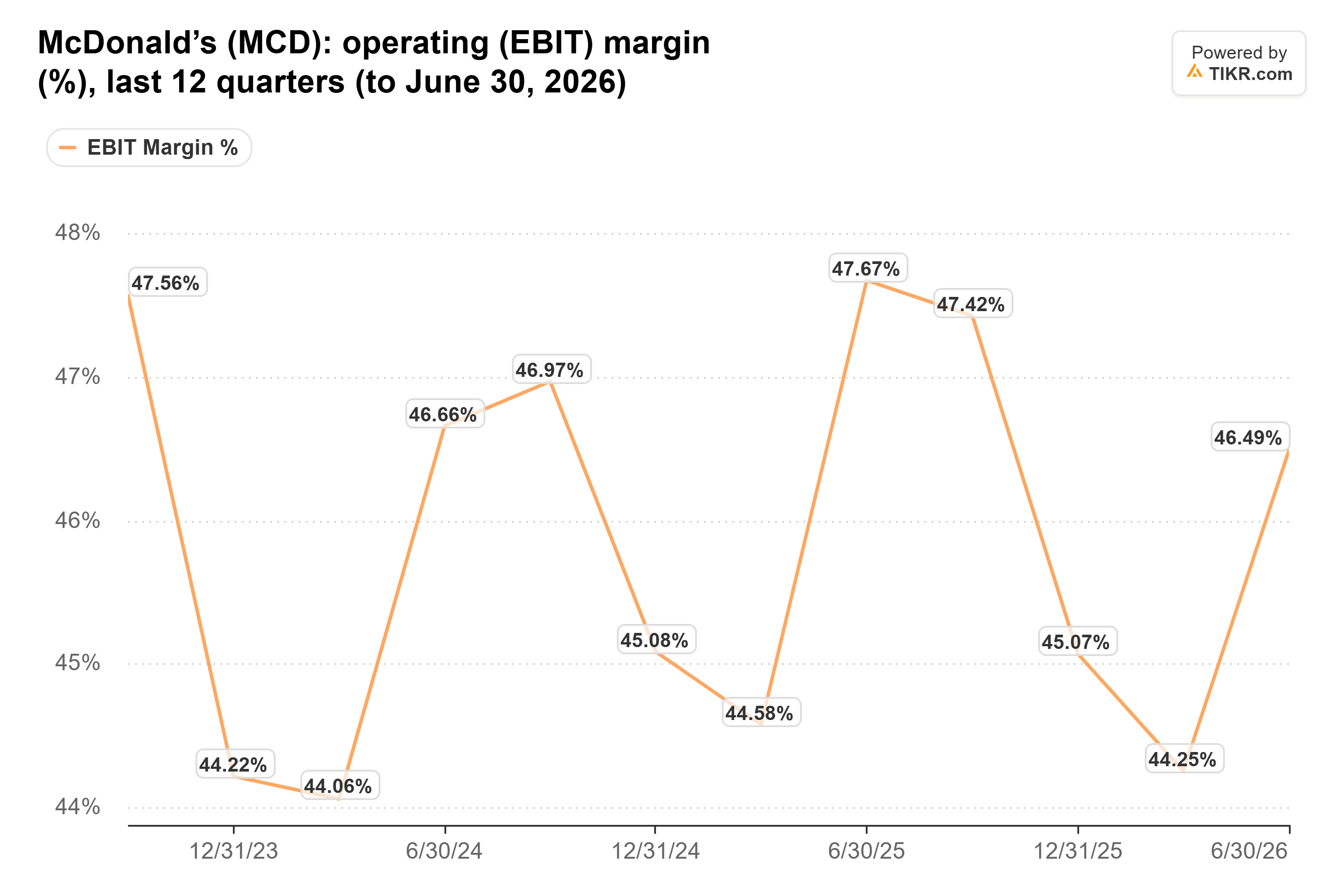
But on TIKR’s EBIT measure, the margin came in below the year before in each of the last two quarters: 44.3% in the first quarter, against 44.6%, and 46.5% in the second, against 47.7%. McDonald’s own adjusted operating margin held at 46.9% for the first half, against 46.8%, so how much it slipped depends on the measure. The spending to win customers back is real either way: SG&A rose 17% in the second quarter, to $817 million.
If the margin falls short of last year’s 47.4% again, I’d read that as the cost of chasing traffic coming out of earnings.
TIKR Tracks 33 Analysts on McDonald’s. How Many Say “Buy”?
See the full breakdown of Buy, Hold, and Sell ratings on McDonald’s, along with Wall Street’s revenue and earnings estimates, all in one place. More than 500,000 investors use TIKR to research stocks like this one. See McDonald’s Analyst Ratings
U.S. traffic still feeds the earnings
The franchise model also shields McDonald’s from the cost of running restaurants. Chipotle runs its own restaurants and doesn’t have that protection: its transactions grew 0.8% in the third quarter, but higher beef, freight and labor costs cut its restaurant-level margin 120 basis points from a year earlier, to 23.3%.
But McDonald’s rent and royalties are a percentage of franchisee sales, so fewer visits hit its earnings eventually. And U.S. visits are down. At its Sept. 23 Investor Day, management said it expects U.S. comparable sales to be slightly negative in the third quarter, after a slightly negative July and August. A year earlier, they grew 2.4%. Placer.ai estimates reported by Reuters show U.S. foot traffic at McDonald’s down from a year earlier in every full month since March.
So beyond EPS, I’d watch two things: whether September came in positive, as management expected, and whether the fourth-quarter outlook calls for positive U.S. comparable sales. Analysts will build their 2027 estimates on those numbers, and they’ve already cut their 2027 EPS estimate by 5% over the past year.
20x pays for the consensus and no more
McDonald’s trades at 20.2x forward earnings, well below its five-year average of 23.9x:
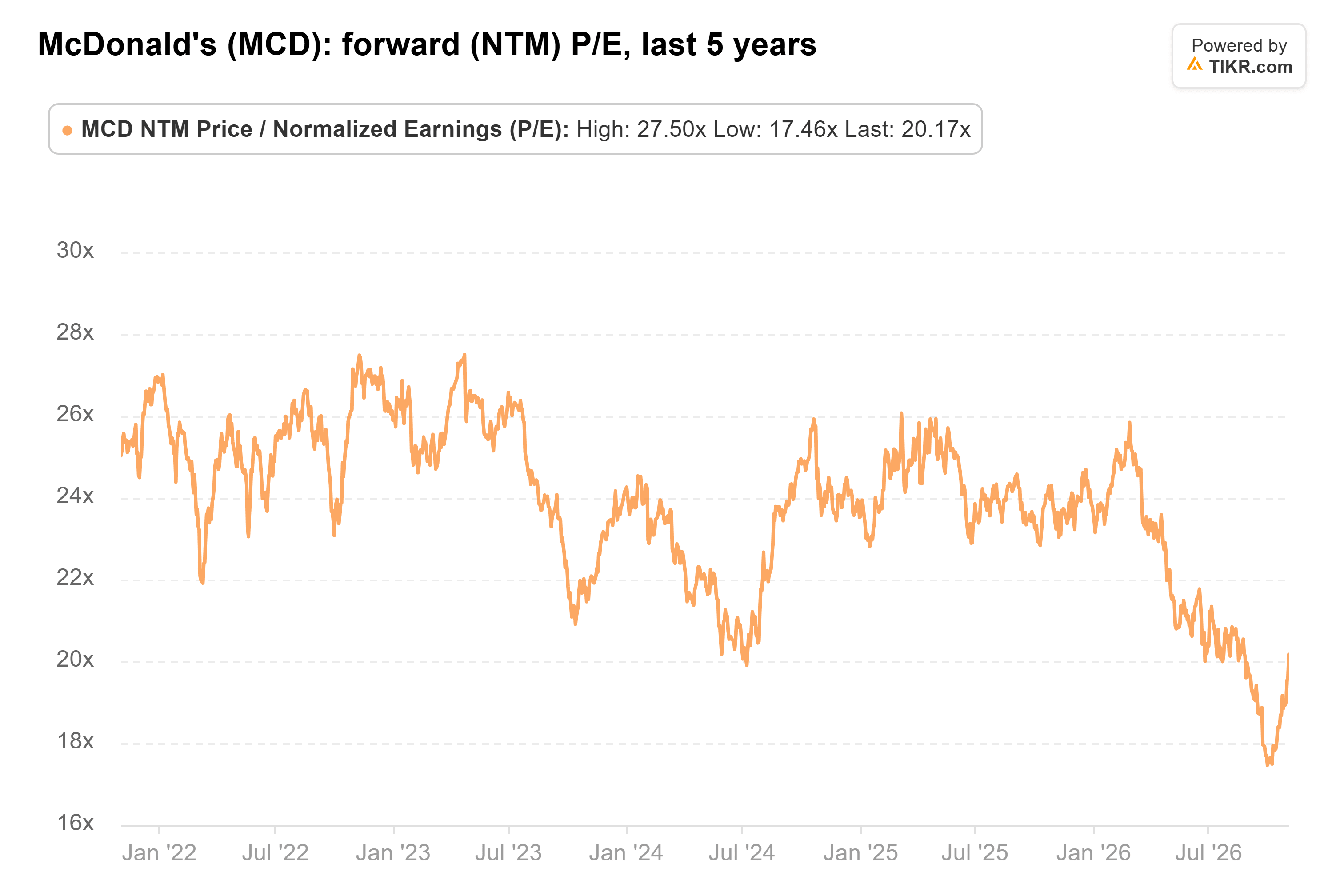
(It hit a five-year low of 17.5x on Sept. 30, a week after Investor Day.)
At 20x, investors are paying for the roughly 6% a year that analysts expect from 2026 to 2028, with nothing extra for a U.S. turnaround. The multiple has come back up from 17.5x since Sept. 30, though, so some of the relief is already in the price.
Steady is enough
For the bull case to hold, Wednesday’s report has to show three things:
- Adjusted EPS growth that holds up in constant currencies
- An operating margin at or above last year’s
- A U.S. outlook that turns positive in the fourth quarter
If McDonald’s delivers all three, I think 20x is a fair price for a business growing earnings at this pace, and the stock can rise with its estimates. If the margin slips again, I’d expect another round of estimate cuts, and the multiple would look less cheap than it does today.
Of course, the bigger test comes early next year. That’s when McDonald’s gives its 2027 guidance, and investors get a first look at the cost of the $8.5 billion in rent relief and capital it plans to give franchisees through 2036.
So what is McDonald’s stock actually worth?
TIKR lets you forecast the future price of any stock in less than a minute. Just enter a few assumptions into TIKR’s valuation model and see what McDonald’s could be worth. Start from Wall Street consensus estimates, or adjust the inputs to reflect your own view of the business. It’s free to use.
Disclaimer:
Please note that the articles on TIKR are not intended to serve as investment or financial advice from TIKR or our content team, nor are they recommendations to buy or sell any stocks. We create our content based on TIKR Terminal’s investment data and analysts’ estimates. Our analysis might not include recent company news or important updates. TIKR has no position in any of the stocks mentioned. Thank you for reading, and happy investing!