

Key Takeaways
- McDonald’s grew Q2 revenue 4% to $7.10 billion, but global comparable sales rose only 1.3% and U.S. guest counts declined.
- CEO Chris Kempczinski expects industry traffic in wholly owned markets to stay flat while inflation remains elevated.
- The $8.5 billion franchisee support plan through 2036 will weigh on parent cash flow before efficiency gains arrive.
- Q3 results in early November will show whether value offerings revive traffic while an AI pricing class action plays out.
McDonald’s (MCD) spent its September investor day doing something big consumer brands rarely do. It told shareholders the backdrop will stay tough.
CEO Chris Kempczinski said industry traffic in the company’s wholly owned markets “will be flat while inflation remains elevated.” Then he paired that warning with an $8.5 billion pledge to franchisees.
Investors hated the combination. Shares fell as much as 6.5% that day and touched a near four-year low of $234.
The stock has not recovered much since. Shares closed at $248 on October 23, down 1.7% on the day and 16.7% over six months, while the Street target sits at $292.
Q3 results land in early November, with the earnings call on November 4.
Check size carries the quarter
Q2 looked fine at the top. Revenue rose 4% to $7.10 billion, systemwide sales grew 5% to $37 billion, and adjusted EPS of $3.38 beat the $3.32 consensus.
The comp detail was thinner:
- Global comparable sales rose 1.3%.
- U.S. comps rose 0.8%, driven by higher average check and product mix.
- Comparable guest counts in the U.S. declined.
That gap matters for a value brand. When growth comes from check size while visits fall, lower-income customers are still pulling back. Placer.ai estimates cited by Reuters show U.S. foot traffic at McDonald’s down year over year in every full month since March.
Compare that with Starbucks (SBUX), which grew global comps 7.9% last quarter on a 4.2% rise in transactions.
Here’s the quarterly revenue trend:
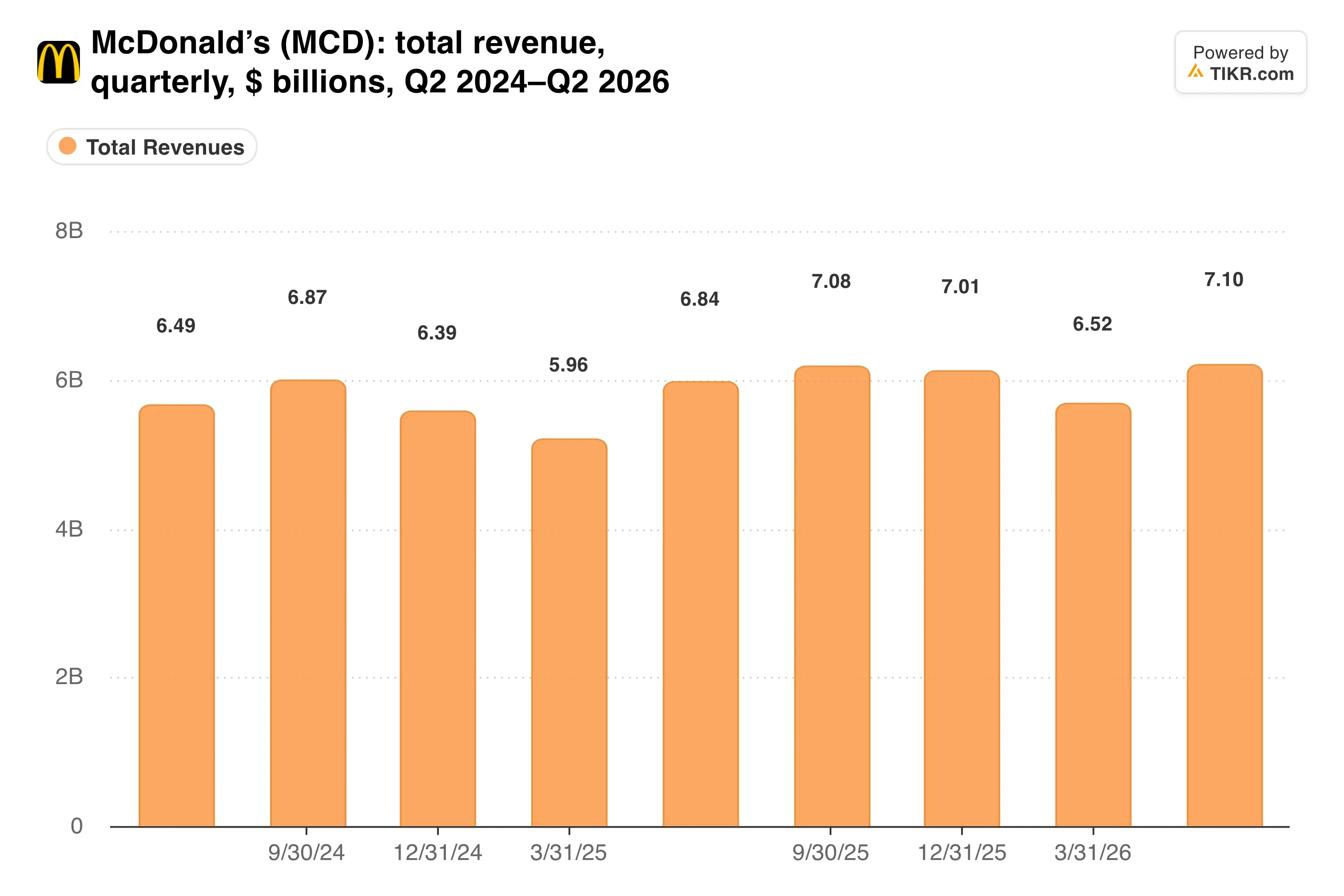
Revenue keeps inching higher, which makes the traffic decline easy to miss.
Inside the $8.5 billion pledge
NEXT is McDonald’s plan to win visits back through better food, faster service and sharper value. The $8.5 billion keeps franchisees on board while they fund remodels that can cost at least $1.2 million per U.S. restaurant.
About $5 billion lands by 2030 through rent relief and capital support. From 2027 through 2030, McDonald’s also expects about $3 billion of baseline capex per year, plus $1.5 billion to $2 billion of cumulative capital partnering.
The payoff targets are ambitious. Management wants operating margins in the low-to-mid 50% range by 2030, up from 46.9% in fiscal 2025. It also expects the plan to add about $100,000 in annual cash flow for the average U.S. restaurant.
That last number is the one franchisees care about. Without it, the remodel math falls apart.
How big is the spending step-up?

Baseline capex of about $3 billion a year comes before the franchisee support, so the parent carries more of the load through 2030.
TIKR tracks 34 analysts on McDonald’s. How many say “Buy”?
See the full breakdown of Buy, Hold, and Sell ratings on McDonald’s, along with Wall Street’s revenue and earnings estimates, all in one place. More than 500,000 investors use TIKR to research stocks like this one. See McDonald’s’ Analyst Ratings
Cheap for a reason, for now
At 18.9x NTM earnings, McDonald’s trades below its recent history and far below Starbucks at 34.3x. However, the balance sheet is stretched, with net debt at 3.23x EBITDA.
The franchisee plan will weigh on parent cash flow before efficiency gains arrive. Meanwhile, a proposed class action alleges that AI pricing tools coordinate menu prices across franchisees. McDonald’s says AI does not set menu prices and that franchisees make their own pricing decisions.
Watch free cash flow as the spending ramps…

Management guides 2026 free cash flow conversion to the low-to-mid 80% range, so any slip there would show up quickly.
One longtime shareholder, Longbow Asset Management CEO Jake Dollarhide, pointed to Starbucks as proof that these resets take time. That comparison cuts both ways, since Starbucks needed close to a year before its investments lifted sales.
My take: McDonald’s is still the best operator in fast food, and a 3.1% yield with a dividend raised to $1.93 gives real support. But I think the stock stays range-bound until U.S. guest counts turn positive, because this plan spends first and earns later.
The November 4 call is the checkpoint. Look for the U.S. guest count trend and any update on how many franchisees have signed on for NEXT remodels.
So what is McDonald’s stock actually worth?
TIKR lets you forecast the future price of any stock in less than a minute. Just enter a few assumptions into TIKR’s valuation model and see what McDonald’s could be worth. Start from Wall Street consensus estimates, or adjust the inputs to reflect your own view of the business. It’s free to use.
Disclaimer:
Please note that the articles on TIKR are not intended to serve as investment or financial advice from TIKR or our content team, nor are they recommendations to buy or sell any stocks. We create our content based on TIKR Terminal’s investment data and analysts’ estimates. Our analysis might not include recent company news or important updates. TIKR has no position in any stocks mentioned. Thank you for reading, and happy investing!


