Key Takeaways
- Visa raised its quarterly dividend 16% to $0.78 a share, a 0.71% yield against 0.52% for Mastercard, whose stock hit a record after a 22% month.
- Mastercard’s dividend takes about 16% of its free cash flow, but with buybacks it returned $14.5 billion in 2025, which was 84% of that cash.
- In the first half of 2026, Mastercard’s buybacks and dividends came to 1.7x its free cash flow, with help from $5.0 billion of new debt.
- At about 30x forward earnings, close to its 31x five-year average, Mastercard’s buybacks still look like a good use of its cash, and its December dividend decision is the next test.
Mastercard (MA) stock is at a record after a 22% month, and its biggest rival just gave income investors a reason to look elsewhere: Visa (V) raised its quarterly dividend 16% to $0.78 a share, payable Dec. 1.
That has investors asking whether Mastercard is the stingier of the two. But the dividend is only a small slice of the cash Mastercard hands back.
Visa wins on the check
Visa’s raise lifts its yield to 0.71%, against 0.52% for Mastercard. On $10,000 invested, that’s $71 a year from Visa and $52 from Mastercard.
So Visa pays more. But the gap is $19 a year on $10,000, and Mastercard’s raises have been just as big: 16%, 15% and 14% in each of the last three Decembers, the latest taking it to $0.87 a quarter.
Visa’s CFO also said where the rest of Visa’s spare cash goes. The company intends “to return excess free cash flow to shareholders through buybacks.” Mastercard works the same way.
TIKR tracks 40 analysts on Mastercard. How many say “Buy”?
See the full breakdown of Buy, Hold, and Sell ratings on Mastercard, along with Wall Street’s revenue and earnings estimates, all in one place. More than 500,000 investors use TIKR to research stocks like this one. See Mastercard’s Analyst Ratings
Most of Mastercard’s cash comes back
Mastercard’s pool of cash to hand back is still growing. Analysts expect its free cash flow to rise from $17.1 billion this year to $23.1 billion in 2028:
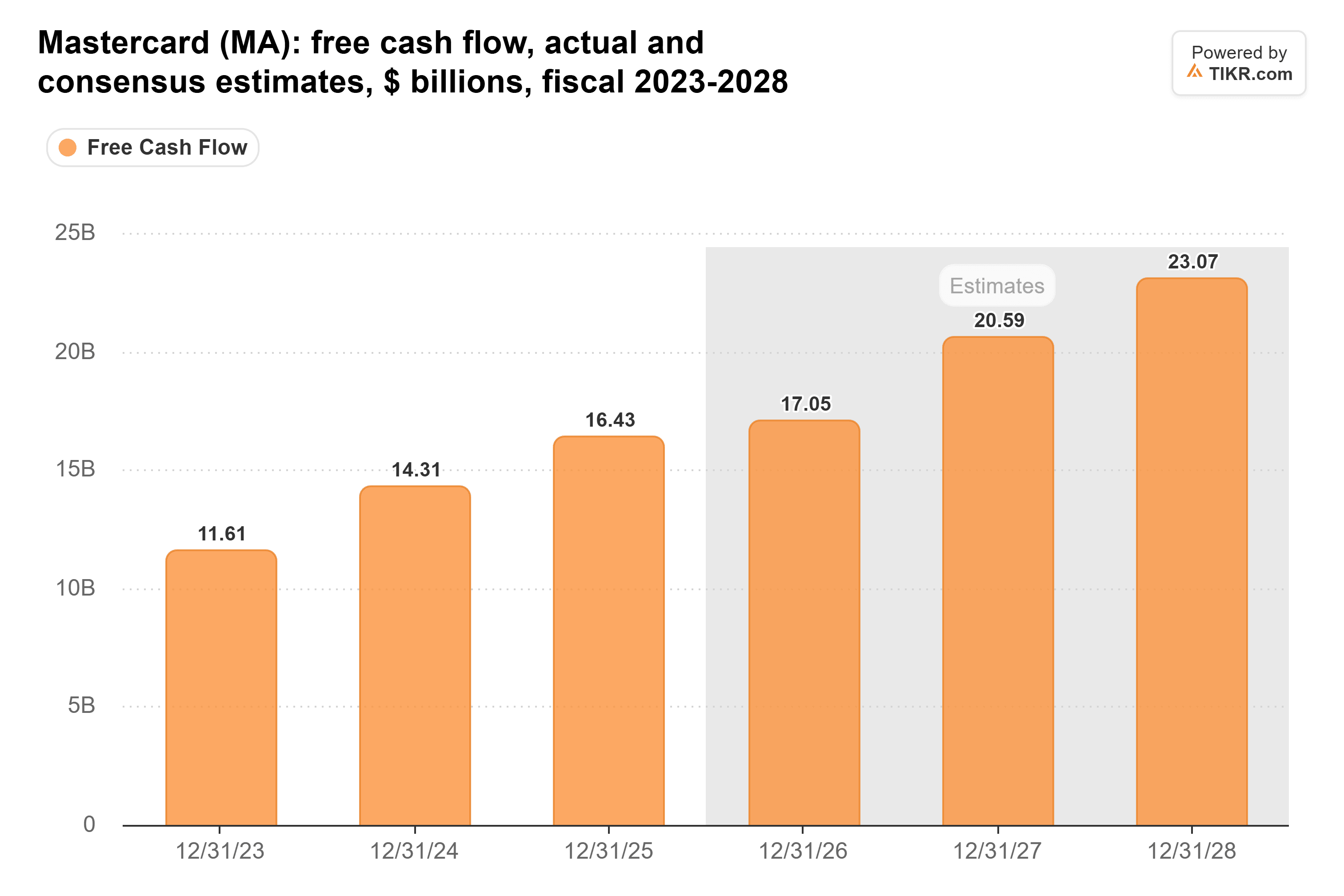
The dividend takes a small slice of that. Mastercard paid $2.76 billion of dividends in 2025, 16% of its $17.2 billion of free cash flow:

Buybacks took most of the rest. Mastercard bought back $11.7 billion of stock in 2025, so it returned $14.5 billion in all, 84% of its free cash flow. That works out to about 2.5% of its $586 billion market value at the last close, nearly five times its dividend yield.
It’s been doing this for years. From 2015 through 2025, it spent $74.4 billion on buybacks, and its diluted share count fell 20%, to 906 million.
Every share left owns a bigger slice of the earnings.
Buying at a record costs more
Of course, the price Mastercard pays for its own stock matters. In the first half of 2026, it bought back $8.9 billion at an average of $508.11 a share, while its forward P/E sank to a five-year low of 23x in early June.
Since then, the multiple has climbed back to about 30x, just under its 31x five-year average:

That means each buyback dollar now buys about a fifth less in earnings than it did in June. But 30x is a normal price for Mastercard, and analysts expect normalized EPS to grow from $17.01 in 2025 to $26.89 in 2028, about 16% a year. Buying back a business growing that fast, at its usual multiple, still makes sense to me.
Mastercard did borrow to pay for some of that June buying, though. Its first-half buybacks and dividends came to $10.5 billion, 1.7x its $6.3 billion of free cash flow, and it sold $5.0 billion of notes in June. Net debt rose to $13.4 billion at June 30, from $8.4 billion at the end of 2025.
Where Mastercard’s cash goes next
Visa pays the bigger check. Mastercard hands back most of its free cash flow, mostly through buybacks, and at its usual multiple those buybacks still look like money well spent. For anyone who isn’t living off the dividend, I’d take Mastercard’s approach.
Mastercard usually raises its dividend in December, so its next declaration will show whether it can match Visa’s 16%. It has $4.9 billion left on its buyback authorization, and I’d expect a new one to come with the raise. After that, fourth-quarter results in late January bring new CFO Ling Hai’s first 2027 outlook, and he has already warned that part of the third quarter’s beat came out of the fourth.
So what is Mastercard stock actually worth?
TIKR lets you forecast the future price of any stock in less than a minute. Just enter a few assumptions into TIKR’s valuation model and see what Mastercard could be worth. Start from Wall Street consensus estimates, or adjust the inputs to reflect your own view of the business. It’s free to use.
Disclaimer:
Please note that the articles on TIKR are not intended to serve as investment or financial advice from TIKR or our content team, nor are they recommendations to buy or sell any stocks. We create our content based on TIKR Terminal’s investment data and analysts’ estimates. Our analysis might not include recent company news or important updates. TIKR has no position in any of the stocks mentioned. Thank you for reading, and happy investing!