Key Takeaways
- The Labor Department finalized a rule, effective in January, that makes it easier to classify workers as independent contractors.
- That lowers the federal risk that Uber (UBER), DoorDash (DASH), and Lyft (LYFT) must treat drivers as employees, who can cost up to 30% more.
- Uber’s operating margin reached 10.7% in fiscal 2025 and DoorDash’s 6.1%, too thin to absorb that kind of cost increase easily.
- The rule makes the earnings analysts expect safer, though state laws and a new Democratic Congress keep the fight going.
Uber just got some help from Washington on the cost its whole business is built around: the people who drive.
On Thursday, the Labor Department finalized a rule that makes it easier for companies to classify workers as independent contractors instead of employees.
That’s good news for DoorDash and Lyft too, since all three build their businesses on drivers and couriers who work as contractors.
What exactly happened
The new rule replaces a standard adopted in 2024 under former President Joe Biden, which set out several factors for deciding whether a worker is an employee under federal wage law.
The new test asks two questions instead: whether the company controls the worker, and whether the worker can make or lose money through their own initiative or investment.
It takes effect in January, 60 days after it’s formally published.
And the stakes are real. Several surveys put the extra cost of an employee at up to 30% more than a contractor, since employees get the minimum wage, overtime pay, unemployment insurance, and expense reimbursements.
TIKR tracks 51 analysts on Uber. How many say “Buy”?
See the full breakdown of Buy, Hold, and Sell ratings on Uber, along with Wall Street’s revenue and earnings estimates, all in one place. More than 500,000 investors use TIKR to research stocks like this one. See Uber’s Analyst Ratings
Uber’s earnings forecasts already assume contractors
Analysts expect Uber’s normalized EPS to more than double, from $2.45 in fiscal 2025 to $5.55 in fiscal 2028:
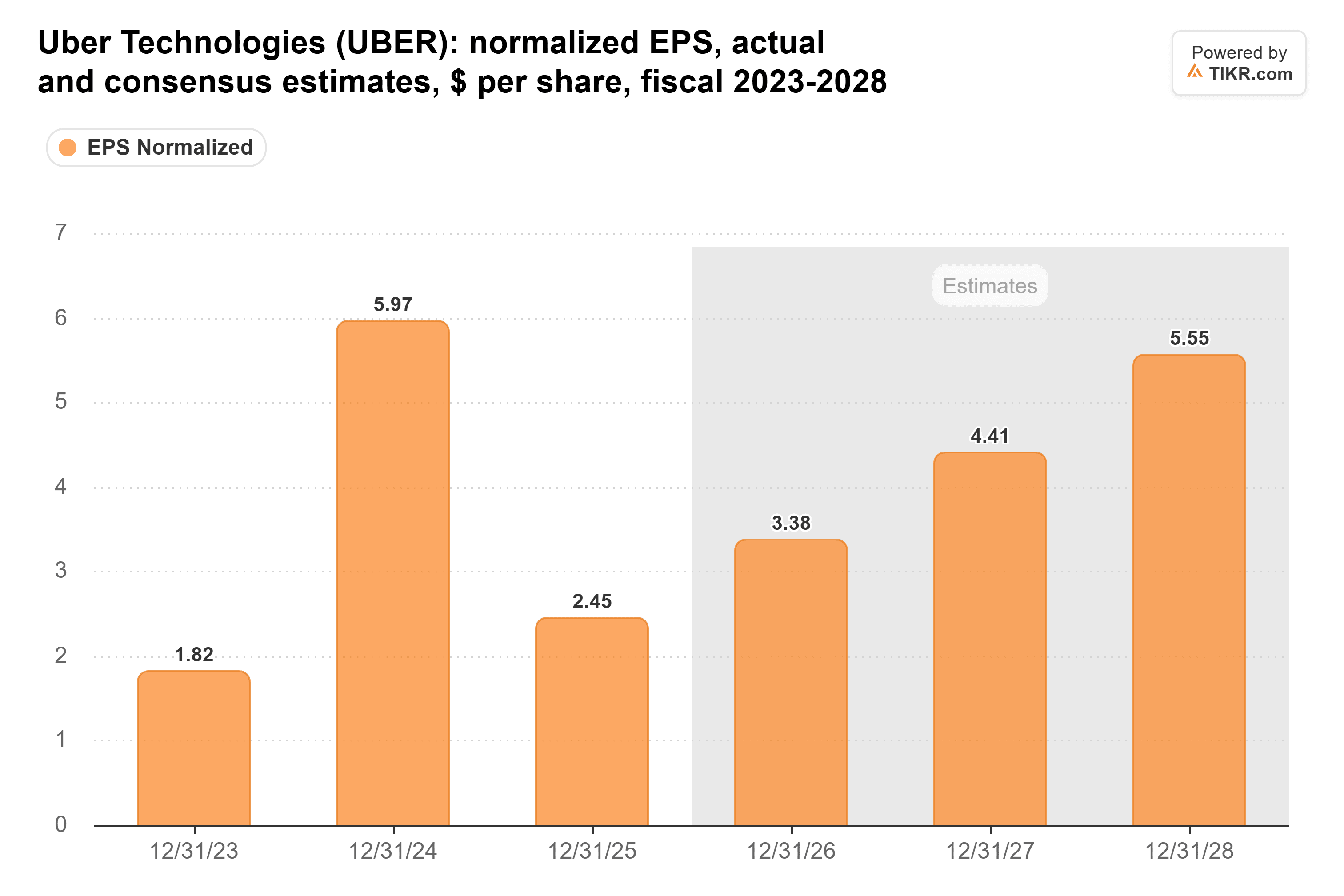
Those estimates already assume drivers stay contractors, so the rule shouldn’t push them higher. It makes them more likely to hold up.
Most of the Uber debate is about robotaxis right now. But human drivers still handle nearly every Uber trip: management said on its Q2 call that autonomous vehicles make up under 0.5% of trips.
So the cost of those drivers will drive Uber’s profits for years, and Uber hasn’t been solidly profitable for long.
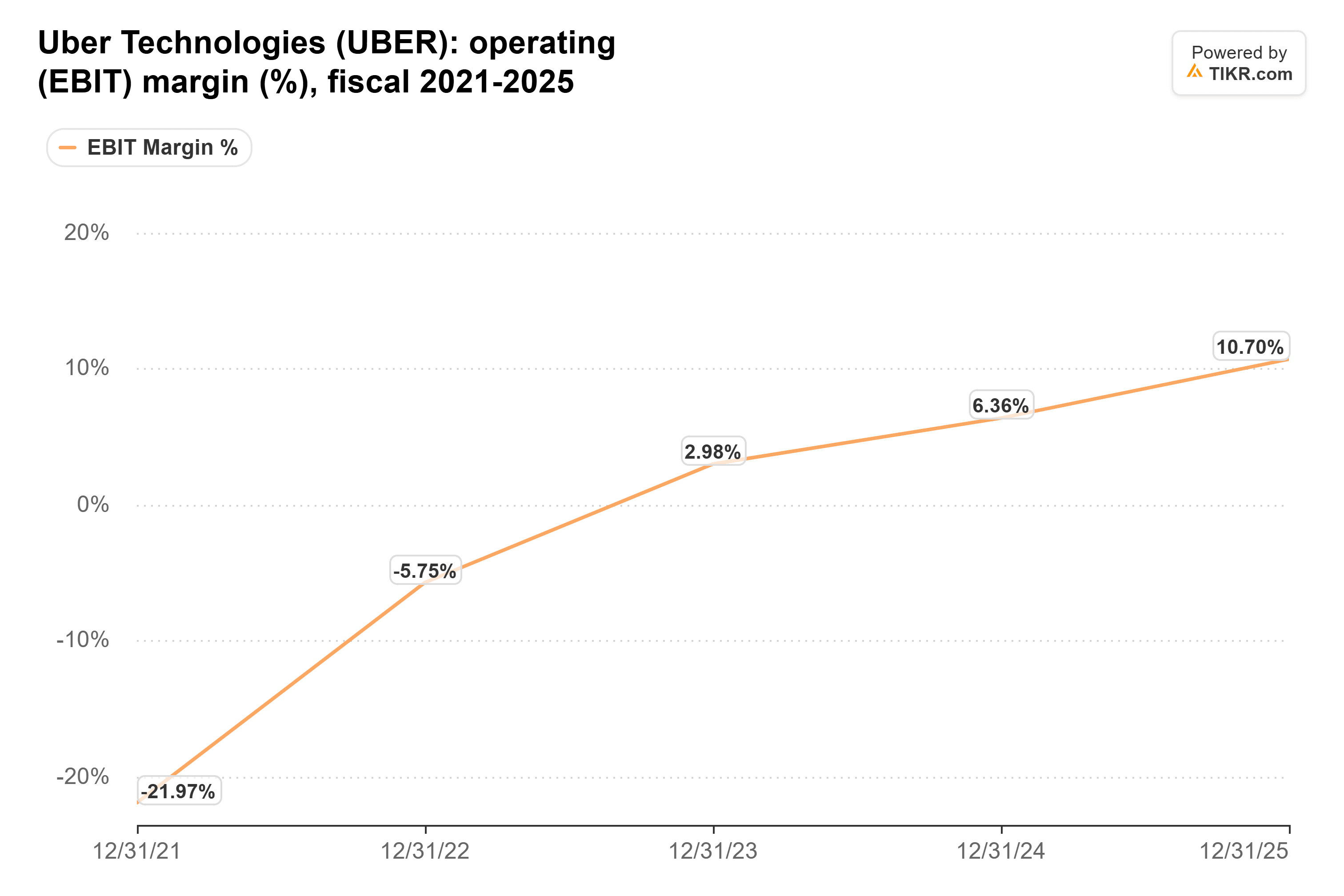
Its GAAP operating margin turned positive in fiscal 2023 and reached 10.7% in fiscal 2025:
Uber kept 30.4% of what riders booked on its Mobility side in fiscal 2025, and drivers’ earnings come out of the rest.
A cost increase of up to 30% on that much bigger pool of money would swamp a 10.7% margin unless riders paid for it in higher fares.
The rule only covers the US, and management says 60% of Mobility bookings come from outside the country.
But the other 40% belongs to the segment that earned 69.1% of Uber’s segment-adjusted EBITDA in fiscal 2025.
DoorDash and Lyft have even less room
DoorDash’s couriers work on the same model, and its profits are thinner than Uber’s. Its operating margin went from -6.7% in fiscal 2023 to 6.1% in fiscal 2025:
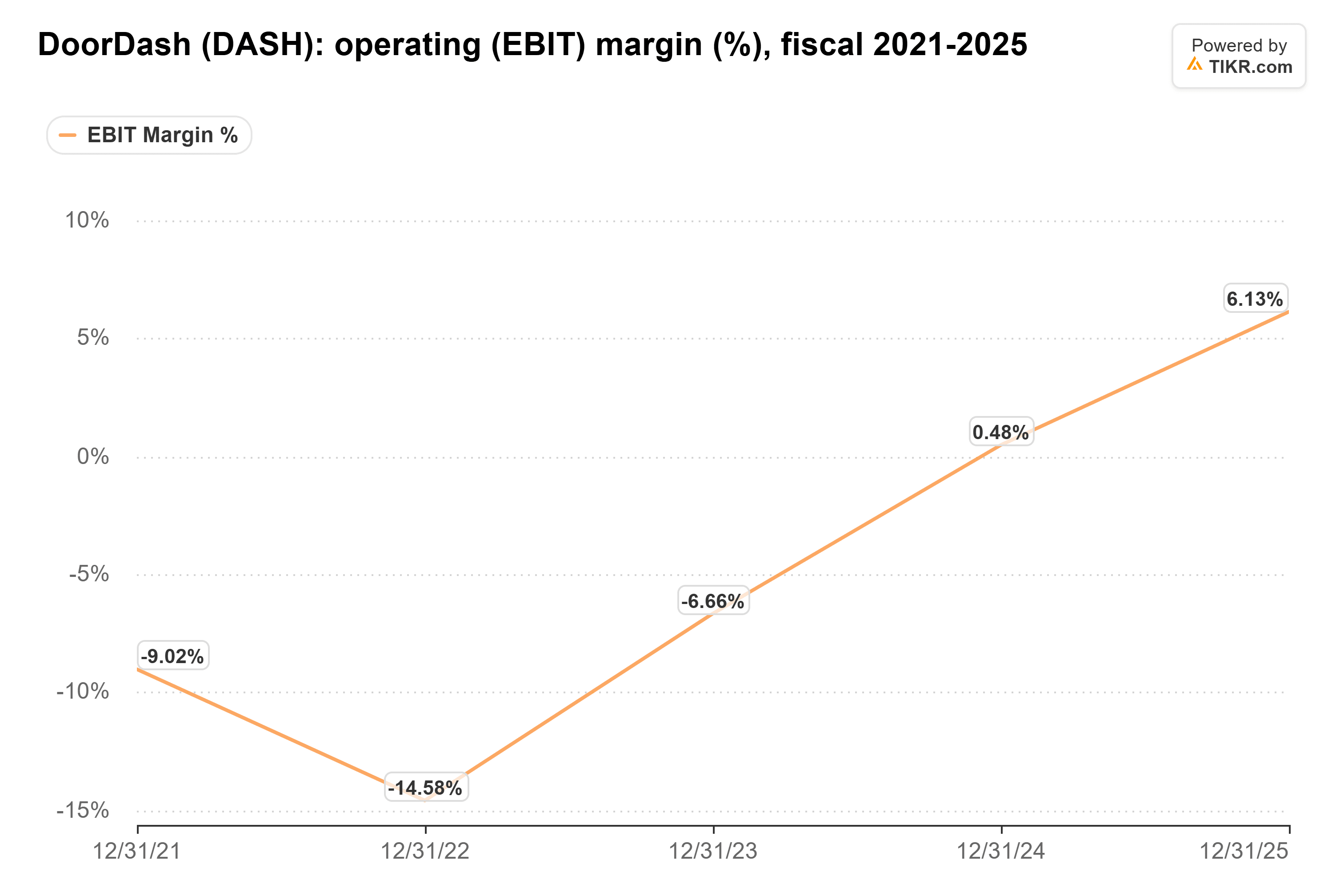
At about 6 cents of operating profit per dollar of revenue, DoorDash has even less room than Uber to absorb employee costs, and at least as much to gain from the rule.
Lyft is in the same boat. Its adjusted EBITDA came to 3.6% of gross bookings in Q3.
Its CFO credited “rides acceleration in North America” for its record quarter, so a US rule covers more of Lyft’s business than Uber’s.
Analysts expect Lyft’s normalized EPS to climb from $1.43 in fiscal 2026 to $2.05 in fiscal 2027, and those estimates depend on the same contractor model.
A federal risk, lowered
None of this ends the fight. The rule applies to federal wage law, and states like California run their own tests for who counts as an employee, so the state-law cases accusing app companies of misclassifying workers, which they deny, go on regardless.
Washington could also swing back. Democrats won both the House and the Senate in the Nov. 3 midterms and take over in January, and the federal standard has changed under each of the last three administrations.
The way I see it, this is a real win for Uber shareholders. Of course, the new Congress and the states still get a say, so watch what both do once the rule takes effect.
So what is Uber stock actually worth?
TIKR lets you forecast the future price of any stock in less than a minute. Just enter a few assumptions into TIKR’s valuation model and see what Uber could be worth. Start from Wall Street consensus estimates, or adjust the inputs to reflect your own view of the business. It’s free to use.
Disclaimer:
Please note that the articles on TIKR are not intended to serve as investment or financial advice from TIKR or our content team, nor are they recommendations to buy or sell any stocks. We create our content based on TIKR Terminal’s investment data and analysts’ estimates. Our analysis might not include recent company news or important updates. TIKR has no position in any of the stocks mentioned. Thank you for reading, and happy investing!