Key Takeaways
- Anthropic’s IPO roadshow showed that, with its Mythos model, it got running on an Advanced Micro Devices (AMD) chip in three days, against the six to 12 months it typically took.
- That cuts at the switching costs behind Nvidia’s (NVDA) 75% gross margin, and AMD and Arista Networks (ANET) stand to gain.
- Nvidia’s pricing is holding for now: management guides gross margin to bottom at 71% to 72% in the January quarter.
- At about 9x forward earnings, Nvidia looks priced for a lot of that damage, and its margin once supply catches up is the test.
Nvidia has had a brutal week before rebounding spectacularly on Monday. Jensen Huang resigned as CEO (the board reinstated him on Nov. 23), and on Friday Nvidia, Advanced Micro Devices and Broadcom each fell more than 10%.
But the bigger long-term problem for Nvidia may have come up on Thursday’s episode of CNBC’s Closing Bell.
One guest described a slide from Anthropic’s IPO roadshow showing that “it typically took them six to 12 months to get up on an AMD chip, but with Mythos, they were able to get up on the chip in three days.”
That’s a big deal.
If AI can move a lab’s software off Nvidia’s CUDA that fast, buyers have a real alternative, and AMD is the obvious winner. So is Arista Networks, which just launched open, standards-based rack-scale AI networks with AMD, Microsoft, and others.
Buyers finally have options
CUDA’s switching costs are a big reason buyers have kept paying up for Nvidia’s chips. Rewriting software for another chip used to take months, and AI is now doing that work.
Analysts already expected AMD’s revenue to nearly triple from fiscal 2025 to fiscal 2027:
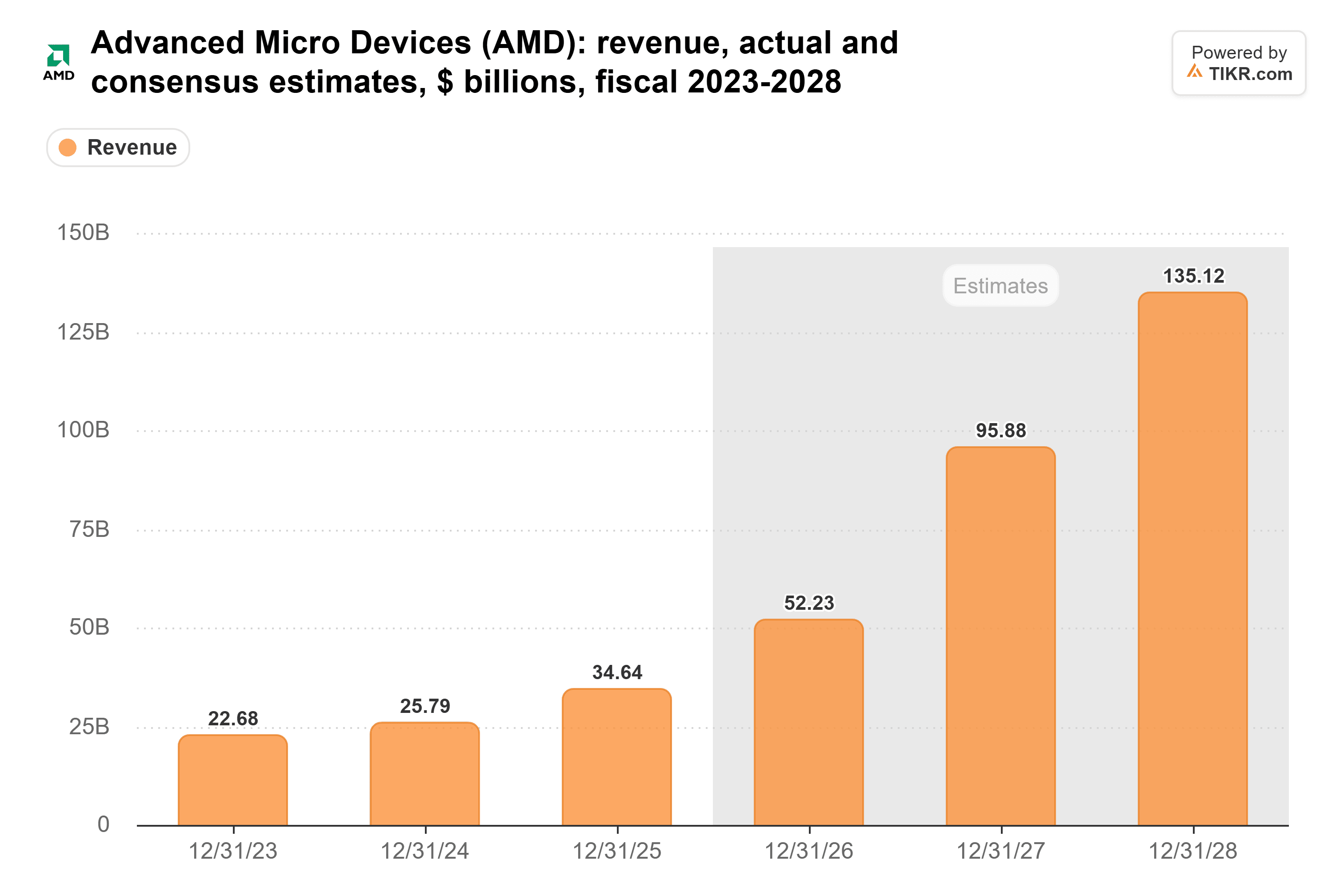
Those estimates predate Thursday’s short-seller report, which knocked AMD down 13%.
Hunterbrook Media, whose affiliated fund is short the stock, reported that newer AMD firmware kept turning up at a blacklisted Chinese server maker, and AMD said the claims misrepresent its business practices and relationships.
TIKR tracks 66 analysts on Nvidia. How many say “Buy”?
See the full breakdown of Buy, Hold, and Sell ratings on Nvidia, along with Wall Street’s revenue and earnings estimates, all in one place. More than 500,000 investors use TIKR to research stocks like this one. See Nvidia’s Analyst Ratings
The 75% margin is what’s at stake
The lock-in shows up in Nvidia’s gross margin. It went from 56.9% in fiscal 2023 to 75.0% in fiscal 2025. In the year ended January 2026, the shift to full Blackwell systems and a $4.5 billion charge on its H20 China chips pulled it down to 71.1%:

It was back at 75% in the October quarter, on record revenue of $115.8 billion.
Any buyer that can move its software in days now has leverage when it negotiates prices, and that leverage costs Nvidia margin.
Supply still sets the price, for now
Porting one lab’s software to an AMD chip is a long way from moving a whole fleet.
Nvidia sells full racks and networking, and demand still runs ahead of supply. Colette Kress, then interim CEO, said on Nvidia’s Q3 call that “Hopper GPUs have recontracted at up to twice their original price under the multi-year agreements, while the B300 rates have risen more than 60% since their introduction.”
Management guides gross margin to bottom at 71% to 72% in the January quarter as memory costs climb, then recover to 72% to 73% in fiscal 2028.
Arista is the open alternative to Nvidia’s networking. Its Q3 revenue rose 58.5% to $3.66 billion, and it guides to $3.9 billion to $4.0 billion for Q4.
If more buyers run AMD chips, I’d expect more of them to wire those clusters with Arista’s open Ethernet.
The market already expects the worst
Nvidia’s forward P/E fell to 10x on Nov. 19, its lowest of the past three years. That compares with a three-year average of 30x and a peak of 47x in June 2024.

The way I see it, AI is draining the CUDA moat faster than anyone expected, and that matters more over the long run than who runs Nvidia. At that multiple, the stock already looks priced for a bust.
A January-quarter gross margin below the 71% to 72% guide, or a fiscal 2028 guide under 72%, would mean the moat is draining into the numbers.
So what is Nvidia stock actually worth?
TIKR lets you forecast the future price of any stock in less than a minute. Just enter a few assumptions into TIKR’s valuation model and see what Nvidia could be worth. Start from Wall Street consensus estimates, or adjust the inputs to reflect your own view of the business. It’s free to use.
Disclaimer:
Please note that the articles on TIKR are not intended to serve as investment or financial advice from TIKR or our content team, nor are they recommendations to buy or sell any stocks. We create our content based on TIKR Terminal’s investment data and analysts’ estimates. Our analysis might not include recent company news or important updates. TIKR has no position in any of the stocks mentioned. Thank you for reading, and happy investing!