Key Takeaways
- Kraft Heinz yields 6.4% on a dividend that was $1.60 a share in both fiscal 2020 and fiscal 2025, while Energy Transfer yields 7.3% after its 20th straight quarterly raise in October.
- Kraft Heinz’s dividend took a comfortable 50% of free cash flow over the trailing 12 months, but analysts expect 63% in 2026 as free cash flow falls during its turnaround.
- Energy Transfer covered its distribution 1.78x with distributable cash flow in 2025, and analysts expect 2.15x in 2026, though it carries more debt and a bigger spending plan.
- The things to watch are Kraft Heinz’s turnaround, which it expects to bring sales growth back in the second half of 2027, and Energy Transfer’s roughly $7 billion growth budget for 2027.
Anyone hunting for dividend income has probably looked at Kraft Heinz (KHC) and Energy Transfer (ET).
But their checks are headed different ways. On Nov. 4, Kraft Heinz declared another $0.40 quarterly dividend, the same $1.60 a year it paid in fiscal 2020, while Energy Transfer had raised its distribution in October for the 20th quarter in a row.
So if I could hold just one for the next 10 years, which would it be?
| Metric | Kraft Heinz (KHC) | Energy Transfer (ET) |
|---|---|---|
| Dividend yield | 6.4% | 7.3% |
| Annual dividend | $1.60 a share | $1.37 a unit |
| Dividend growth, fiscal 2020-2025 | 0.0% a year | 7.8% a year |
| Coverage, last reported | 50% cash dividend payout ratio (TTM to June 27, 2026) | 1.78x distributable cash flow coverage (fiscal 2025) |
| Coverage, forward (fiscal 2026 consensus) | 63% cash dividend payout ratio | 2.15x distributable cash flow coverage |
| Net debt/EBITDA (LTM) | 2.71x | 3.83x |
| Interest coverage (LTM) | 4.93x | 3.13x |
6 safe dividend stocks paying retirees 6%+ yields
There are over 100 stocks paying 6%+ annual dividends today.
But after an extensive investment review leveraging TIKR’s proprietary data, we now believe only six of them are truly safe for retirees.
They’re all yours as part of our new investment report. Learn more about how to get access right here.
Kraft Heinz is paying for a turnaround
Kraft Heinz’s sales are still shrinking. Third-quarter organic net sales fell 1.1% from a year earlier. It expects constant currency adjusted operating income to fall 16% to 18% in fiscal 2026 as it puts more than $700 million this year back into the business.
The dividend is covered for now, at a comfortable 50% of free cash flow over the twelve months to June 27, 2026, though analysts expect 63% in fiscal 2026. Free cash flow has covered it every year since fiscal 2019 but one:
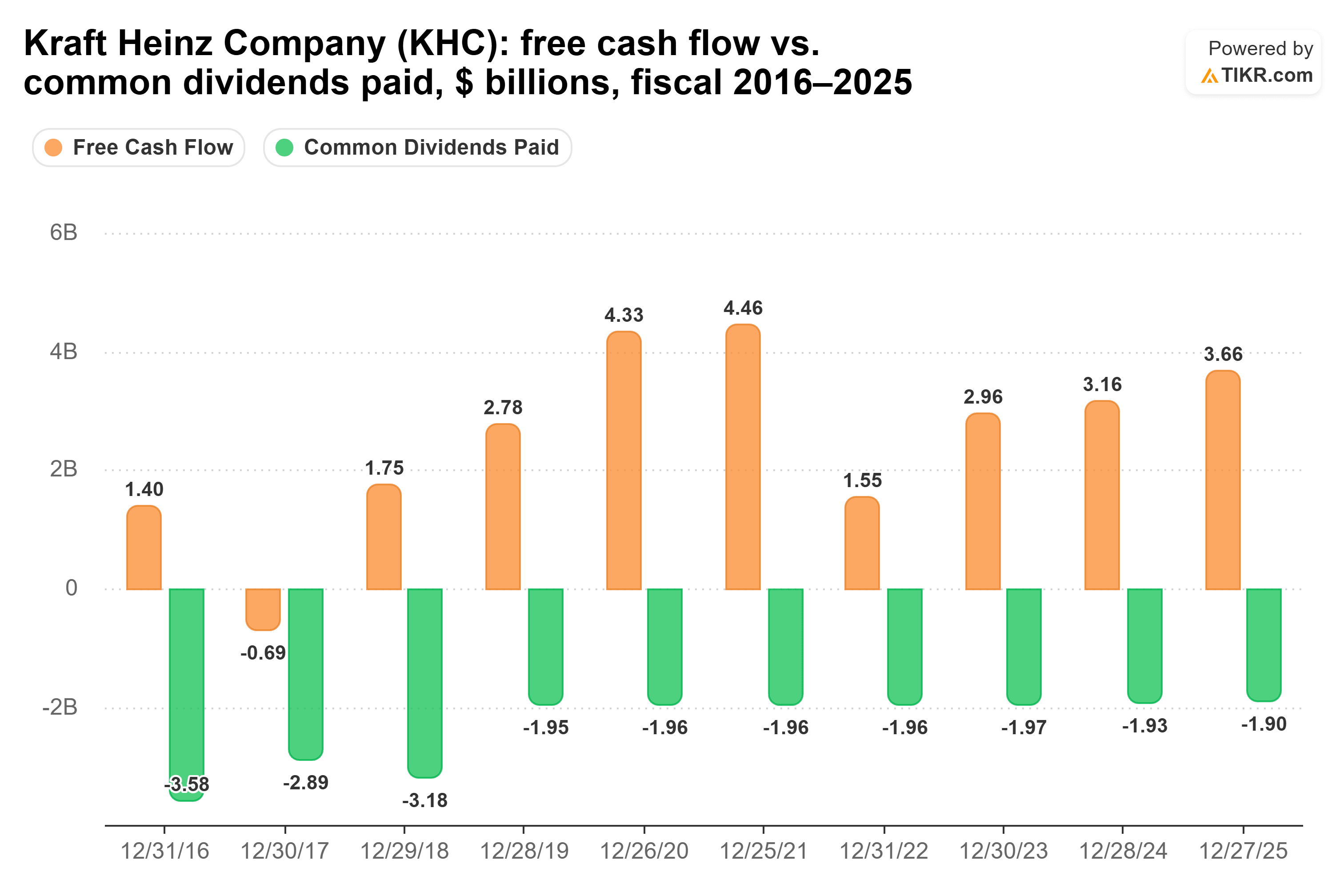
That exception was fiscal 2022, at a risky 126%. The chart also shows the dividend bill dropping from $3.18 billion in fiscal 2018 to $1.95 billion in fiscal 2019, so this payout has been cut before.
The risk is that the turnaround takes longer than the cushion lasts.
Energy Transfer is growing into its payout
Where Kraft Heinz is fighting to hold its sales, Energy Transfer is setting records. Third-quarter distributable cash flow rose 33% from a year earlier to $2.52 billion, on demand from power plants, data centers and LNG. On Nov. 3, it raised its 2026 adjusted EBITDA guidance to $19.7-$19.9 billion, from $18.8-$19.1 billion.
As a partnership, it pays distributions on units, with a K-1 at tax time. October’s raise to $0.3425 a quarter was “the Partnership’s twentieth consecutive increase to its quarterly cash distribution,” and management has said it’s targeting “a long-term annual distribution growth rate of 3% to 5%.”
Distributable cash flow covered the distribution 1.78x in fiscal 2025, and analysts expect a well-covered 2.15x in fiscal 2026 as the raised guidance comes through. Coverage has stayed above 1.7x every year since fiscal 2018:
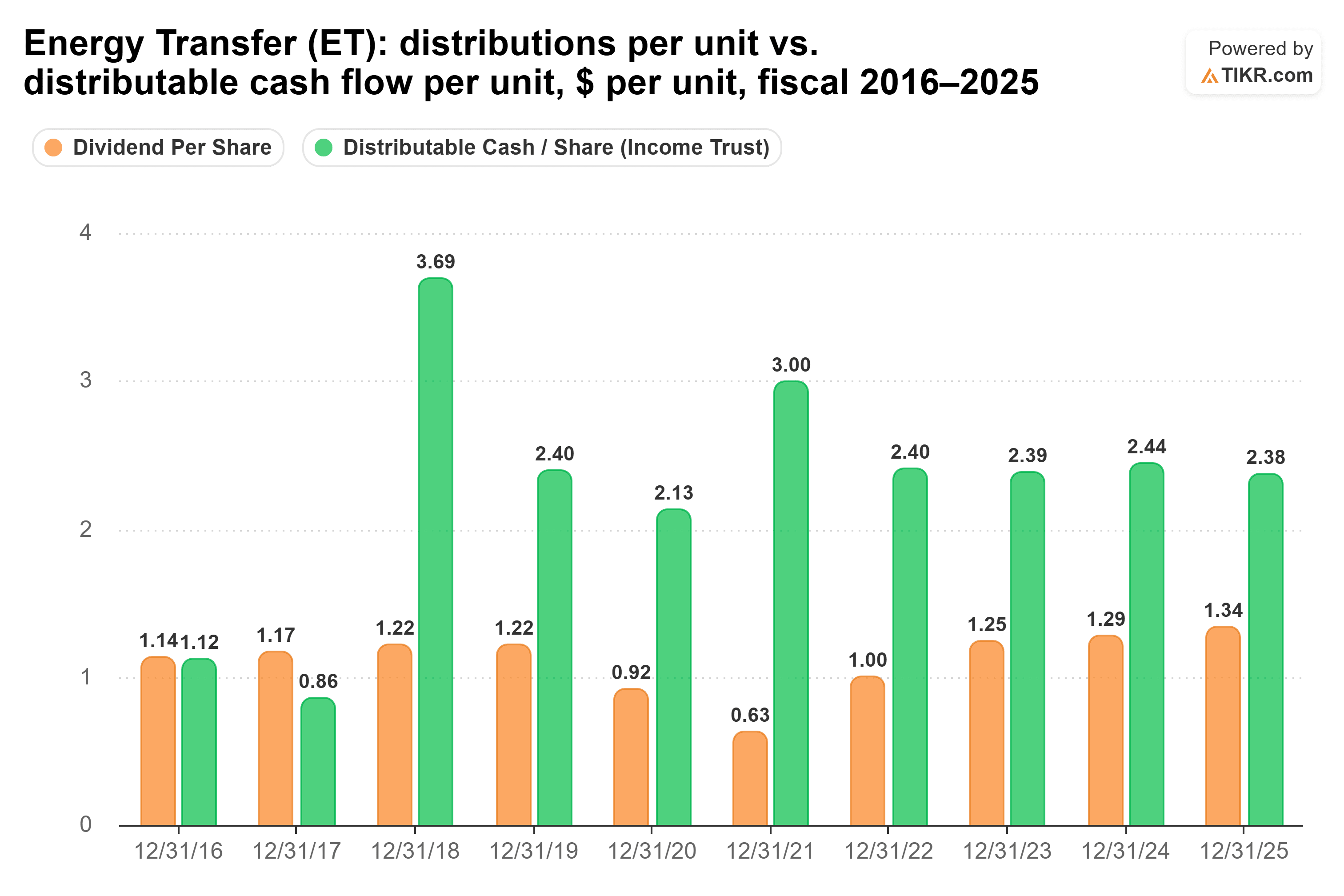
The chart also shows distributions falling from $1.22 a unit in fiscal 2019 to $0.63 in fiscal 2021, with coverage above 2x, so a big cushion hasn’t always protected the check.
The main risk is debt. Energy Transfer carries 3.83x net debt/EBITDA, and on Oct. 6, it agreed to buy Vaquero Midstream for about $2.63 billion, partly in new units.
So which dividend wins?
If I can only hold one dividend stock for the next 10 years, it’s Energy Transfer.
At each dividend’s pace now, $10,000 in Energy Transfer would pay about $9,049 over the decade, against about $6,400 from Kraft Heinz, and Kraft Heinz’s income never catches up.
Energy Transfer’s pace looks like it can hold, with coverage expected to widen. Kraft Heinz’s free cash flow is expected to shrink:
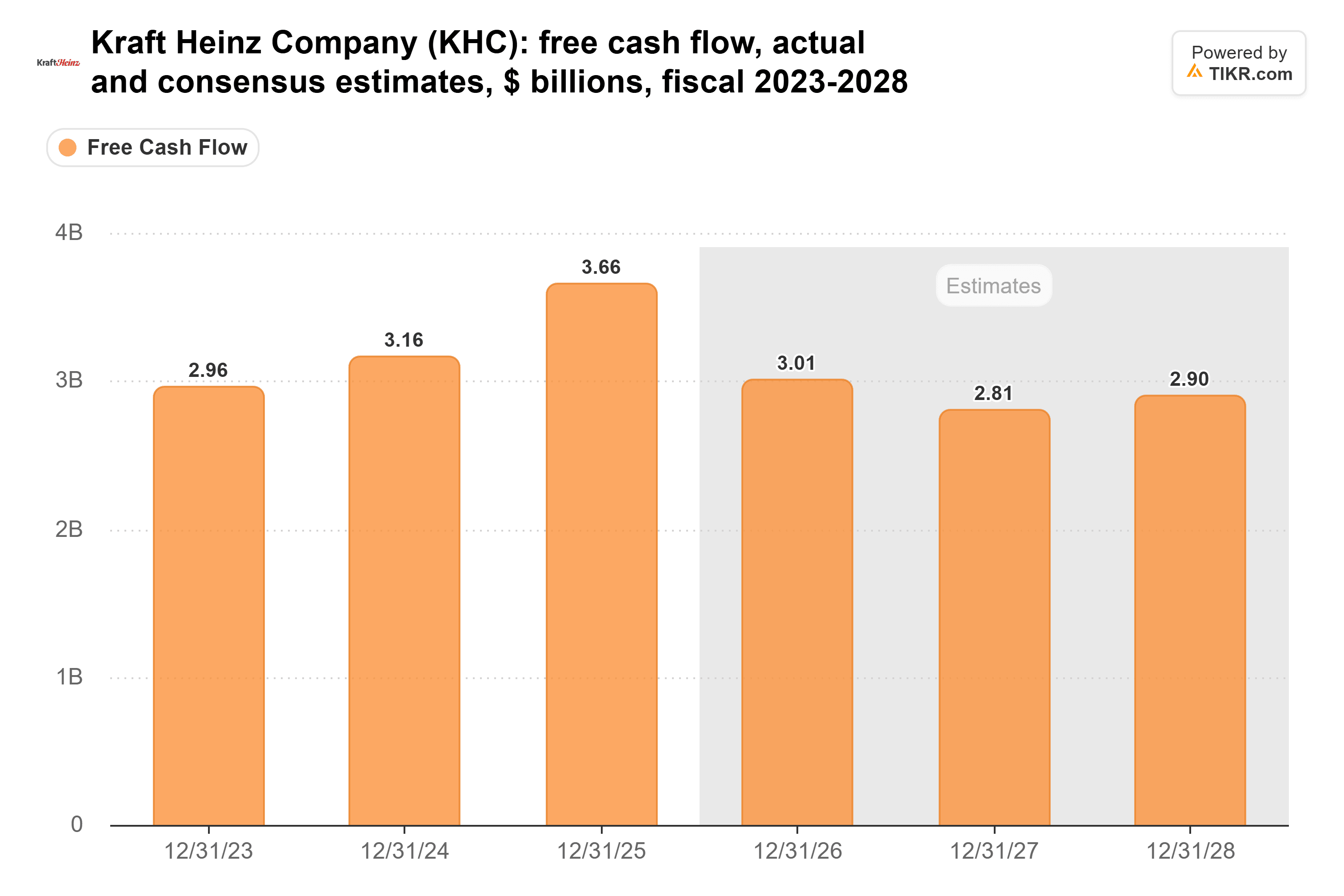
Analysts see it falling from $3.66 billion in fiscal 2025 to $3.01 billion in fiscal 2026 and $2.81 billion in fiscal 2027. At its Nov. 12 Investor Day, the company projected 2027 adjusted operating income down low single digits and about $500 million of free cash flow after dividends. I wouldn’t count on a raise anytime soon.
Kraft Heinz still has the safer balance sheet, with interest coverage of 4.93x against Energy Transfer’s 3.13x. Its dividend is covered, its Nov. 4 deal to sell its North America coffee business at a $650 million value frees up cash, and it expects sales growth to resume in the second half of 2027. It’s just that over 10 years, I’d rather own the growing check from the growing business.
Of course, Energy Transfer has to put about $7 billion to work next year. If those projects don’t earn what management expects, the raises could slow.
Forget Energy Transfer: 6 safe 6%+ dividend yields you can buy right now
Dividends can hold the key to enormous wealth. But only if you buy the right ones.
Picking the right high-yield dividend stock can be the difference between a dream retirement…and scraping by every month, waiting for the next Social Security check to clear.
We’ve identified six stocks yielding 6%+ that we believe every retiree should know about right now. (And Energy Transfer isn’t one of them.)
Disclaimer:
Please note that the articles on TIKR are not intended to serve as investment or financial advice from TIKR or our content team, nor are they recommendations to buy or sell any stocks. We create our content based on TIKR Terminal’s investment data and analysts’ estimates. Our analysis might not include recent company news or important updates. TIKR has no position in any of the stocks mentioned. Thank you for reading, and happy investing!