Key Takeaways
- Of the 460 big funds that have filed 13Fs for the quarter ended Sept. 30, 14 bought Marsh & McLennan Companies and 6 sold, with Ken Fisher’s Fisher Investments among the buyers.
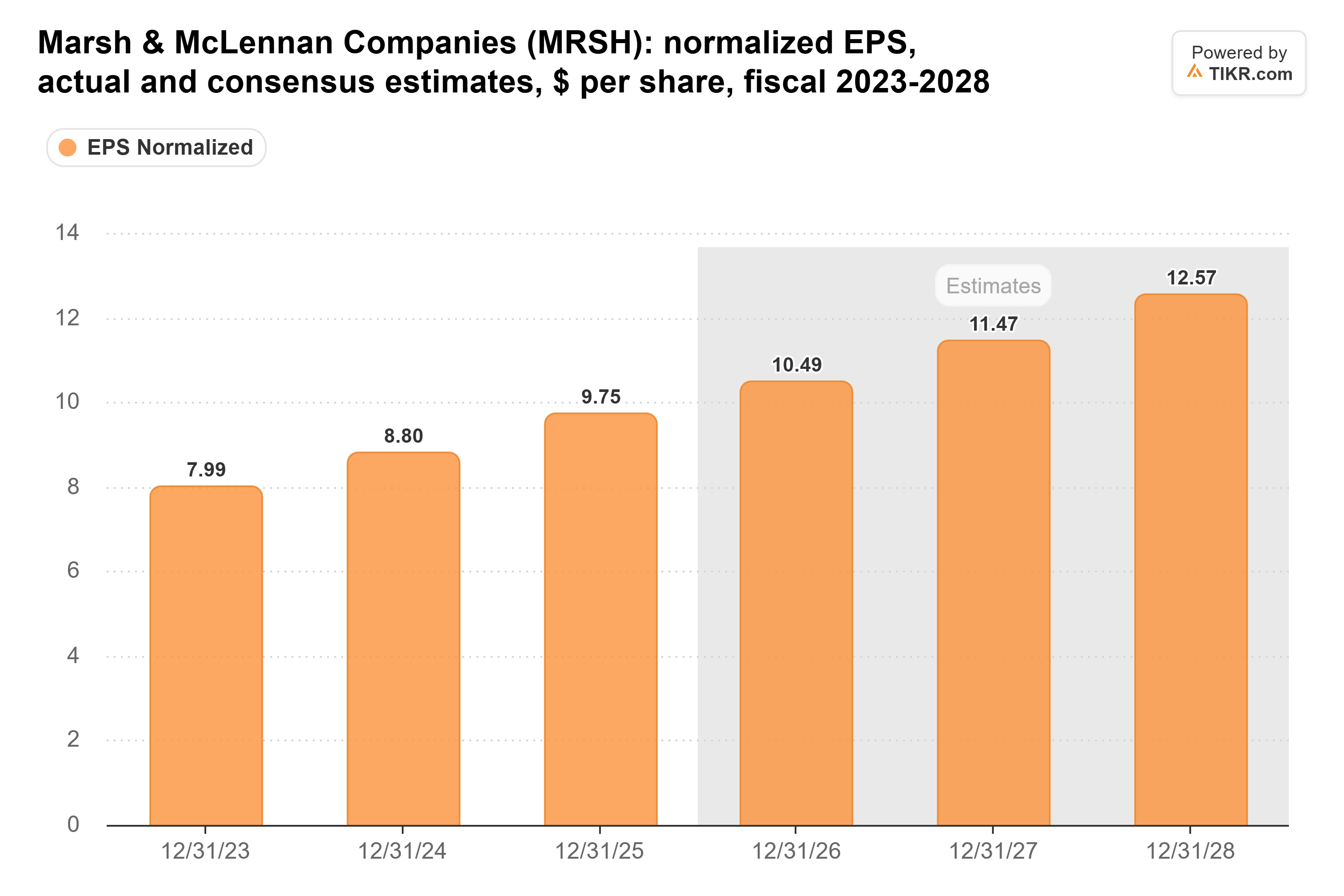
- The numbers favor the buyers: earnings estimates rise every year through 2028, and the stock still trades below its five-year average multiple.
- The stock is up 27% since Sept. 30, about as much as rivals Arthur J. Gallagher and Brown & Brown, and now sits above analysts’ average price target.
- Fourth-quarter results early next year need to show underlying revenue growth holding near the third quarter’s 5%.
Big funds couldn’t agree on Marsh & McLennan Companies (MRSH) in the third quarter, and the stock has run hard since.
The company now goes by Marsh, and its stock is up 27% from its Sept. 30 price to the last close, right alongside Arthur J. Gallagher (AJG) and Brown & Brown (BRO). The 13Fs for the quarter ended Sept. 30 show which funds held more of it going into that run, and which held none.
TIKR tracks 23 analysts on Marsh & McLennan Companies. How many say “Buy”?
See the full breakdown of Buy, Hold, and Sell ratings on Marsh & McLennan Companies, along with Wall Street’s revenue and earnings estimates, all in one place. More than 500,000 investors use TIKR to research stocks like this one. See Marsh & McLennan Companies’ Analyst Ratings
Fourteen buyers, and one big one
Of the 460 big funds that have filed 13Fs for the quarter (funds readers know, or ones with $1 billion or more of US stocks, leaving out quant and index funds), 14 bought Marsh, either opening a position or adding 20% or more. Six sold out or cut 20% or more, and 28 held it at the quarter’s end.
The biggest buyer was Bill Nygren’s Harris Associates, the firm behind the Oakmark funds, which manages $109.48 billion. Its 13F, filed Nov. 16, shows it added 24%, going from 8.69 million shares to 10.78 million, about $357 million of stock at quarter-end prices. That made Marsh its 10th-largest holding, at $1.84 billion and 2.4% of its 13F stocks.
Independent Franchise Partners, which manages $23.85 billion, opened a new position of 800,862 shares, about $137 million at quarter-end prices. Scharf Investments, which manages $4.21 billion, added 72% to reach 590,848 shares, and Marsh is now 3.4% of its 13F stocks.
Ken Fisher’s Fisher Investments bought too, adding 48% to reach 3,316 shares. That’s about $184,000 of buying, too small to show up as a share of its $348.26 billion of 13F stocks.
The biggest seller walked away
Parnassus Investments, which manages $41.09 billion, made the biggest sale. Its 13F, filed Oct. 22, shows it sold all 2.05 million of its shares, about $341 million at quarter-end prices. Marsh had made up 0.9% of its 13F stocks the quarter before.
L1 Capital International, whose 13F holds $1.86 billion of US stocks, sold all 340,997 of its shares, about $57 million at quarter-end prices. That stake had been 3.3% of its 13F stocks.
Sone Capital Management, which manages $1.61 billion, sold its 65,402 shares. In the same quarter it opened a new position in Brown & Brown: 258,575 shares worth $16 million, or 1% of its 13F stocks. Three of the six sellers also added Taiwan Semiconductor in the quarter.
Do the numbers back the buyers?
Marsh’s third quarter, reported Oct. 15, gave the buyers something to point to. Revenue rose 8% to $6.9 billion, or 5% on an underlying basis, and adjusted EPS climbed 10% to $2.03 (GAAP EPS was $1.69). The company also bought back about 2.7 million shares for $500 million in the quarter. Reinsurance was the soft spot, with revenue down 6% to $374 million.
Analysts expect that growth to keep going, with normalized EPS rising every year from $9.75 in fiscal 2025 to $12.57 in fiscal 2028:
Even after the run, the stock isn’t expensive against its own history. Marsh trades at 19x forward earnings, below its five-year average of 22x and well off its December 2021 peak of 26x:
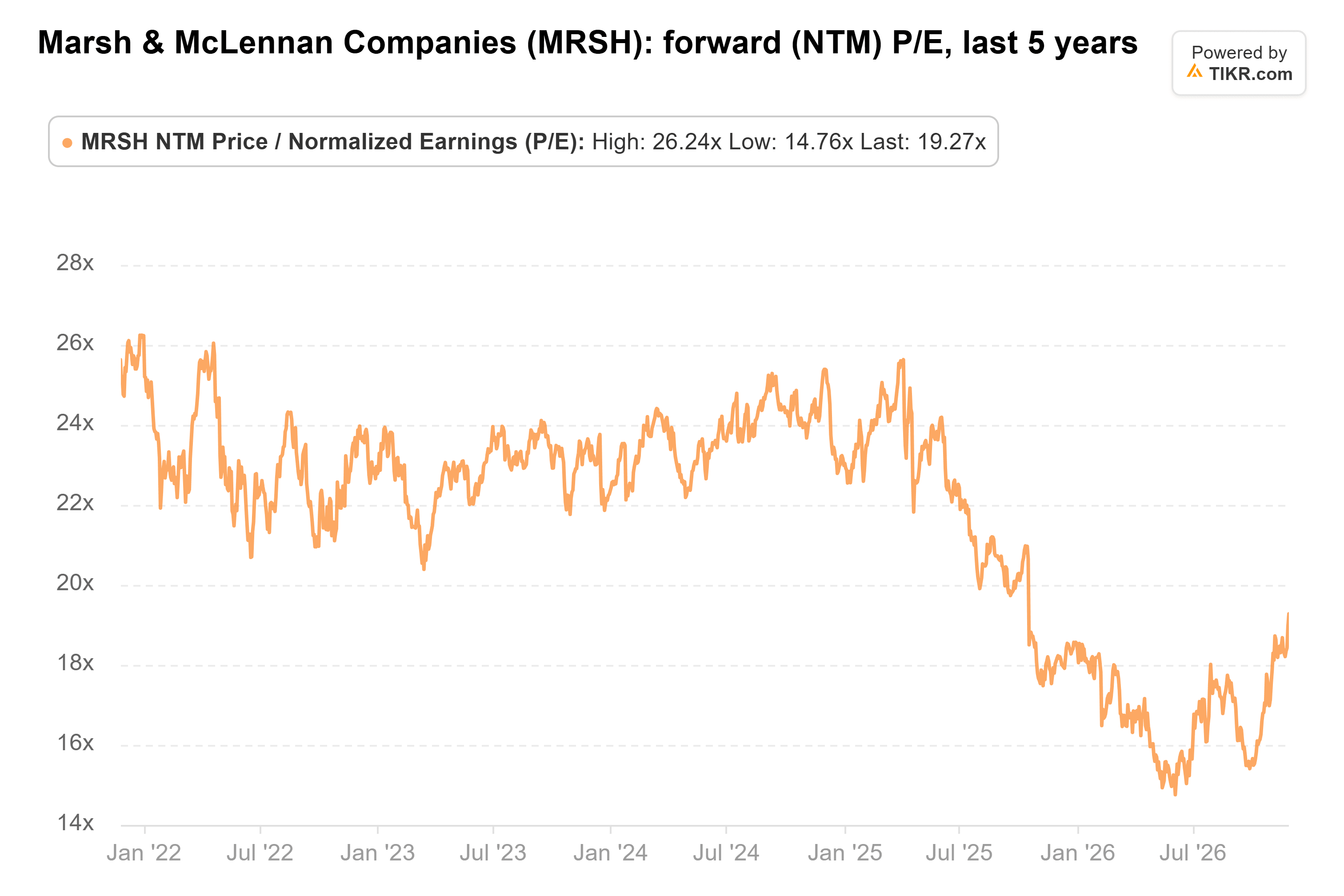
It traded at 15x as recently as June 3, so most of the climb since then has come from the multiple recovering.
The Street hasn’t followed the stock up. Analysts’ average price target is $210.48. That’s 3% below the last close and a bit lower than the $213.53 it stood at a year ago:
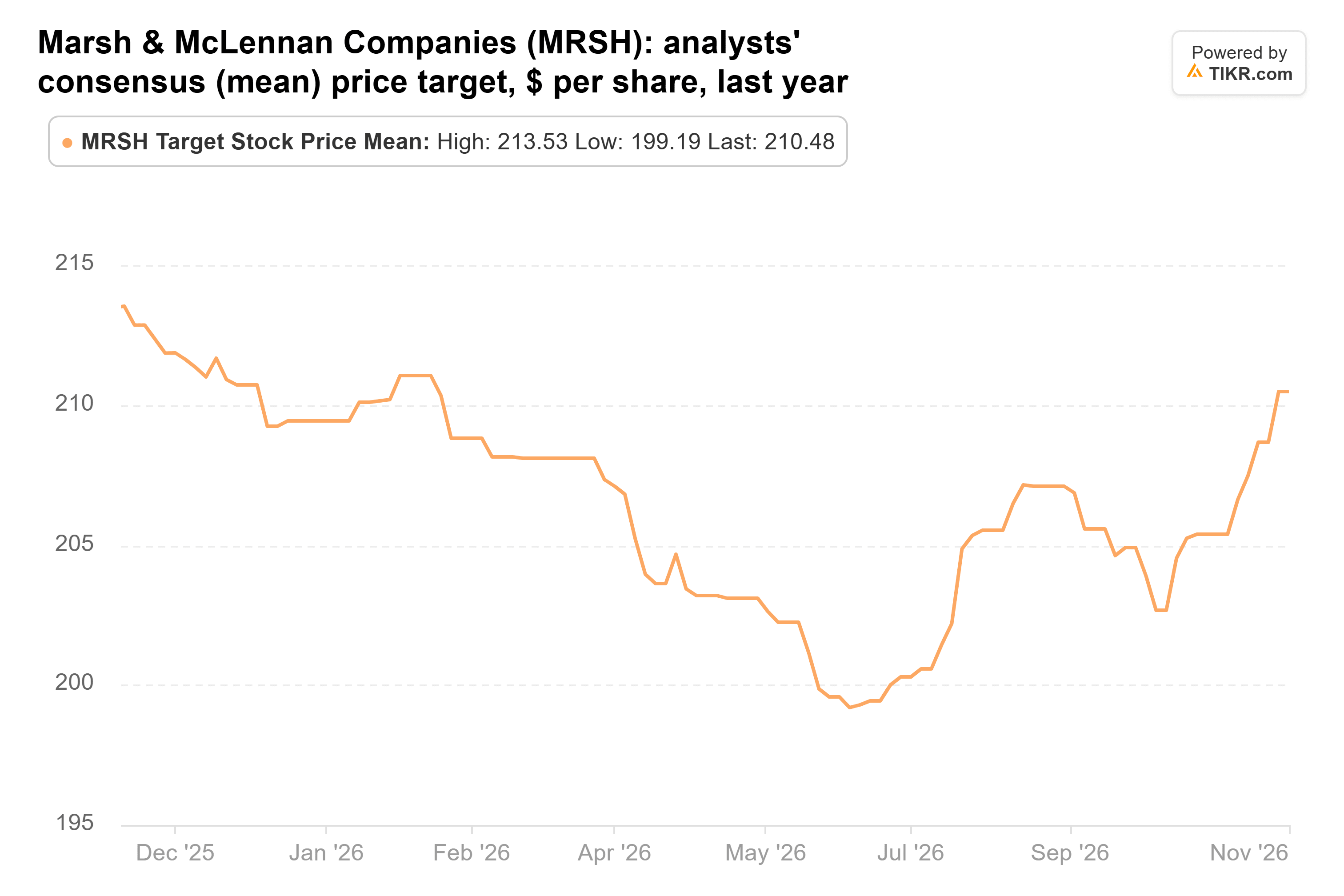
Only the highest target, $235, sits well above today’s price.
Marsh didn’t rally alone, either. Gallagher is up 28% since Sept. 30 and Brown & Brown is up 29%. Brown & Brown got there even after it fell 5% on Oct. 28 on a third-quarter revenue miss and 1.2% organic growth. Gallagher trades at 20x forward earnings and Brown & Brown at 17x, which puts Marsh in the middle of its group.
The buyers have the better case
I side with the buyers. Marsh grew adjusted EPS 10% last quarter, analysts expect high-single-digit growth every year through 2028, and it keeps buying back stock. At 19x, it still trades below the multiple investors have usually paid for it.
The risk is the price. The stock sits 1% below its 52-week high and above the Street’s average target, so the next leg up has to come from earnings growth.
Fourth-quarter results, expected early next year, are the next test. Underlying revenue growth holding near 5%, with reinsurance growing again, would keep the buyers’ case intact. The funds’ 13Fs for the quarter ending Dec. 31, due by mid-February, will show who stuck with their side.
So what is Marsh stock actually worth?
TIKR lets you forecast the future price of any stock in less than a minute. Just enter a few assumptions into TIKR’s valuation model and see what Marsh could be worth. Start from Wall Street consensus estimates, or adjust the inputs to reflect your own view of the business. It’s free to use.
Disclaimer:
Please note that the articles on TIKR are not intended to serve as investment or financial advice from TIKR or our content team, nor are they recommendations to buy or sell any stocks. We create our content based on TIKR Terminal’s investment data and analysts’ estimates. Our analysis might not include recent company news or important updates. TIKR has no position in any of the stocks mentioned. Thank you for reading, and happy investing!