Key Takeaways
- Johnson & Johnson (JNJ) and Coca-Cola (KO) yield 1.9% and 2.3%, and both raised their 2026 outlooks in October.
- Johnson & Johnson’s dividend used 62% of its free cash flow over the latest twelve months, against 79% at Coca-Cola.
- Coca-Cola’s dividends exceeded its free cash flow in fiscal 2024 and 2025, and it now expects at least $13 billion of free cash flow in 2026.
- Johnson & Johnson’s main risk is a proposed talc settlement that brought $5.5 billion of pre-tax charges in Q3.
Johnson & Johnson took $5.5 billion of pre-tax charges in Q3 2026 for a proposed settlement of its ovarian talc lawsuits. It still raised its full-year outlook on Oct. 13.
Two weeks later, Coca-Cola raised its free cash flow forecast for the year. That came after two years in which its dividend cost more than its business brought in.
Income investors count on both for a raise every year. So which streak is safer?
| Metric | Johnson & Johnson (JNJ) | Coca-Cola (KO) |
|---|---|---|
| Dividend yield | 1.9% | 2.3% |
| Annual dividend | $5.36 | $2.12 |
| Dividend growth, fiscal 2020-2025 | 5.2% a year | 4.5% a year |
| Cash dividend payout ratio (TTM) | 62% | 79% |
| Net debt/EBITDA | 0.8x | 1.5x |
| Interest coverage | 26.8x | 10.7x |
Source: TIKR and StockAnalysis, Nov. 9, 2026. Payout ratios are for the twelve months to Sept. 27, 2026 (JNJ) and Oct. 2, 2026 (KO).
6 safe dividend stocks paying retirees 6%+ yields
There are over 100 stocks paying 6%+ annual dividends today.
But after an extensive investment review leveraging TIKR’s proprietary data, we now believe only six of them are truly safe for retirees.
They’re all yours for free as part of our new investment report, which you can access right here.
Johnson & Johnson: plenty of cash, one big lawsuit
Johnson & Johnson’s drug business is doing the heavy lifting. Innovative Medicine sales rose 7.9% to $16.8 billion in Q3 2026, as new launches made up for STELARA’s losses to biosimilars. MedTech grew just 2.5%, to $8.6 billion.
The dividend has plenty of room. Over the twelve months to Sept. 27, 2026, it took a comfortable 62% of free cash flow: $12.72 billion of $20.59 billion.
That’s been the pattern for years. Free cash flow has topped the dividends paid in every fiscal year since 2016:
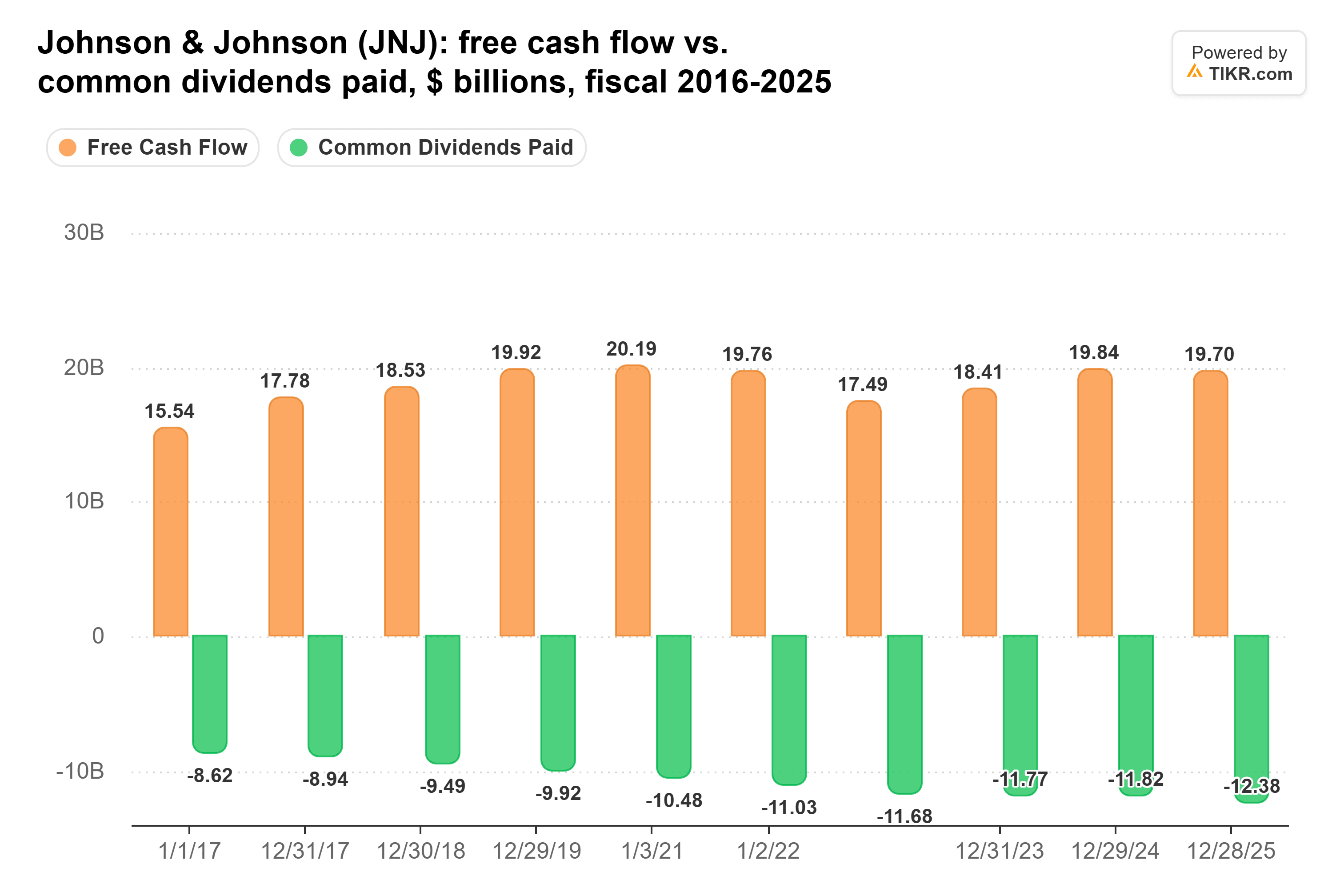
Its payout ratio ranged from 51.9% in fiscal 2020 to 66.8% in fiscal 2022.
On its Q2 call, management said it remains “committed to returning capital directly to shareholders, primarily through our dividend.” It expects about $21 billion of free cash flow this year.
The risk is talc. The charges cut Q3 net earnings to $210 million, from $5.15 billion a year earlier, and shares slipped 4% in premarket trading after the report.
The settlement also needs “the express participation of at least 95% of the remaining ovarian claims,” CFO Joseph Wolk said on the call. His read: “We are trending to meet the 95% threshold.”
Coca-Cola: two lean years, then a rebound
Johnson & Johnson’s cash barely wavered, but Coca-Cola’s swung hard, even with its business growing.
Q3 2026 net revenue grew 7% to $13.4 billion, unit case volume rose 5%, and comparable EPS climbed 11% to $0.91.
On Dec. 1, Rob Gehring, CEO Americas of Monster Energy, takes over its North America unit from John Murphy, who stays on as president and CFO.
The checks keep coming. On Oct. 15, the board declared a regular quarterly dividend of 53 cents a share, the rate it set in February with its 64th straight yearly raise.
Over the twelve months to Oct. 2, 2026, the dividend used 79% of free cash flow ($11.23 billion of $14.28 billion). It’s covered, but with much less to spare.
In the two years before that, free cash flow didn’t cover it:
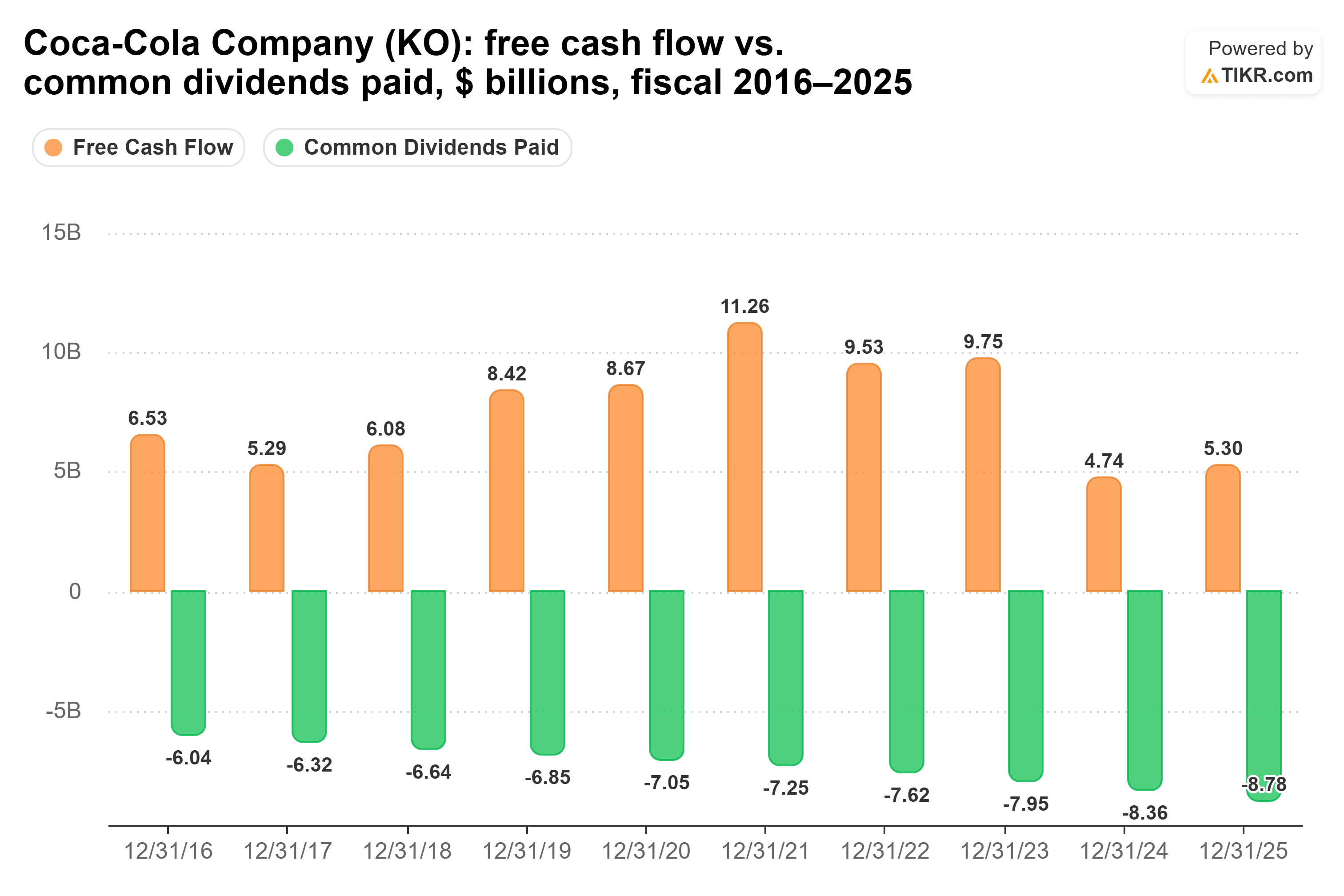
Free cash flow fell from $9.75 billion in fiscal 2023 to $4.74 billion in fiscal 2024. Dividends ran to 176.3% of it that year and 165.8% in fiscal 2025.
This year, the cash is back. Free cash flow reached $11.4 billion through Q3, and on Oct. 27 Coca-Cola raised its full-year forecast to at least $13.0 billion, from $12.4 billion.
“I believe our balance sheet today is in as good a shape as it’s been for many years,” Murphy said on the call. Even so, its net debt runs 1.3x EBITDA, nearly twice Johnson & Johnson’s 0.8x.
There are risks here too. Coca-Cola’s dispute with the IRS still awaits a court decision. And shares fell 2% on Oct. 27 as price/mix grew just 1%, short of the 2-3 points management aims for.
So which dividend wins?
Johnson & Johnson’s streak is the safer one. Its dividend has more room; its cash covered the dividend in every year of the last decade, and it carries less debt.
Coca-Cola’s case is real. It pays the bigger check: $10,000 earns $230 a year at its 2.3% yield, against $190 at Johnson & Johnson’s 1.9%.
At each company’s 5-year growth rate, that’s about $341 and $301 in year 10, a 3.4% and 3.0% yield on your cash.
Johnson & Johnson wouldn’t catch up until about 2052. And Coca-Cola’s free cash flow is back above its dividend this year.
But Coca-Cola’s dividend outran its cash two years running, and Johnson & Johnson’s never came close. I’ll take the smaller check with the bigger cushion.
Of course, the talc settlement still needs those claimants to sign on. If it falls short of that 95% bar, Johnson & Johnson’s biggest legal fight goes on.
Forget Johnson & Johnson: 6 safe 6%+ dividend yields you can buy right now
Dividends can hold the key to enormous wealth. But only if you buy the right ones.
Picking the right high-yield dividend stock can be the difference between a dream retirement…and scraping by every month, waiting for the next Social Security check to clear.
We’ve identified six stocks yielding 6%+ that we believe every retiree should know about right now. (And Johnson & Johnson isn’t one of them.)
Disclaimer:
Please note that the articles on TIKR are not intended to serve as investment or financial advice from TIKR or our content team, nor are they recommendations to buy or sell any stocks. We create our content based on TIKR Terminal’s investment data and analysts’ estimates. Our analysis might not include recent company news or important updates. TIKR has no position in any of the stocks mentioned. Thank you for reading, and happy investing!