Key Takeaways
- Jeff Bezos warned that an outside Nvidia CEO would have a “vanishingly small chance” of succeeding, as filings show former CEO Jensen Huang can nominate two directors.
- Huang’s nominees would face a vote at the annual meeting, usually in June, so his quicker path back is through the current board.
- Nvidia beat estimates in its first report since Huang left and raised its outlook for fiscal 2028 revenue growth to about 75% from 70%.
- At 13x forward earnings, about a third of its five-year average, the stock already prices in the leadership risk, so Huang’s return would be extra upside.
Jeff Bezos has some advice for Nvidia (NVDA): if Jensen Huang isn’t coming back, promote from within.
“If you don’t bring Jensen back, I would not hire an outsider,” the Amazon (AMZN) founder said at a Semafor conference on Nov. 17. “Nvidia is too complicated. I think outside CEOs in complex companies have a vanishingly small chance of succeeding.” Bezos took his own advice at Amazon in 2021, handing the CEO job to longtime insider Andy Jassy, who was then running Amazon Web Services.
The same day, Reuters reported that company filings let Huang, who resigned as CEO on Nov. 12, nominate two directors to Nvidia’s board.
That’s his first real path back.
Two seats, but not until June
Nvidia’s rules let any shareholder with more than 3% of its voting power for at least three years put director candidates on its ballot. Huang and related entities own roughly 3.5% and have been over that line for more than three years, according to LSEG data cited by Reuters. His nominees would need to qualify as independent directors and would go on the ballot at the annual meeting, usually in June. Two seats wouldn’t give his allies control, but it’s a much smaller step than the full proxy fight JPMorgan said it would take.
The faster route is for the board to change its mind. Chair Harvey Jones said on Nvidia’s Nov. 17 earnings call that the board “does not intend to reinstate Jensen as CEO.” Later that night, Semafor reported that a faction of directors is still pushing for Huang’s return while others narrow the search, with Arm CEO Rene Haas and Marvell CEO Matt Murphy both considered. Bezos’s warning is aimed at exactly that kind of pick.
TIKR tracks 63 analysts on Nvidia. How many say “Buy”?
See the full breakdown of Buy, Hold, and Sell ratings on Nvidia, along with Wall Street’s revenue and earnings estimates, all in one place. More than 500,000 investors use TIKR to research stocks like this one. See Nvidia’s Analyst Ratings
Kress’s first quarter went just fine
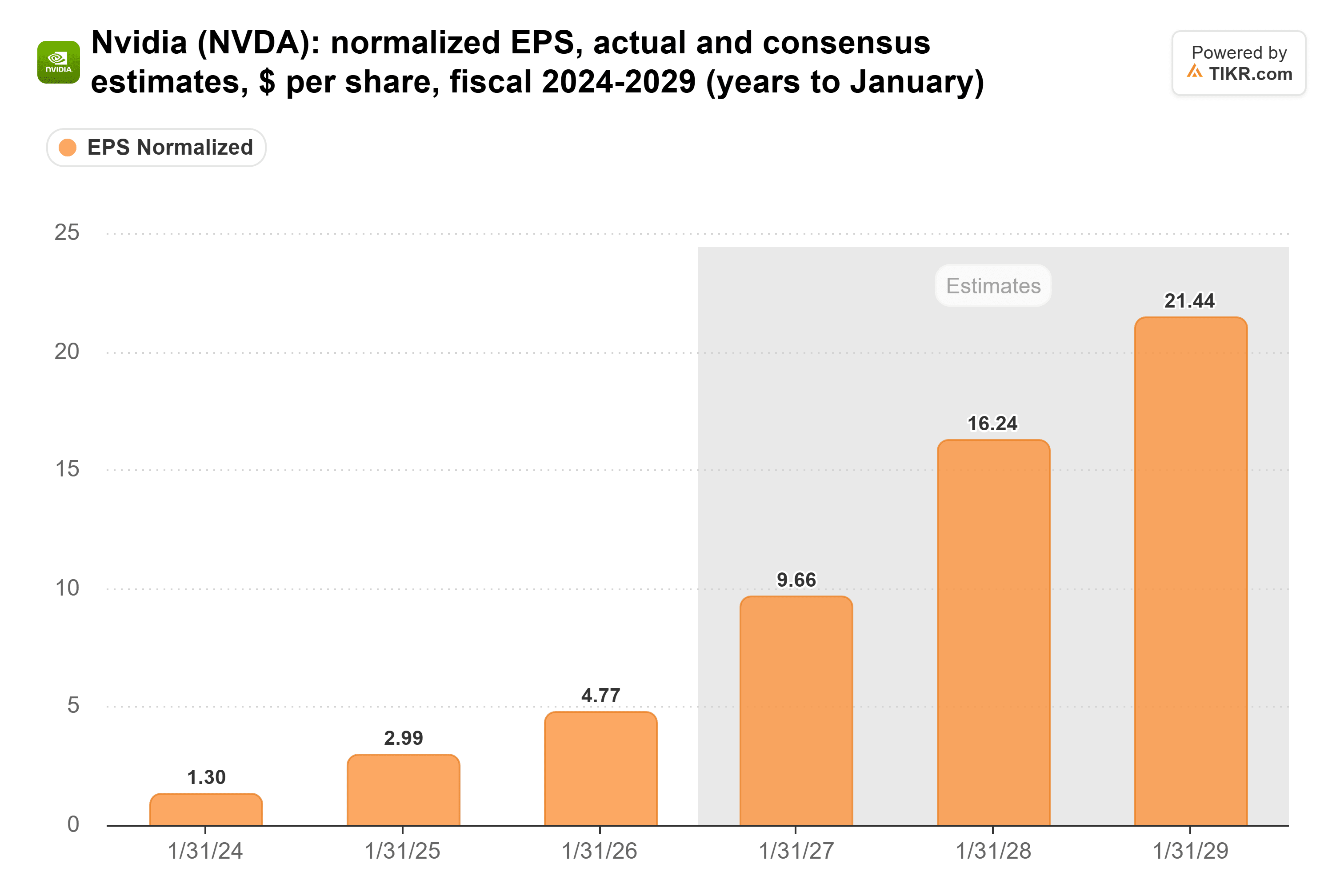
Huang’s exit hasn’t hurt the numbers so far. In Nvidia’s first report without him, adjusted EPS for the fiscal third quarter came in at $2.68 on revenue of $115.8 billion, against the $2.47 and $109.1 billion analysts expected. That quarter ended Oct. 25, before Huang left, so the forward view says more: interim CEO Colette Kress raised the outlook for fiscal 2028 revenue growth to about 75% from 70%.
Analysts expect earnings per share to keep climbing for years:
A quarter that steady also gives the board time. As Gavin Baker, managing partner and CIO of Atreides Management, said on TBPN: “Colette is an extremely capable CFO who I think will be a good interim CEO, which means there’s no pressure on the board to make a fast decision.” Baker isn’t a neutral voice: he co-signed a Nov. 13 letter asking the board to keep Huang’s potential return on the table.
The stock is priced for the worst
Nvidia went into the report at 13x forward earnings. That’s its lowest in five years and about a third of its 36x average over that time:
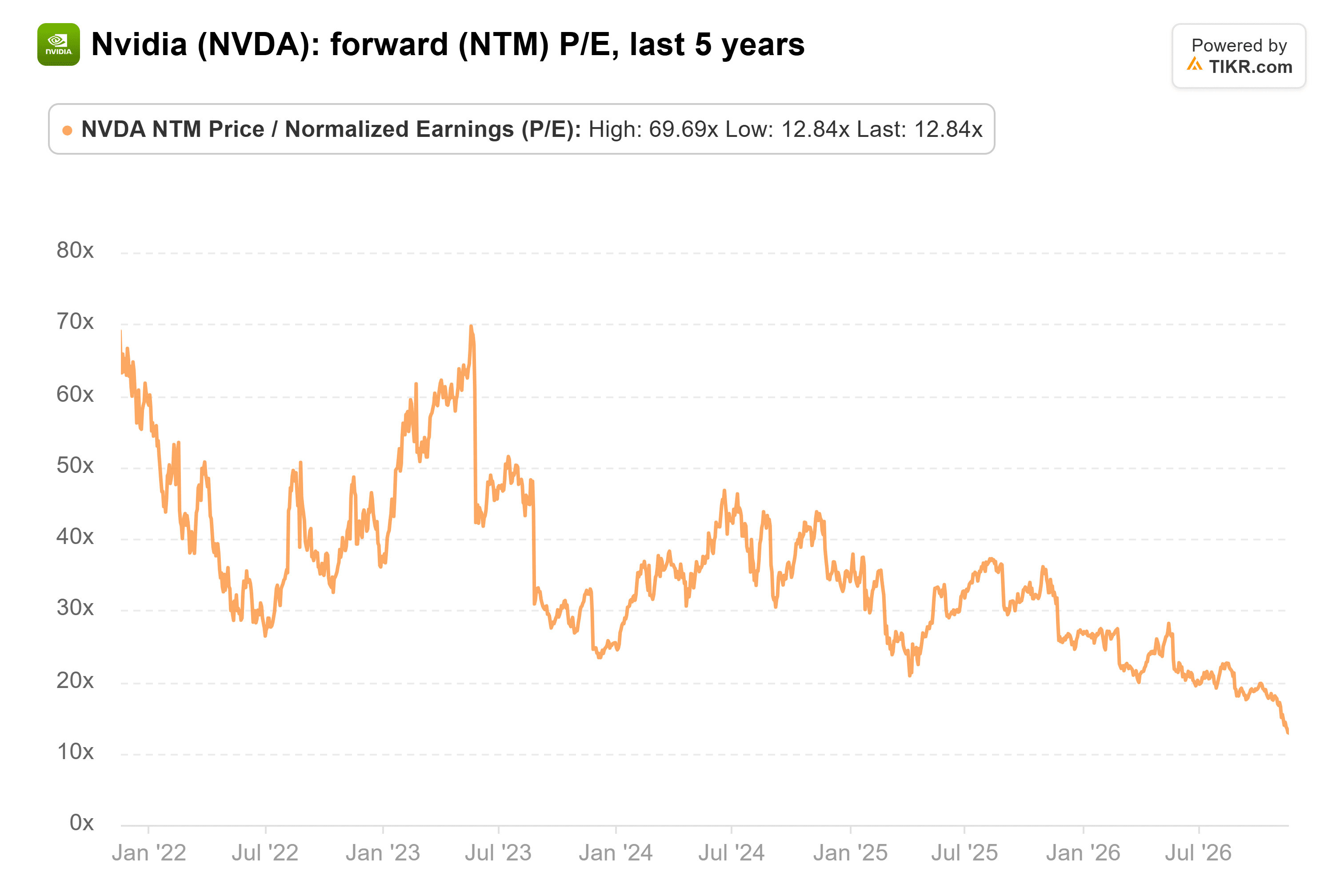
That gap is the leadership discount, and the beat didn’t shrink it. Shares closed down 2.9% on Nov. 18, leaving them 36% below their Oct. 6 record close, according to Reuters. Huang’s return is the obvious way to close the gap. Baker called Huang “irreplaceable,” pointing to supply relationships he said work without formal contracts. Even so, Kress said on the call that Nvidia is confident in “the supply and additional supply” behind its raised fiscal 2028 outlook, so those relationships have held up without him so far.
Huang would be a bonus
The main risk is the board’s investigation, opened Nov. 8, into reports that Huang was the target of a foreign intelligence effort. Nobody knows yet what it will find, and a finding against him would make a return harder by any route.
Nvidia stock doesn’t need Huang back. With estimates still rising, the price already assumes the worst on leadership, so his return would be extra upside. The next test is the fourth-quarter report, expected in late February: revenue of at least $126.1 billion, the low end of Kress’s guidance of $130 billion plus or minus 3%, would show her Nvidia can keep executing while the board decides who runs it.
So what is Nvidia stock actually worth?
TIKR lets you forecast the future price of any stock in less than a minute. Just enter a few assumptions into TIKR’s valuation model and see what Nvidia could be worth. Start from Wall Street consensus estimates, or adjust the inputs to reflect your own view of the business. It’s free to use.
Disclaimer:
Please note that the articles on TIKR are not intended to serve as investment or financial advice from TIKR or our content team, nor are they recommendations to buy or sell any stocks. We create our content based on TIKR Terminal’s investment data and analysts’ estimates. Our analysis might not include recent company news or important updates. TIKR has no position in any of the stocks mentioned. Thank you for reading, and happy investing!