Key Takeaways
- Insuring chipmakers’ debt now costs more than insuring the cloud giants that buy their chips.
- Bill Dudley warns that falling chip prices would hit NVIDIA twice: on its guarantees and in its earnings.
- NVIDIA’s own debt isn’t the worry. It made $96.7 billion of free cash flow last fiscal year.
- The real risk is $108.5 billion of customer-linked guarantees, and shareholders carry it first.
Bond traders have repriced the AI supply chain, and the chipmakers came out on the wrong side. Insuring the debt of NVIDIA (NVDA) and Broadcom (AVGO) now costs more than insuring Microsoft (MSFT) and Alphabet (GOOG), the cloud giants buying their chips.
Goldman Sachs put a basket of chipmakers at about 80 basis points in early August, roughly 20 below the cloud companies. Three months later, the basket had doubled to about 160 and moved above them. ZeroHedge’s post on X put it in three words: “Risk Is Migrating.”
One investor on r/ValueInvesting listed 53 basis points for Microsoft, 88 for Alphabet, 128 for NVIDIA and 192 for Broadcom, implying a 10.1% five-year default probability for NVIDIA. Those prices predate NVIDIA’s Nov. 12 announcement that Jensen Huang had resigned as CEO.
Dudley Sees Two Hits for NVIDIA
On Bloomberg Surveillance on Nov. 9, Bill Dudley, a Bloomberg Opinion columnist and former New York Fed president, said he isn’t sure the Fed can see all of the AI boom’s risks, and pointed to NVIDIA:
“NVIDIA is guaranteeing the value of their chips. So what happens if the value of their chips goes down? Not only do they have to come up with the money to make good those guarantees, but … their earnings are going to suffer because they’re going to have lower chip prices.”
One drop in chip prices, two hits.
NVIDIA Can Cover Its Own Debts
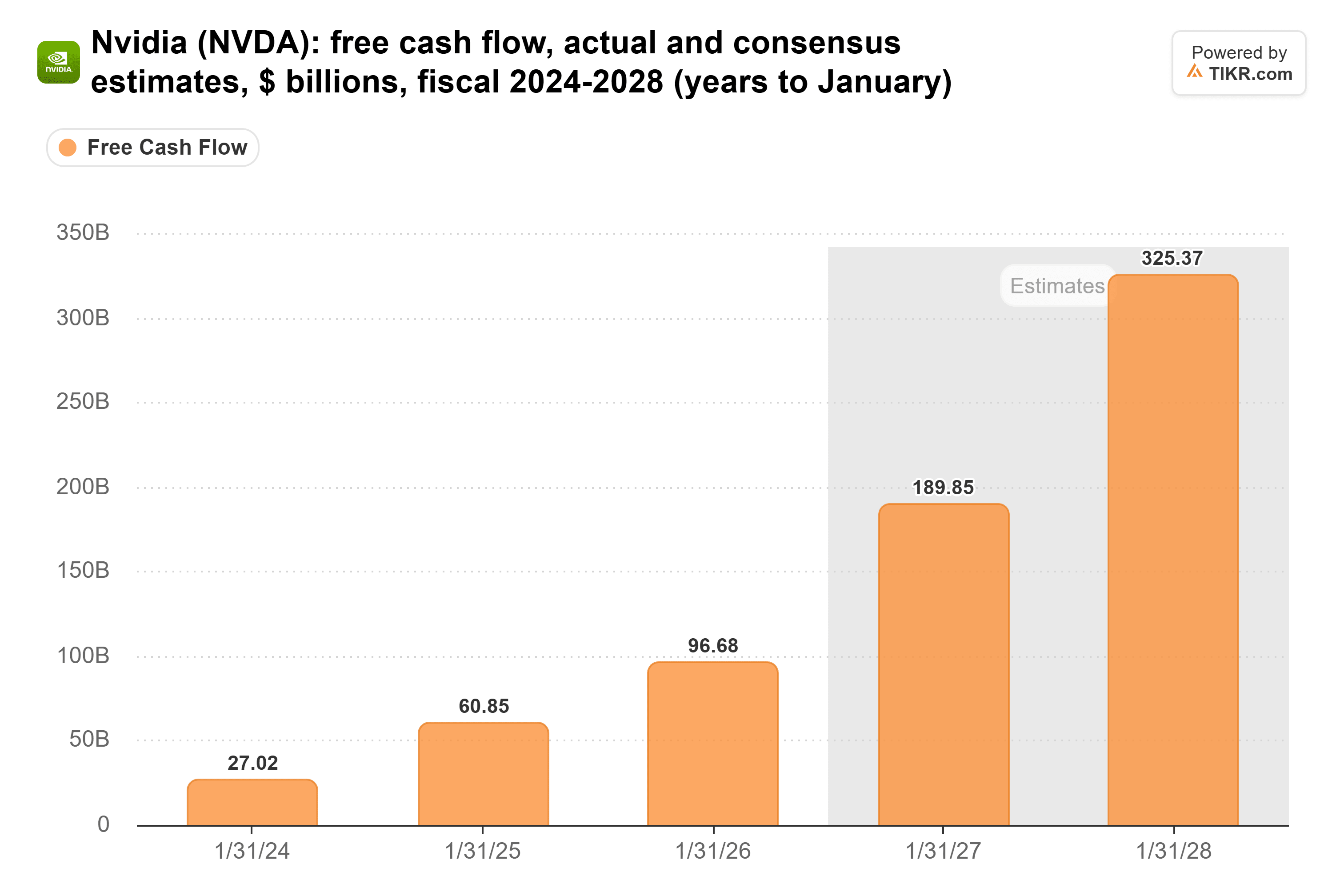
NVIDIA generated $96.7 billion of free cash flow in the year ended January 2026, and analysts expect about $190 billion this fiscal year.
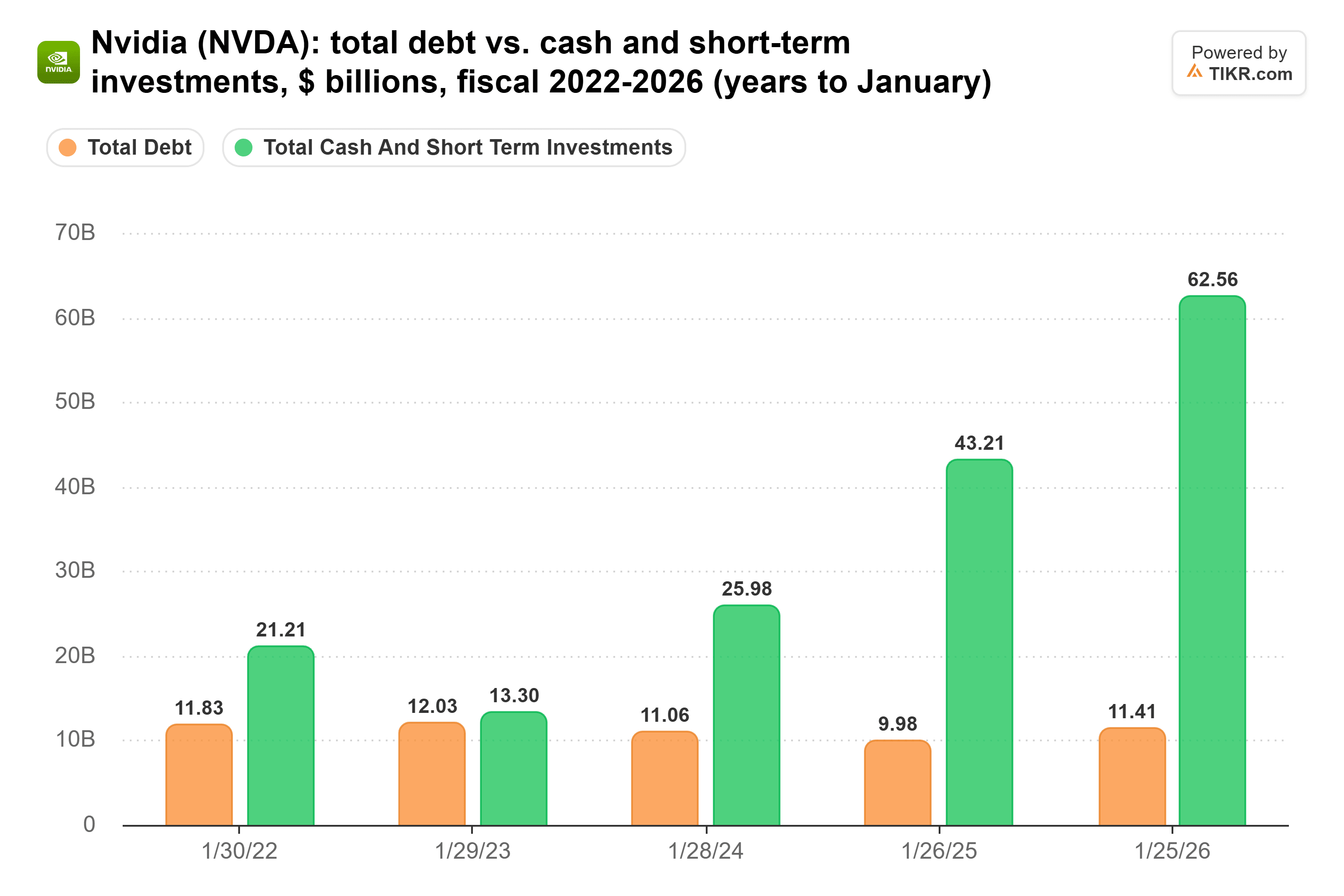
At the end of that fiscal year, it held $62.6 billion of cash and short-term investments against $11.4 billion of total debt.
Even after selling $25.0 billion of notes in June, it held $56.6 billion of cash, cash equivalents and marketable debt securities against $33.4 billion of notes on July 26.
Alphabet, which swap traders treat as the safer credit, made $73.3 billion of free cash flow in 2025, about three-quarters of NVIDIA’s.
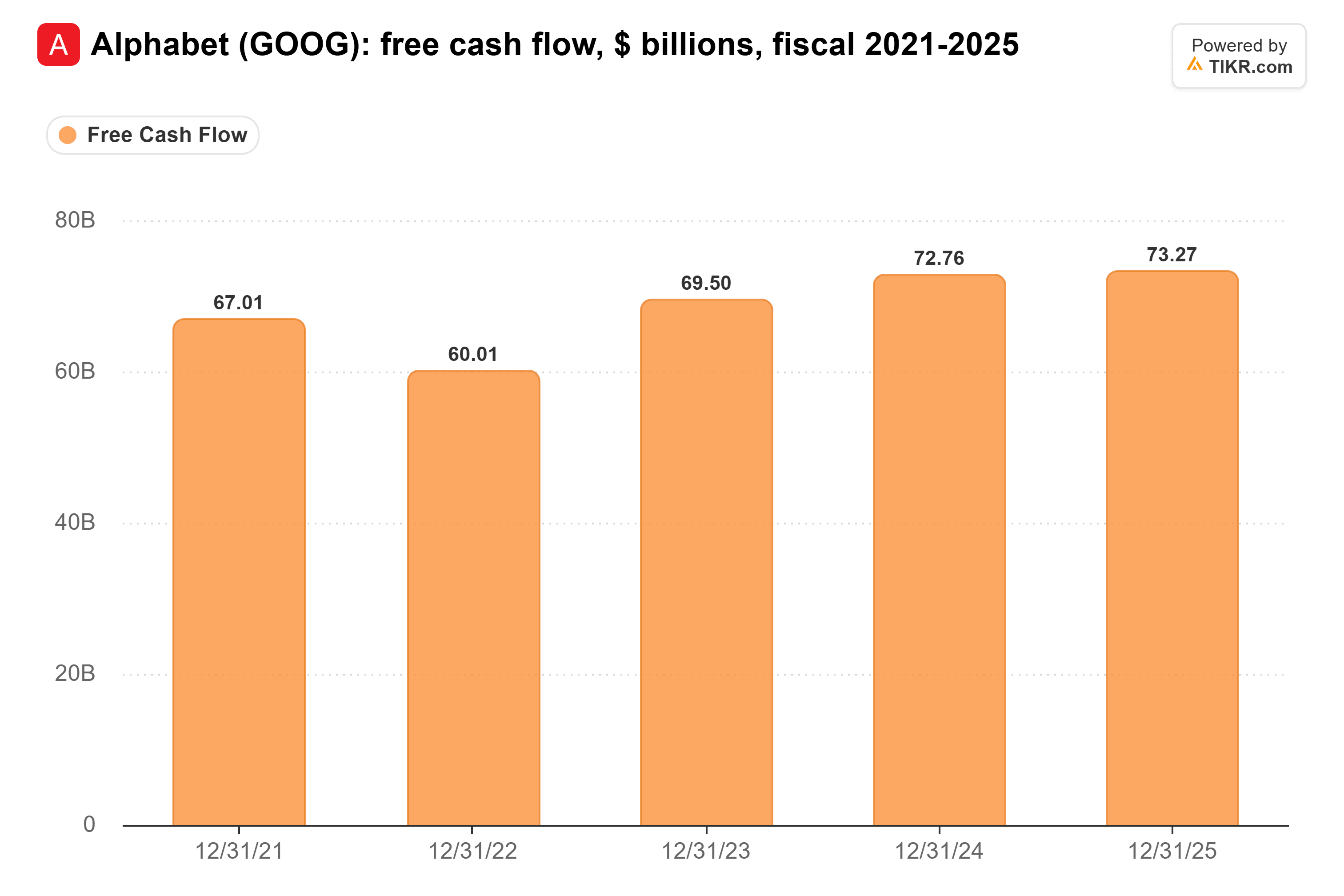
Next to those numbers, 10.1% looks far too high as a forecast. It’s derived from the swap price, assumes 40% recovery and includes a premium for risk.
TIKR Tracks 62 Analysts on NVIDIA. How Many Say “Buy”?
See the full breakdown of Buy, Hold, and Sell ratings on NVIDIA, along with Wall Street’s revenue and earnings estimates, all in one place. More than 500,000 investors use TIKR to research stocks like this one. See NVIDIA’s Analyst Ratings
NVIDIA’s Customers Are the Credit Risk
Goldman blames faster GPU depreciation and chipmakers financing their customers. NVIDIA’s latest 10-Q sizes the second: $108.5 billion of maximum gross guarantee exposure, including a $105.0 billion cap signed in August for OpenAI’s Ohio campus. That one pays out only on certain tenant defaults and phases in from fiscal 2029.
Lenders price whose credit backs the chips. IREN pays a blended 6.0% on the GPU debt tied to its Microsoft contract, against a fixed 9.0% on its non-investment-grade financing. NVIDIA’s Ohio guarantee is built around that gap: it ends once OpenAI earns a satisfactory credit rating. That’s the customer risk Goldman flags.
Broadcom is in the same spot: Bloomberg reported in August that it had backstopped most of a $35 billion debt package funding purchases of its chips.
Shareholders Carry This Risk First
The bond market has the direction right: risk has moved to the companies funding the buildout. But NVIDIA’s bondholders would feel it last. If a lab NVIDIA backs misses its rent, or chip prices fall, its earnings and free cash flow take the hit long before its notes are in danger.
NVIDIA’s credit is rock solid. Its stock is another matter: it now carries a lender’s risk on top of a chipmaker’s.
NVIDIA reports Nov. 17, its first results under interim CEO Colette Kress. Days sales outstanding hit 60 in the July quarter, up from 45, which NVIDIA put down to longer payment terms for large investment-grade customers. Another jump, or a new round of guarantees, would likely push those spreads wider.
So What Is NVIDIA Stock Actually Worth?
TIKR lets you forecast the future price of any stock in less than a minute. Just enter a few assumptions into TIKR’s valuation model and see what NVIDIA could be worth. Start from Wall Street consensus estimates, or adjust the inputs to reflect your own view of the business. It’s free to use.
Disclaimer:
Please note that the articles on TIKR are not intended to serve as investment or financial advice from TIKR or our content team, nor are they recommendations to buy or sell any stocks. We create our content based on TIKR Terminal’s investment data and analysts’ estimates. Our analysis might not include recent company news or important updates. TIKR has no position in any of the stocks mentioned. Thank you for reading, and happy investing!