Key Takeaways
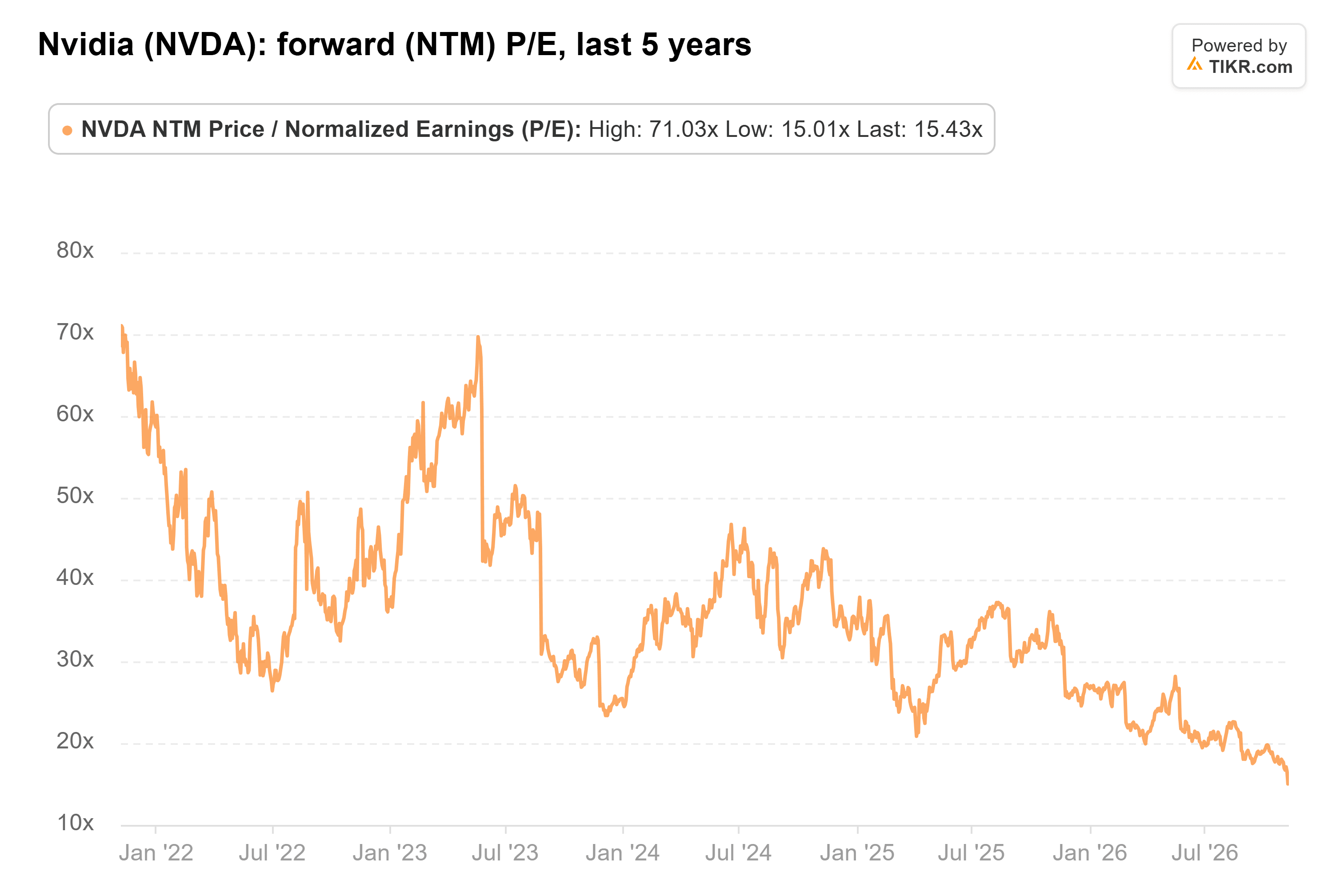
- NVIDIA’s forward P/E fell to 15x in last week’s chip selloff, a five-year low, while Micron trades at 3.9x.
- One investor put NVIDIA’s required growth at 20% a year for a decade; on trailing free cash flow it’s about 16%, against 1.8% for Micron.
- Analysts’ fiscal 2030 estimate is already 4.6 times NVIDIA’s trailing free cash flow.
- The Huang probe and the Nov. 17 report are the next tests.
NVIDIA (NVDA) just hit its lowest forward P/E in five years after fears of a slower US data-center build-out knocked about 9% off the stock last Thursday.
That has some investors comparing it with Micron Technology (MU), which trades at 3.9x forward earnings. One r/ValueInvesting poster titled a post “Nvidia just another Micron” and asked whether NVIDIA was headed for a multiple of about 5x.
An investor on r/stocks flipped the question with a reverse DCF on 14 chip stocks: trailing free cash flow, Nov. 5 closing prices, a 9% discount rate, and ten years of growth followed by flat cash flow. The poster got 20% for NVIDIA and 2.6% for Micron. Rerunning those inputs, I get about 16% for NVIDIA and 1.8% for Micron. The 20% matches NVIDIA’s older $96.7 billion fiscal-year base, not its roughly $127 billion trailing figure.
So much for “just another Micron.”
The Market Already Expects Micron’s Boom to Fade
At 1.8%, Micron’s price pays for roughly today’s cash flow and little more. Commenters in the r/ValueInvesting thread explained why: memory chips are built to industry standards, so buyers can switch suppliers, while there’s mostly nowhere else to buy what NVIDIA sells. With 2.5% growth forever after year ten, the bars drop to about 13% and negative 0.5%.
TIKR Tracks 62 Analysts on Nvidia. How Many Say “Buy”?
See the full breakdown of Buy, Hold, and Sell ratings on Nvidia, along with Wall Street’s revenue and earnings estimates, all in one place. More than 500,000 investors use TIKR to research stocks like this one. See Nvidia’s Analyst Ratings
Analysts See NVIDIA Clearing the Bar Early
NVIDIA generated $96.7 billion of free cash flow in fiscal 2026 (the year ended January 2026), and analysts expect it to keep climbing:
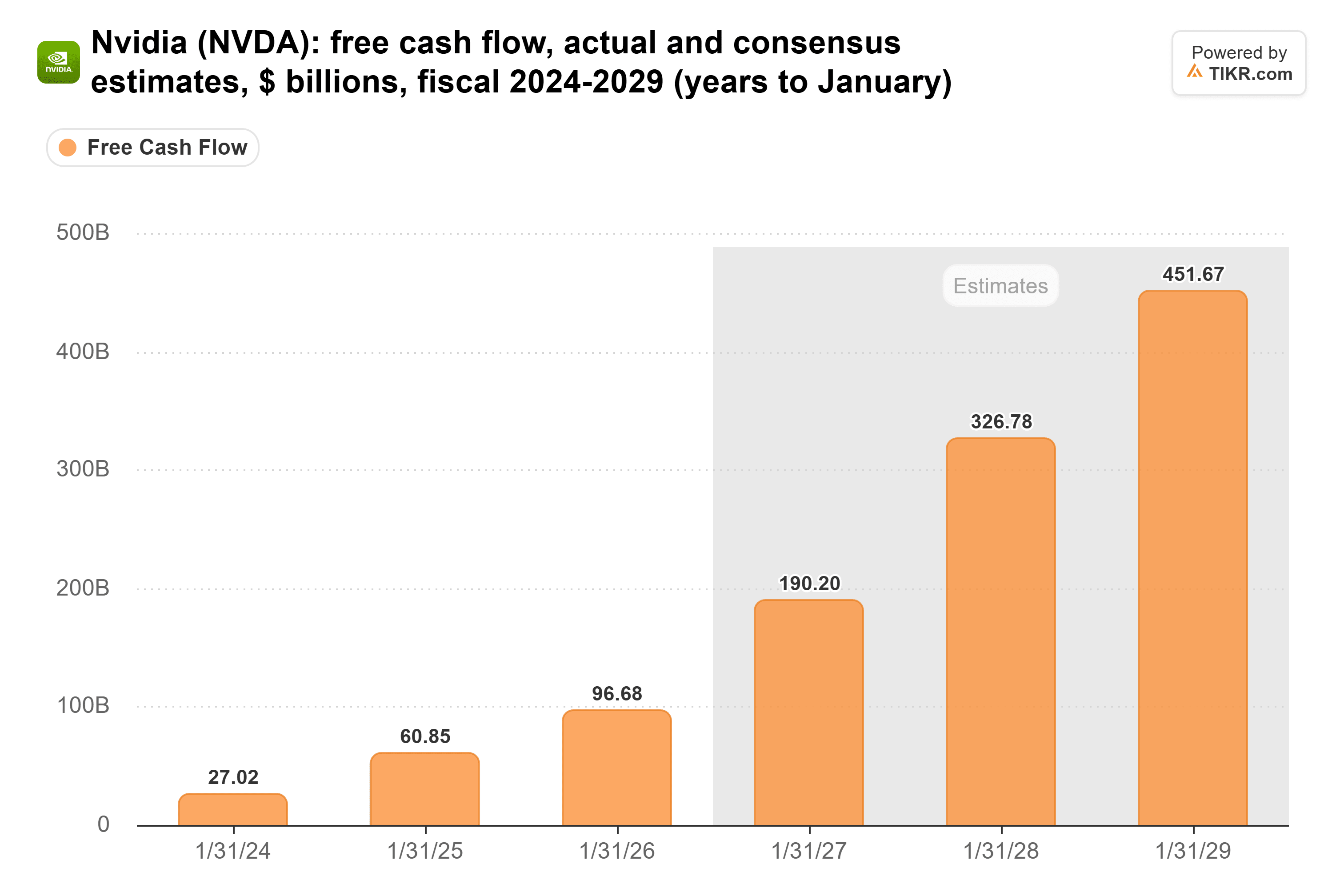
Sixteen percent a year for ten years multiplies cash flow about 4.4 times. Analysts expect $583 billion in fiscal 2030, about 4.6 times the roughly $127 billion NVIDIA generated in the 12 months to July, and only three and a half years later. Just three analysts forecast that far, but the 14 covering fiscal 2029 still expect $452 billion.
NVIDIA Has Been Through a Bust Before
Those estimates come from the top of a boom, though. Another r/ValueInvesting poster warned that chip stocks look most expensive at the start of a cycle and cheapest at the end. NVIDIA has lived that: in fiscal 2023, revenue was flat at $27.0 billion and operating margin, excluding the $1.35 billion Arm deal charge, fell to 20.7% from 37.3%. Analysts also see revenue growth slowing from 68.2% in fiscal 2028 to 21.3% by fiscal 2030.
The multiple already reflects some of that. NVIDIA’s forward P/E hit 15x on Nov. 5, against a five-year average of 36x:
Then There’s the Jensen Huang Probe
On Sunday, NVIDIA’s board opened an independent investigation into reports that CEO Jensen Huang was the target of a foreign intelligence effort, and the stock slipped about 3% overnight to near $180. Huang admitted in an email to staff that he had been unfaithful to his wife. The New York Times reported on Oct. 29 that US intelligence believes the woman, a former Megaspeed executive, passed information to Beijing. The board sees no reason to believe national security or NVIDIA secrets were compromised, and Huang remains CEO.
The bigger risk sits in Washington. Three House committee chairs gave Huang until Nov. 11 to accept a closed-door briefing on Nov. 18, and Washington also decides NVIDIA’s export licenses.
Why NVIDIA Can Clear the 16% Bar
The market isn’t pricing NVIDIA like another Micron. Its price needs about 16% growth a year for a decade, and analysts’ estimates get there by fiscal 2030, about six years early. I think 15x forward earnings is a good price for a business still growing this fast.
The Nov. 17 report comes first: its receivables, January-quarter margin guide and read on US data-center demand will show whether those estimates hold.
So What Is NVIDIA Stock Actually Worth?
TIKR lets you forecast the future price of any stock in less than a minute. Just enter a few assumptions into TIKR’s valuation model and see what NVIDIA could be worth. Start from Wall Street consensus estimates, or adjust the inputs to reflect your own view of the business. It’s free to use.
Disclaimer:
Please note that the articles on TIKR are not intended to serve as investment or financial advice from TIKR or our content team, nor are they recommendations to buy or sell any stocks. We create our content based on TIKR Terminal’s investment data and analysts’ estimates. Our analysis might not include recent company news or important updates. TIKR has no position in any of the stocks mentioned. Thank you for reading, and happy investing!