Key Takeaways
- David Tepper’s Appaloosa added 28% to its Micron stake in the third quarter, making it 17.6% of its 13F stocks. It also added to SpaceX and NVIDIA and sold all of its AMD.
- Micron and NVIDIA have each fallen 34% since Sept. 30, SpaceX is flat and AMD is down 9%.
- Micron and NVIDIA trade at low multiples of forward earnings for their own history, while SpaceX is priced for a compute buildout that still burns cash.
- NVIDIA is the move most worth following, and Micron’s mid-December report is the next big date for the fund’s largest holding.
David Tepper’s Appaloosa leaned harder into AI last quarter, and two of the stocks it added to have each lost a third of their value since.
Its 13F for the quarter ended Sept. 30, filed Nov. 16, shows it added 28% to Micron (MU), now its largest holding, and grew its SpaceX (SPCX) stake by 1,626%. It also added 31% to NVIDIA (NVDA) and sold all of its Advanced Micro Devices (AMD).
The firm manages $20.4 billion in all, and its 13F held $7.56 billion of US stocks across 24 positions. Over the quarter, it opened or added to six positions and sold out of one.
Tepper’s biggest bet got a lot cheaper
Appaloosa held 1.25 million Micron shares at Sept. 30, worth $1.33 billion at quarter-end prices. That’s 28% more shares than it held at June 30, and Micron is now 17.6% of its 13F stocks and its No. 1 position. The stock has fallen 34% since Sept. 30. On Nov. 16, the Commerce Department began requiring licenses for advanced chip exports to Indonesia, Malaysia, Singapore, Thailand and Brazil, a rule aimed at the AI accelerators that use Micron’s high-bandwidth memory, and Micron sank as the memory selloff deepened. A day later, GF Securities told clients NAND could swing into surplus in 2027. NAND brought Micron $31.8 billion of its $133.2 billion of revenue in fiscal 2026, though GF sees Micron as better protected than its rivals because of its DRAM and HBM sales.
TIKR tracks 50 analysts on Micron. How many say “Buy”?
See the full breakdown of Buy, Hold, and Sell ratings on Micron, along with Wall Street’s revenue and earnings estimates, all in one place. More than 500,000 investors use TIKR to research stocks like this one. See Micron’s Analyst Ratings
The Street still sees Micron more than doubling
Micron trades at about 4x forward earnings. Its median on TIKR’s quarter-end readings since 2014 is 9.9x. Today’s multiple is close to its 2017 and 2018 readings of 3.7x to 5.3x, when the last memory cycle peaked. So the market is pricing today’s earnings as a peak.
Analysts disagree. They’ve raised their average target from $214 a year ago to $1,562 now.
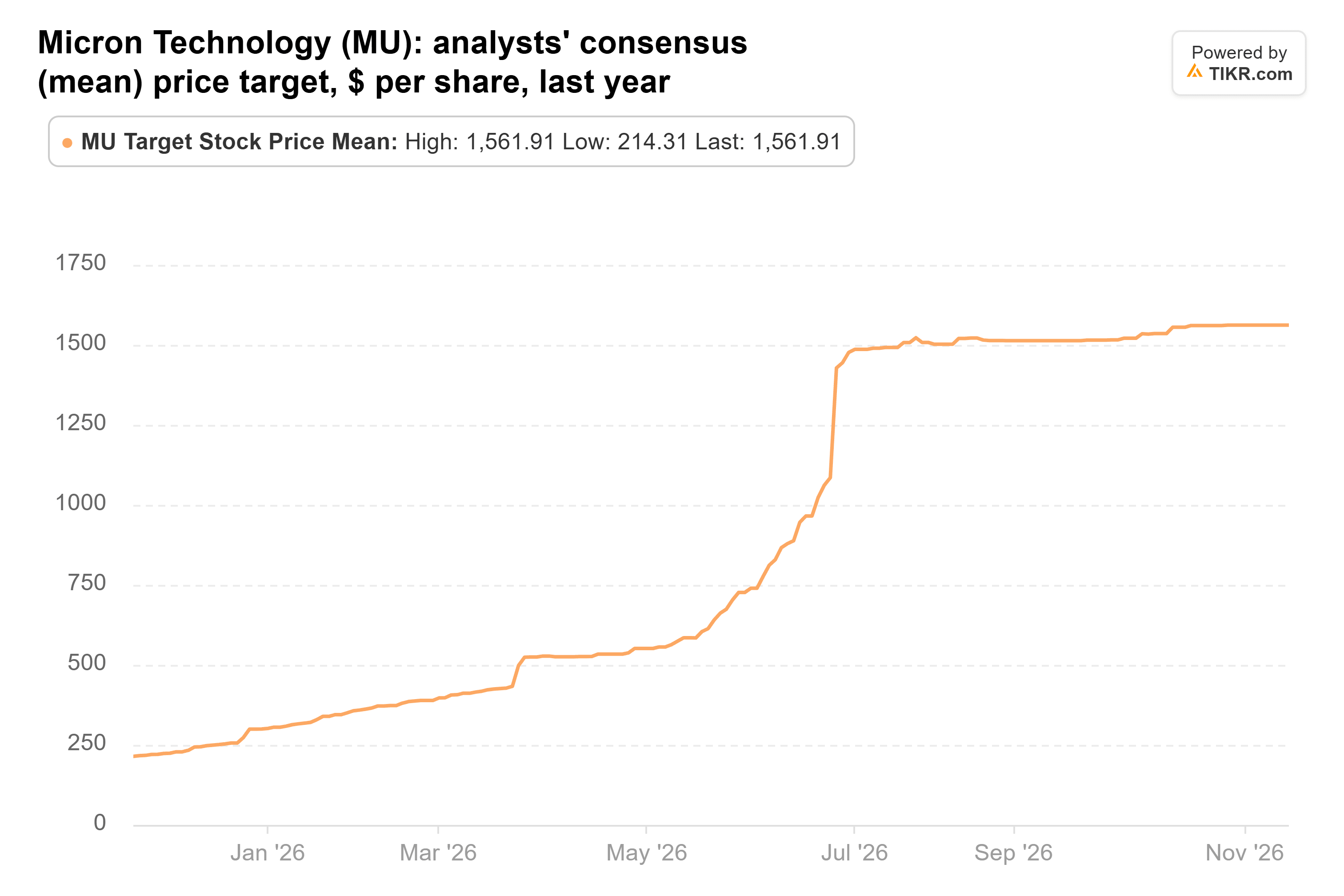
That target is 121% above the latest close, and 49 analysts cover the stock. Consensus has normalized EPS rising from $75.52 in fiscal 2026 to $206.89 in fiscal 2028, then slipping to $203.33 in fiscal 2029. Those estimates came before GF’s warning. Micron does have a cushion: 26 multi-year take-or-pay contracts that management estimates will cover over 35% of revenue through 2030, and a buyback of up to $35.16 billion that can start Dec. 9.
SpaceX jumped into the top five
Appaloosa held 3.88 million SpaceX shares at Sept. 30, worth $557 million. That’s 7.4% of its 13F stocks and its No. 4 position, with 1,626% more shares than it held at June 30. The stock is up 0.1% since Sept. 30.
The business is moving much faster than the stock. Third-quarter revenue rose 161% to $14.6 billion, and $7.56 billion of it came from the Super Intelligence segment, which rents out AI compute. On Nov. 14, SpaceX also caught Starship’s upper stage with its launch tower for the first time.
That growth is expensive. Management guides fourth-quarter capex to $35 billion to $40 billion, and consensus has free cash flow at negative $150 billion for 2027. Morgan Stanley’s Adam Jonas puts $170 of his $300 target on enterprise AI. That business leans on one customer: Anthropic supplies about two-thirds of the segment’s sales, Bloomberg reported. Either side can end its contract on 90 days’ notice.
SpaceX trades at about 47x forward earnings. It has only been public since June, so there’s little history to compare that with. Analysts’ average target has more than doubled since it listed.

The average target of $258 is 79% above the latest close, but the 40 analysts’ targets run from $70 to $800. Wall Street hasn’t settled on what this company is worth.
NVIDIA got cheaper on better guidance
Appaloosa held 2.00 million NVIDIA shares at Sept. 30, worth $457 million. That’s 6.0% of its 13F stocks and its No. 6 position, after a 31% rise in its share count. The stock has dropped 34% since Sept. 30. Jensen Huang resigned as CEO on Nov. 12, and CFO Colette Kress took over as interim CEO.
Her first report, on Nov. 17, guided the January quarter to about $130 billion of revenue. She also raised NVIDIA’s growth outlook for fiscal 2028, the year ending January 2028, to about 75% from about 70%. Collections were weaker: days sales outstanding rose to 64 from 60. NVIDIA blamed the timing of Rubin shipments and longer payment terms for certain investment-grade customers.
NVIDIA now trades at about 10x forward earnings, far below its 36x five-year average on TIKR. Analysts’ average target is $247, down from $329 in late October but still 63% above the latest close, and 62 analysts cover the stock.
AMD is out, and it has held up better
Appaloosa sold all 197,500 AMD shares it held at June 30, a $115 million position that was 1.5% of its 13F stocks then. AMD has fallen 9% since Sept. 30, far less than NVIDIA. Its third quarter was strong: data-center revenue rose 97% to a record $8.5 billion, and AMD guided fourth-quarter revenue to about $17 billion. The same Nov. 16 export rule covers its Instinct GPUs, though.
Analysts have more than doubled their average AMD target over the past year, to $658 from $277.

That target is 24% above the latest close. AMD trades at about 35x forward earnings, right at its 35x five-year average, while NVIDIA trades far below its own. On multiples alone, I’d rather own the NVIDIA shares Appaloosa added than the AMD shares it sold.
NVIDIA is the move I’d follow
All three adds depend on AI spending, and the new export rule reaches every chipmaker here. If that spending slows, Micron, SpaceX and NVIDIA are likely to fall together.
Of Tepper’s moves, NVIDIA is the one I’d copy. It trades at about 10x forward earnings, and its interim CEO just raised the outlook. Micron is even cheaper, but its multiple is where memory stocks trade at a cycle peak, and the NAND warning puts its 2027 estimates at risk. SpaceX costs 47x forward earnings for a buildout that consensus expects to burn $150 billion of cash in 2027.
Micron reports its fiscal first quarter in mid-December against a $61.5 billion revenue guide. Appaloosa’s next 13F is due in mid-February and will show whether it still held all three at Dec. 31.
So what is Micron stock actually worth?
TIKR lets you forecast the future price of any stock in less than a minute. Just enter a few assumptions into TIKR’s valuation model and see what Micron could be worth. Start from Wall Street consensus estimates, or adjust the inputs to reflect your own view of the business. It’s free to use.
Disclaimer:
Please note that the articles on TIKR are not intended to serve as investment or financial advice from TIKR or our content team, nor are they recommendations to buy or sell any stocks. We create our content based on TIKR Terminal’s investment data and analysts’ estimates. Our analysis might not include recent company news or important updates. TIKR has no position in any of the stocks mentioned. Thank you for reading, and happy investing!