
Key Takeaways
- HPE CEO Antonio Neri said Monday that HPE’s financing arm “has not provided financing to neocloud or high-risk customers.”
- Dell’s lower-grade financing receivables rose to $4.4 billion at July 31, 2026, from $1.8 billion six months earlier, and its quarterly loss provision rose to $122 million from $11 million.
- Dell called its customer financing “selective and short-term” on Tuesday’s call.
- The third-quarter 10-Q will show whether the lower-grade book kept growing.
Hewlett Packard Enterprise (HPE) raised its outlook Monday night, and its stock still fell 16% Tuesday. One line from the call deserves more attention than it’s getting.
“Although HPE Financial Services does support the AI opportunity, it has not provided financing to neocloud or high-risk customers,” Neri said.
Dell Technologies (DELL) can’t say that. It reported a record $132.3 billion AI backlog Tuesday night, after its stock fell 12% in the session.
Neoclouds like CoreWeave (CRWV), down 12% Tuesday, are exactly the buyers Neri is avoiding. Dell shipped the market’s first Nvidia GB300 NVL72 racks to CoreWeave in July 2025. CoreWeave’s third-quarter net interest expense was $846 million, more than 4x its $207 million operating income. You can see why a lender might pass.
Dell Has Become a Big Lender
Dell’s financing receivables reached $20.4 billion at July 31, from $14.3 billion at the end of January.
Lower-grade receivables, the bottom tier of Dell’s own credit grades, grew fastest: up 144% in six months, to $4.4 billion, its quarterly filing shows. The provision for financing losses climbed to $122 million in the quarter, from $11 million a year earlier.
Dell doesn’t say who sits in that tier. But it says its AI servers go mainly to a few large customers and cloud providers, in deals involving larger amounts of credit.
Dell’s Answer Is “Selective,” Not “Never”
On its call, Dell said: “When we use DFS financing, it is selective and short-term, bridging the customer from purchase order to cluster go-live.” On neoclouds, it remains “highly selective about the partners we work with.”
That’s a filter, not a refusal. HPE’s line is a flat no.
TIKR Tracks 24 Analysts on Hewlett Packard Enterprise. How Many Say “Buy”?
See the full breakdown of Buy, Hold, and Sell ratings on Hewlett Packard Enterprise, along with Wall Street’s revenue and earnings estimates, all in one place. More than 500,000 investors use TIKR to research stocks like this one. See Hewlett Packard Enterprise’s Analyst Ratings
Dell now guides to $29.68 of non-GAAP EPS this fiscal year, up nearly 190%:

Next to that, a $122 million provision is a rounding error. The question is whether it stays one.
The Cash Hasn’t Kept Up
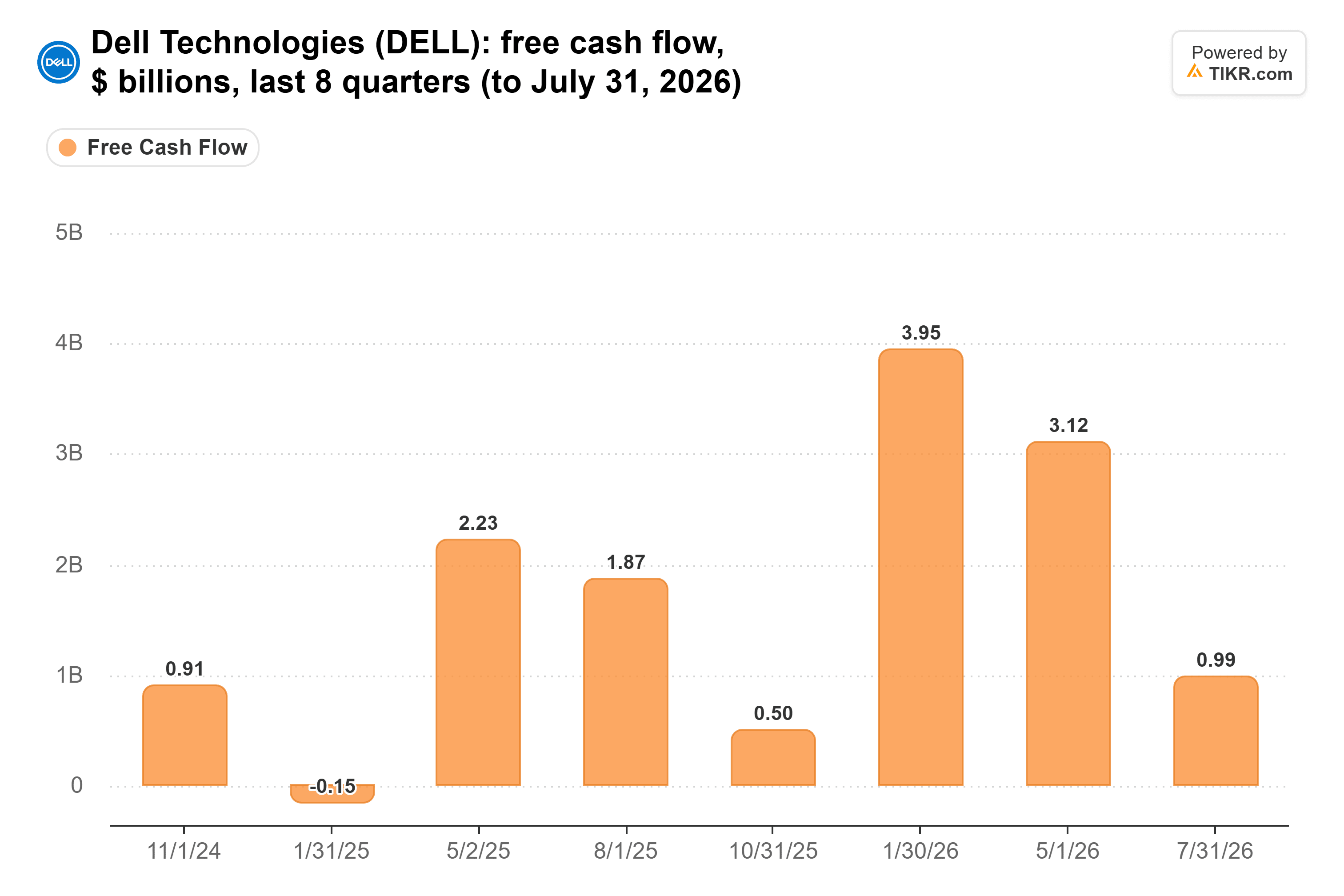
First-half net income rose to $7.6 billion from $2.1 billion a year earlier, but free cash flow was flat at $4.1 billion. Financing receivables took up $6.4 billion of operating cash, and free cash flow fell to $986 million in the quarter to July 31:
Debt Is Doing the Funding
Total debt reached $35.3 billion at July 31, from $25.4 billion at the end of January 2025. In the first half, Dell returned $6.3 billion to shareholders, more than its free cash flow, and borrowed a net $3.0 billion to cover the gap. It returned another $4.9 billion in the third quarter.

Bottom Line
HPE nearly doubled its server revenue to $8.8 billion last quarter without financing neocloud or high-risk buyers. Dell is carrying credit risk its closest rival won’t touch. The $4.4 billion is small next to a $132.3 billion backlog. But if debt-heavy buyers struggle, Dell holds the paper.
In the 10-Q, I’d watch for a provision at or below $122 million, a lower-grade book that stops growing, and free cash flow closing the gap with net income.
So What Is Dell Stock Actually Worth?
TIKR lets you forecast the future price of any stock in less than a minute. Just enter a few assumptions into TIKR’s valuation model and see what Dell could be worth. Start from Wall Street consensus estimates, or adjust the inputs to reflect your own view of the business. It’s free to use.
Disclaimer:
Please note that the articles on TIKR are not intended to serve as investment or financial advice from TIKR or our content team, nor are they recommendations to buy or sell any stocks. We create our content based on TIKR Terminal’s investment data and analysts’ estimates. Our analysis might not include recent company news or important updates. TIKR has no position in any of the stocks mentioned. Thank you for reading, and happy investing!