
Key Takeaways
- At today’s prices, $1,000 a month in dividends takes 6,000 shares of Wells Fargo, about $493,700, or 9,375 shares of Bank of America, about $460,000.
- Both dividends are well-covered: Wells Fargo paid out 27% of its fiscal 2025 normalized EPS, and Bank of America paid out 28%.
- Bank of America’s $1.2 billion regulatory penalty cut into its third-quarter earnings, but the bank kept its $0.32 quarterly dividend.
- Bank of America’s check costs about $33,600 less, and its dividend grew faster from fiscal 2020 to fiscal 2025.
Bank of America (BAC) has had a rough fall. In October it took a $1.2 billion regulatory penalty, and its stock is about 25% below its Aug. 17 high of $65.23.
That hurts shareholders, but it helps anyone buying income today. The drop has pushed Bank of America’s yield to 2.6%, above the 2.4% at Wells Fargo (WFC).
So let’s take a hypothetical retiree who wants a $1,000 monthly dividend check from one of the two. At today’s prices, Wells Fargo takes 6,000 shares, which cost about $493,700. Bank of America takes 9,375 shares, which cost about $460,000.
| Stock | Yield | Shares for $1,000 a month | Cost | Payout ratio of normalized EPS, fiscal 2025 | Fiscal 2026 consensus |
|---|---|---|---|---|---|
| Wells Fargo (WFC) | 2.4% | 6,000 | $493,680 | 27% | 26% |
| Bank of America (BAC) | 2.6% | 9,375 | $460,031 | 28% | 27% |
Source: TIKR, at today’s prices, with each dividend at its current rate ($2.00 a share a year for Wells Fargo, $1.28 for Bank of America).
6 safe dividend stocks paying retirees 6%+ yields
There are over 100 stocks paying 6%+ annual dividends today.
But after an extensive investment review leveraging TIKR’s proprietary data, we now believe only six of them are truly safe for retirees.
They’re all yours as part of our new investment report. Learn more about how to get access right here.
Wells Fargo is doing more with fewer people
Wells Fargo raised its quarterly dividend 11%, to $0.50 from $0.45, starting with the third quarter of 2026. The earnings behind that dividend are growing. Third-quarter net income rose to $6.0 billion from $5.6 billion a year earlier.
Headcount is down 8% from a year ago, and CEO Charlie Scharf says “Expense savings have funded much of the investments that are making the company stronger.” Analysts expect fiscal 2026 normalized EPS of $7.18, up 14% from fiscal 2025’s $6.31. That keeps the dividend well-covered: it took 27% of normalized EPS in fiscal 2025, and consensus puts fiscal 2026 at 26%.
That cushion wasn’t always there. Wells Fargo’s dividend fell from $1.92 a share in fiscal 2019 to $0.60 in fiscal 2021, after normalized EPS dropped to $1.06 in fiscal 2020.
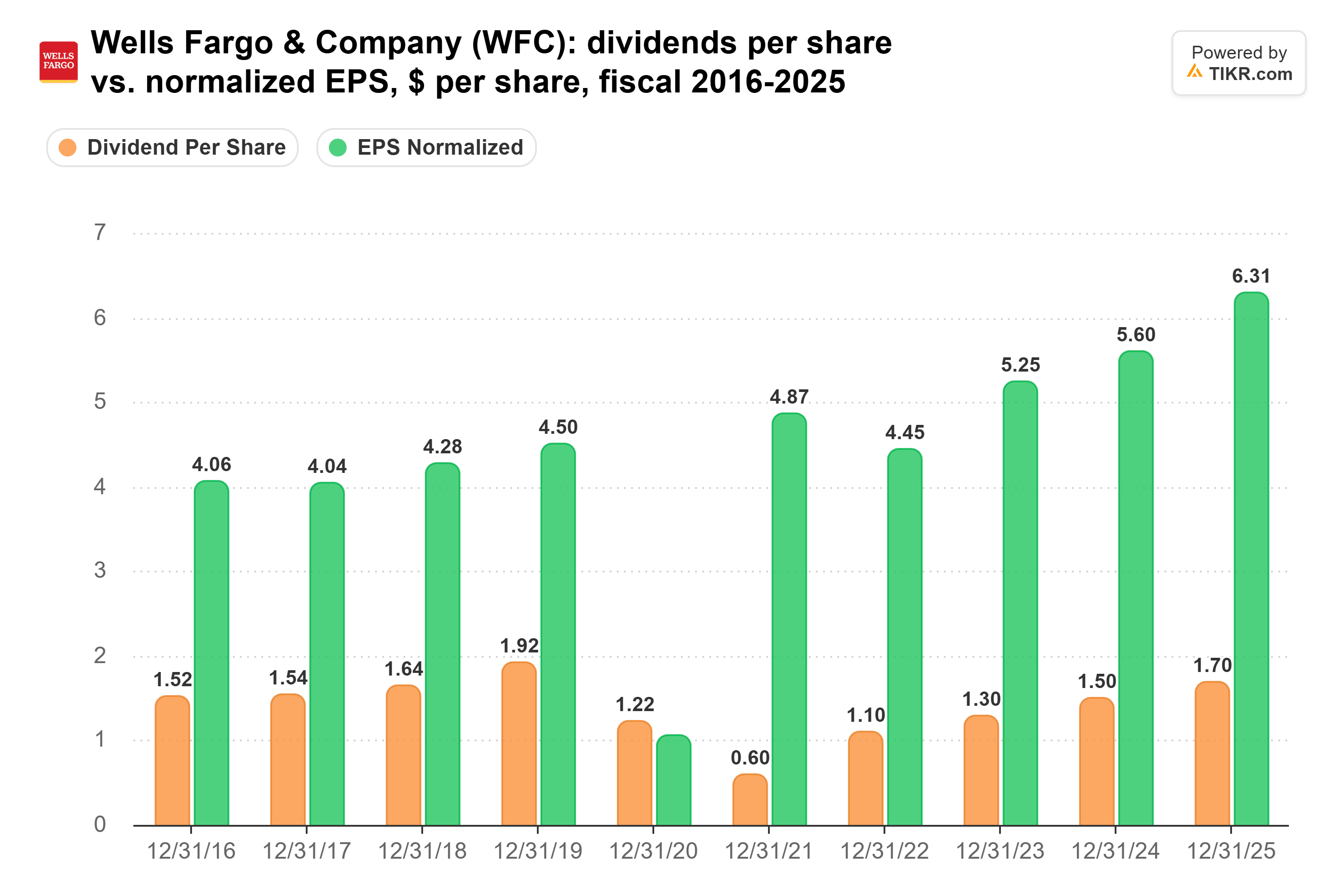
The dividend was back to $1.70 by fiscal 2025, and the payout ratio has stayed between 24.7% and 26.9% since fiscal 2022.
Its CET1 ratio fell to 10.0% from 11.0% a year earlier, which puts it at the bottom of its 10% to 10.5% target range. CFO Michael Santomassimo says the bank will “use buybacks as sort of that lever” to stay in that range. So the $2.5 billion of stock it bought back in the third quarter would shrink before the dividend did.
Since the report, Bloomberg reported on Nov. 18 that Wells Fargo plans to name JPMorgan Chase executive Allison Beer as its next chief operating officer. That doesn’t change the dividend picture.
Bank of America took a $1.2 billion hit and kept paying
Bank of America’s raise this summer was even bigger. On July 24, it lifted its quarterly dividend 14%, to $0.32 from $0.28. Lending is carrying the bank right now. Third-quarter net interest income rose 8% to $16.4 billion, and wealth management client balances passed $5 trillion.
On Oct. 13, the Treasury Department’s FinCEN assessed a $1.2 billion penalty for anti-money-laundering and sanctions violations. The charge cut third-quarter reported EPS to $0.91, from $1.04 a year earlier. Without it, adjusted EPS was $1.08.
The dividend still has plenty of room. It took 28% of normalized EPS in fiscal 2025, and consensus has 27% for fiscal 2026, on normalized EPS of $4.51, up 18%. Management’s guidance supports that jump. It expects net interest income to grow about 8% this year and 8% or more in 2027.
Bank of America’s dividend held up in a bad year, too. It still rose in fiscal 2020, to $0.72 a share from $0.66, even though normalized EPS fell to $1.87.

Which $1,000 check I’d take
Bank of America is the less covered of the two, at 28% of normalized EPS against Wells Fargo’s 27%, so it’s the one to test. But a one-point gap with both banks under 30% isn’t much risk. CFO Alastair Borthwick laid out the bank’s priorities on the third-quarter call: “We know we have to support the regulatory minimum and the dividend. And then whatever is left, we’re going to return to shareholders.” And on Oct. 21, about a week after the penalty, the board declared its regular $0.32 dividend.
So I’d take Bank of America’s check. It costs about $33,600 less for the same $1,000 a month, which is more than two years of checks you keep up front. Its dividend has also grown faster: 8.4% a year from fiscal 2020 to fiscal 2025 ($0.72 to $1.08 a share), against 6.9% for Wells Fargo ($1.22 to $1.70).
Wells Fargo’s check is still a good one. It’s a hair better covered, and its earnings are climbing. I just lean toward the dividend that kept rising in 2020, especially when it comes at a discount.
Both banks should report fourth-quarter results in mid-January. For Bank of America, the test is a return to operating leverage in the fourth quarter and net interest income on pace for 8% or more growth in 2027. For Wells Fargo, it’s about $13 billion of fourth-quarter net interest income.
Forget Bank of America: 6 safe 6%+ dividend yields you can buy right now
Dividends can hold the key to enormous wealth. But only if you buy the right ones.
Picking the right high-yield dividend stock can be the difference between a dream retirement…and scraping by every month, waiting for the next Social Security check to clear.
We’ve identified six stocks yielding 6%+ that we believe every retiree should know about right now. (And Bank of America isn’t one of them.)
Disclaimer:
Please note that the articles on TIKR are not intended to serve as investment or financial advice from TIKR or our content team, nor are they recommendations to buy or sell any stocks. We create our content based on TIKR Terminal’s investment data and analysts’ estimates. Our analysis might not include recent company news or important updates. TIKR has no position in any of the stocks mentioned. Thank you for reading, and happy investing!